Blog · 21 October 2026 · 12 min read
Why is every location different in a padel project?
Every padel project is unique: ground conditions, wind load and permits vary per location. Discover which factors determine the approach.

In this article
- Which location factors determine the feasibility of a padel project?
- How do ground conditions influence the choice of foundation?
- What are the consequences of wind load for the steel structure?
- When is an acoustic study mandatory for a padel court?
- How do sound-absorbing panels work on a padel court?
- What influence do sound-absorbing panels have on the structure?
- How does the permit process for an outdoor padel court work?
- Not sure whether outdoor padel is feasible at your location?
- Frequently asked questions
Every location is different in a padel project because ground conditions, wind load, distance to homes and local permit requirements can vary greatly. What is a straightforward installation at one location may call for a completely different structural approach at another. The questions below give a concrete answer, theme by theme, on what you can expect when preparing an outdoor padel project.
Which location factors determine the feasibility of a padel project?
The feasibility of an outdoor padel project is determined by a combination of ground conditions, available space, wind load, distance to homes and the applicable zoning plan rules. None of these factors stands on its own. Together they determine which structural and acoustic measures are needed and whether the project is feasible in terms of permits.
A site analysis is therefore the first step in any serious padel project. It looks at the available space relative to the minimum dimensions of a padel court, accessibility for transport and installation, the ground conditions based on soil investigations, the distance to noise-sensitive uses such as homes, and the position relative to surrounding buildings and open terrain.
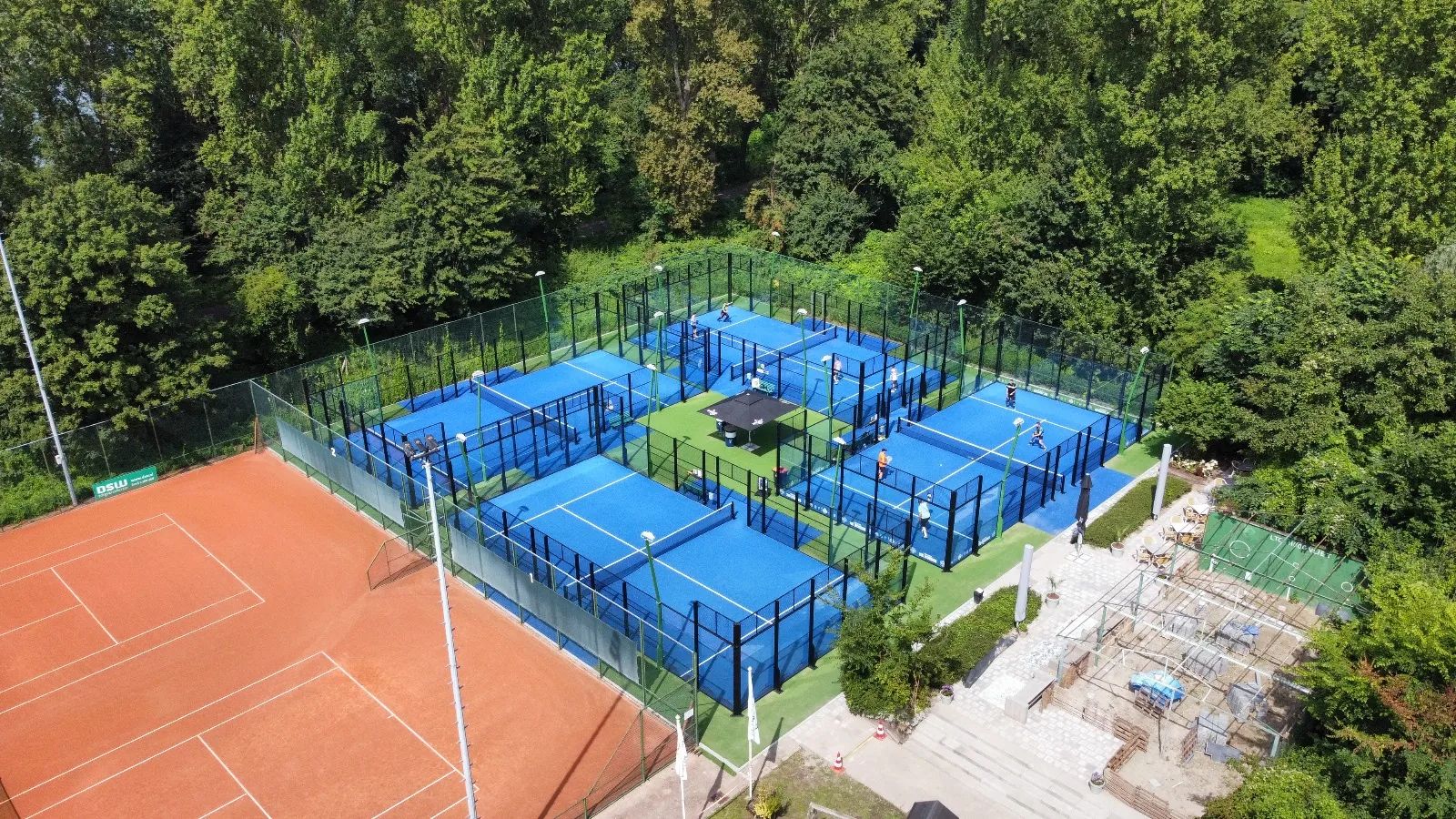
It is precisely this combination of factors that makes every location unique. A sports park in an urban setting near a residential area has very different requirements from an outdoor court on open terrain on the edge of a village. At the first location, noise and permits play a major role. At the second, wind load may be the deciding factor for the structural design.
Because these factors are interrelated, it is wise to discuss having a padel court built at an early stage with a producer who controls the technical development in-house. That way, structural choices, foundation advice and noise measures can be aligned with each other during the planning phase.
How do ground conditions influence the choice of foundation?
The ground conditions determine which type of foundation is technically sound and practically feasible. At a location with load-bearing, stable ground, more foundation options are available than at a location with soft or waterlogged soil. Without a proper foundation, there is a risk of settlement, tilting and damage to the steel structure.
Three commonly used foundation types are applied for outdoor padel courts, each with its own technical properties:
- Drainage concrete is a water-permeable type of concrete in which rainwater drains directly through the foundation into the subsoil. It has a high bearing capacity, is suitable for heavy loads and, when used correctly, lasts 25 to 40 years on average. It is often combined with a ring foundation with steel reinforcement to absorb wind load effectively.
- Supersub is a foundation solution based on foam concrete. The material is light, self-levelling and water-permeable in outdoor applications. Supersub is shock-absorbing, which contributes to playing comfort, and in many cases it can be poured within a single day. The thickness typically varies between 10 and 15 centimetres, depending on the ground conditions.
- ZOAB asphalt (open-graded asphalt concrete) is a porous asphalt variant that lets water through. It is used less often for padel, but can be a suitable option in certain situations.
Which type is most suitable depends on the ground conditions based on soil investigations, the intensity of use, the location and the available budget. Foundation advice is always drawn up on the basis of the specific situation. You can find more information about the various options on the page about a padel court including groundwork.
What are the consequences of wind load for the steel structure?
Wind load is one of the determining forces in the design of an outdoor padel court. The structure must be calculated for the wind forces that can occur at the specific location, taking into account the wind zone, the surroundings and the presence of closed surfaces such as sound-absorbing panels.
An open steel structure with mesh lets most of the wind through. As soon as closed panels are added, wind permeability decreases and the wind load on the structure rises. This has direct consequences for the dimensioning of columns, connections, base plates and anchors. The structure must be adapted accordingly, otherwise a risk to structural safety arises.
The location plays a major role here. A padel court on open terrain, on the coast or near tall buildings can face higher wind load than a court at a sheltered location. Wind zoning according to the applicable European standards determines the design wind load per location.
Because in-house production makes it possible to adapt columns, connections and other structural components to the specific project, at I-Padel we can structurally calculate every court for the actual situation. You can read more about the structural design on the page about structure and wind load.
When is an acoustic study mandatory for a padel court?
An acoustic study for a padel court is mandatory in many cases when the location is near homes or other noise-sensitive uses. The municipality ultimately determines which studies are necessary as part of the permit application. There is no general threshold value that applies to every situation.
Padel produces more noise than tennis. The ball hitting glass and steel, combined with the cage structure acting as a resonance box, results in an average sound power level of around 91 dB. That is roughly 10 dB more than with tennis. For a location near homes, an acoustic study is therefore almost always part of the permit process.
An acoustic study is carried out by a specialised, independent consultancy. The consultant calculates the expected noise level at noise-sensitive uses and assesses whether additional measures are needed. I-Padel does not carry out acoustic studies itself, but supplies the technical product specifications, structural data and engineering needed to carry out the calculations correctly.
Whether a study is mandatory in your situation depends on the location, the distance to homes, the zoning plan and municipal policy rules. If in doubt, always contact the municipality or an acoustic consultant before taking further steps in the project.
How do sound-absorbing panels work on a padel court?
Sound-absorbing panels work as a source measure: they are fitted directly onto or around the padel cage to limit the spread of sound as close to its origin as possible. Instead of intercepting sound only after it has spread over a greater distance, the emission is already reduced at the structure itself.
The panels usually contain rock wool, a mineral fibre with an open structure that partly absorbs sound waves. When sound hits the panel, part of the kinetic energy is converted into heat. As a result, less sound is reflected back into the surroundings. The exact effect depends on the material thickness, density, finish, placement and the frequencies of the sound involved.
The distinction between sound absorption and sound insulation is relevant here. Sound absorption focuses on taking up sound energy within the material, which reduces reflections. Sound insulation limits the transmission of sound from one side to the other. In padel projects, both principles often play a role at the same time.
The position of the panels has a major influence on the result. During the practical measurement at LTC Hofgeest in Velserbroek, the panels were installed above the glass on the two short ends of the tested padel court. Within that specific configuration, an indicative noise reduction of around 3 dB(A) was measured after correcting for background noise. These results apply only to the situation studied and must not be used as a general performance figure for other projects.
You can read more about how panels work and how they are applied on the page about acoustic solutions for padel.
What influence do sound-absorbing panels have on the structure?
Adding sound-absorbing panels to a padel court has direct consequences for the structural load. Panels reduce the wind permeability of the cage structure, which increases the wind force on the steelwork. The structure must be calculated for this and reinforced where necessary before panels can be applied safely.
The reinforcement can consist of heavier posts, additional columns or modified connections and base plates. Which modifications are needed depends on the wind zone of the location, the position and surface area of the panels and the existing structural setup of the court.
Because sound-absorbing panels become part of the overall steel structure, it is technically wise to take them into account already during the engineering phase. When panels are added afterwards to an existing court that has not been calculated for them, the structure must be reassessed by a structural engineer. This also applies to existing courts that are extended with noise measures.
Panels can also be applied afterwards to existing padel courts, but this always requires a structural reassessment. The additional load must never be underestimated. A structural engineer assesses the situation and determines whether and how the existing structure can be modified.
How does the permit process for an outdoor padel court work?
In the Netherlands, an outdoor padel court is regarded as a structure and therefore falls under building regulations. In most cases an environmental permit (omgevingsvergunning) is required. The permit process runs through the municipality and takes 8 to 12 weeks on average, depending on the complexity of the project and the municipality.
A permit application for an outdoor padel court usually requires several technical documents:
- Structural calculations in accordance with the Building Decree (Bouwbesluit)
- An acoustic study (almost always mandatory for locations near homes)
- A light study
- A site plan
- Possibly an ecological or archaeological study, depending on the location
The municipality assesses the application on the basis of the full situation: noise, structural safety, spatial integration and the applicable regulations. Sound-absorbing panels can contribute to a feasible permit process, but are only one possible measure. There is no guarantee that applying panels or other measures will automatically lead to a permit being granted.
Building without a permit is not an option. The municipality can halt the project, impose fines or require the cage structure to be removed. After completion, an inspection by Kiwa ISA Sport is also mandatory for official matches.
We can guide and coordinate the entire permit process, including the zoning plan check, consultation with the municipality, coordination of the noise and light studies and the delivery of structural calculations. You can find more information on the page about a permit for a padel court.
Not sure whether outdoor padel is feasible at your location?
We are happy to think along with you about the court configuration, structural preparation and possible noise measures. Together with your acoustic consultant, we look at which solution is technically feasible and suits the project. Get in touch via the page about noise solutions for padel courts for an initial, no-obligation exploration.
Frequently asked questions
On average, how long does it take from the first site analysis to completion of an outdoor padel court?
The total lead time of an outdoor padel project typically varies between 6 and 12 months, depending on the complexity of the site and the permit process. The permit process alone takes 8 to 12 weeks on average, and additional studies such as an acoustic or ecological study take extra time. It is wise to start the site analysis and preliminary consultation with the municipality well before the desired opening date.
Can I also add sound-absorbing panels later to an existing padel court?
Yes, that is technically possible, but it always requires a structural reassessment by a certified structural engineer. Panels considerably increase the wind load on the steel structure, and an existing court that has not been calculated for this must first be checked before panels can be fitted safely. Never have this done without a prior structural assessment, because underestimating the additional load can lead to structural unsafety.
What are the most common mistakes in preparing a padel project?
The most common mistake is starting the permit process and the accompanying studies too late, so that the planned opening date turns out to be unachievable. A second common mistake is underestimating the influence of ground conditions on the choice of foundation: without a soil investigation, a foundation is sometimes chosen that does not match the actual situation. Finally, the structural impact of sound-absorbing panels is regularly overlooked, which leads to costly modifications afterwards.
Is an environmental permit always required, or are there situations in which a padel court can be built without a permit?
In practice, an environmental permit for an outdoor padel court is almost always required, because a padel cage is regarded as a structure in the Netherlands. Building without a permit is only possible under very strict conditions laid down in the Environmental Planning Decree (Besluit omgevingsrecht), and a full padel cage does not usually fall under these. Always contact the municipality beforehand to check which regulations apply to your specific location and zoning plan.
What influence does the proximity of tall buildings or trees have on the wind load of a padel court?
Tall buildings and trees can redirect and amplify wind flows, so that the wind load on a nearby padel court may turn out higher than the standard wind zoning based on the location would suggest. This phenomenon, also known as channelling or the turbulence effect, must be included in the structural calculations. Based on the specific surroundings, a structural engineer determines whether additional reinforcement of columns, connections or anchors is necessary.
How do I know which foundation type is most suitable for my location?
Choosing the right foundation type always starts with a soil investigation, in which the bearing capacity and composition of the subsoil are mapped out. On the basis of that data, combined with the intensity of use of the court, the site conditions and the available budget, foundation advice is drawn up. Never decide on cost alone: a foundation that does not match the ground conditions will in time lead to settlement and damage to the steel structure.
What happens if it turns out after completion that the noise standards are exceeded after all?
If measurements after completion show that the noise standards are exceeded, the municipality can require additional measures or restrict the hours of use of the court. In that case, it must be investigated which additional source measures are technically feasible, such as extra sound-absorbing panels, a noise barrier or adjustments to playing schedules. This once again underlines the importance of a thorough acoustic study before the permit application, so that measures are included in the design phase and costly modifications afterwards are avoided.