Blog · 3 November 2026 · 11 min read
What are the advantages of acoustic panels over a noise barrier?
Acoustic panels dampen noise at the source, cost less and take up no extra space. Find out when panels work better than a noise barrier.
In this article
- What is the difference between a source measure and a noise barrier?
- How much space does a noise barrier take up compared with acoustic panels?
- What effect do acoustic panels have on the structure of the padel court?
- How do acoustic panels perform in a permit application for an outdoor padel court?
- Are acoustic panels also suitable for existing padel courts?
- What does a noise barrier cost compared with integrated acoustic panels?
- Not sure whether outdoor padel is feasible at your location?
- Frequently asked questions
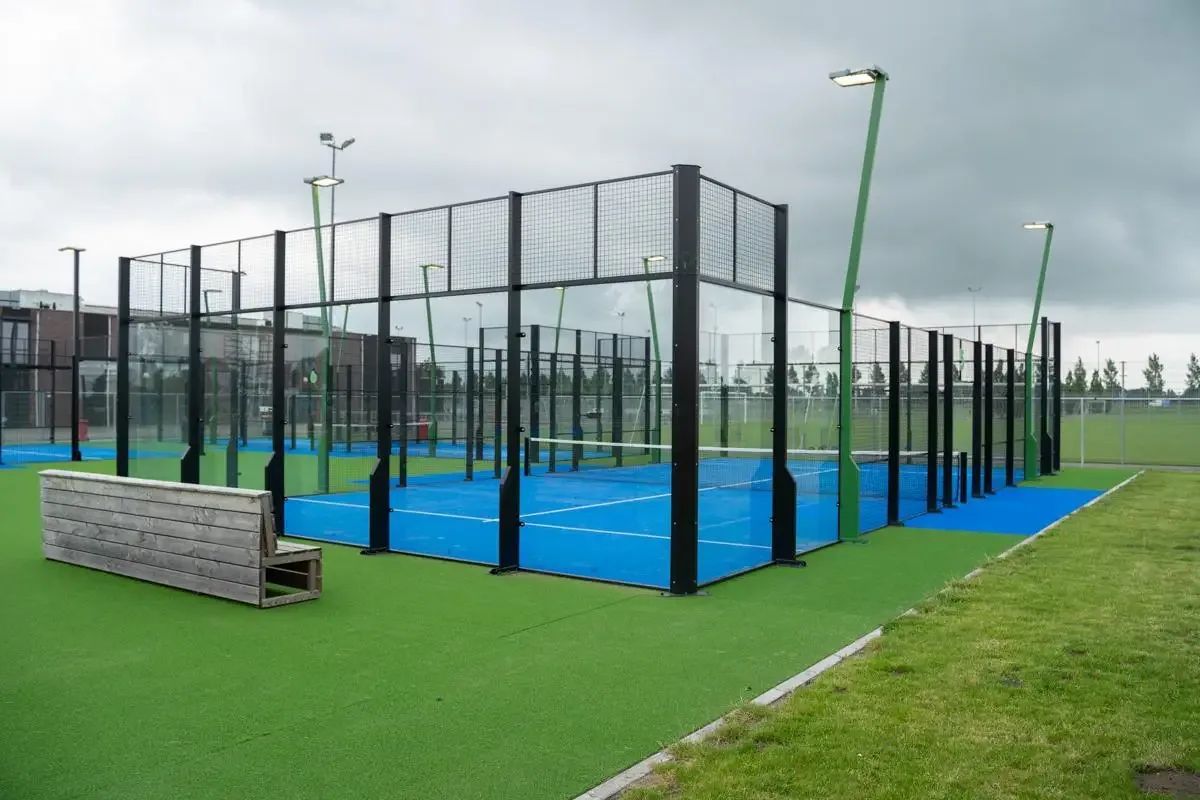
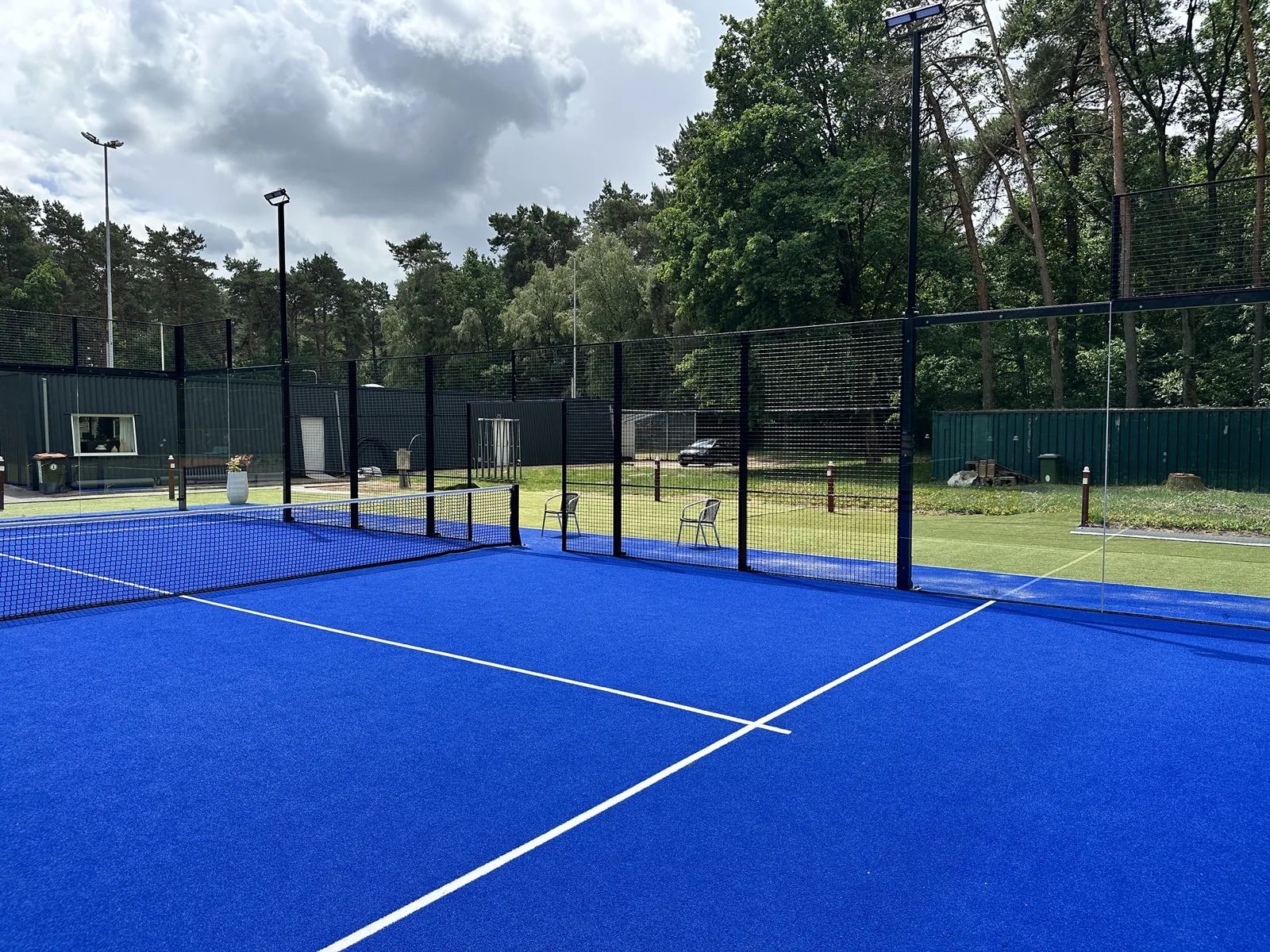
Acoustic panels differ from a noise barrier in one fundamental way: they work directly at the source. The panels are fitted to the outside of the padel cage and dampen the sound at the moment it is created, before it spreads into the surroundings.
A noise barrier works differently: it is placed next to or around the court and blocks sound that has already been emitted. Which approach is most suitable depends on the location, the space available and the results of an independent acoustic study. The following questions explain the main differences.
What is the difference between a source measure and a noise barrier?
A source measure is a measure applied directly at the noise source, so that less sound is emitted into the surroundings. A noise barrier or sound wall is a transmission measure: the sound has already been emitted, but is blocked before it reaches the surroundings. In padel, the source is the padel cage itself, in particular the contact between ball and glass or fencing.
Integrated sound-absorbing panels are an example of a source measure. They are fitted to the outside of the mesh of the cage structure and absorb sound energy instead of letting it reflect back. The panels have been independently tested and have sound absorption class A, with an absorption value of αw 0.80. This means that a large share of the sound energy is absorbed by the material.
A noise barrier or sound wall stands apart from the court and acts as a physical barrier between the source and the surroundings. The barrier blocks sound waves that have already been emitted. This is a different mechanism from absorption at the source, and its effectiveness depends heavily on the height, length and position of the barrier relative to the court and the homes to be protected.
In practice, acoustic solutions for padel often combine both measures. The panels reduce the noise at the source, after which a berm, if needed, limits the remaining sound emission further. This can also reduce the height required for the berm, which can simplify both costs and permit procedures.
How much space does a noise barrier take up compared with acoustic panels?
A noise barrier requires considerably more space than acoustic panels. Berms can reach six to eight metres in height and tens of metres in length, and also require their own foundation and structural calculation. Acoustic panels are fitted directly to the existing padel cage and take up no additional ground area beyond the structure itself.
This difference in space is, in practice, one of the most decisive factors when choosing between the two solutions. Sports parks near residential areas often have limited space around the courts. A freestanding noise barrier six metres high and forty metres long is sometimes simply not feasible on a tight site, whereas panels on the existing structure can still be used in the same situation.
Berms also require their own structural foundation, for which soil investigation data (CPT) of the subsoil is needed. With panels on the padel cage, the foundation is already in place, although the cage structure itself does have to be calculated for the extra load the panels create. More on this in the next section.
What effect do acoustic panels have on the structure of the padel court?
Acoustic panels have a direct effect on the wind load on the padel cage. Because the panels reduce the wind permeability of the structure, the cage catches more wind. The steel structure must be calculated for this and, in many cases, reinforced before panels can be used safely.
This structural consequence is regularly underestimated in practice. A standard padel cage is calculated for the wind load that applies to an open structure with mesh. When part of that mesh is replaced by solid panels, the wind behaviour of the structure changes significantly. Depending on the wind zone, the height of the panels and their position on the court, this can mean heavier posts, additional columns or modified connections are required.
Because we manufacture the steel structure entirely in-house, structural adjustments can be made during the engineering phase. This is a significant advantage over imported standard courts, where structural changes are often limited or not possible. The structure and wind load are calculated specifically for each project, based on the location, the wind zone and the desired panel configuration.
For existing courts, the structure must always be reassessed before panels are installed. A structural engineer must determine whether the existing steel structure can handle the extra load and, if not, which reinforcements are needed. We supply the technical product specifications and engineering required for this assessment.
How do acoustic panels perform in a permit application for an outdoor padel court?
As a source measure, acoustic panels can contribute to a permit process that is achievable, but whether they are sufficient to meet municipal noise standards depends entirely on the project-specific situation. An independent acoustic consultancy determines, on the basis of measurements and calculations, which measures are needed at a specific location.
When assessing a permit for a padel court, municipalities look not only at the maximum noise production, but also at the duration and frequency of the noise, the distance to noise-sensitive buildings and the existing noise load in the area. For outdoor padel courts near homes, an acoustic study is almost always a mandatory part of the application.
Acoustic panels as a source measure have a concrete advantage in permit procedures: they are compact, visually less intrusive than a large noise barrier and can be integrated into the existing court structure. In some situations this makes them easier to obtain a permit for than a freestanding berm six metres high, which in many cases is classed as an independent structure and therefore requires its own environmental permit.
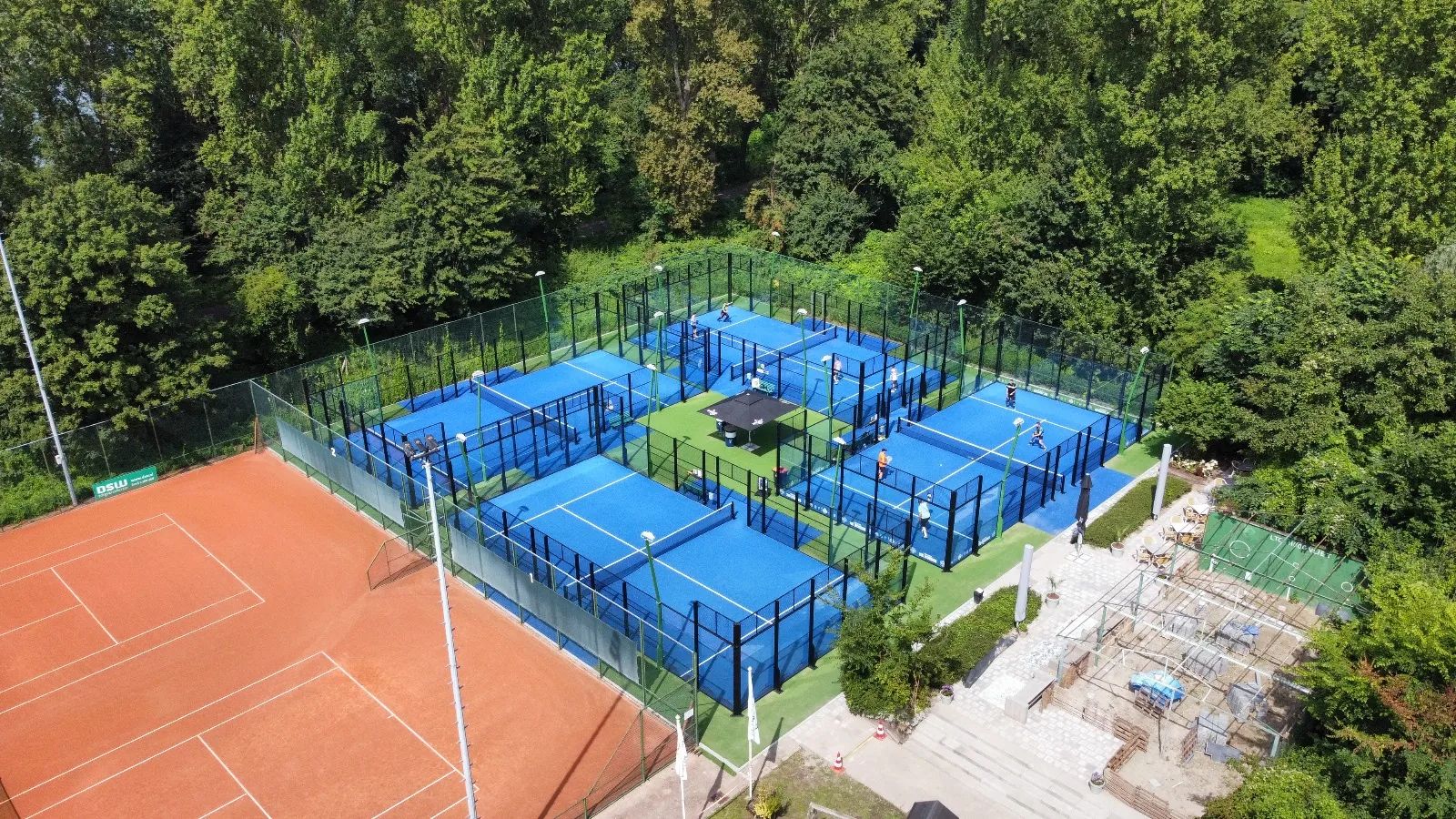
During a practical measurement at LTC Hofgeest, an indicative noise reduction of approximately 3 dB(A) was measured within the configuration studied, after correction for background noise. These results apply only to the situation studied and must not be presented as a general product guarantee. On the basis of such measurement data and the specific local conditions, an acoustic consultant can assess whether panels contribute enough to meeting the required noise standards.
Are acoustic panels also suitable for existing padel courts?
Acoustic panels can also be retrofitted to existing padel courts, but this always requires a structural assessment beforehand. The existing steel structure must be calculated for the extra wind load the panels create. Without this assessment, installation is not structurally sound.
In practice, this means that a structural engineer assesses the existing cage structure on the basis of the material specifications, the current condition of the structure and the desired panel configuration. Depending on the outcome, the existing structure may be suitable, or additional reinforcements may be needed before the panels can be fitted safely.
For existing courts built with a standard imported structure, this can be a limiting factor. Importers generally do not supply structural calculations or engineering for later modifications, certainly not for small numbers of courts. For existing projects, we can support the technical assessment and, where necessary, develop a suitable structural solution.
Besides the structural side, the permit situation also plays a role. Adding sound-absorbing panels to an existing court afterwards can be classed as a modification of the structure, for which an additional environmental permit may be required. This differs per municipality and per situation.
What does a noise barrier cost compared with integrated acoustic panels?
A noise barrier generally costs more than integrated acoustic panels, because a berm is an independent structure with its own foundation, calculations and permit process. The exact costs of both solutions depend heavily on the project situation and cannot simply be compared without a location-specific assessment.
The cost of a noise barrier consists of several components: the construction of the berm itself, the foundation, the structural calculations, the permit procedure and any finishing costs such as planting or green screening. For berms six to eight metres high and tens of metres long, these costs add up quickly. A berm also requires enough space on the site, which at some locations is a limiting or even impossible factor.
Acoustic panels are fitted to the existing cage structure. The costs consist of the panels themselves, the structural adjustments to the cage structure that are needed, and installation. If the padel cage is designed with future panels in mind during the engineering phase, additional structural costs can be limited. For a newly built outdoor padel court, this is the most efficient approach.
Where a combination of panels and a berm is the most effective solution, the panels can help to make the berm lower. This can both reduce the cost of the berm and simplify the permit procedure. The final cost of a noise solution always depends on the location, the surroundings, the number of courts and the results of an acoustic study. A project-specific assessment is needed to produce a reliable cost estimate.
For a complete picture of the cost of a padel court including noise measures, it is wise to map out all relevant factors at an early stage, so that the business case can be assessed realistically.
Not sure whether outdoor padel is feasible at your location?
We are happy to help you think through the court configuration, structural preparation and possible noise measures. Together with your acoustic consultant, we look at which solution is technically feasible and fits the project. Get in touch via our page on acoustic solutions for padel for an initial, non-binding exploration.
Frequently asked questions
How long does it take to install acoustic panels on an existing or new padel cage?
The actual installation of acoustic panels on a padel cage generally takes one to two days per court, depending on the configuration and the number of panels. The preparation, including the structural assessment and any modifications to the cage structure, takes more time and must be fully completed before installation begins. For new builds, it is wise to include the panels in the engineering phase, so that the lead time of the overall project stays as short as possible.
What maintenance do acoustic panels require and how long do they last?
Acoustic panels for outdoor use are designed for an outdoor climate and require minimal maintenance. Periodic cleaning, for example with water and a soft brush, is enough to keep the panels in good condition and maintain their absorption performance. The service life depends on the material used and the weather conditions at the location; ask the supplier about the specific warranty terms and expected service life for your situation.
Can I decide myself on which sides of the padel cage the acoustic panels are fitted?
Yes, the panel configuration is in principle project-specific and can be tailored to the direction of the nearest noise-sensitive buildings. Based on the location and the position of surrounding homes, an acoustic consultant determines which sides of the cage contribute most to the noise emitted into the surroundings. It is wise to base this choice on an acoustic study, so that the panels are used where they achieve the greatest reduction.
What if the acoustic panels and a noise barrier together are still not enough to meet the noise standards?
If a combination of source measures and a noise barrier proves insufficient, there are additional options, such as limiting opening hours, changing the court orientation for new builds, or increasing the distance to noise-sensitive buildings.
In extreme cases, a municipality may decide that the location is not suitable for outdoor padel without drastic changes. An independent acoustic consultancy can map out the feasibility of the location at an early stage, so that you do not face any surprises during the permit procedure.
Does an acoustic study have to be carried out by a certified consultancy, or can I do it myself?
For a permit application to the municipality, an acoustic study from an independent and recognised acoustic consultancy is almost always required. A measurement or calculation carried out yourself is generally not accepted by municipalities as supporting evidence. Make sure the consultancy has experience with sports noise and is familiar with the applicable standards from the Besluit activiteiten leefomgeving (Bal, the Dutch Environment and Planning Activities Decree) or the local noise rules that apply to your project.
Do acoustic panels affect playing comfort or the experience of the padel court?
Acoustic panels are fitted to the outside of the cage structure and have no direct effect on the playing surface or the glass walls that the ball is played against. In practice, players notice little difference in playing comfort. However, the perception of sound inside the cage may change slightly because less sound is reflected back from the surroundings, which some players find more pleasant.
Is there any subsidy or financing available for noise measures at padel courts?
In some cases, municipal or provincial subsidy schemes are available for noise-reducing measures at sports facilities, for example via the Nationaal Sportakkoord (National Sports Agreement) or local sustainability funds. Availability and conditions differ greatly per municipality and per year. It is wise to contact the municipality at an early stage and, if necessary, consult a subsidy adviser to find out which schemes may apply to your project.