

Sound-absorbing panels
Less noisefor the neighbourhood
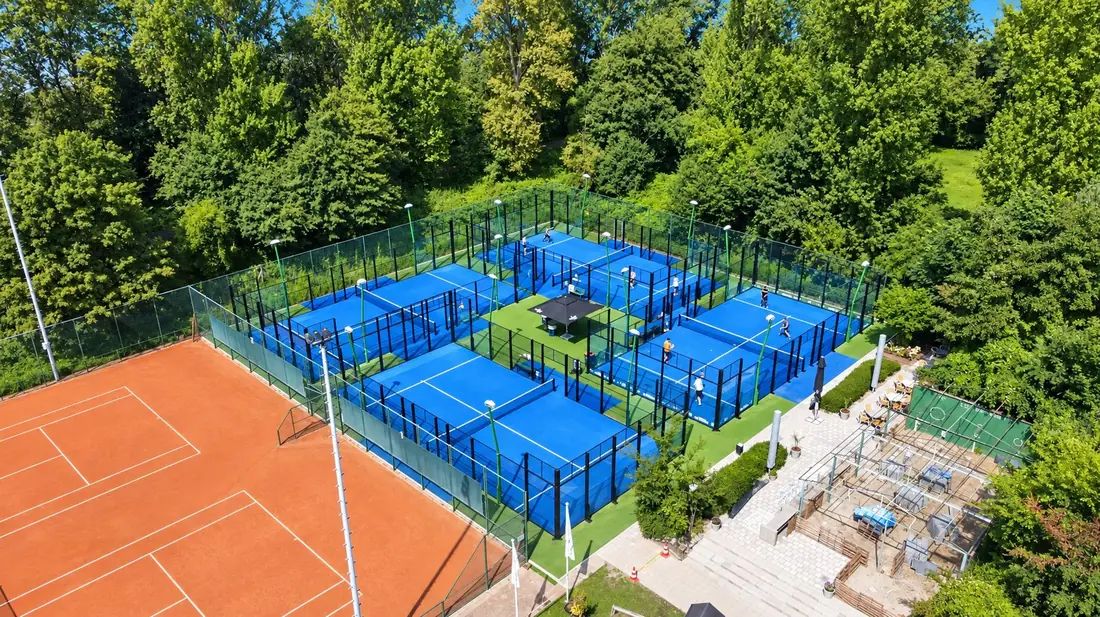
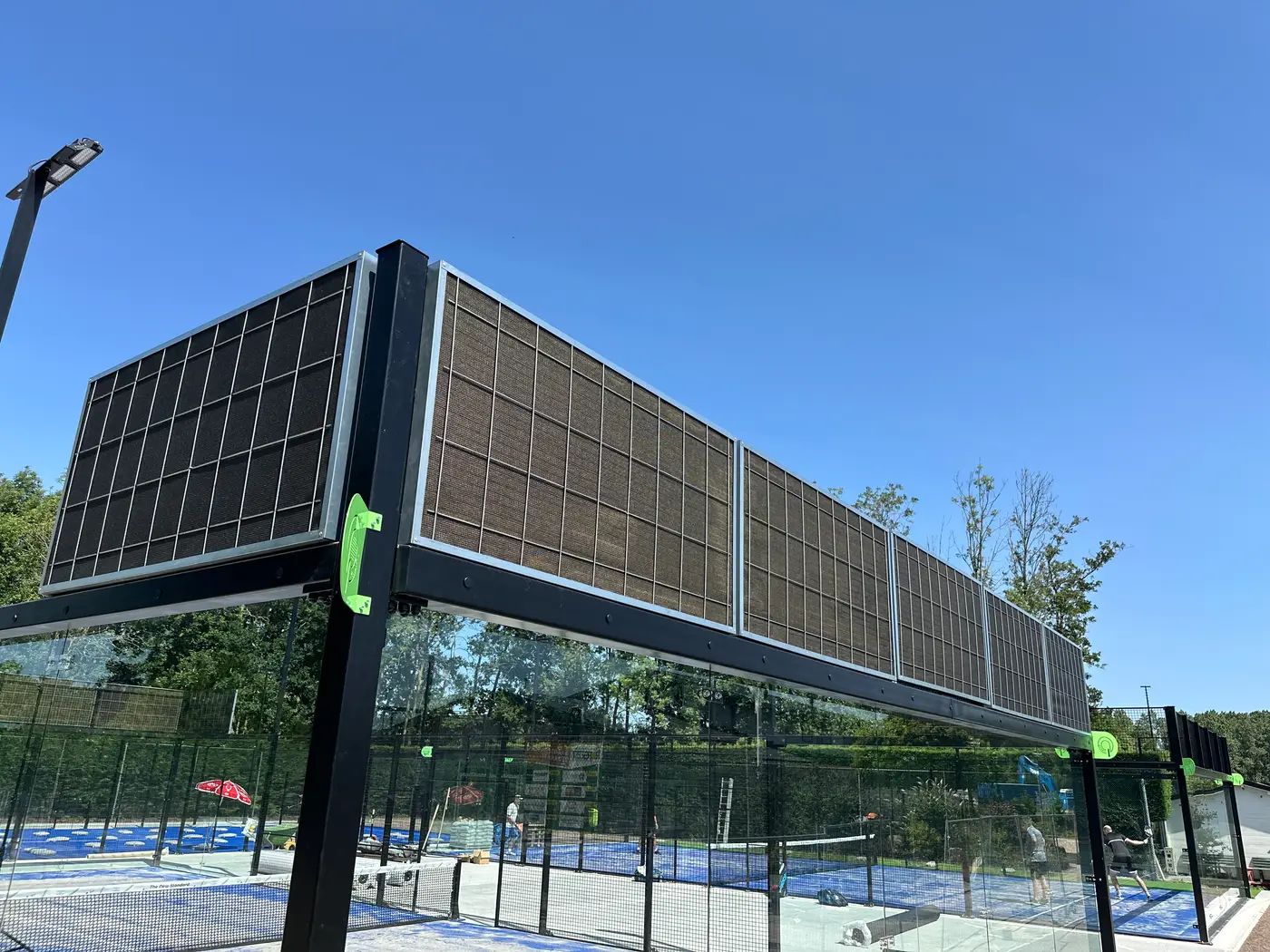
Noise is one of the most discussed topics around padel courts. Sports parks close to a residential area face complaints from neighbours, stricter requirements from the municipality and lengthy permit procedures. With sound-absorbing panels on the outside of the mesh we demonstrably reduce the noise, while the court stays open and the game feels the same.
- Absorption class A, αw 0.80 and DLα 8 dB
- Independently tested in an acoustic laboratory
- Court stays open, the game stays the same
How it works
Where the noise comes from, and where we dampen it
Padel noise has two parts: the source noise of racket and ball, and the contact noise of balls hitting the glass and the mesh. It is mainly that contact noise against the mesh and the open parts of the cage that determines how much nuisance the neighbourhood experiences. That noise is intense and frequent, so at outdoor padel courts close to homes, measures are often needed to keep playing.
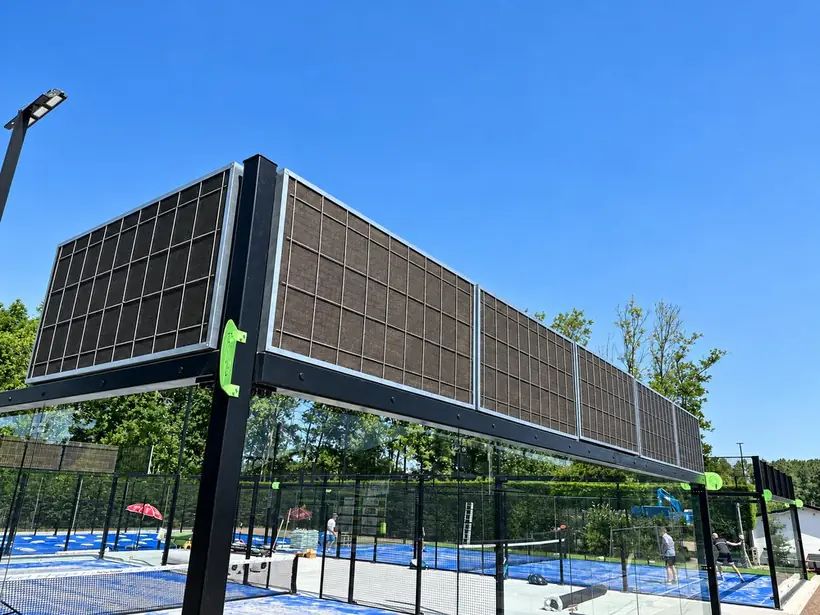
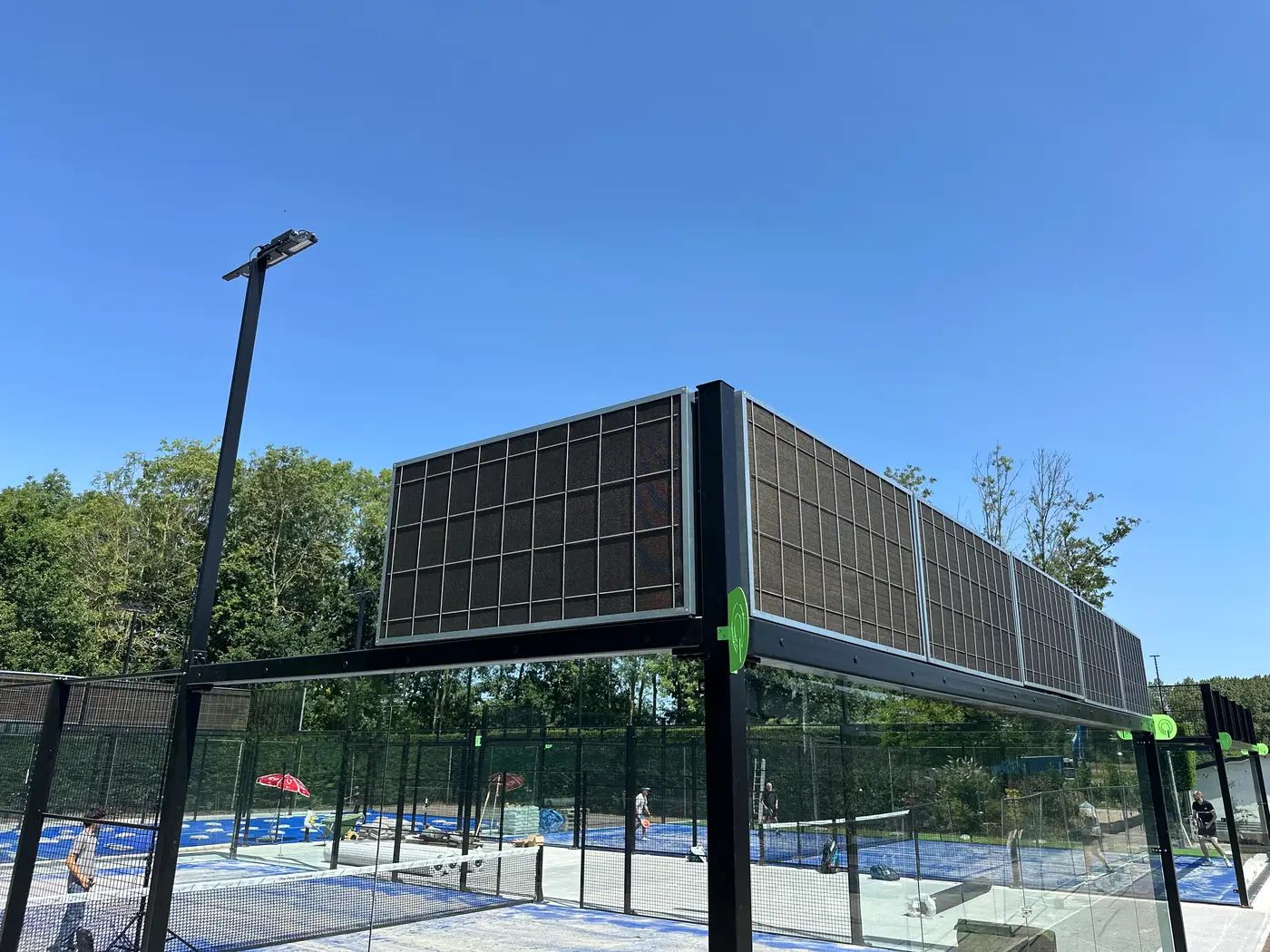
That is why we mount the sound-absorbing panels exactly there: on the outside of the mesh. The sound is not reflected but absorbed. The dynamics of the game stay the same and the court remains visually open.
The panels consist of a high-quality sound-absorbing system in a robust construction, made for outdoor use and built to withstand years of weather and wind. You will find all measures side by side under our noise solutions.
- Mounted on the outside of the mesh
- Sightlines and game dynamics are preserved
- Robust construction, resistant to weather and wind
Independently tested
Demonstrable noise reduction in figures
The performance of the panels was tested in an acoustic laboratory, in accordance with the applicable standards. The values show that the panel absorbs a large part of the incident sound, precisely in the frequencies typical of padel. In practice, that means a clearly audible reduction towards the neighbourhood.
| Measurement | Result | What it means |
|---|---|---|
| Sound absorption class | A | The class for how much sound the surface absorbs instead of reflecting. |
| Sound absorption value (αw) | 0.80 | On a scale from 0 (everything reflected) to 1 (everything absorbed). |
| Sound absorption index (DLα) | 8 dB | A single figure for the absorption of the whole panel, in decibels. |
| Airborne sound insulation (Rw) | 22 dB | How much sound the panel stops from one side to the other. |
| Sound insulation index (DLR) | 19 dB | A single figure for the insulation of the whole panel, in decibels. |
αw and DLα describe absorption (taking in sound), Rw and DLR describe insulation (blocking sound).
Structure
Panels call for a heavier court structure
An often underestimated point: sound-absorbing panels change the wind permeability of the cage. Where the mesh normally lets wind through, the panels form a closed surface that catches the wind load. That directly affects the forces acting on the structure.
That is why we reinforce the court structure in such cases, matched to the wind area, the height and position of the panels and the degree to which wind permeability is reduced. Think of heavier posts, extra columns or modified connections. We make the calculations in accordance with the applicable standards, so the safety and lifespan of the court stay guaranteed.
A noise solution is therefore never just an acoustic choice, but a structural one too. It is precisely that combination that makes a solution technically sound and accepted by the municipality. Because we produce the steel structure ourselves, we build the reinforcement straight into the construction of the court.
- Per wind areacalculated to the standards
- S350structural steel, hot-dip galvanised
- 15years of warranty on the steel structure
Flexible per location
Not every location needs the same solution
We apply the panels where they make the biggest difference. The final configuration is matched to the noise report and the situation on site.
- On one side of the courtOnly on the side facing the homes, where the reduction is needed.
- In the lower or upper metresOnly the lower and/or upper metres of the cage, if the noise report calls for it.
- Over several sides or courtsFor several courts, or for homes on different sides of the park.
- Combined with other measuresTogether with glass walls or a noise barrier next to the court.
Complete solution
Panels as part of an approach that adds up
Sound-absorbing panels are usually one part of a broader approach. We combine them with noise measurements and noise reports, structural adjustments to the cage and, where needed, an additional noise wall. The result is a solution that is acoustically, structurally and administratively sound, and that improves the relationship between club, municipality and neighbourhood.
- Less noise nuisance for residents
- Higher chance of a permit being granted
- More playing hours, including evenings
- Durable and low-maintenance
- First
Noise measurement and noise report
We look at the distance to the homes, the wind area and the applicable regulations. The noise report determines where panels are needed and how high.
- Design
Panels and structure in one calculation
We calculate the panel configuration and the reinforcement of the cage together, in accordance with the applicable standards. That way the solution is technically sound and fits the permit application.
- If needed
Noise barrier next to the court
If extra reduction is needed, a noise barrier is a good addition or alternative. Such a barrier can be tens of metres long and up to 8 metres high. Especially when homes are close to the court or when the reduction is needed in one direction.
- Then
Permit and installation
With the noise report and the structural calculation in hand, we help with the permit. We produce the reinforced structure ourselves and our own installation team builds the court and the panels.
Frequently asked questions
Questions about sound-absorbing panels
Is your question not listed? Call us or request a price indication.
How much noise do the panels stop?
In the laboratory the panel measures a sound absorption index (DLα) of 8 dB and a sound insulation index (DLR) of 19 dB, with absorption class A and an αw of 0.80. How much of that you notice in practice depends on the distance to the homes, the number of sides with panels and the rest of the situation. We work that out in the noise report.
Does the court still look the same?
Yes. The panels sit on the outside of the mesh, so the court stays visually open from the inside. The dynamics of the game do not change: the ball reacts to glass and mesh as you are used to, only the sound is absorbed instead of reflected.
Why does the structure need reinforcing?
Because the panels form a closed surface where the mesh used to let wind through. The wind load on the cage therefore increases. We calculate the reinforcement per wind area, height and position of the panels, in accordance with the applicable standards, and include it in the construction of the court. We give a 15-year warranty on the steel structure.
When do you choose a noise barrier instead of panels?
When extra reduction is needed, for example because homes are very close to the court or because the noise has to come down in one specific direction. A noise barrier stands next to the court and is often an addition to the panels, sometimes an alternative. The noise report shows which combination fits.
Do the panels help with the permit?
Yes. Municipalities set increasingly strict noise requirements, especially for sports parks close to a residential area. With independently tested panels, a structural calculation and a noise report, the chance of a permit is considerably higher. Read how that process works under permit for a padel court.
Knowledge base
More about noise and acoustic panels
Background on noise measurements, panels, noise barriers and the permit.
 Building a padel court · 24 August 2026What misconceptions exist regarding noise nuisance at padel?Noise nuisance in padel: 7 common misconceptions debunked with technical substantiation. Discover what is really true regarding standards and measures.
 Building a padel court · 18 August 2026When is padel noise perceived as a nuisance?Padel noise already reaches 91 dB — 10 dB more than tennis. Discover which standards apply, when an inspection is mandatory, and which measures prevent nuisance.
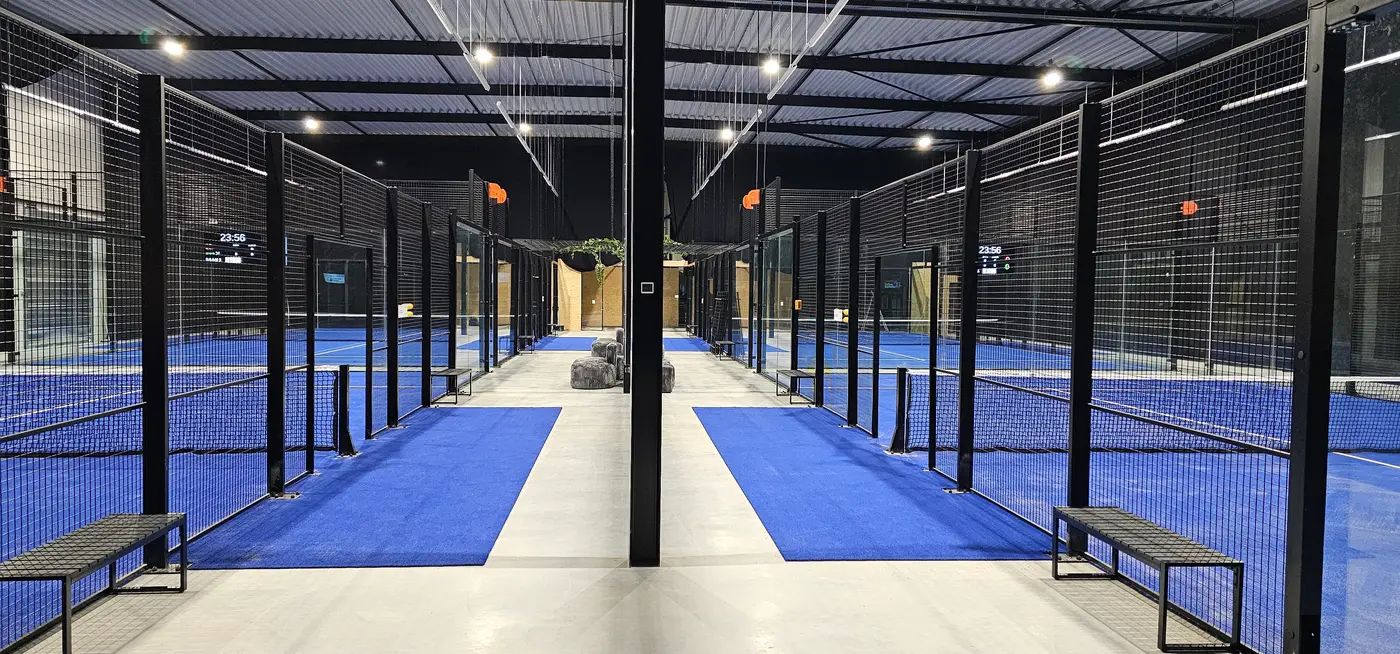 Building a padel court · 30 May 2026Does an indoor padel court cause noise nuisance to the surrounding area?Indoor padel court and noise pollution? Discover the standards (91 dB), legal regulations, and smart measures to prevent complaints.