Blog · 4 November 2026 · 10 min read
Is a source measure a good alternative to a large noise barrier?
Source measure or noise barrier for a padel court? Find out when sound-absorbing panels are enough and what an acoustic study determines.
In this article
- What is the difference between a source measure and a noise barrier?
- How do sound-absorbing panels work as a source measure on a padel court?
- When is a source measure sufficient and when is it not?
- How do sound-absorbing panels affect the steel structure?
- Do you need an acoustic study if you apply a source measure?
- What are the practical advantages of a source measure compared with a large noise barrier?
- Not sure whether outdoor padel is feasible at your location?
- Frequently asked questions
In many situations, a source measure can be a more compact and practical alternative to a large noise barrier. Instead of blocking sound after it has spread, you tackle it directly at the source: the padel court itself. Whether a source measure is sufficient depends entirely on the location, the distance to homes and the outcome of an independent acoustic study. Below we answer the most frequently asked questions on this topic.
What is the difference between a source measure and a noise barrier?
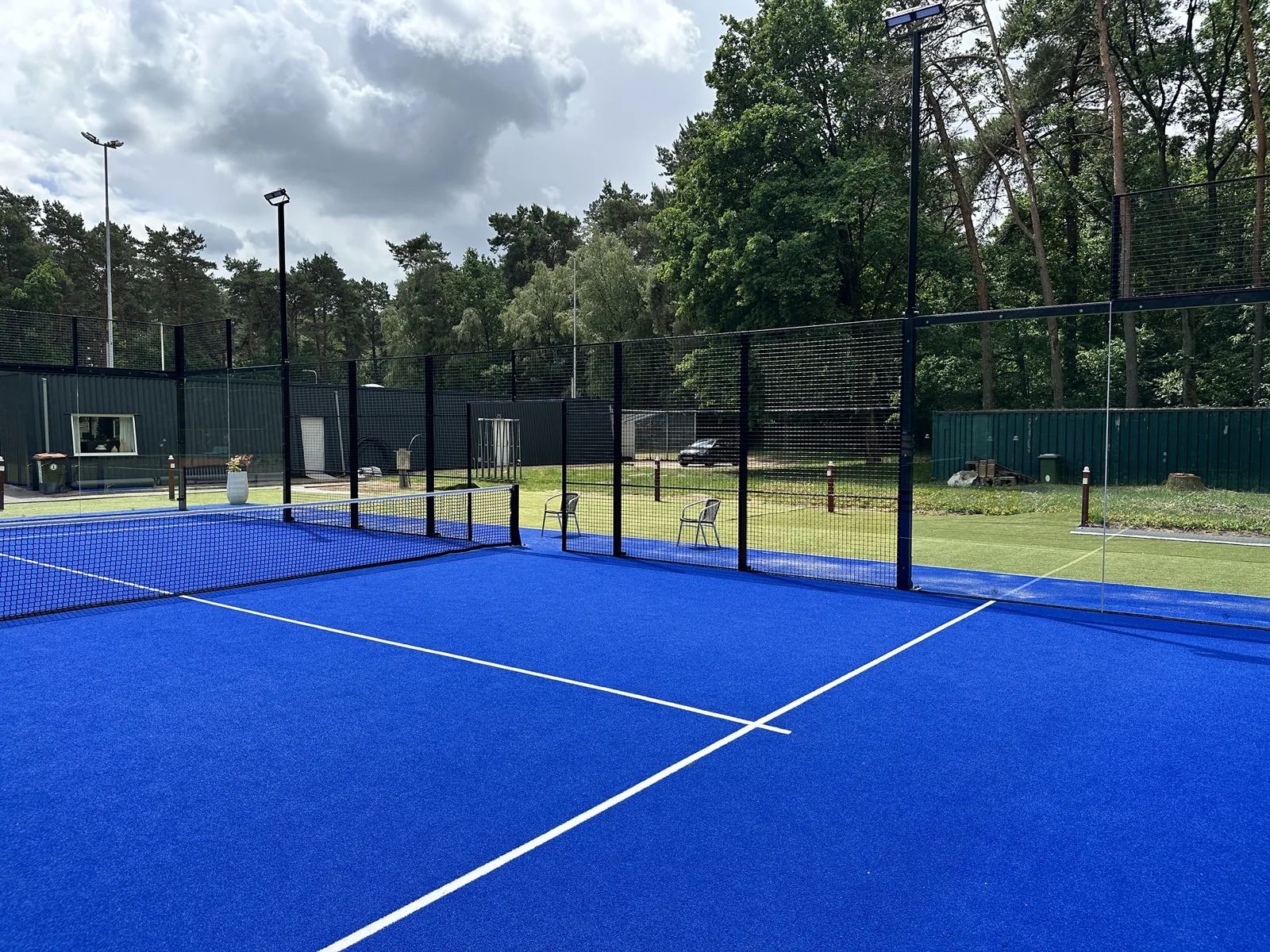
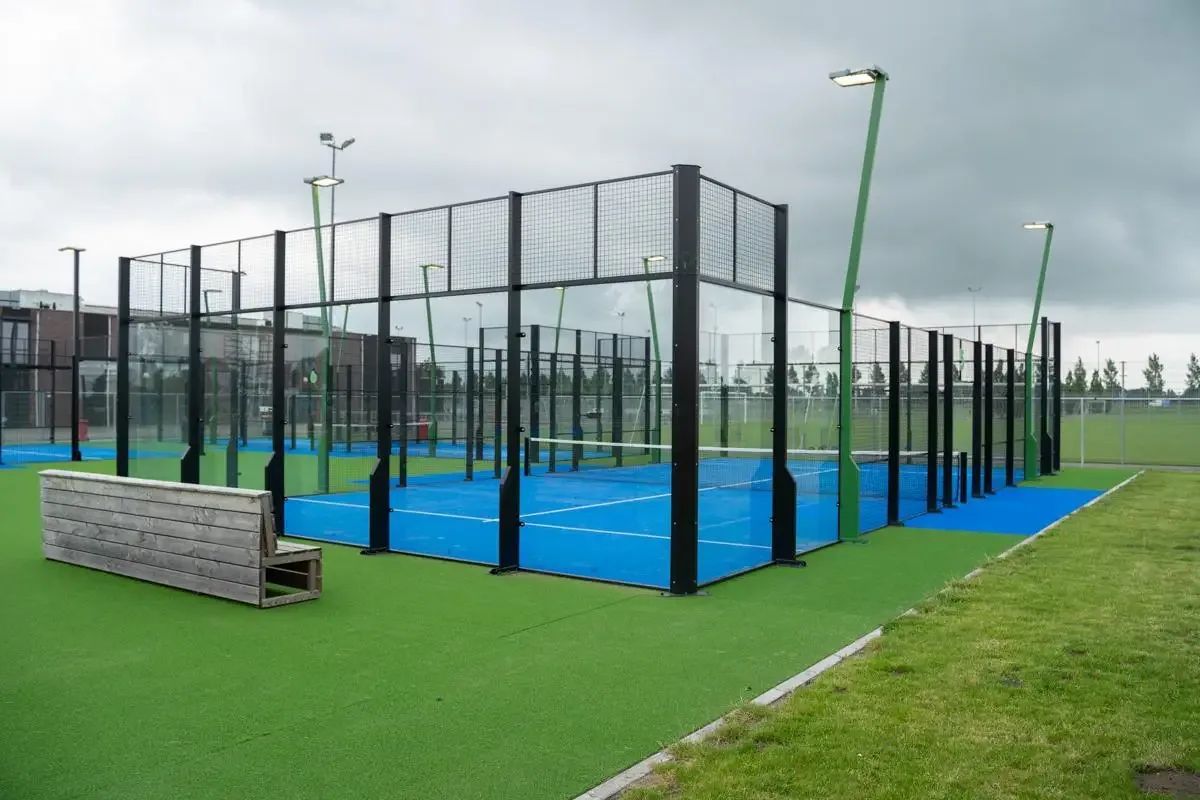
A source measure is applied directly at the sound source to prevent sound from spreading. On a padel court, integrated sound-absorbing panels are an example of such a source measure: they are fixed to the outside of the cage structure and absorb part of the sound before it reaches the surroundings.
A noise barrier works differently. It is a free-standing structure placed next to or around the padel court. The barrier blocks and absorbs sound that has already been produced before it reaches nearby homes. A noise barrier therefore works at a greater distance from the source and is intended to limit sound transmission towards sensitive locations.
The difference lies in the approach: source measures reduce the sound produced at the source, while a noise barrier limits its spread along the way. Both measures can be used separately or in combination, depending on what the location and the acoustic study require. In some situations a combination of both proves the best fit, allowing the noise barrier to be built lower thanks to the panels. Read more about the available acoustic solutions for padel on our overview page.
How do sound-absorbing panels work as a source measure on a padel court?
Sound-absorbing panels are fixed to the outside of the mesh of the cage structure. They contain an absorbent core, usually made of rock wool, a mineral fibre with an open structure. That structure ensures that sound waves are partly absorbed instead of reflected. The kinetic energy of the air particles is converted into heat, so that part of the sound energy disappears.
The distinction between sound absorption and sound insulation is relevant here. Sound absorption means that sound energy is taken up by the material, so reflections decrease. Sound insulation focuses on limiting sound transmission from one side to the other. In padel projects both principles often play a role at the same time, depending on the choice of material, the structure and the placement of the panels.
The position of the panels is very important. During the field study at LTC Hofgeest, the panels were fitted above the glass on the two end sides of the padel court. Within that configuration, after correction for background noise, an indicative noise reduction of around 3 dB(A) was measured. These results apply only to that specific situation and should not be regarded as a general product guarantee. Other locations may require a different configuration.
When is a source measure sufficient and when is it not?
Whether a source measure is sufficient on its own depends on several factors: the distance to homes, the layout of the site, the number of courts, the intensity of use and the applicable noise standards. There is no universal threshold at which panels are always sufficient or always fall short.
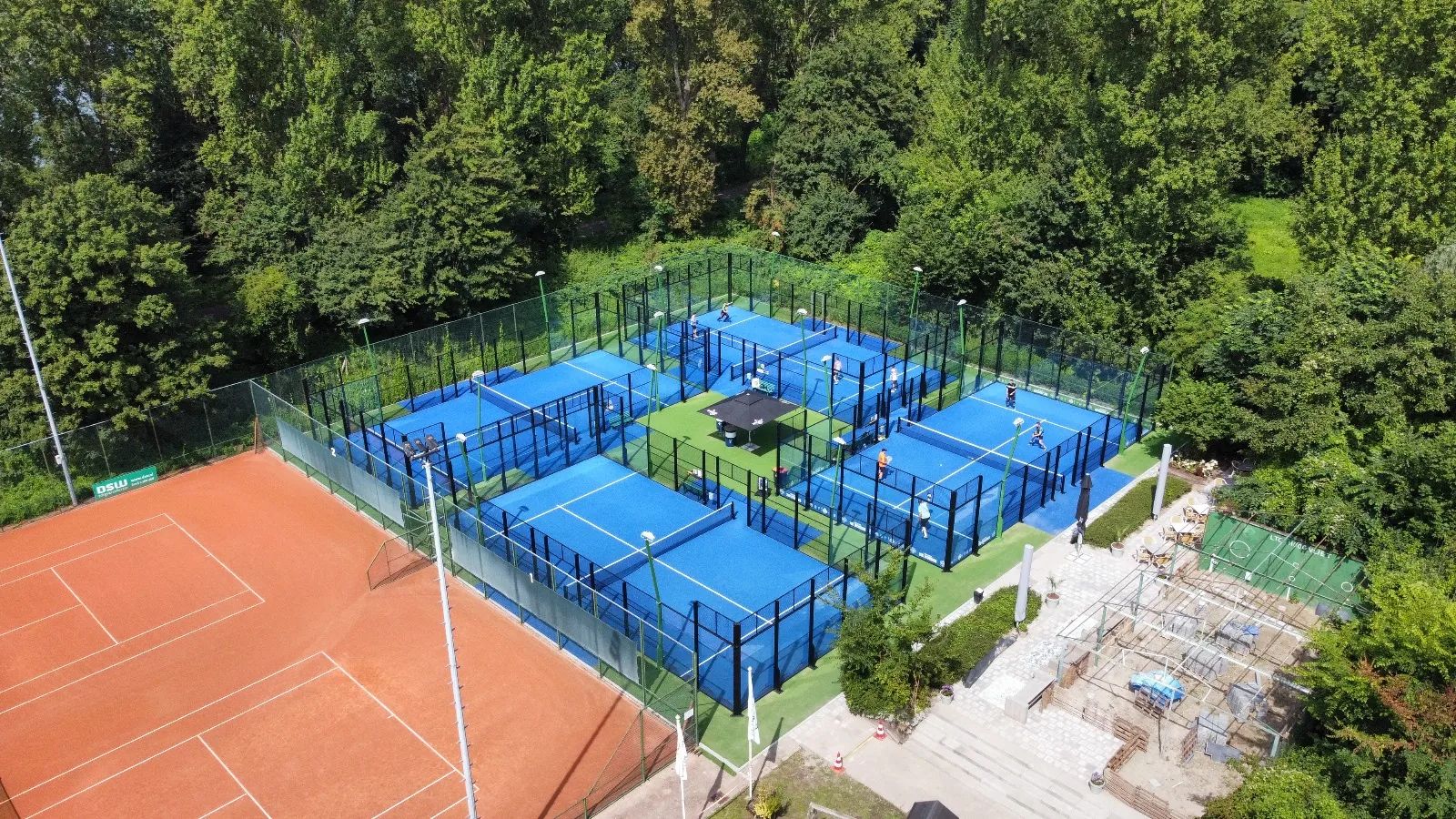
Where homes are at a good distance, the court is favourably oriented and there are no direct sound reflections from buildings, a source measure can often be a suitable solution. At locations bordering residential areas, or at padel parks with several courts in use at the same time, the cumulative noise load is higher. In those cases a source measure may not be enough, and an additional noise barrier or a combination of measures is needed.
Evening use, tournaments and intensive recreational use also create a different noise profile than daytime use. Municipalities assess not only the maximum noise level, but also how long and how often sound occurs. An independent acoustic consultant maps all these factors and determines which combination of measures is needed to meet the applicable requirements. We supply the technical product specifications and structural data so that the calculations can be carried out correctly.
How do sound-absorbing panels affect the steel structure?
Sound-absorbing panels should never be considered separately from the structure they are mounted on. Panels reduce the wind permeability of the cage: where wind used to pass through the mesh, it now meets a closed surface. This creates additional wind load on the steel structure, which is transferred through the structure to the foundation.
This means the structure must be calculated for the extra load caused by the panels. For a new padel court this can be taken into account during the engineering phase, by using heavier posts, additional columns or adapted connections. For an existing court, a structural assessment is required before panels are fitted. Not every existing steel structure can safely absorb the additional wind load.
Because we produce the steel structures ourselves, we can make structural adjustments in the design phase when an acoustic study shows that panels are needed. This avoids costly changes afterwards. Read more about the relationship between structure and wind load on our structure page.
Do you need an acoustic study if you apply a source measure?
In most cases, yes. For outdoor padel courts near homes, an acoustic study is almost always a mandatory part of the permit procedure, regardless of which noise measures are applied. Based on this study, the municipality assesses whether the location meets the applicable noise standards.
An independent acoustic consultancy maps the existing situation, determines the relevant assessment points and calculates different scenarios. The influence of the surroundings is also taken into account: existing noise sources such as roads or railways, the position of buildings and the presence of natural screening. Only on the basis of that analysis can it be determined which measures are needed and what effect may be expected from them.
We do not carry out acoustic studies ourselves. Our role is to supply technical product specifications, structural data and information about the available noise measures, so that the acoustic consultant can include them correctly in the calculations. Cooperation between client, municipality, acoustic consultant, structural engineer and manufacturer ensures that noise measures are integrated into the design. Read more about the permit procedure for a padel court on our permit page.
What are the practical advantages of a source measure compared with a large noise barrier?
In suitable situations, a source measure such as integrated sound-absorbing panels offers several practical advantages over a free-standing noise barrier. The panels are part of the padel structure itself, so no extra ground space is needed for a separate structure next to the court.
A noise barrier usually requires more space, its own foundation, a structural calculation and, in almost all cases, an environmental permit, because it is regarded as a separate structure. Noise barriers can reach heights of six to eight metres and be tens of metres long, which has a major spatial and financial impact on the project. The costs of a padel court with a noise barrier are therefore usually higher than when only source measures are applied.
At the same time, a source measure is not sufficient in every situation. Where homes are close by or where the noise load is high due to intensive use, a noise barrier may be needed to meet the standards. In those cases, combining panels and a noise barrier can actually be an advantage: the panels reduce the sound produced at the source, so the noise barrier can be built lower. This saves costs and in some situations makes obtaining a permit easier.
Which solution fits best differs per project and can only be established through a project-specific assessment. General statements such as “panels are always cheaper than a noise barrier” are technically incorrect and should be avoided. The outcome of the acoustic study, the location and the structural conditions together determine which approach is most suitable. See also our page on sound-absorbing panels for more information on how acoustic panels are used in practice.
Not sure whether outdoor padel is feasible at your location?
We are happy to think along about the court configuration, structural preparation and possible noise measures. Together with your acoustic consultant, we look at which solution is technically feasible and suits the project. Get in touch via our page on acoustic solutions for padel for an initial, no-obligation exploration.
Frequently asked questions
Can I decide myself whether sound-absorbing panels are sufficient for my location, or do I always need a consultant?
You can make an initial estimate yourself based on the distance to homes, the number of courts and the expected intensity of use, but a final assessment always requires an independent acoustic study. Municipalities do not accept self-assessments in the permit procedure; they ask for calculations by a recognised acoustic consultancy. A consultant also takes into account factors that are hard to estimate yourself, such as reflections from the surroundings, background noise levels and the cumulative load from multiple courts.
What are common mistakes when using sound-absorbing panels on a padel court?
A common mistake is retrofitting panels to an existing steel structure that was not designed for them. Panels considerably increase the wind load on the cage, and not every existing structure can safely absorb that extra load without modifications. Another frequent mistake is installing panels without a prior acoustic study, only to find out afterwards that additional measures such as a noise barrier are still needed. This leads to higher costs than if everything had been integrated in the design phase.
Does it matter where the sound-absorbing panels are placed?
Yes, the placement directly affects the effectiveness of the measure. Panels on the end sides of the court work differently from panels along the long sides, and the height at which they are fitted partly determines which sound frequencies are absorbed.
The optimal configuration depends on the position of the court relative to homes and the specific sound paths identified in the acoustic study. Always have the positioning matched to the findings of the acoustic report.
Can sound-absorbing panels also be used on covered or semi-covered padel courts?
Covered or semi-covered courts have different acoustic conditions, because sound can reverberate inside the structure and is transmitted through the facade or roof rather than directly through the open cage. Sound-absorbing panels can play a role in those situations too, but their application and positioning differ from a fully outdoor court. An acoustic consultant with experience in sports facilities can determine which approach is most effective in that specific situation.
How early in the planning process should I think about noise measures?
As early as possible, preferably in the feasibility phase before the location is finalised. Noise measures affect the structural design, the space needed around the courts, the foundation and the total project budget. If acoustic requirements are only considered late in the process, changes to the structure can be costly or even lead to a revised permit application. By taking possible panels or a noise barrier into account during the engineering phase, expensive changes afterwards are avoided.
What can I expect from the permit procedure if I want to use both panels and a noise barrier?
With a combination of panels and a noise barrier, you usually need to submit the correct permit documentation for both elements. The panels are part of the padel structure itself and are included in the permit for the court, while a free-standing noise barrier is in most cases regarded as a separate structure that requires its own environmental permit. The acoustic report explains why the combination of measures is needed and what combined effect is expected, which makes the municipality’s assessment easier.
What if the acoustic study shows that even a combination of panels and a noise barrier is not enough?
In that case there are further options to consider, such as changing the orientation of the court, limiting the hours of use (especially in the evening), increasing the distance to sensitive locations or reconsidering the total number of courts.
Sometimes a location is simply not acoustically suitable for outdoor padel at the desired scale, and a covered option offers a solution. An acoustic consultant can calculate different scenarios to determine which adjustment offers the most feasible and cost-efficient solution.