Blog · 4 September 2026 · 13 min read
Why is every location acoustically different?
Every padel court has a unique acoustic profile. Discover which location factors determine the noise emission and when an acoustic study is mandatory.
In this article
- Which location factors determine the noise emission of a padel court?
- How do the surroundings affect background noise and noise assessment?
- What is the acoustic difference between an indoor and an outdoor padel court?
- Why is an acoustic study mandatory for each location?
- Which noise measures are suitable for which type of location?
- How do sound-absorbing panels affect the structure of the padel court?
- When is an acoustic study not needed for a padel court?
- Not sure whether outdoor padel is feasible at your location?
- Frequently asked questions
Every location is acoustically different because the noise emission of a padel court is determined by a combination of factors that can vary greatly from project to project. The surroundings, the distance to homes, the buildings present, the wind direction and the background noise together mean that two identical padel courts at two different locations can have a completely different acoustic profile. The sections below answer the most common questions about location-specific acoustics at padel courts, from the role of the surroundings to the question of when an acoustic study is mandatory.
Which location factors determine the noise emission of a padel court?
The noise emission of a padel court is determined by the combination of the noise source itself, the surroundings through which the noise spreads and the location of sensitive uses such as homes. No single factor stands on its own. The emission is always the result of several variables at the same time.
The main sources of padel noise are the contact between racket and ball, the ball hitting the glass or the fencing, and the voices of players. The impulsive character of this noise, short recognisable peaks rather than a constant background noise, often makes it more noticeable to local residents than the average noise measurement suggests.
Besides the source itself, the following location factors play a major role:
- Distance to homes or other noise-sensitive uses. The greater the distance, the more the noise is absorbed by the surroundings before it reaches a home.
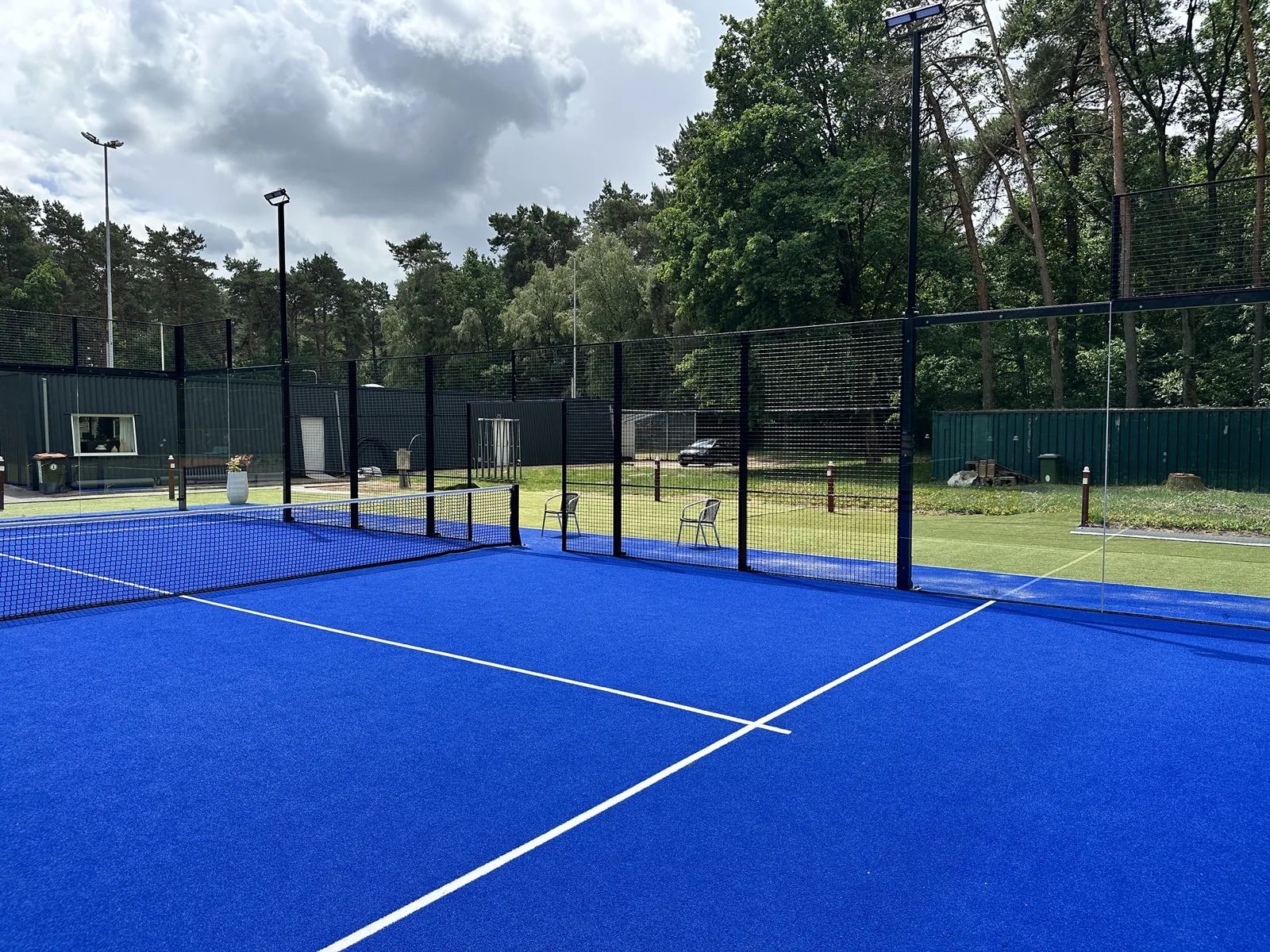
- Openness of the site. On an open site, noise spreads almost unhindered in all directions. Enclosed locations with buildings or green strips behave differently.
- Presence of reflective surfaces. Facades, walls and hard paving can reflect noise towards homes.
- Vegetation and green strips. Planting absorbs a limited amount of noise, but the contribution is generally small and strongly dependent on density and height.
- Wind direction and wind speed. Wind can carry noise towards sensitive uses or, conversely, away from homes. This effect is variable and changes from day to day and from season to season.
- Temperature and humidity. Atmospheric conditions influence the way noise travels through the air.
Because all these factors play a role at the same time, the noise load of a padel court can never be assessed solely on the basis of the court itself. The entire surroundings must be taken into account in the assessment. This is also why acoustic solutions for padel are always assessed on a project-specific basis.
How do the surroundings affect background noise and noise assessment?
The background noise at a location has a direct influence on the noise assessment of a padel court. The higher the background noise already is, for example because of road traffic, railways or industry, the smaller the relative contribution of the padel court to the total noise load. In a quiet environment, the same noise level from a padel court stands out much more.
In acoustic studies, the background noise is measured to determine how much the padel court adds on top of it. This distinction is important: noise standards do not test the absolute noise level, but the contribution of a new activity to the existing situation. A location along a busy road therefore has a different starting point than a quiet residential neighbourhood.
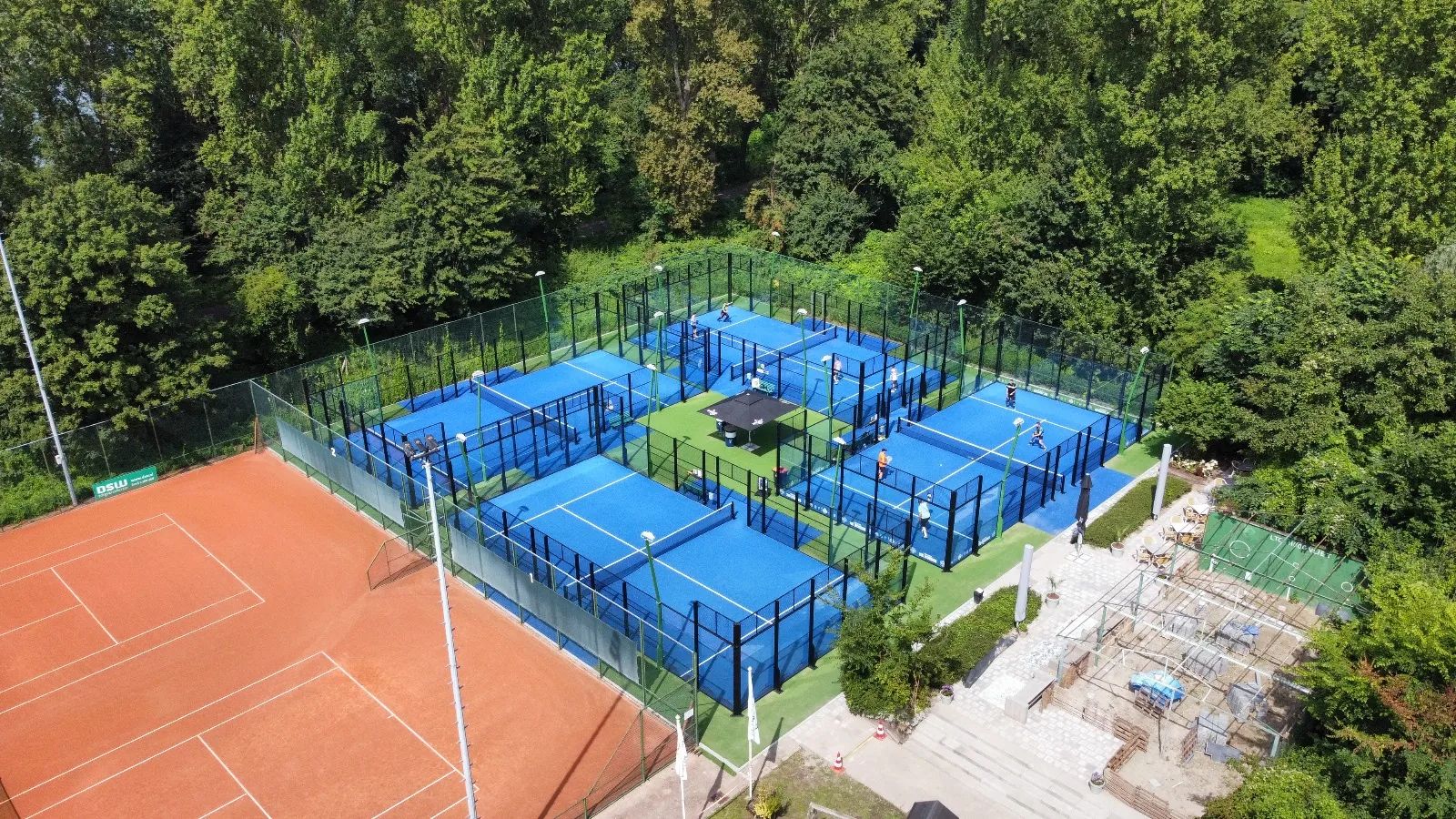
In practical terms, this means an identical padel court can be permitted without problems at one location, while the same court at a quieter location requires additional measures. This is one of the reasons why background noise is always part of an independent acoustic study. During the practical measurement at LTC Hofgeest, this was explicitly taken into account when assessing the measurement results.
What is the acoustic difference between an indoor and an outdoor padel court?
Acoustically speaking, an indoor padel court differs fundamentally from an outdoor padel court. With an indoor padel court, the noise is largely kept inside the hall by the enclosed structure. With an outdoor padel court, the noise spreads freely into the surroundings, which considerably increases the likelihood of nuisance for local residents.
With an indoor court, the acoustics of the hall itself play a major role. Hard walls, concrete floors and a low ceiling can cause noise to be reflected within the space. This affects the playing experience and the ambient noise inside the hall, but generally has little influence on homes outside the building.
With an outdoor padel court, the conditions are fundamentally different:
- Noise spreads in all directions across the surrounding site.
- Wind direction and weather conditions influence the spread every day.
- There are no enclosing walls to hold back noise.
- The distance to homes and the openness of the site largely determine the noise load on the surroundings.
This explains why permit requirements for outdoor padel courts are almost always stricter than for indoor situations, and why an acoustic study is mandatory for outdoor projects in most cases. You can find more information on the technical requirements for an outdoor padel court on our project page.
Why is an acoustic study mandatory for each location?
An acoustic study is mandatory per location because noise standards are tested against the specific situation of that location. There is no general standard that applies to every padel court in every place. The municipality assesses the application on the basis of local conditions, the distance to homes and the existing background noise.
When applying for an environmental permit for an outdoor padel court, an acoustic study is in most cases part of the required documentation. The study is carried out by an independent acoustic consultancy and calculates the expected noise load on the sensitive uses in the surroundings.
On the basis of the results of the study, it is determined whether additional measures are needed. These can be sound-absorbing panels, a noise barrier, adjustments to the site layout or a combination of several solutions. Which measure is suitable depends entirely on the project-specific situation and the calculations of the acoustic consultancy.
We do not carry out acoustic studies ourselves, but we supply the technical product specifications, structural data and engineering needed to carry out acoustic calculations correctly. You can read more about applying for a permit for a padel court on our permit page.
Which noise measures are suitable for which type of location?
Which noise measure is suitable depends on the location, the distance to homes, the space available and the results of the acoustic study. There is no standard solution that delivers the same result at every location. The most commonly applied measures are sound-absorbing panels as a source measure, free-standing noise barriers and combinations of the two.
Sound-absorbing panels as a source measure
Sound-absorbing panels are mounted directly on the padel structure. They work as a source measure: the noise is limited as close to the source as possible, before it spreads across the site. This has the advantage that the footprint remains limited. Traditional noise barriers or free-standing screens require additional foundations and take up more space, which can be a drawback at existing sports parks with limited room.
Panels are particularly suitable when homes are located on one or two sides of the court. The configuration can be matched to the direction of the sensitive uses. The panels we use consist of Eurorail Ecowand panels with 55 millimetres of rock wool and a density of 160 kilograms per cubic metre, finished with plastic mesh and a metal profile. Gap-free mounting is important here, because small openings can negatively affect the acoustic performance.
Free-standing noise barriers
A noise barrier is a free-standing structure placed next to or around the padel court. Noise barriers can be effective when the distance to homes is limited and panels alone offer insufficient reduction. They are available in heights up to 6 to 8 metres and can be built over tens of metres.
A drawback is the larger footprint and the additional structural and permit-related requirements that come with it. You can find more information on the application of noise barriers around padel courts on our dedicated page.
Combination of measures
In some situations a combination of sound-absorbing panels and a noise barrier is the most suitable. The panels limit the emission at the source, so a noise barrier can be built lower and more compactly. This can have a positive effect on both the costs and the permit feasibility. The final configuration is always determined on the basis of the acoustic study and the project-specific conditions.
How do sound-absorbing panels affect the structure of the padel court?
Sound-absorbing panels have a direct influence on the structural load of the padel court. Panels are closed surfaces that catch the wind. The more closed surface a structure has, the greater the wind load exerted on the steel structure and the foundation. The structure must be recalculated for this before panels are mounted.
This applies to both new courts and existing structures. For existing padel courts, a structural assessment is needed to determine whether the steel structure can safely absorb the extra load. Not every existing structure is suitable for this without modifications.
With new courts, the placement of the panels can be taken into account directly during the engineering phase. This is an important advantage of in-house production: structural modifications can already be made in the design phase, so that the court as a whole is designed for the final configuration, including noise measures. The steel structures we produce are made from S350 structural steel and are hot-dip galvanised, after which a high-quality powder coating is applied. This duplex protection system offers long-lasting protection against the weather.
The wind load at a location also depends on the wind zone, the height of the structure and the surrounding buildings. Locations on open sites or near the coast generally experience a higher wind load than locations surrounded by buildings or planting. You can read more about the relationship between structure and wind load on our structure page.
When is an acoustic study not needed for a padel court?
In some situations an acoustic study is not mandatory, but this depends on the municipality, the location and the nature of the project. For indoor padel courts in an existing hall without structural modifications, an acoustic study is not always part of the permit procedure. The municipality assesses this per application.
For outdoor padel courts, an acoustic study is in most cases mandatory, especially when the location is near homes, schools or care institutions. The distance to sensitive uses and the local noise standards determine whether a study is necessary.
There are situations in which an acoustic study may be less urgent:
- The location is a long way from homes or other noise-sensitive uses.
- The background noise at the location is already high because of nearby infrastructure.
- The municipality has indicated, on the basis of a preliminary consultation, that no study is needed.
It is wise to always verify this beforehand with the municipality or through an acoustic consultant. Building without the required permits or studies carries risks: the municipality can halt a project, impose fines or demand removal of the structure. We are happy to support clients when they have a padel court built and go through the permit process.
Not sure whether outdoor padel is feasible at your location?
We are happy to think along with you on the court configuration, structural preparation and possible noise measures. Together with your acoustic consultant, we look at which solution is technically feasible and suits the project. Get in touch via our page on acoustic solutions for padel for an initial, no-obligation exploration.
Frequently asked questions
How early in the planning process should I engage an acoustic consultant?
It is strongly advisable to involve an acoustic consultant in the earliest phase of the project, preferably before the choice of location is final. An early acoustic exploration can determine whether a location is feasible at all, which measures are needed and what impact they have on the budget and the site layout. Making modifications afterwards is considerably more expensive and sometimes technically more limited than when noise measures are included in the engineering phase.
What are the most common mistakes when assessing the noise nuisance of a padel court?
A common mistake is to assess the noise load on the basis of distance alone, without taking into account the impulsive character of padel noise, reflective surfaces or the wind direction. Background noise is also regularly underestimated as a determining factor: a location that seems quiet during the day can have a very different acoustic profile in the evening or at weekends. In addition, initiators sometimes underestimate the structural consequences of adding sound-absorbing panels afterwards to an existing structure that was not calculated for them.
Can I make a rough estimate of the noise load myself before engaging an acoustic consultancy?
A general orientation is possible by looking at the distance to the nearest homes, the openness of the site and the background noise present at the location. If the nearest home is more than 100 metres away and the surroundings have a relatively high background noise, the chance of problems is smaller. Even so, this is no substitute for a professional acoustic study: only a calculation based on measured and certified data is legally valid in a permit procedure.
How long does an acoustic study take on average, and what does it cost?
The turnaround time of an acoustic study generally ranges from two to six weeks, depending on the complexity of the location and the availability of the acoustic consultancy. Costs range from a few hundred euros for a simple calculation to several thousand euros for a full field study with practical measurements at a complex location. It is wise to request several quotes and to check whether the consultancy has experience with sports facilities and specifically with padel courts.
What happens if the acoustic study shows that the location does not meet the noise standards?
If the calculated noise load exceeds the applicable standards, there are several options: taking additional noise measures such as sound-absorbing panels or a noise barrier, adjusting the site layout or the orientation of the courts, or limiting the hours of use. In some cases a combination of measures can still make the situation permittable. Only if none of these options leads to an acceptable result is the location acoustically unsuitable for an outdoor padel court.
Do specific noise standards apply to padel courts, or do they fall under general sports facility standards?
There is no specific legislation for padel courts; they fall under the broader regulations for sports facilities and outdoor activities, such as the Activities Decree (Activiteitenbesluit) or local environmental plans. Municipalities generally apply the guidelines of the VNG (Association of Dutch Municipalities) for the permissible noise level of recreational and sporting activities at sensitive uses. Because municipalities have some policy discretion, the standards applied can differ slightly from municipality to municipality, which is an extra reason to contact the local permits department at an early stage.
Are sound-absorbing panels also suitable for existing padel courts that are already causing complaints?
Yes, sound-absorbing panels can also be applied retrospectively to existing padel courts, but this always requires a structural assessment of the existing steel structure and foundation first. Not every existing structure is suitable, without modifications, for absorbing the extra wind load of closed panels. When the structure is suitable or can be modified, panels as a source measure offer an effective and space-saving solution to reduce existing noise complaints without drastic changes to the surroundings.