Blog · 6 September 2026 · 12 min read
When is an acoustic study needed for a padel court?
Is an acoustic study for a padel court mandatory? Find out when, what it costs and how to avoid permit delays.
In this article
- Which situations make an acoustic study mandatory?
- What exactly does an acoustic study for a padel court measure?
- What is the difference between an acoustic study and a noise calculation?
- Who carries out an acoustic study for a padel court?
- Which noise measures can improve the outcome of a study?
- What does an acoustic study for a padel court cost?
- How early in the project should you have an acoustic study carried out?
- Not sure whether outdoor padel is feasible at your location?
- Frequently asked questions
In most cases, an acoustic study for a padel court is mandatory as soon as an outdoor padel court is built near homes or other noise-sensitive uses. The municipality requests this study as part of the permit application, so that it can be demonstrated that the noise load on the surroundings stays within the statutory standards. In this article we answer the most common questions about when, why and how an acoustic study for an outdoor padel project is carried out.
Which situations make an acoustic study mandatory?
In most cases, an acoustic study is mandatory when an outdoor padel court is built near homes or other noise-sensitive uses. The municipality assesses this as part of the environmental permit. The closer the court is to homes, the greater the chance that a study is formally required.
Padel produces more noise than tennis. The ball hitting glass and steel, combined with the cage structure acting as a resonance box, results in an average sound power level of around 91 dB. That is roughly 10 dB more than with tennis. This makes noise a serious point of attention in padel projects, especially in urban areas or at locations bordering residential neighbourhoods.
In practice, these are the situations in which an acoustic study is almost always requested:
- The padel court is placed outdoors and is located close to homes or other noise-sensitive buildings.
- The municipality requires, as part of the permit for a padel court, that the noise load is substantiated.
- Local residents have lodged objections, or the surroundings are sensitive.
- The location falls within a zoning plan that sets specific noise requirements for sports activities.
For indoor padel courts in an existing hall, an acoustic study is less often mandatory, but this depends on the situation and the municipality. For outdoor projects it is almost always a requirement. Do not assume it is not needed without first verifying this with the municipality.
What exactly does an acoustic study for a padel court measure?
An acoustic study for a padel court maps out how much noise the court produces and what noise load this causes at nearby homes or other sensitive uses. The consultant calculates or measures the noise level at the facades of surrounding buildings and tests it against the applicable standards from the Activities Decree (Activiteitenbesluit) or the environmental permit.
Specifically, an acoustic consultant looks at:
- The sound power level of the padel court, including the contribution of ball on glass, ball on mesh and player noise.
- The distance between the court and the nearest noise-sensitive uses.
- The surroundings: buildings, trees, differences in height and other factors that can shield or, conversely, amplify noise.
- The intensity of use: how many hours per day and per week is play taking place, and at what times.
- The noise load on the facades of homes, expressed in dB(A), for day, evening and night.
On the basis of this data, the consultant determines whether the location meets the standards without additional measures, or whether noise measures are needed. The outcome of this study partly determines which technical solutions are applied and how the outdoor padel court is configured.
What is the difference between an acoustic study and a noise calculation?
A noise calculation is a mathematical prediction of the expected noise load based on input data such as sound power level, distance and environmental factors. An acoustic study is broader and, in addition to calculations, can include field measurements, an assessment of the situation and advice on noise measures. In practice the two terms are sometimes used interchangeably, but they are not the same thing.
For a permit application, a calculation is sufficient in many cases, provided it has been carried out by a recognised acoustic consultancy and is based on correct input data. If there is doubt about the actual noise load, or if local residents have lodged objections, a municipality may ask for additional field measurements. This makes the study more extensive and therefore more expensive.
Timing also makes an important difference. A noise calculation can be carried out early in the project, based on the planned situation. Field measurements are only possible once the court is in place. For the permit phase, work is therefore almost always based on calculations, supplemented with practical data on the sound power level of padel courts.
Who carries out an acoustic study for a padel court?
An acoustic study for a padel court is carried out by an independent acoustic consultancy. These are specialised firms with knowledge of environmental noise, sports facilities and the relevant legislation and regulations. The municipality reviews the report and checks whether it meets the requirements set.
It is important that the consultancy is independent. A report from a party that also has a stake in the outcome is generally not accepted by municipalities. We do not carry out acoustic studies ourselves. Our role is to supply the technical product specifications, structural data and engineering needed to carry out the calculations correctly.
In practice it works as follows: the acoustic consultant needs accurate information about the court, the configuration and any noise measures. We supply that technical substantiation. On that basis, the consultant can produce a reliable calculation and draw up advice that matches the actual situation. Good cooperation between the builder, the structural engineer and the acoustic consultancy is a prerequisite for this.
Which noise measures can improve the outcome of a study?
When an acoustic study shows that the noise load is too high, several measures are possible to improve the situation. Which measure is most suitable depends on the location, the distance to homes, the space available and the results of the study itself.
The most commonly applied solutions are:
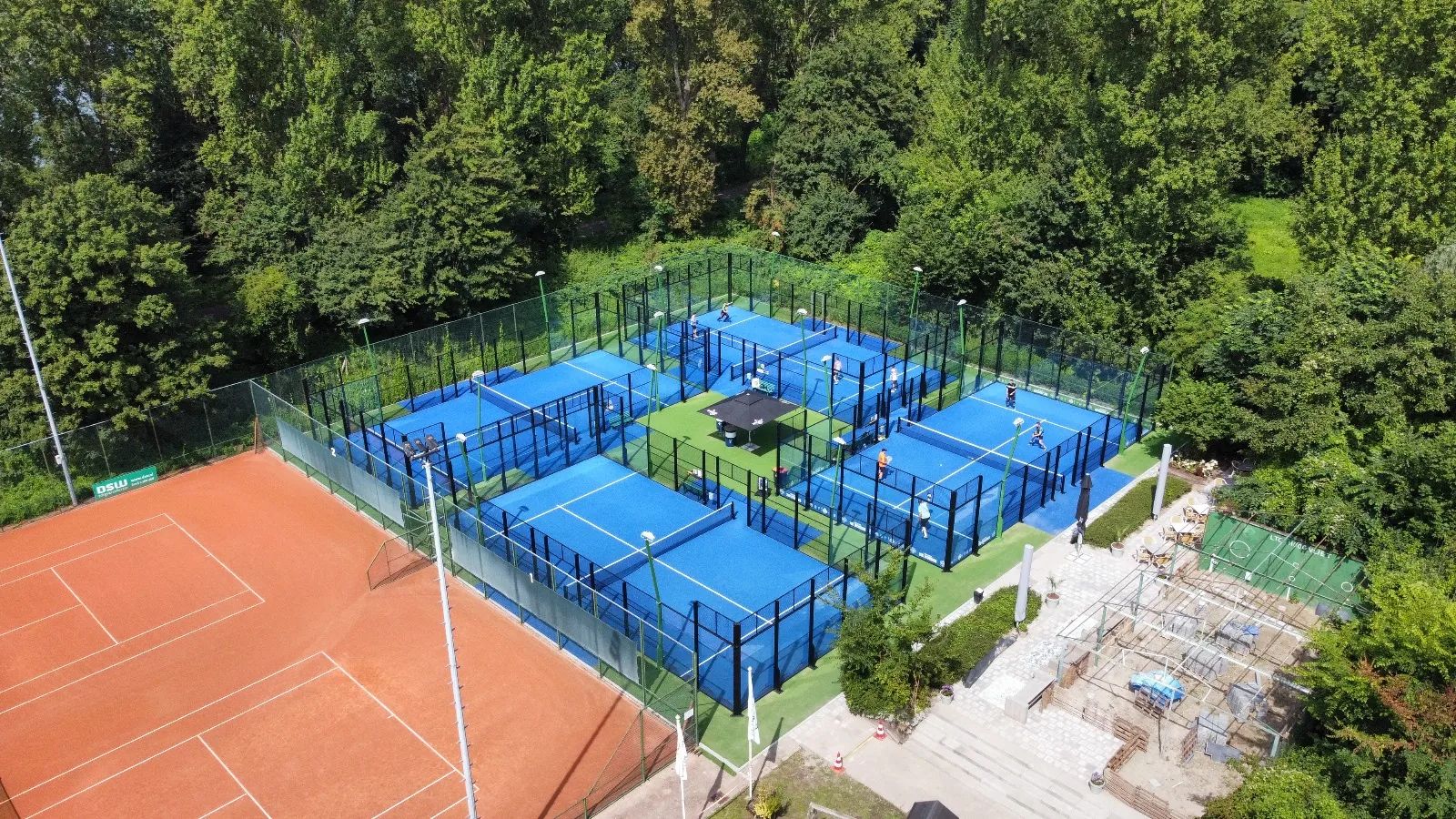
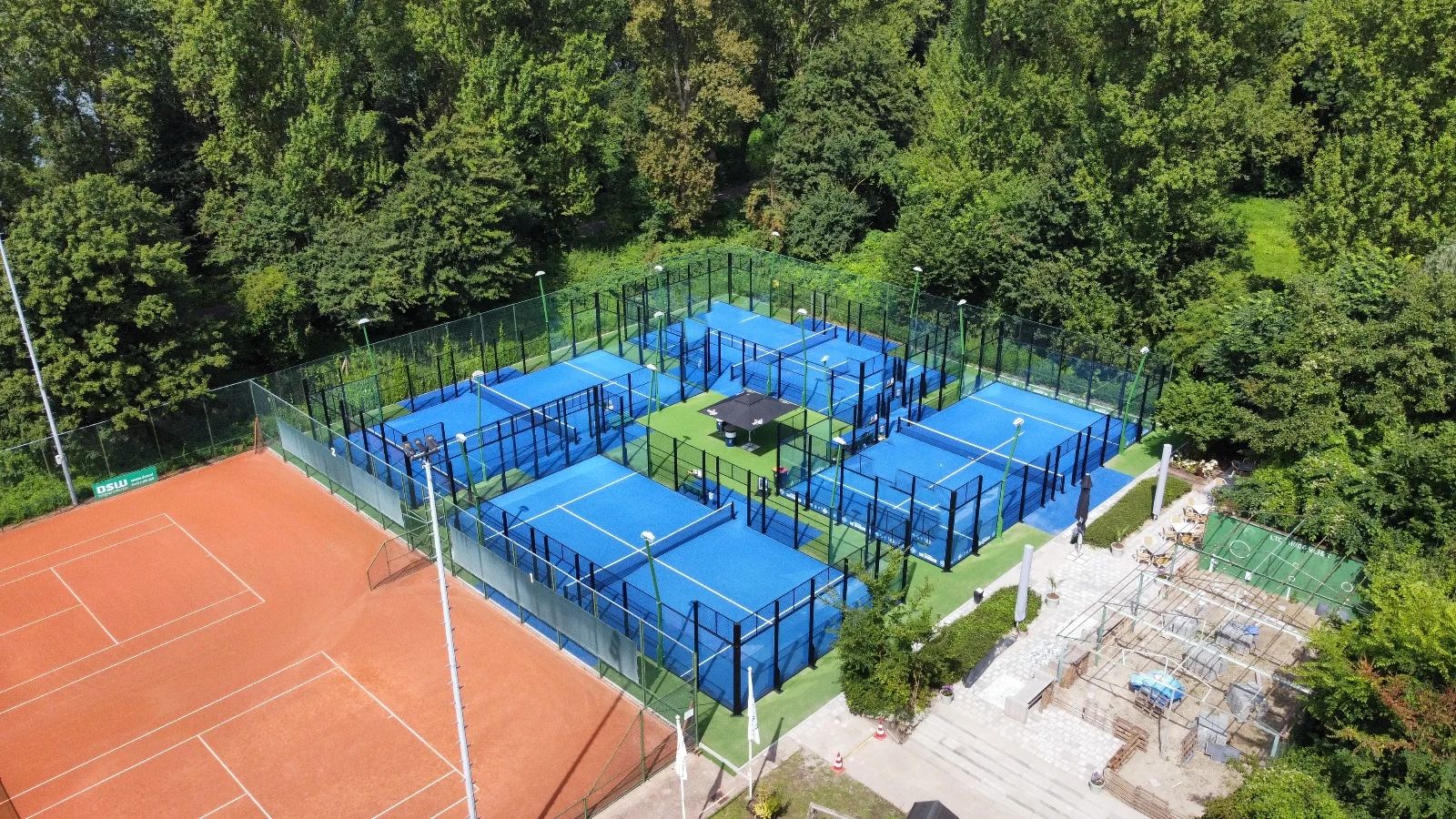
- Sound-absorbing panels: these are placed on the outside of the cage structure and work as a source measure. They absorb part of the noise directly at the court, so less noise is radiated to the surroundings. In a practical measurement at LTC Hofgeest, an indicative noise reduction of around 3 dB(A) was measured within the configuration studied, after correction for background noise. These results apply only to that specific situation. You can find more information on how they work and their specifications on the page about acoustic solutions for padel.
- Noise barriers: free-standing structures placed next to or around the court that shield homes from noise. They can be finished with planting, which also helps with acceptance by the municipality and local residents. A noise barrier almost always requires a separate environmental permit.
- A combination of panels and a noise barrier: in many situations a combination is the most effective. The panels reduce the noise at the source, and the barrier blocks the remaining noise towards the surroundings. This can also mean the noise barrier can be built lower, which saves costs and can simplify the permitting process.
- Adjustments to the site layout: sometimes it is possible to position the court differently on the site, which increases the distance to homes or directs the noise emission in a less sensitive direction.
An important technical point with sound-absorbing panels is that they affect the wind load on the structure. Panels reduce the wind permeability of the cage structure, which puts more wind pressure on the structure. The structure and wind load must therefore be recalculated before panels are applied. This applies both to new courts and to existing situations.
What does an acoustic study for a padel court cost?
The cost of an acoustic study for a padel court varies depending on the scope of the study, the number of courts, the complexity of the location and the consultancy carrying out the study. Giving an indication without knowing the specific situation is not meaningful, but as a general guideline, an acoustic calculation for a simple project costs considerably less than an extensive study including field measurements.
Factors that influence the cost:
- The number of padel courts and the overall scale of the project.
- The complexity of the surroundings: an urban area with a lot of buildings requires more calculation work than an open location.
- Whether field measurements are needed in addition to the calculations.
- Whether the consultancy also draws up advice on noise measures.
- Whether additional reporting is needed for an objection procedure or additional municipal requirements.
Keep in mind that the cost of the acoustic study is part of the total project cost. For outdoor padel projects, the foundation, structure, permit process and any noise measures are all cost factors that play a part in the total investment.
How early in the project should you have an acoustic study carried out?
Have an acoustic study carried out as early as possible, preferably before the permit application is submitted. The earlier the results are known, the more room there is to adjust the court configuration, its position on the site or the noise measures to be applied, without this leading to delays or extra costs.
In practice we see projects run into delays because the acoustic study is scheduled too late in the process. The municipality requests the report as part of the permit application. If it turns out at that point that additional measures are needed, the application has to be supplemented or revised. That costs time and money.
Involving an acoustic consultant early has another advantage: the consultant can help with the choice of location and the orientation of the courts. Sometimes a small adjustment in positioning is enough to reduce the noise load on homes, without any additional measures being needed.
We advise including the acoustic study in the project planning as soon as the choice of location and the number of courts have been fixed. That way, the engineering of the structure and any noise measures can be aligned directly with the results of the study. When you have a padel court built, this is a step you do not want to skip.
Not sure whether outdoor padel is feasible at your location?
We are happy to think along with you on the court configuration, structural preparation and possible noise measures. Together with your acoustic consultant, we look at which solution is technically feasible and suits the project. Get in touch via the page on acoustic solutions for padel for an initial, no-obligation exploration.
Frequently asked questions
Can I determine for myself whether an acoustic study is needed, or should I always check with the municipality?
You can make an initial estimate based on the distance to homes and the nature of the surroundings, but the final assessment always lies with the municipality. Before submitting the permit application, contact the environmental agency or the municipal service desk to ask whether an acoustic study is required for your specific location. Never assume it is not needed without having this confirmed in writing, because a missing report can delay the permit procedure considerably.
What happens if the acoustic study shows that the standards are exceeded?
If the calculations show that the noise load exceeds the statutory standards, that does not automatically mean the project cannot go ahead. In most cases, noise measures are proposed, such as sound-absorbing panels, a noise barrier or an adjusted court position, after which a recalculation is made. Only if the standards cannot be met even with measures can the municipality refuse the permit. An acoustic consultant engaged early can help prevent this scenario by contributing from the design phase onwards.
Do different noise standards apply to padel courts at a sports club than at a commercial padel club?
The applicable standards depend primarily on the zoning designation of the location and the surroundings, not necessarily on the type of operator. Sports clubs generally fall under the Activities Decree, but the municipality can also impose tailor-made requirements through the environmental permit. Commercial padel clubs in urban areas may face stricter requirements, especially if intensive play also takes place in the evening or at weekends. Always have this checked by an acoustic consultant who is familiar with local regulations.
How long does it take for an acoustic study to be completed?
The turnaround time of an acoustic study depends on the complexity of the location and the availability of the consultancy, but as a rule allow two to four weeks for a standard noise calculation. When field measurements are needed, the turnaround time increases, because suitable measurement moments also have to be scheduled and the court must already be operational. Therefore schedule the study well ahead of the intended submission date of the permit application, to avoid delays in the permit process.
Does the acoustic study have to be repeated if I later want to add extra courts to the complex?
Yes. When the number of courts is increased, the total noise emission of the location changes, so a new or supplementary calculation is necessary. For a new permit application for the extension, the municipality will again ask for acoustic substantiation. It is wise to take possible future expansion into account in the initial application, so that the acoustic consultant can include it in the design and you are not faced with surprises.
What information do I need to supply to the acoustic consultancy so that the study can start?
An acoustic consultancy needs at least the following information: the exact location and orientation of the planned courts, the distance to surrounding homes and noise-sensitive uses, the planned hours and intensity of use, and technical specifications of the court structure, including any noise measures. If you work with a specialised padel court construction partner, they can supply the structural and technical product data directly to the consultancy, which speeds up the process considerably.
Can an acoustic report from an earlier, similar project be used for my own permit application?
No, an acoustic report is always location-specific and cannot be reused for another application. The calculations are based on the exact situation on site, including the distances, surrounding buildings, court orientation and intensity of use, which differ from project to project. A municipality will therefore not accept a report from another location as substantiation. Earlier studies can, however, serve as a reference for the acoustic consultancy when estimating the approach and the expected results.