Blog · 26 October 2026 · 12 min read
Padel court near homes: which steps do you take before construction?
Building a padel court next to homes? Discover 7 steps: from site analysis and acoustic study to permit and structure. Improve your chances of success.
In this article
- What determines whether a padel court next to homes is feasible?
- Step 1: Map out the location and surroundings
- Step 2: Check the zoning plan and local rules
- Step 3: Have an acoustic study carried out
- Step 4: Determine which noise measures are needed
- Step 5: Have the structure calculated per location
- Step 6: Choose the right foundation type for the location
- Step 7: Submit the permit application with the right documentation
- A well-prepared application improves the chances of success
- Frequently asked questions
Building a padel court next to homes is feasible both technically and in terms of permits, but it requires careful preparation. Noise nuisance, soil conditions, wind load and local regulations all play a role. Anyone who works through these steps in the right order considerably improves the chances of a successful project and a smooth permit process.
What determines whether a padel court next to homes is feasible?
The feasibility of an outdoor padel court next to homes depends on a combination of factors. Noise is the most decisive, but by no means the only point of attention. The distance to noise-sensitive uses such as homes, schools or care facilities largely determines which measures are needed and whether a permit is feasible.
Padel noise differs fundamentally from other outdoor sports. It consists of a combination of impulsive sounds: the racket hitting the ball, the ball bouncing off glass or fencing, and the voices of players. Local residents experience these short, recognisable peaks differently from constant background noise at the same average level. That makes an objective assessment of the noise situation necessary before a project starts.
Besides noise, soil conditions, available space, the wind load at the location and local zoning plan rules also play a role. No two locations are alike. That is why a project-specific assessment is always the starting point.
Step 1: Map out the location and surroundings
The first step is a thorough analysis of the location itself. How far away are the nearest homes? Are there schools, care facilities or other noise-sensitive uses in the area? From which direction does the wind mainly blow, and are there buildings or green strips that can reflect or shield noise?
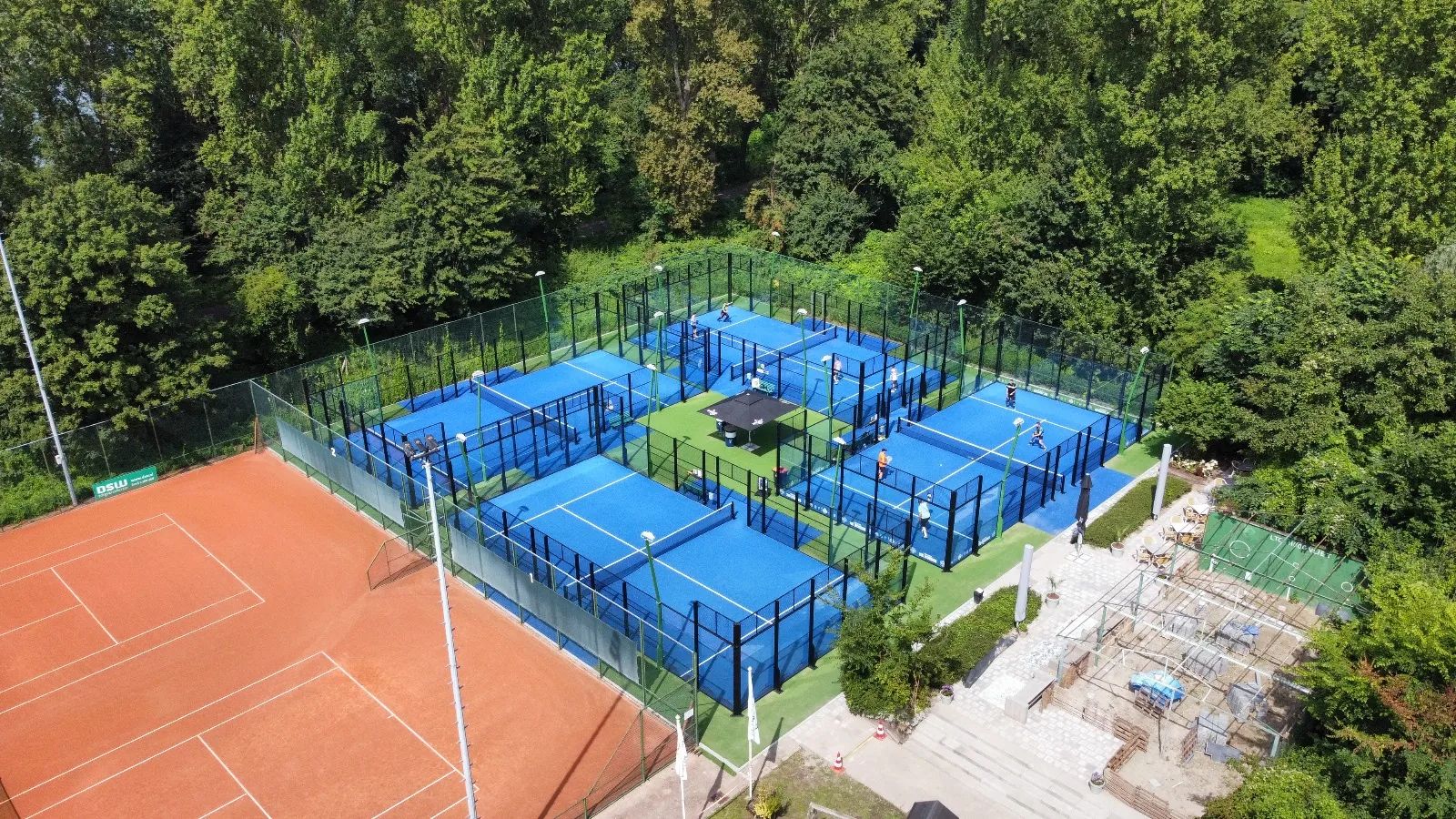
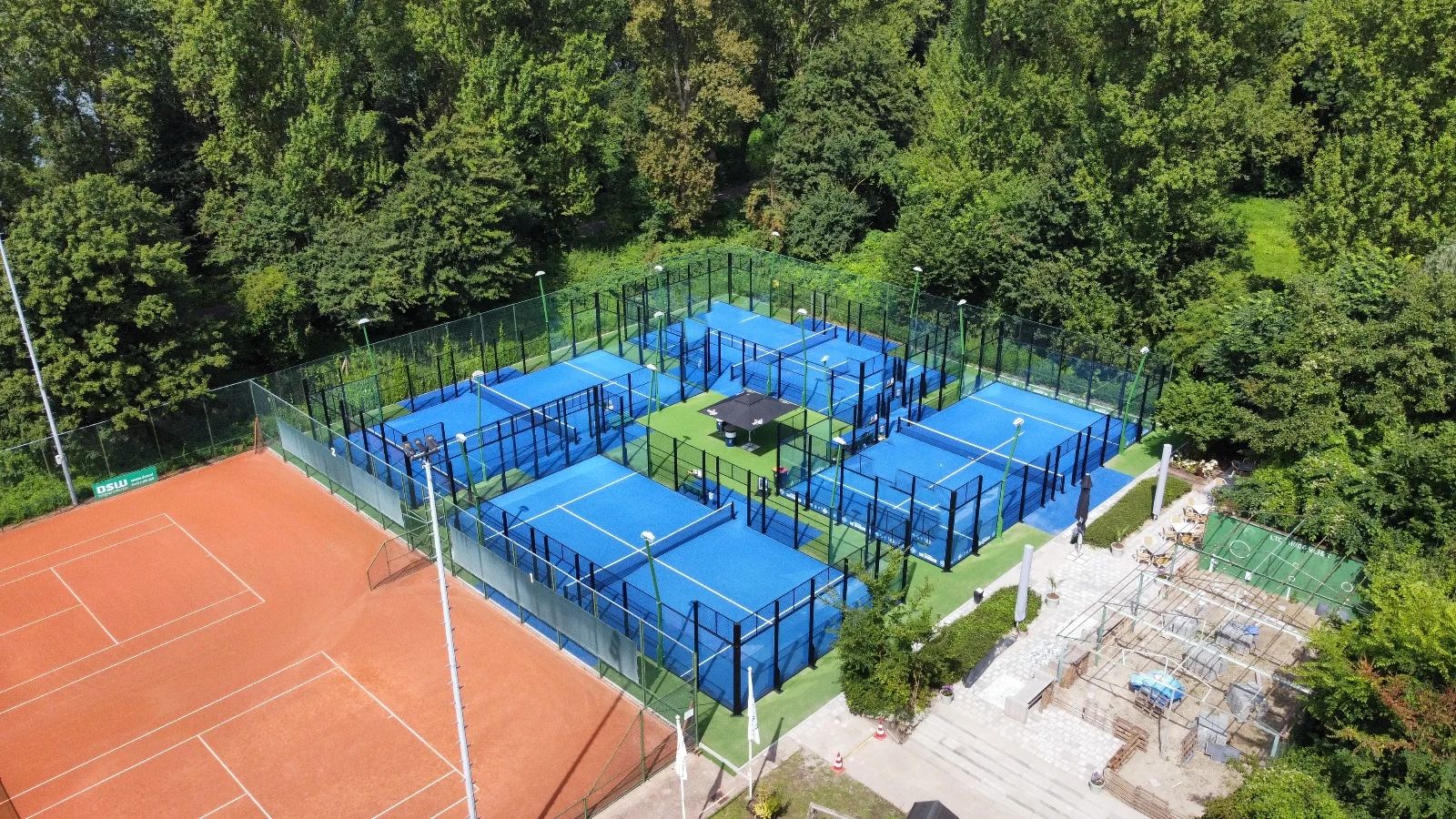
The number of courts you want to build is also relevant. A single padel court produces a different noise profile from four or six courts in simultaneous use. The spread of the courts, the distance between them and their orientation relative to homes influence the cumulative noise load. A configuration that works well at one location may prove inadequate at another.
Record your findings in a clear site sketch. This forms the basis for all the following steps and helps both the municipality and an acoustic consultant to assess the situation quickly.
Step 2: Check the zoning plan and local rules
Before moving on to technical detailing, it is wise to consult the zoning plan that applies. In the Netherlands a padel court is regarded as a structure and therefore falls under building regulations. In most cases an environmental permit is required, especially for outdoor placement near residential buildings.
Check whether the designation of the plot allows sports activities and whether restrictions apply to building height, noise production or lighting. Some municipalities apply additional noise standards for sports facilities close to homes. These standards can be stricter than national standards.
An early conversation with the municipality, even before a formal application is submitted, can save a lot of time. Municipalities are often willing to think along at an early stage about what is feasible. This preliminary consultation also gives insight into which documents will later be expected with the permit application. You can find more information about applying for a permit for a padel court on our page on this subject.
Step 3: Have an acoustic study carried out
For a location next to homes, an acoustic study is in most cases mandatory as part of the permit application. An independent acoustic consultancy maps out the existing noise situation, determines the relevant assessment points and calculates different scenarios to determine which measures are needed.
The study looks not only at the padel courts themselves, but also at the influence of the surroundings. Existing noise sources such as roads or railway lines, the presence of reflecting facades and the facility's opening hours all play a role. A court used only during the day is assessed differently from a facility that is also played on intensively in the evening.
We do not carry out acoustic studies ourselves. Our role is to supply the technical product specifications, structural data and engineering information the acoustic firm needs to make correct calculations. Based on the results of the study, a suitable structural solution can then be developed.
Step 4: Determine which noise measures are needed
Based on the acoustic study it becomes clear whether noise measures are needed and, if so, which. There are various options, each with its own advantages and disadvantages depending on the location.
Integrated sound-absorbing panels are a source measure: they are fitted directly on the padel structure and limit the spread of noise from the source. The panels we use consist of rock wool panels with a bulk density of 160 kilograms per cubic metre, finished with plastic mesh and a metal profile. They are installed gap-tight, which is important for the acoustic performance.
In a practical measurement at LTC Hofgeest, an indicative noise reduction of approximately 3 dB(A) was measured within the configuration studied, after correction for background noise. These results apply only to that specific situation. You can read more about how they work and where they are used on our page about acoustic solutions for padel.
Freestanding noise barriers are another option. They are placed next to or around the court and work at a greater distance. They are effective when homes are on one specific side, but take up more space and require an additional foundation and environmental permit. In some situations a combination of panels and a noise barrier is the most suitable. Which solution is appropriate depends on the project-specific situation and the results of the acoustic study.
Step 5: Have the structure calculated per location
A padel court is not a standard product that you can put down anywhere. Every location faces different conditions: wind load, surrounding buildings, noise requirements from the municipality and spatial constraints. The steel structure must be calculated for the specific requirements of the place where the court will stand.
This applies in particular when sound-absorbing panels are used. Panels reduce the wind permeability of the structure, so considerably more wind force is transferred to the steel structure and foundation. The structure must be recalculated accordingly before panels are fitted. In many cases heavier posts, additional columns or modified connections are needed. This applies both to new courts and to existing structures to which panels are added afterwards.
We produce the steel structures entirely in-house, from S350 structural steel, hot-dip galvanised and finished with a high-quality powder coating. This means structural modifications can be made during the design phase when the acoustic study calls for additional measures. You can find more about structure and wind load on our structure page.
Step 6: Choose the right foundation type for the location
The foundation is one of the most location-dependent components of an outdoor padel project. The soil conditions, the groundwater level, the wind load and the desired water drainage together determine which foundation type is most suitable.
The most commonly used options for outdoor padel courts are drainage concrete, Supersub and ZOAB asphalt. Drainage concrete is a water-permeable type of concrete in which rainwater drains straight through the foundation into the ground. It is stable, has a high load-bearing capacity and, with good maintenance, lasts 25 to 40 years on average.
Supersub is a foundation solution based on foam concrete: lightweight, self-levelling and shock-absorbing. It is water-permeable in the outdoor version and can in many cases be poured within a single day. ZOAB asphalt (open-graded asphalt concrete) is a porous asphalt variant that lets water through and can be a suitable choice in certain situations.
All foundation materials used must be inspected in the Netherlands by Kiwa ISA Sport. We work exclusively with certified materials and advise on the basis of location, use and budget, not on what happens to be in stock. You can find more information about the different options on our page about a padel court including groundwork.
Step 7: Submit the permit application with the right documentation
When the site analysis, the acoustic study and the structural calculations are complete, the formal permit application can be submitted. A complete application generally contains the following documents: structural calculations in accordance with the Dutch Building Decree (Bouwbesluit), an acoustic study, a lighting study, a site plan and, depending on the location, possibly an ecological or archaeological study.
The processing time of a permit application averages 8 to 12 weeks, depending on the municipality and the complexity of the project. A complete and well-substantiated application reduces the chance of delay from requests for additional information. Missing documents or unclear justifications are a common cause of delay.
We can guide and coordinate the permit process, including the zoning plan check, the consultation with the municipality, the coordination of noise and lighting studies and the supply of structural calculations. Building without a permit is not an option: the municipality can halt the project, impose fines or require the cage structure to be removed.
A well-prepared application improves the chances of success
Anyone who works through the steps in the right order will find that a padel court next to homes is feasible in many situations, both technically and in terms of permits. The key lies in careful preparation in which site analysis, acoustic study, structural calculations and permit documentation are aligned with each other.
Noise measures such as integrated panels or a noise barrier can contribute to a workable permit process, but which solution is suitable differs per project. An independent acoustic consultant determines which measures are needed on the basis of the specific situation. We supply the technical substantiation, engineering and structural detailing needed for this.
Cooperation between the client, the municipality, the acoustic consultant, the structural engineer and the producer ensures that noise measures can be integrated into the design. This avoids costly changes afterwards and leads to a solution in which structural safety, acoustic performance and feasibility are optimally aligned.
Not sure whether outdoor padel is feasible at your location?
We are happy to think along about the court configuration, structural preparation and possible noise measures. Together with your acoustic consultant, we look at which solution is technically feasible and suits the project. Get in touch via our page about noise solutions for padel courts for a first, no-obligation exploration.
Frequently asked questions
What is the minimum distance in metres between a padel court and the nearest home?
There is no legally defined minimum distance that applies to the whole of the Netherlands. The required distance is determined on the basis of an acoustic study and differs per situation. Factors such as the number of courts, the opening hours, the presence of noise-reducing measures and the municipality's local noise standards together determine whether a particular distance is sufficient. As a rule of thumb: the shorter the distance to homes, the more far-reaching the noise measures generally need to be.
What if the acoustic study shows that the location is not feasible?
An unfavourable result does not automatically mean the end of the project. In many cases the study also gives insight into which adjustments could lead to a feasible situation, such as a different court orientation, limiting the opening hours, using sound-absorbing panels or installing a noise barrier. It is wise to involve the acoustic firm early, so that alternative configurations can be calculated in the design phase before irreversible choices are made.
Can I also add sound-absorbing panels to an existing padel court afterwards?
That is technically possible, but it always requires a structural recalculation of the existing steel structure and foundation. Sound-absorbing panels considerably reduce the wind permeability of the cage, so the wind forces on the structure increase sharply. An existing structure has in many cases not been calculated for this as standard. Depending on the outcome, reinforced posts, extra columns or modified connections may be necessary before panels can be fitted safely.
On average, how long does it take from the first idea to the handover of an outdoor padel court next to homes?
Allow on average for a lead time of 6 to 12 months for a complete process, depending on the complexity of the location and the speed of the permit process. The permit application itself generally takes 8 to 12 weeks, but the preparatory steps such as site analysis, acoustic study and structural calculations also take time. Good preparation and early consultation with the municipality can shorten the total lead time considerably.
What common mistakes should I avoid when applying for a permit for a padel court?
The most common mistakes are: starting the acoustic study too late, submitting an incomplete permit application without all required documents, and not holding preliminary consultation with the municipality before the formal application is submitted. The influence of sound-absorbing panels on the structural calculations is also regularly underestimated, which later leads to costly changes. By aligning all disciplines, acoustics, structure and permit, from the very start, you avoid most delays.
Does lighting also require a permit, and what effect does it have on local residents?
Yes, lighting in most cases requires a permit and is part of the environmental permit application. Municipalities set requirements for light emission, particularly in the evening and towards homes. A lighting study is often a mandatory part of the application. Modern LED lighting systems with directional fixtures and dimming functions can considerably reduce light nuisance for local residents and contribute to a smoother permit process.
Does it matter for the permit whether the padel court is operated by a sports club or a commercial party?
The form of operation can indirectly affect the assessment, in particular through the expected intensity of use and opening hours. A commercial padel court that is open seven days a week until 11 p.m. has a heavier acoustic profile than a court at a small club with limited evening hours. In the permit application and the acoustic study, the planned opening hours and the expected number of simultaneous players are included in the calculations. It is therefore important to supply realistic and representative usage scenarios.