Blog · 7 September 2026 · 12 min read
How do you make an outdoor padel project feasible near homes?
Outdoor padel court next to homes? Find out which noise measures, permits and structural choices make your project technically feasible.
In this article
- Which noise measures are possible for an outdoor padel court?
- How do sound-dampening panels work on a padel court?
- Do I need an acoustic study for an outdoor padel court?
- What effect do noise panels have on the structure of the padel court?
- How does a permit process work for an outdoor padel court next to homes?
- What is the difference between a noise barrier and sound-dampening panels?
- When is an outdoor padel project next to homes technically feasible?
- Not sure whether outdoor padel is feasible at your location?
- Frequently asked questions
An outdoor padel project next to homes is technically feasible, but it calls for careful preparation. Noise nuisance, permit requirements and structural choices together determine whether a location is feasible. We answer the questions that come up most often below, as concretely as possible.
Which noise measures are possible for an outdoor padel court?
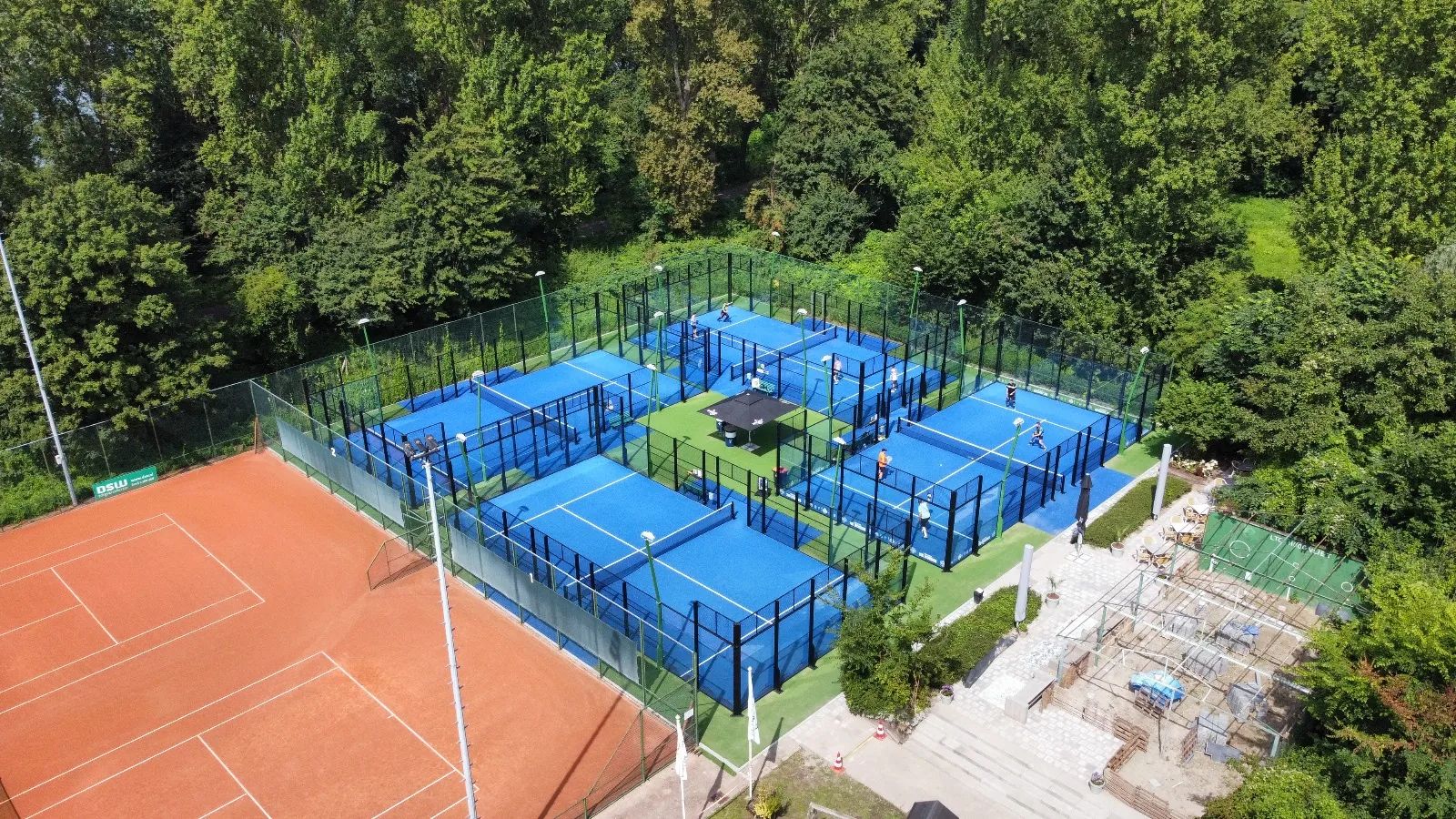
For an outdoor padel court next to homes, two main categories of noise measures are available: source measures applied directly on or at the padel cage, and screening measures such as noise embankments placed between the court and the surroundings. Which measure is suitable depends entirely on the location, the distance to homes and the results of an independent acoustic study.
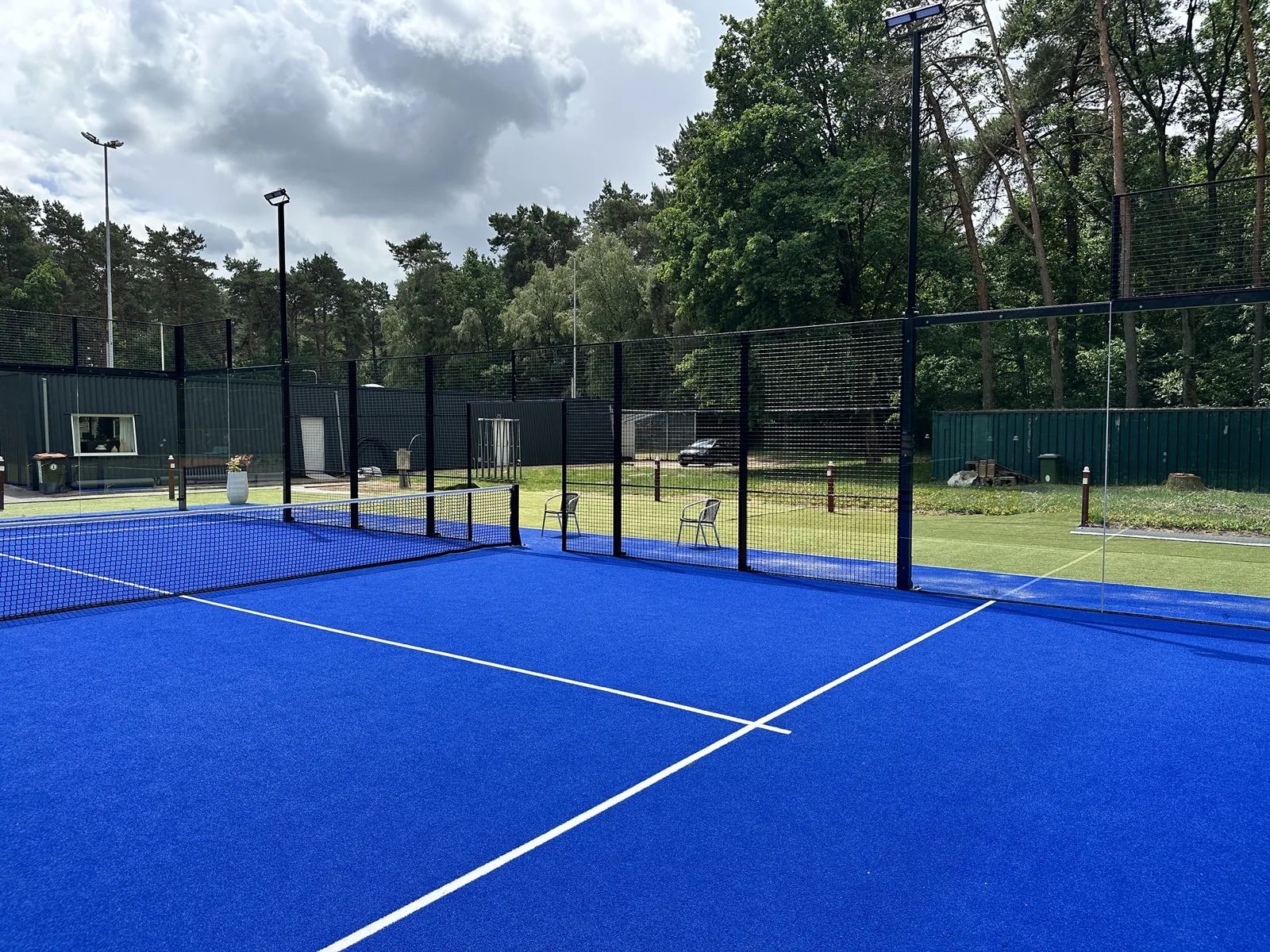
Sound-dampening panels are a widely used source measure. They are fixed to the outside of the fencing of the cage structure and ensure that sound is absorbed at the source instead of being reflected. This limits the spread of sound to the surroundings without changing the playing space.
An acoustic solution for padel also includes freestanding noise embankments. These are placed next to or around the court and can be built up to a height of six to eight metres. They are particularly suitable when noise has to be limited in one specific direction, for example towards a residential area. In some situations a combination of panels and a noise embankment is the most effective approach, in which the embankment can be built lower thanks to the additional effect of the panels.
Adjustments to the site layout, such as repositioning courts or adding green strips, can also help limit noise nuisance. These options are generally assessed in conjunction with the other measures and the space available at the location.
How do sound-dampening panels work on a padel court?
Sound-dampening panels work as a source measure: they are placed directly on the padel cage and absorb part of the sound produced by racket-to-ball contact and by the ball hitting glass or fencing. Because the noise is tackled at the source, it spreads less far into the surroundings. How well they work depends on the position, the number of panels and the specific conditions of the location.
The panels generally consist of a frame filled with sound-absorbing material such as rock wool, a mineral fibre with an open structure that absorbs sound energy. They are fixed to the outside of the fencing, so the inside of the court remains free and the dynamics of play are preserved.
In a practical measurement at LTC Hofgeest in Velserbroek, an indicative noise reduction of around 3 dB(A) was measured within the configuration studied, after correcting for background noise. This value applies only to that specific situation and must not be used as a general performance benchmark. Every location has different conditions, so the final results may differ.
The panels can be applied on one side of the court, on several sides, or in the lower and upper metres of the cage. They can also be applied afterwards to existing courts, provided the structure is recalculated for this.
Do I need an acoustic study for an outdoor padel court?
For an outdoor padel court next to homes, an acoustic study is in most cases mandatory as part of the permit application. Municipalities request this study to assess whether the new situation meets the applicable noise standards. Even when a permit is not formally required, an acoustic study can be valuable for addressing objections from local residents at an early stage.
Padel produces more noise than tennis. The ball hitting glass and steel, in combination with the cage structure that can act as a sound box, results in an average sound power level of around 91 dB. That is roughly 10 dB more than with tennis. At locations near residential buildings, that difference is noticeable to local residents.
An independent acoustic consultancy maps out the existing noise situation, determines the relevant assessment points and calculates various scenarios. On that basis it is assessed which combination of measures is needed to meet the applicable requirements. We do not carry out acoustic studies ourselves. Our role consists of supplying technical product specifications, structural data and information about the available noise measures, so that these can be correctly included in the acoustic firm’s calculations.
Cooperation between the client, the municipality, the acoustic consultant and the structural engineer ensures that noise measures can be included already during the design. That avoids costly modifications afterwards.
What effect do noise panels have on the structure of the padel court?
Sound-dampening panels have a direct effect on the structural load of the padel court. Because the panels partly close off the fencing, wind permeability decreases. This means the structure takes up more wind pressure than an open cage structure. The steel structure has to be recalculated for this and, in most cases, reinforced.
The reinforcement can consist of heavier posts, additional columns or adapted connections, depending on the position of the panels, the number of sides on which they are applied and the wind zone of the location. Open terrain, coastal locations and locations near tall buildings call for a specific structural assessment.
This is precisely why sound-dampening panels are preferably included already in the engineering phase. When the structure is designed from the outset with the extra load, the wind force can be safely transferred to the foundation. Application to existing courts is also possible, but always requires a structural reassessment before the panels are fitted.
More information about the technical background of structure and wind load helps you understand which choices are made during the engineering phase.
How does a permit process work for an outdoor padel court next to homes?
For an outdoor padel court next to homes, an environmental permit is almost always mandatory. The application is assessed by the municipality and generally includes several technical justifications. The processing time averages eight to twelve weeks, depending on the municipality and the complexity of the project.
In most cases the permit application includes the following documents:
- Structural calculations in accordance with the Bouwbesluit (Dutch Building Decree)
- An acoustic study
- A lighting study
- A site plan
- Sometimes an ecological or archaeological study
On the basis of these documents, the municipality assesses whether the project meets the applicable regulations. When local residents object, the procedure can take longer. A well-substantiated application with an independent acoustic report increases the chance of a smooth permit process.
We can guide and coordinate the entire process, including the zoning plan check, consultation with the municipality, coordination of the noise and lighting studies, supplying structural calculations and support with any objection procedures. You can read more about what is involved in a permit for a padel court on the corresponding page.
Building without a permit is not an option. The municipality can halt the project, impose fines or require the cage structure to be removed. That risk never outweighs the time saved.
What is the difference between a noise barrier and sound-dampening panels?
The main difference is the position relative to the sound source. Sound-dampening panels are placed directly on the padel cage and tackle the noise at the source. A noise barrier or noise embankment is a freestanding structure placed next to or around the court that intercepts the sound after it has left the court. The two measures work differently and can be applied in different situations.
Sound-dampening panels as a source measure
Panels are fixed to the outside of the fencing of the cage structure. They absorb sound directly at the source, so less noise spreads to the surroundings. One advantage of this approach is the limited space required. The panels need no extra ground area outside the court. A point of attention is that the structure has to be calculated for the extra wind load that the panels cause.
Noise embankments as a screening measure
An outdoor padel court next to homes can also be fitted with a freestanding noise embankment. This embankment is placed between the court and the homes and blocks the sound wave after it has left the court. Noise embankments can be built up to a height of six to eight metres and can be applied over tens of metres. They do require a structural calculation, soil sounding data and, in almost all cases, an environmental permit, because they are regarded as a structure.
In many situations a combination of both measures is the most effective. The panels reduce the noise at the source, so the noise embankment can be built lower. That saves costs and in some cases makes the permit easier to obtain. Which approach is most suitable is determined by the independent acoustic study.
When is an outdoor padel project next to homes technically feasible?
An outdoor padel project next to homes is technically feasible when the noise load on the surrounding homes can be brought within the applicable standards, the structure meets the wind load requirements of the location and the foundation is suitable for the soil conditions on site. Whether that is the case can only be established after a site analysis and an independent acoustic study.
Factors that determine feasibility include:
- The distance between the padel courts and the nearest homes
- The orientation of the courts relative to the homes
- The presence of existing buildings, trees or other obstacles that screen sound
- The wind zone of the location and the space available for noise measures
- The soil conditions and the foundation options
- The requirements of the municipality and the results of the acoustic study
Every location is different. A project that is feasible at one location without additional measures may require a combination of sound-dampening panels, a noise embankment and adjustments to the site layout at another. The assessment always starts with the location itself.
On every project we work with structural engineers, acoustic consultants and municipalities to determine which combination of measures is technically feasible and fits the permit conditions. You can read more about having a padel court built and the steps involved on the construction page.
A custom-built padel court in which the structure, noise measures and foundation are aligned with each other from the design stage avoids costly modifications afterwards and increases the chance of a successful permit process.
Not sure whether outdoor padel is feasible at your location?
We are happy to help you think through the court configuration, structural preparation and possible noise measures. Together with your acoustic consultant, we look at which solution is technically feasible and suits the project. Get in touch for an initial exploration via our page on acoustic solutions for padel.
Frequently asked questions
How early in the planning process should I engage an acoustic consultant?
It is strongly advisable to involve an acoustic consultant already in the initiative phase, before final choices are made about the location, court orientation or structure. Early acoustic advice prevents you from having to make costly modifications later to a design that has already been fixed. In addition, the results of the study can be included directly in the permit application, which can considerably shorten the permit process.
What are the most common mistakes when building an outdoor padel court next to homes?
A common mistake is starting construction before all permits have been granted, which can lead to the project being halted or even mandatory demolition of the structure. Another frequent slip is adding sound-dampening panels afterwards to a structure that has not been structurally calculated for them, which leads to extra costs for reassessment and possible reinforcement. Finally, clients regularly underestimate the impact of court orientation on the noise load of nearby homes, whereas a simple adjustment in the design phase can prevent this problem.
How much extra do sound-dampening panels and noise embankments cost?
The costs depend strongly on the location, the number of panels required or the length and height of the noise embankment, and the wind zone of the site. Sound-dampening panels on one side of the court are generally a relatively limited investment, whereas a freestanding noise embankment of six to eight metres over several tens of metres is a considerably larger cost item. Always have both options calculated in combination with the structural requirements of your specific location, so that you get a realistic picture of the total project costs.
Can local residents object after the permit has already been granted?
Yes, after the environmental permit has been granted, local residents have a statutory objection period within which they can submit an objection to the municipality. If the objection is declared well-founded, this can lead to additional requirements or, in exceptional cases, to withdrawal of the permit. A well-substantiated permit application with an independent acoustic report and transparent communication towards local residents before the application considerably reduces the chance of successful objection procedures.
Is it possible to retrofit noise measures to existing padel courts?
Yes, both sound-dampening panels and freestanding noise embankments can be applied afterwards to existing padel courts. For sound-dampening panels, a structural reassessment is always required, because the extra wind load affects the existing steel structure and foundation. With noise embankments, a new environmental permit is also needed in almost all cases, because they are regarded as an independent structure.
What role does the orientation of the padel courts play in limiting noise nuisance?
The orientation of the courts relative to nearby homes has a direct influence on the noise load. By positioning the courts so that the short sides, where most noise is released through the impact of the shots, do not face homes directly, the noise load can be reduced already in the design phase. This is a simple and cost-effective measure that, in combination with other noise solutions, makes the overall approach more efficient.
On average, how long does it take for an outdoor padel project to be fully realised, from initial exploration to completion?
The total lead time of an outdoor padel project next to homes generally varies between six and eighteen months, depending on the complexity of the location and the permit process. The permit procedure alone takes eight to twelve weeks on average, but with objection procedures this can increase. Good preparation, in which the acoustic study, structural calculations and zoning plan check are started early, is the most effective way to keep the total lead time under control.