Blog · 8 September 2026 · 11 min read
Why is noise dampening at the source so effective in padel?
Noise dampening at the source tackles padel noise before it spreads. Find out how panels with an 8 dB absorption index simplify your permit.
In this article
- What makes a source measure more effective than a noise barrier?
- How do sound-dampening panels work on a padel court?
- How many dB of reduction does a source measure offer in padel?
- What effect do sound-dampening panels have on the structure?
- When is a source measure mandatory for an outdoor padel court?
- What is the difference between sound-dampening panels and a noise embankment?
- Does every padel court with noise problems benefit from a source measure?
- Not sure whether outdoor padel is feasible at your location?
- Frequently asked questions
Noise dampening at the source is effective in padel because the sound is tackled where it arises: directly at the cage structure. As a result, noise no longer has to be stopped over large distances by a separate barrier or embankment. In many situations this makes a source measure more compact, technically more effective and easier to integrate into the design of a padel court. Which solution is most suitable differs per location. The questions below help you make the right assessment.
What makes a source measure more effective than a noise barrier?
A source measure tackles noise where it is released, namely at the cage structure itself. A noise barrier stands at a distance from the source and tries to block sound after it has already been radiated. Because sound spreads in all directions, a barrier has to be big enough to interrupt that spread effectively. A source measure does not have that problem.
In padel, most of the noise is released by the impact of the ball on the glass and the mesh of the cage structure. The cage acts as a kind of sound box that amplifies the sound and radiates it outwards. When you fit sound-dampening panels directly to that cage structure, a large part of the sound is absorbed before it can spread.
A noise barrier has to compensate for this by blocking sound at a distance. That calls for larger dimensions, a heavier structure and often more space on the site. At locations close to homes or with limited space, a source measure is therefore more practical in many situations. Moreover, in some cases a source measure can reduce the required height of an additional noise embankment, which can also simplify the permit process.
How do sound-dampening panels work on a padel court?
Sound-dampening panels are fixed to the outside of the mesh of the cage structure. They absorb sound instead of reflecting it back. As a result, the amount of sound reaching the surroundings decreases, while the dynamics of play inside the court are preserved.
The panels have been independently tested in an acoustic laboratory. These tests show that they fall into sound absorption class A, with an absorption value of 0.80 and an absorption index of 8 dB. The airborne sound insulation is Rw 22 dB, with a sound insulation index of 19 dB. In practice this results in an audible reduction at distances of around 40 to 100 metres, depending on the situation.
The panels can be applied in different ways: on one side of the court facing homes, in the lower or upper metres of the cage, or around several courts at once. They can also be applied afterwards to existing padel courts, provided the structure is suitable for it or is modified. You can read more about the application on the page about acoustic solutions for padel.
How many dB of reduction does a source measure offer in padel?
Laboratory tests show an absorption index of 8 dB and a sound insulation index of 19 dB for the panels tested. In practice the measured reduction is lower, because environmental factors such as background noise, reflections and the specific configuration of the location play a major role.
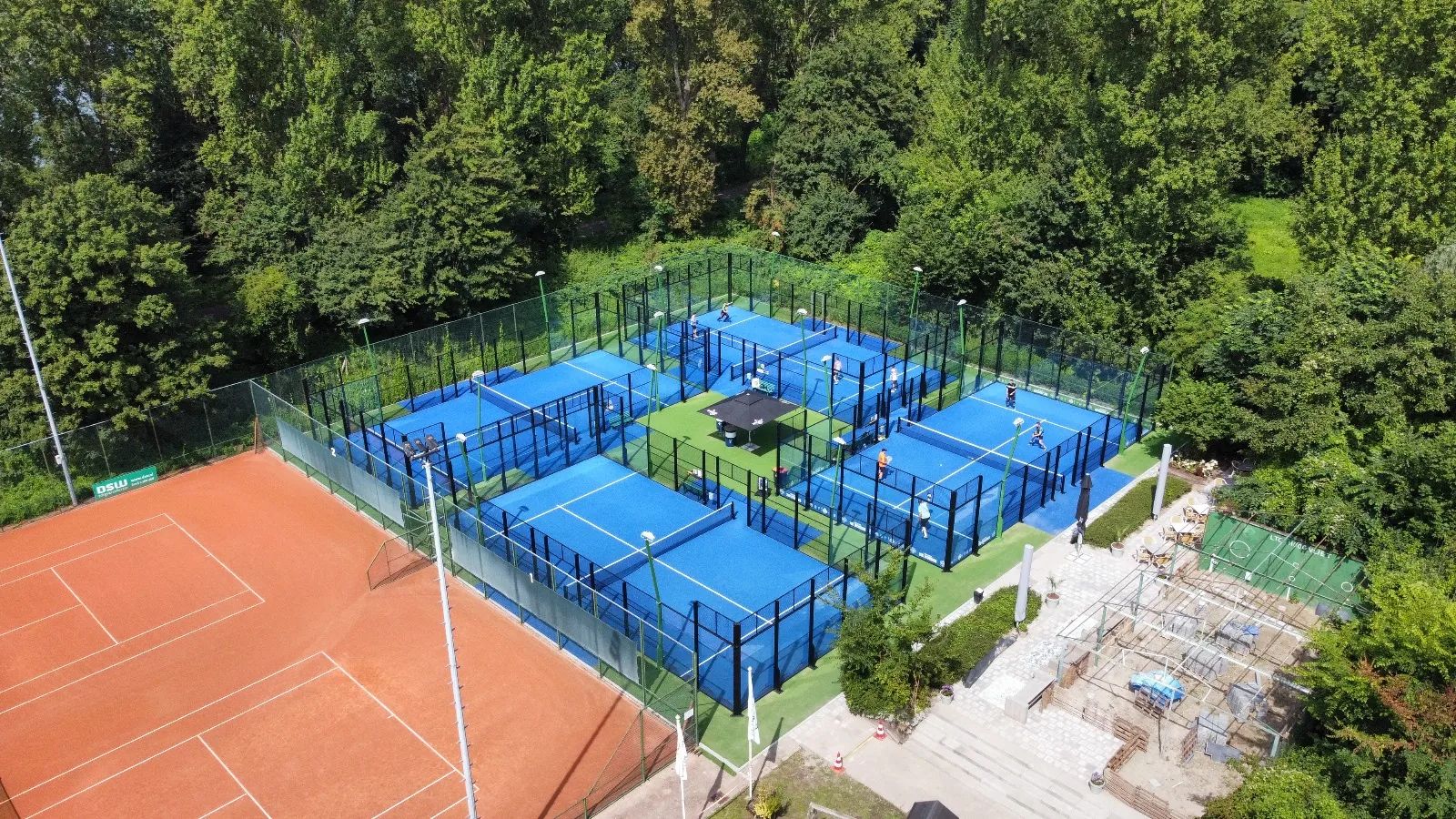
In a practical measurement at LTC Hofgeest, an indicative noise reduction of around 3 dB(A) was measured within the configuration studied, after correcting for background noise. This is a relevant result: a reduction of 3 dB(A) is experienced by the human ear as a clearly audible decrease in the sound level. Even so, these results apply only to the situation studied and must not be used as a general product guarantee.
The final reduction at another location depends on factors such as the distance to homes, the surroundings, the configuration of the panels, the wind direction and the background noise levels on site. An independent acoustic consultant determines, on the basis of a project-specific study, which reduction is achievable in your situation and which measures are needed for it.
What effect do sound-dampening panels have on the structure?
Sound-dampening panels reduce the wind permeability of the cage structure. As a result the structure catches more wind, which leads to a higher wind load on the steel structure, the connections and the foundation. This has direct structural consequences that have to be calculated during the engineering phase.
In practice this means that in many cases the steel structure has to be reinforced. That can consist of heavier posts, additional columns or adapted connections. The exact modifications depend on the wind zone, the position and surface area of the panels and the specific configuration of the court.
When panels are integrated into a new project, this can already be taken into account in the design phase. With existing courts, a structural assessment is necessary before panels are fitted. A structural engineer then has to assess whether the existing structure is suitable or needs to be modified. You can find more about the relationship between structure and wind load on the relevant page.
We produce the steel structures ourselves, which makes it possible to adapt columns, connections and base plates project by project when additional requirements arise from noise measures or a higher wind load. That gives more technical freedom than with an imported standard court.
When is a source measure mandatory for an outdoor padel court?
A source measure is not legally mandatory, but it may be necessary to meet the noise standards that apply to your location. Whether a source measure is required depends on the results of an acoustic study and the requirements the municipality sets in the context of the environmental permit.
Padel produces on average more noise than tennis. The sound power level of a padel court averages around 91 dB, which is about 10 dB more than with tennis. At locations close to residential buildings, an acoustic study is almost always mandatory as part of the permit application. That study shows whether the noise load on the façades of nearby homes falls within the applicable standards.
When the calculated noise load is too high, something has to change. That can be a source measure, a noise embankment, an adjustment to the site layout or a combination of measures. Which measure is required is determined by the acoustic consultant on the basis of the study. The municipality then assesses whether the proposed solution is sufficient for the permit to be granted. You can read more about applying for a permit for a padel court on the permit page.
What is the difference between sound-dampening panels and a noise embankment?
Sound-dampening panels are a source measure: they are placed directly on the cage structure and absorb sound where it is released. A noise embankment is a freestanding structure placed next to or around the court that blocks sound towards homes after it has already been radiated.
The two solutions work differently and have different areas of application. Sound-dampening panels are compact, integrated into the court and need no extra space on the site. They are therefore suitable for locations where space is limited. A noise embankment can bridge greater distances and is effective when sound from several sources has to be stopped towards one specific side.
In many situations a combination of both is the most effective. The panels reduce the noise at the source, so the noise embankment can be built lower. A lower embankment is structurally simpler, takes up less space and can simplify the permit procedure. Which combination is suitable differs per location and is determined on the basis of an acoustic study. On the page about noise embankments around an outdoor padel court you will find more information about the use of freestanding noise structures.
Does every padel court with noise problems benefit from a source measure?
Not every situation calls for a source measure. Whether sound-dampening panels are the right solution depends on the location, the distance to homes, the direction of the noise nuisance and the results of an acoustic study. A source measure is one of the possible measures, not automatically the best choice in every situation.
At locations where noise is a problem in one specific direction, targeted placement of panels on that side of the court can already make a relevant contribution. At locations where noise is a problem from several directions, or where the distance to homes is very small, a combination of measures may be needed.
There are also situations in which a source measure is less suitable. When the existing cage structure is structurally unsuitable for the extra wind load and reinforcement is not feasible, or when the required reduction is greater than what panels can offer, other or additional measures are needed. An independent acoustic consultant and a structural engineer can jointly assess which approach is technically feasible and permit-feasible in your situation.
We support clients by thinking along on the technical possibilities at an early stage, working with acoustic consultants and supplying the engineering needed to carry out calculations correctly. You can read more about our approach on the page about noise solutions for padel courts.
Not sure whether outdoor padel is feasible at your location?
We are happy to help you think through the court configuration, structural preparation and possible noise measures. Together with your acoustic consultant, we look at which solution is technically feasible and suits the project. Get in touch via the page on acoustic solutions for padel for an initial, no-obligation exploration.
Frequently asked questions
Can I also have sound-dampening panels fitted afterwards to an existing padel court?
Yes, in principle sound-dampening panels can also be applied afterwards to existing padel courts. The condition is that the existing cage structure is structurally suitable for the extra wind load that the panels cause, or is made suitable. A structural engineer must assess the existing situation before panels are fitted. If the structure needs reinforcement, that can consist of heavier posts, extra columns or adapted connections.
How early in the planning process should I think about noise measures?
It is strongly advisable to include noise measures already in the design phase, before the permit application. When an acoustic study and a structural assessment are carried out early in the process, measures such as sound-dampening panels or a noise embankment can be integrated directly into the design. That avoids expensive modifications afterwards and speeds up the permit procedure, because the municipality receives a complete and well-substantiated file.
Which parties do I need to realise a good noise solution for my padel court?
For a complete noise solution you generally work with three parties: an independent acoustic consultant who carries out the noise study and determines the required reduction, a structural engineer who calculates the wind load and structural modifications, and a construction partner or supplier who provides the technical engineering and execution. It is an advantage if these parties work together early in the project, so that the acoustic requirements and structural possibilities are aligned.
What if the calculated noise reduction of panels is not enough for the permit?
If sound-dampening panels alone do not offer enough reduction to meet the municipal noise standards, a combination of measures is needed. Think of supplementing them with a noise embankment, adjusting the site layout or restricting opening hours. The acoustic consultant calculates which combination of measures delivers the required reduction. An advantage of the source measure here is that the required noise embankment can be built lower and more compact.
Do sound-dampening panels affect playing comfort or the experience of the court?
The panels are fixed to the outside of the mesh and have no effect on the playing surface or the dynamics of play inside the court. In practice, players notice little difference in playing comfort. The acoustics inside the cage may change somewhat because less sound is reflected, which some players find more pleasant.
Are there maintenance requirements for sound-dampening panels on a padel court?
Sound-dampening panels are designed for outdoor use and generally require little maintenance. Periodic inspection of the fixings is advisable, especially after periods of strong wind, to check that the connections to the cage structure are intact. Cleaning may be needed to keep the absorption performance up to standard, depending on the surroundings and the degree of soiling.
Do I have to apply for a separate permit to fit sound-dampening panels?
Whether a separate permit is needed depends on the municipality and the specific situation. In many cases sound-dampening panels fall under the environmental permit for the padel court itself, especially when they were already included in the permit application. When panels are added afterwards to an existing permitted court, an amendment permit or notification may be needed. It is wise to check this beforehand with the municipality or through the acoustic consultant who is guiding the file.