Blog · 30 August 2026 · 11 min read
Why does padel sound different from tennis?
Padel sounds different from tennis because of glass, steel and impulsive noise of up to 91 dB. Discover the causes and effective noise measures for your padel court.
In this article
- Which materials cause the hard sound in padel?
- How does the glass wall amplify the sound of a padel court?
- Why does an outdoor padel court sound louder than an indoor court?
- Which sound frequencies does a padel court produce?
- How far does the sound of a padel court carry?
- Are there structural measures that reduce padel noise?
- Not sure whether outdoor padel is feasible at your location?
- Frequently asked questions
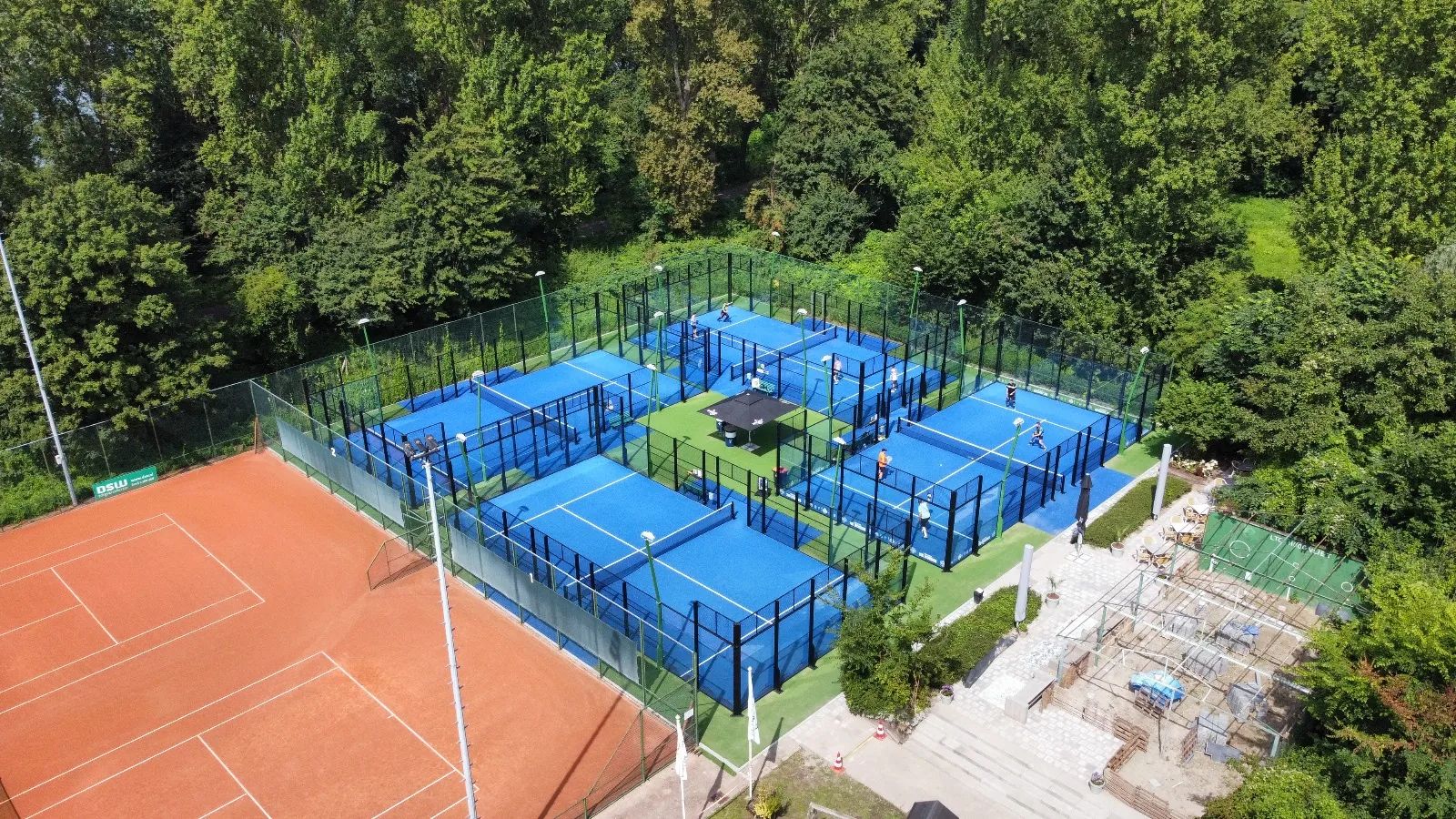
Padel sounds different from tennis because the cage structure of a padel court amplifies and reflects the sound. Whereas in tennis the ball is hit on an open court, a padel court is surrounded by glass and steel. That combination produces a different sound character: shorter, sharper and repetitive. How exactly this works, which materials play a role and what it means for acoustic solutions for padel, you can read below.
Which materials cause the hard sound in padel?
The hard sound in padel is caused by the combination of a hard ball, a stiff racket and hard surfaces in the direct vicinity of the court. A padel court consists of steel, toughened safety glass and steel fencing. None of these materials absorbs much sound. Instead, they reflect the sound back into the playing area and out into the surroundings.
The padel ball is made of rubber and has a relatively hard shell. On contact with the racket, the glass or the fencing, a short, sharp crack is produced. This type of sound is also called impulsive noise: it consists of clearly recognisable peaks that local residents find disturbing, even at relatively low average noise levels.
The racket also plays a role. Modern padel rackets have a stiff core of foam or carbon. That stiffness results in a hard, direct transfer of energy to the ball. The result is a higher peak value on contact, which reinforces the impulsive character of the sound.
By comparison: in tennis the strung racket is somewhat more damping, the ball is less hard and the surroundings are completely open. There are no walls to reflect the sound. As a result the sound spreads more quickly and sounds less intrusive at a distance.
How does the glass wall amplify the sound of a padel court?
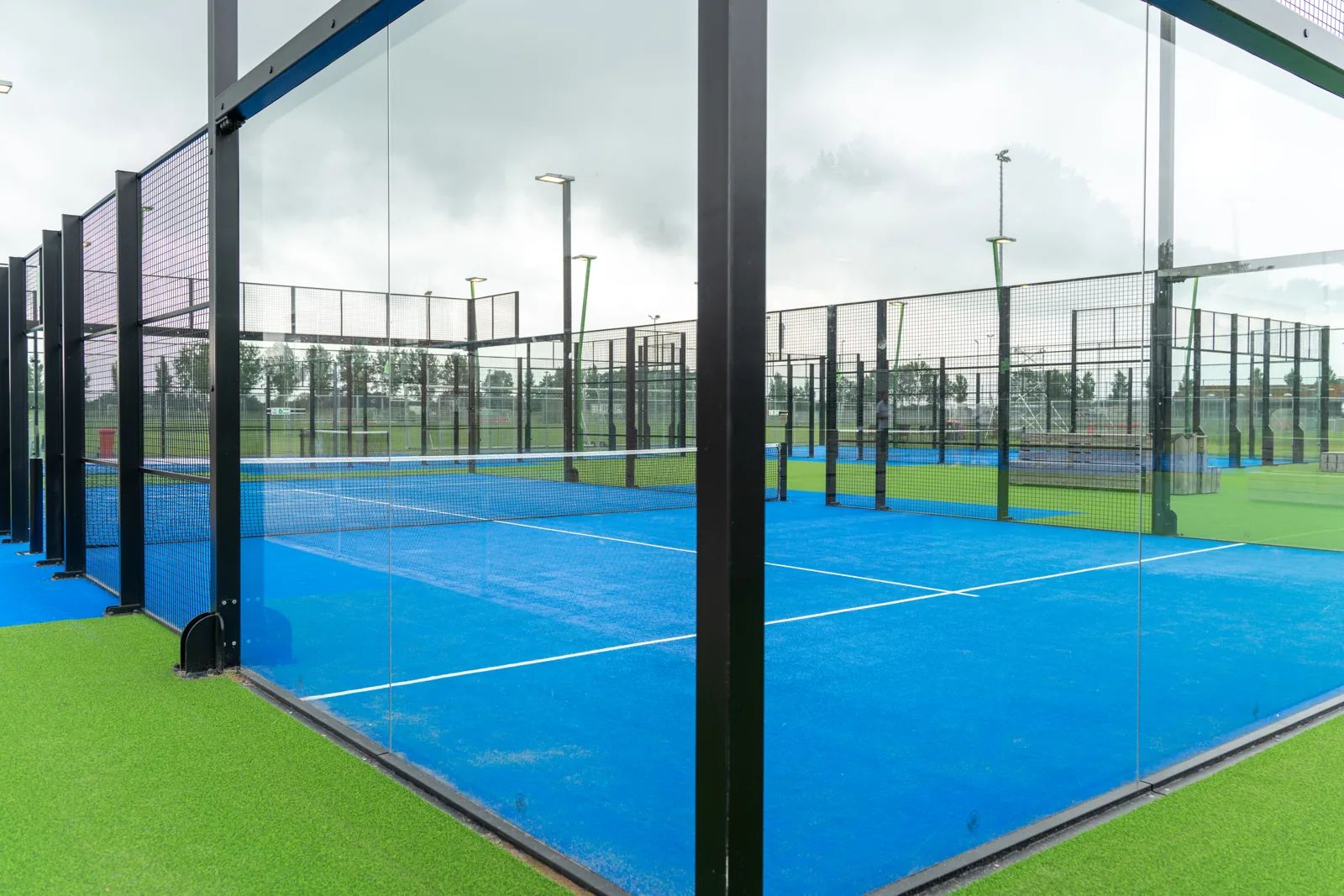
The glass walls of a padel court amplify the sound because they act as hard, reflective surfaces. When the ball hits the glass, a loud, sharp crack is produced. The glass absorbs virtually no sound and sends the sound wave straight back into the surroundings. This makes glass contact the largest noise source on a padel court.
Toughened safety glass, as used in padel courts, is a dense and stiff construction. These properties are favourable for safety and durability, but unfavourable for noise. Open fencing lets sound waves partly pass through. Glass does not: it reflects the energy almost completely.
Moreover, the cage structure functions as a kind of resonance box. The steel structure and the glass together form an enclosed space within which sound can be reflected several times before it escapes. This extends the audible duration of every contact moment and makes the sound more intrusive than on an open playing field.
This is also the reason why sound-absorbing panels, as a source measure, are placed directly on the cage structure. By mounting absorbing material on the outside of the fencing, part of the sound waves is intercepted at the source before they spread further. You can read more about this approach on the page about acoustic solutions for padel.
Why does an outdoor padel court sound louder than an indoor court?
An outdoor padel court sounds louder than an indoor court because there is no enclosing hall to capture and dampen the sound. Indoors, the sound is absorbed by the walls, ceiling and floor of the hall. Outdoors, the sound spreads freely in all directions, with no obstacles to dampen it.
With an indoor padel court, the hall itself contributes to the acoustic situation. Walls of concrete or metal can also reflect, but the enclosed space limits the spread to the outside. The sound largely stays inside the hall. Local residents notice little of it.
With an outdoor padel court there is no enclosing structure. The sound of racket, ball and glass spreads directly into the surroundings. On open sites, such as sports parks on the edge of residential neighbourhoods, the sound can be audible over a considerable distance. The absence of natural screening amplifies this effect.
Wind direction also plays a role. Wind can carry sound towards homes, even if the distance would be sufficient in itself. This makes the choice of location and the orientation of the courts relevant when assessing possible noise nuisance. When building an outdoor padel court, this is taken into account at an early stage.
Which sound frequencies does a padel court produce?
A padel court produces mainly noise in the mid and higher frequency bands. These are impulsive sounds: short, sharp peaks that arise when the ball contacts the racket, the glass or the fencing. These frequencies are clearly audible to the human ear and are experienced as disturbing, even at relatively low average noise levels.
Impulsive noise differs from continuous noise in that its character is repetitive and unexpected. Local residents find this more annoying than a constant background tone, such as the sound of a busy road. Municipalities take this into account when assessing noise nuisance: not only the average noise load is assessed, but also the peak values and the frequency at which peaks occur.
The sound power level of a padel court is estimated in our knowledge base at around 91 dB. By comparison, for tennis this is on average about 10 dB lower. This difference is significant, because an increase of 10 dB is perceived by the human ear as roughly twice as loud. This explains why padel provokes more reactions from local residents than tennis, even with a comparable playing time and location.
How far does the sound of a padel court carry?
How far the sound of a padel court carries depends on several factors and differs per location. Factors such as the distance to homes, the height of surrounding buildings, the presence of existing noise sources and the position of the sports park together determine how the sound is experienced. No universal distance can be given beyond which padel noise is no longer audible.
On open sites without natural screening, the sound of a padel court can still be audible at a great distance. In urban environments with buildings around the sports park, the sound is dampened more quickly by reflections and absorption by buildings. A location bordering a residential neighbourhood therefore requires a different assessment than a sports park in an industrial area.
The number of courts also plays a role. A single padel court produces a different noise picture than a padel park with four or six courts in use at the same time. The cumulative noise load increases as more courts are in use simultaneously. The spread of the courts, the distance between them and their orientation relative to homes influence the overall noise picture.
Intensity of use and opening hours are equally relevant. Evening use and tournaments lead to a higher noise load than recreational use during the day. Municipalities assess not only the maximum noise production, but also the duration and frequency with which noise occurs. Because of all these variables, an independent acoustic study is necessary in many situations for outdoor padel projects before a permit is granted.
Are there structural measures that reduce padel noise?
Yes, there are structural measures that can reduce padel noise. The most commonly applied are sound-absorbing panels placed directly on the cage structure and free-standing noise barriers positioned next to the court. Which measure is suitable depends on the project-specific situation and the results of an independent acoustic study.
Sound-absorbing panels as a source measure
Sound-absorbing panels are fixed to the outside of the fencing of the padel cage. They work as a source measure: the sound is intercepted as close as possible to its origin, before it spreads over a greater distance. The panels we use in practice consist of rock wool with a density of 160 kilograms per cubic metre, finished with plastic mesh and a metal profile. They are mounted gap-free, because small openings can negatively affect the acoustic performance.
An important point of attention with this measure is the structural consequence. Sound-absorbing panels reduce the wind permeability of the cage structure. As a result, the wind load on the steel structure increases. This means the structure must be recalculated for this extra load before panels are mounted. For existing courts a structural assessment is necessary. For new courts this can already be taken into account in the engineering phase, which prevents costly modifications afterwards.
Noise barriers as an additional or alternative measure
A noise barrier is a free-standing structure placed next to or around the padel court. Unlike panels, a noise barrier works at a greater distance from the source. Noise barriers can be built to heights of six to eight metres and tens of metres long. They are particularly suitable when homes are located on one specific side of the sports park.
A noise barrier requires a structural calculation, soil sounding data and, in almost all cases, an environmental permit. At existing sports parks the space available for a noise barrier is sometimes limited. Sound-absorbing panels on the cage structure take up less space, which can be a practical advantage at busy locations. You can read more about the differences between the two solutions on the page about acoustic solutions for padel.
In some situations a combination of both measures is the most effective. In that case a noise barrier can be built lower thanks to the complementary effect of the panels, which can save costs and simplify the permitting process. The final configuration is always determined on the basis of the acoustic study, the location and the structural conditions.
We supply the technical product specifications, structural data and engineering that an acoustic consultant needs to carry out calculations correctly. On the basis of those results, a structure can then be developed that is suitable for the recommended measures. That is also the reason why we always calculate the structure and wind load on a project-specific basis.
Not sure whether outdoor padel is feasible at your location?
We are happy to think along with you on the court configuration, structural preparation and possible noise measures. Together with your acoustic consultant, we look at which solution is technically feasible and suits the project. Get in touch via the page on acoustic solutions for padel for an initial, no-obligation exploration.
Frequently asked questions
Do I need a permit to fit sound-absorbing panels on an existing padel court?
This depends on the municipality and the specific situation. In many cases, sound-absorbing panels on an existing cage structure fall under permit-free building, but a noise barrier of more than two metres almost always requires an environmental permit. Always consult your municipality or an environmental law specialist before you start the work, so that you are not faced with surprises.
When in the construction process do I need to take noise into account, and can I still solve it afterwards?
It is best to include noise in the engineering phase, before the court is built. At that point, structural modifications for extra wind load can be included in the design at no extra cost. Afterwards, solutions are still possible, but they require a structural reassessment of the existing steel structure and can turn out considerably more expensive.
How many dB of reduction can I realistically expect from sound-absorbing panels or a noise barrier?
The exact reduction depends strongly on the location, the height and the type of measure, and can only be determined reliably through an independent acoustic study. As a rough indication: well-mounted sound-absorbing panels can deliver a reduction of a few dB at the source, while a combination of panels and a noise barrier can in favourable cases achieve 10 dB or more. Always have this calculated by a certified acoustic consultant.
What is a common mistake when tackling noise nuisance around padel courts?
A common mistake is installing measures without a prior acoustic study, so that the solution chosen does not match the actual noise situation. Another common mistake is not mounting sound-absorbing panels gap-free: even small openings in the structure can significantly reduce the acoustic performance. Good preparation and correct installation are at least as important as choosing the right product.
Does it matter on which side of the padel court the sound-absorbing panels are placed?
Yes, placement makes a big difference. Panels are ideally placed on the side(s) facing the nearest homes or sensitive uses. Based on the acoustic study and the position of the court relative to the surroundings, it is determined which sides have priority. Full enclosure is not always necessary and not always structurally feasible, so a targeted approach can be both more effective and more cost-efficient.
Are there also requirements from the Building Decree or the Activities Decree for padel noise?
Outdoor padel courts generally fall under the rules of the Activities Decree on environmental management (Activiteitenbesluit milieubeheer), which sets limit values for long-term average noise levels and maximum peak values on the facades of nearby homes. Municipalities can impose additional tailor-made requirements on the basis of an acoustic report. It is wise to contact the municipality at an early stage to find out which standards apply specifically to your location.
Can I, as a private individual or sports club, have an acoustic study carried out myself, or is that something for large project developers?
An acoustic study is accessible to anyone who wants to build a padel court or already operates one, regardless of the scale of the project. Both small sports clubs and large padel parks have such studies carried out. The cost of an acoustic report is relatively limited in proportion to the total investment in a court, and can prevent costly modifications afterwards or legal proceedings with local residents.