Blog · 23 September 2026 · 13 min read
Why does a padel court make so much noise?
Padel produces an average of 91 dB, 10 dB more than tennis. Discover the causes, noise standards and effective measures for your outdoor location.

In this article
- Which sounds does a padel court produce exactly?
- Why is padel noise louder than tennis noise?
- How far does the noise from a padel court carry?
- Which factors determine how much nuisance local residents experience?
- What are the legal noise standards for padel courts in the Netherlands?
- Which measures reduce the noise from a padel court?
- Do you need an acoustic study for an outdoor padel court?
- Not sure whether outdoor padel is feasible at your location?
- Frequently asked questions
A padel court produces more noise than most people expect beforehand. The combination of a hard ball, a stiff racket and a closed steel structure with glass walls results in a sound power level of approximately 91 dB on average, which is roughly 10 dB more than with tennis.
This makes noise nuisance from a padel court one of the most common challenges when building outdoor padel venues, especially when homes are nearby. The questions below give you a clear picture of how padel noise arises, how far it carries and which measures are available.
Which sounds does a padel court produce exactly?
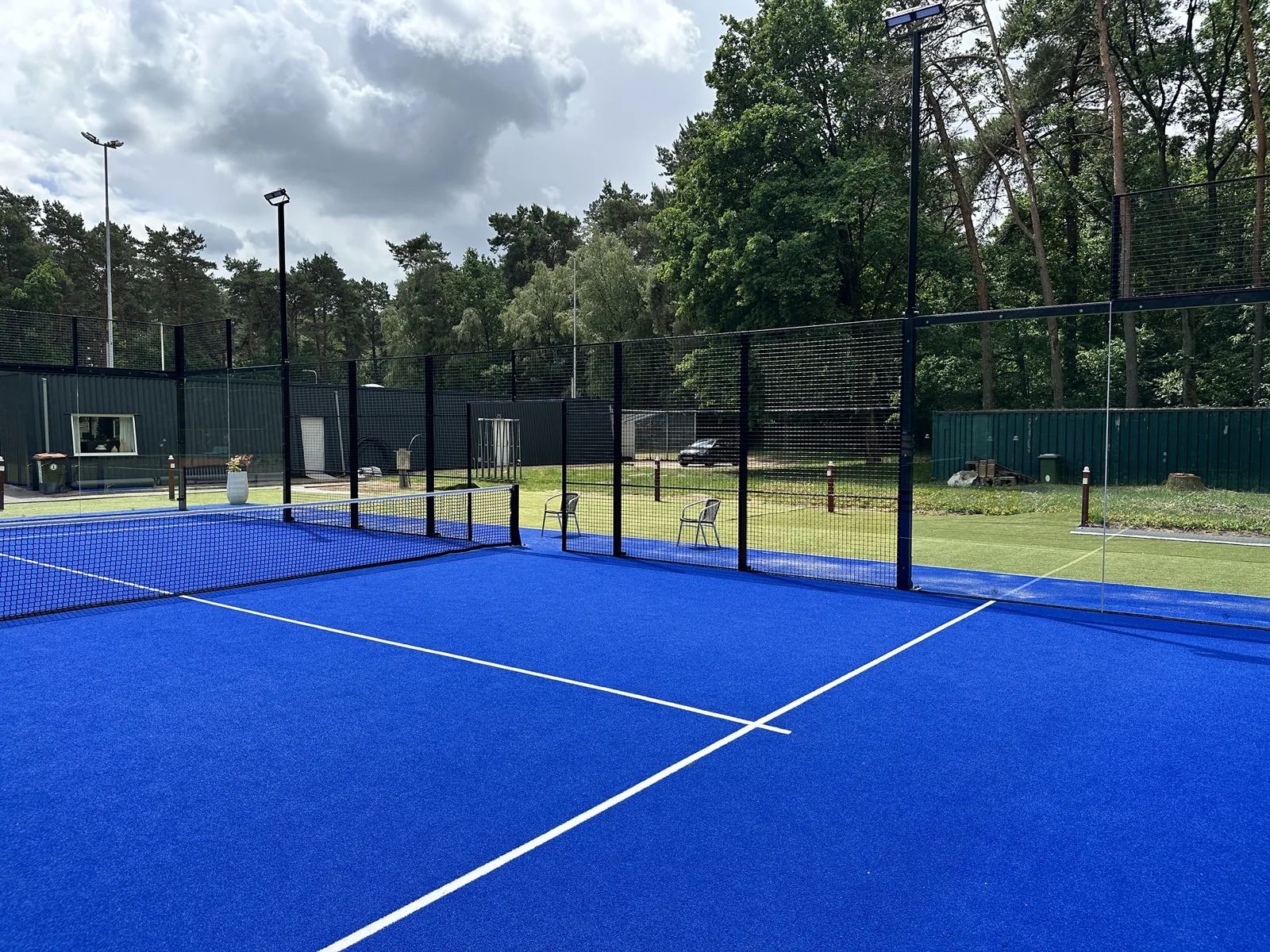
A padel court produces two kinds of sound: the contact sound of the ball on the racket and the impact sound of the ball on the glass walls and the metal mesh of the cage structure. The second type by far determines the noise load on the surroundings the most. The closed construction of the padel cage reinforces this effect, because sound is reflected and escapes via several surfaces.
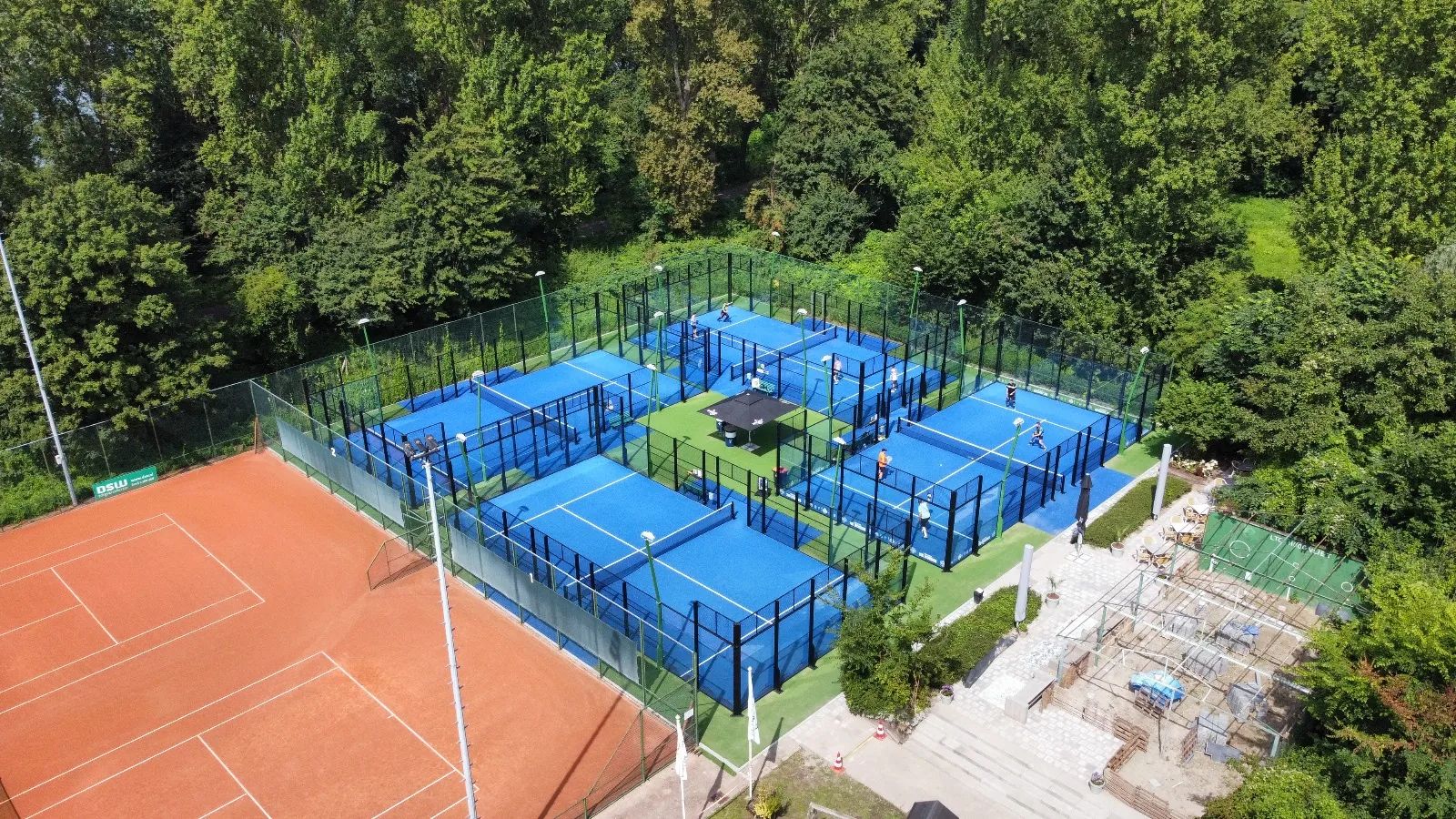
In tennis, the ball mainly bounces on the ground and on the racket. In padel, the ball also bounces off the glass back walls and the mesh on the sides. These surfaces are hard and reflect sound efficiently. In addition, the cage structure acts as a kind of sounding board: the steel structure and the glass amplify and spread the sound into the surroundings. This is why padel noise is perceived as intrusive, even at some distance from the court.
The sound is impulsive in nature. This means it consists of short, repeated peaks rather than a constant background noise. Impulsive sound is generally experienced by local residents as more annoying than an even sound level, which increases the subjective nuisance.
Why is padel noise louder than tennis noise?
Padel noise is louder than tennis noise because of the combination of the characteristics of play and the construction of the court. In padel, balls are hit hard against glass walls and metal mesh, which creates impact sounds that hardly occur in tennis. The average sound power level of a padel court is approximately 91 dB, compared with about 81 dB for tennis. That difference of 10 dB is considerable.
By comparison: an increase of 10 dB is perceived by the human ear as a doubling of the perceived sound level. This means that in practice a padel court is experienced as twice as loud as a tennis court at a comparable distance.
In addition, the construction plays a role. The padel cage is a closed structure with hard, reflective surfaces. Glass reflects sound almost completely, while the steel structure conducts vibrations well. With tennis, this closed enclosure is absent, so sound spreads more freely and is amplified less by the structure itself.
How far does the noise from a padel court carry?
Under favourable conditions, the noise from a padel court can be audible at a distance of 100 metres or more. The exact range depends on several factors, including the layout of the court, the buildings present, the wind direction, the time of day and the background noise level in the surroundings. There is no fixed distance within which noise is always, or never, a problem.
Sound spreads from the source in all directions. As the distance increases, the sound level decreases, but the rate at which this happens depends on the surroundings. In open, flat terrain without buildings, sound spreads further than in a built-up environment where buildings shield or absorb the sound. Wind can amplify sound in a certain direction, so that residents at a greater distance sometimes experience more nuisance than those who live closer but in a different wind direction.
When assessing acoustic solutions for padel, it is therefore always necessary to analyse the specific location. A project-specific acoustic study maps out how far sound carries at a given location and which measures may be needed.
Which factors determine how much nuisance local residents experience?
The perceived noise nuisance from a padel court is determined by a combination of technical, spatial and environmental factors. The distance between the court and the nearest homes is the most decisive variable, but certainly not the only one. The orientation of the court, the presence of sound-absorbing or reflecting objects in the surroundings and the background noise level also play an important role.
Factors that increase the nuisance include, among others, an open setting without shielding buildings, intensive use in the evening hours when background noise is low, the presence of several courts next to each other, and an orientation in which the short ends of the court face homes. The short ends are the sides where the glass back walls are located, and it is precisely there that most noise escapes.
Factors that limit the nuisance are a greater distance to homes, existing buildings or planting as natural shielding, a lower intensity of use and the application of noise measures such as acoustic panels or noise barriers. Because all these factors differ per location, a general statement about the nuisance to be expected is not possible without a location-specific study.
What are the legal noise standards for padel courts in the Netherlands?
In the Netherlands, the noise standards for padel courts are laid down in the Besluit activiteiten leefomgeving (Bal; Activities Decree for the Living Environment) and the local environmental plans of municipalities. The standards depend on the environmental category of the location and the time of day. For sports activities, standards generally apply for the long-term average rating level (LAr,LT) and the maximum sound level (LAmax). The exact limit values differ per situation and per municipality.
As a general starting point, for sports facilities in the daytime period (07:00 to 19:00) municipalities often apply a standard of 50 dB(A) for the long-term average sound level on the facade of nearby homes. In the evening period (19:00 to 23:00), a stricter standard of 45 dB(A) generally applies, and in the night period activities are not permitted in most cases. In permit processes, padel courts are assessed as a sports facility, with the municipality determining which standards apply.
It is important to know that municipalities can also set additional requirements on the basis of the environmental plan or specific local regulations. An independent acoustic consultant determines, on the basis of an acoustic study, whether a project meets the applicable standards. We do not carry out acoustic studies ourselves, but we supply the technical product specifications and structural data needed to carry out these calculations correctly.
Which measures reduce the noise from a padel court?
Several measures can help to reduce noise nuisance around a padel court. The most commonly used solutions are integrated sound-absorbing panels as a source measure and freestanding noise barriers as shielding. Which measure is suitable depends entirely on the project-specific situation and the results of an independent acoustic study.
Sound-absorbing panels as a source measure
A source measure is a measure applied directly at the sound source, in this case directly on or around the padel cage itself. Sound-absorbing panels are mounted on the outside of the cage structure and limit the spread of sound at an early stage. Because the sound is tackled close to the source, a relatively compact solution can in certain situations be more effective than a larger measure at a greater distance.
The panels contain rock wool, a mineral fibre with an open structure that partly absorbs sound waves. The kinetic energy of the air particles is converted into heat, so that part of the sound energy is absorbed instead of reflected. The distinction between sound absorption (absorbing sound energy) and sound insulation (limiting transmission to the other side) is relevant here. In padel projects, both principles often play a role at the same time.
An important technical point of attention is that sound-absorbing panels affect the wind load on the structure. Because the panels reduce the wind permeability of the cage, extra wind pressure arises on the steel structure. The structure must be calculated for this and, in many cases, reinforced. This is one reason why we always integrate sound-absorbing panels in the engineering phase of the project, so that structural safety remains guaranteed.
In a practical measurement at LTC Hofgeest in Velserbroek, an indicative noise reduction of approximately 3 dB(A) was measured within the configuration studied, after correction for background noise. These results apply only to the situation studied and must not be used as a general performance benchmark for other projects.
Noise barriers as shielding
A noise barrier is a freestanding structure placed next to or around the padel court that shields sound towards homes. Unlike panels on the cage, a noise barrier works at a greater distance from the source. Noise barriers can be built to heights of up to 6 to 8 metres and tens of metres in length. They require a structural calculation, cone penetration test data of the subsoil and, in almost all cases, an environmental permit.
In many situations, a combination of sound-absorbing panels and a noise barrier is the most effective. The panels limit the noise at the source, which means the noise barrier can in some cases be built lower. This can save costs and simplify the permit process.
Do you need an acoustic study for an outdoor padel court?
In most cases, an acoustic study is necessary when an outdoor padel court is built near homes or other noise-sensitive buildings. The study is often a mandatory part of the permit application to the municipality. The municipality ultimately determines which studies are necessary, but in practice an acoustic study is almost always requested for outdoor padel projects.
An independent acoustic consultant carries out the study and calculates the expected noise load on the facades of nearby homes. Based on the results, it is determined whether additional noise measures are necessary and which measures are most suitable for the specific location. We do not carry out acoustic studies ourselves, but we work with specialised consultants and supply the technical product specifications and structural data they need for their calculations.
For the permit for a padel court, in addition to the acoustic study, structural calculations, a lighting study and a site plan are generally also required. The exact documents needed differ per municipality and per project. It is wise to contact the municipality at an early stage to find out which requirements apply to the specific location.
For indoor padel courts in an existing hall, an acoustic study is not always mandatory, but this depends on the situation and local regulations. If in doubt, it is advisable to verify this in advance with the municipality.
Want to know which noise measures are technically feasible for your location? Then take a look at our approach on the page about outdoor padel courts for an overview of the possibilities for outdoor projects.
Not sure whether outdoor padel is feasible at your location?
We are happy to think along with you about the court configuration, structural preparation and possible noise measures. Together with your acoustic consultant, we look at which solution is technically feasible and suits the project. Get in touch via our page about acoustic solutions for padel for an initial, no-obligation exploration.
Frequently asked questions
Can I assess myself whether my location is suitable for an outdoor padel court, without immediately engaging an acoustic consultant?
You can make a first rough estimate yourself by looking at the distance to the nearest homes, the openness of the terrain and the orientation of the planned court. If the short ends of the court face homes at less than 50 metres, the likelihood of noise nuisance is considerable. Even so, this own assessment never replaces a professional acoustic study, because factors such as wind direction, background noise and reflecting buildings in the surroundings can strongly influence the outcome.
What is the most common mistake in planning an outdoor padel court in relation to noise?
The most common mistake is that noise nuisance is only taken into account after the court orientation and location have already been fixed. By turning the short ends of the court away from nearby homes already in the design phase, you can structurally reduce the noise load at no extra cost. A second common mistake is underestimating the evening period: it is precisely after 19:00, when background noise drops, that the noise standards become stricter and the likelihood of complaints is greatest.
How much noise reduction can I realistically expect from sound-absorbing panels on the cage?
Based on a practical measurement at LTC Hofgeest in Velserbroek, an indicative reduction of approximately 3 dB(A) was measured within the configuration studied. Although this sounds modest, 3 dB(A) can in practice make the difference between meeting or not meeting the applicable noise standards. It is important not to use general reduction figures: the actual performance always depends on the specific location, the court configuration and the measure applied, and must be calculated by an independent acoustic consultant.
Does a noise barrier affect the permit procedure, and how long does such a process take on average?
Yes, in almost all cases a noise barrier requires a separate environmental permit, which can extend and complicate the permit process. Noise barriers of 6 to 8 metres high are visually present in the surroundings and can meet with objections from local residents or aesthetic requirements of the municipality. By contacting the municipality early in the project and considering a combined approach of panels and a lower noise barrier, you can sometimes simplify the process and limit the lead time.
Do different rules apply if I want to extend an existing tennis club with padel courts?
When an existing sports location is extended with padel courts, the total noise load of the facility is reassessed, including the activities already present. This means that adding padel courts can lead to the applicable standards being exceeded, even if the existing tennis courts met the standards on their own. It is wise to ask the municipality whether the current environmental permit allows extension with padel, and if not, which additional studies and measures are needed.
Are there also noise measures that I can apply afterwards if the court has already been built?
Yes, both sound-absorbing panels and noise barriers can in principle also be applied afterwards, but this brings additional challenges. With panels on an existing cage, the steel structure must still be calculated for the increased wind load, which can lead to costly reinforcements. A freestanding noise barrier is structurally independent of the cage and is therefore relatively easy to place afterwards, provided the space on the site allows it and an environmental permit is obtained.
What can I do if local residents complain about noise nuisance from an existing padel court?
Start by having an acoustic measurement carried out at the location to establish objectively whether the applicable noise standards are being exceeded. If so, you as an operator are obliged to take measures; if the standards are not exceeded, a measurement also gives you something to hold on to in the conversation with local residents.
Practical first steps are limiting playing times in the evening period, adjusting the court layout and investigating whether sound-absorbing panels or a noise barrier are feasible at the location in question.