Blog · 12 October 2026 · 11 min read
Which noise measure takes up the least space at a sports park?
Integrated sound-absorbing panels take up no extra space at a sports park. Find out which measure suits the location of your padel court.
In this article
- Which noise measures are available for a padel court?
- How much space does a traditional noise barrier take up?
- What are sound-absorbing panels and how do they work?
- Why do integrated panels take up less space than a noise barrier?
- What effect do sound-absorbing panels have on the structure of the court?
- Do I need an acoustic study for an outdoor padel court?
- Which measure is the most suitable for a site with little space?
- Not sure whether outdoor padel is feasible at your site?
- Frequently asked questions
Of all noise measures for an outdoor padel court, integrated sound-absorbing panels take up the least space. They are mounted directly on the steel structure of the court and require no extra ground area outside the court itself. A freestanding noise barrier or earth berm, by contrast, always needs additional space next to the court, which quickly becomes a bottleneck at a busy sports park.
Which measure is ultimately the most suitable depends on the location, the distance to homes and the results of an independent acoustic study. This article answers the most frequently asked questions about noise measures and space requirements.
Which noise measures are available for a padel court?
For outdoor padel courts there are broadly two categories of noise measures: source measures, which tackle the noise directly at the court, and transmission measures, which limit the spread of noise towards the surroundings. The most commonly used solutions are integrated sound-absorbing panels, freestanding noise barriers and earth berms. In some projects, a combination of several measures is used.
A source measure is applied directly at the noise source. In padel, this means sound-absorbing panels are attached to the outside of the cage structure. The noise is absorbed before it spreads any further. A noise barrier or earth berm works differently: it is placed next to or around the court and blocks the noise on its way to the surroundings.
Which measure is the most suitable differs per project. Factors such as the distance to homes, the location of the sports park, the available space and the local permit requirements together determine which approach is technically feasible and can obtain a permit. An independent acoustic consultant maps this out for each site. You can read more about the available acoustic solutions for padel on our page about noise solutions.
How much space does a traditional noise barrier take up?
A freestanding noise barrier or earth berm always requires extra space outside the playing surface of the padel court. Depending on the required height and length, a noise berm can be tens of metres long and reach heights of six to eight metres. The structure itself needs its own foundation, which means a strip of land next to the court has to be reserved for the wall and the associated groundworks.
At a sports park where several courts are side by side, or where the available space is already tight, this can be a serious bottleneck. A noise berm eight metres high and twenty metres long has a considerable visual and spatial impact. In addition, an environmental permit is almost always required for a noise berm, because the municipality regards this structure as a building work. That calls for a structural calculation, soil investigation (CPT) data and a formal permit procedure.
Noise berms can, however, be finished with planting, such as climbing plants on a coconut-fibre or green cloth. This improves the spatial integration and increases the likelihood of acceptance by the municipality and local residents. Even then, the ground area required remains a relevant factor in the decision. On the page about outdoor padel courts and noise barriers you can read more about the possible applications.
What are sound-absorbing panels and how do they work?
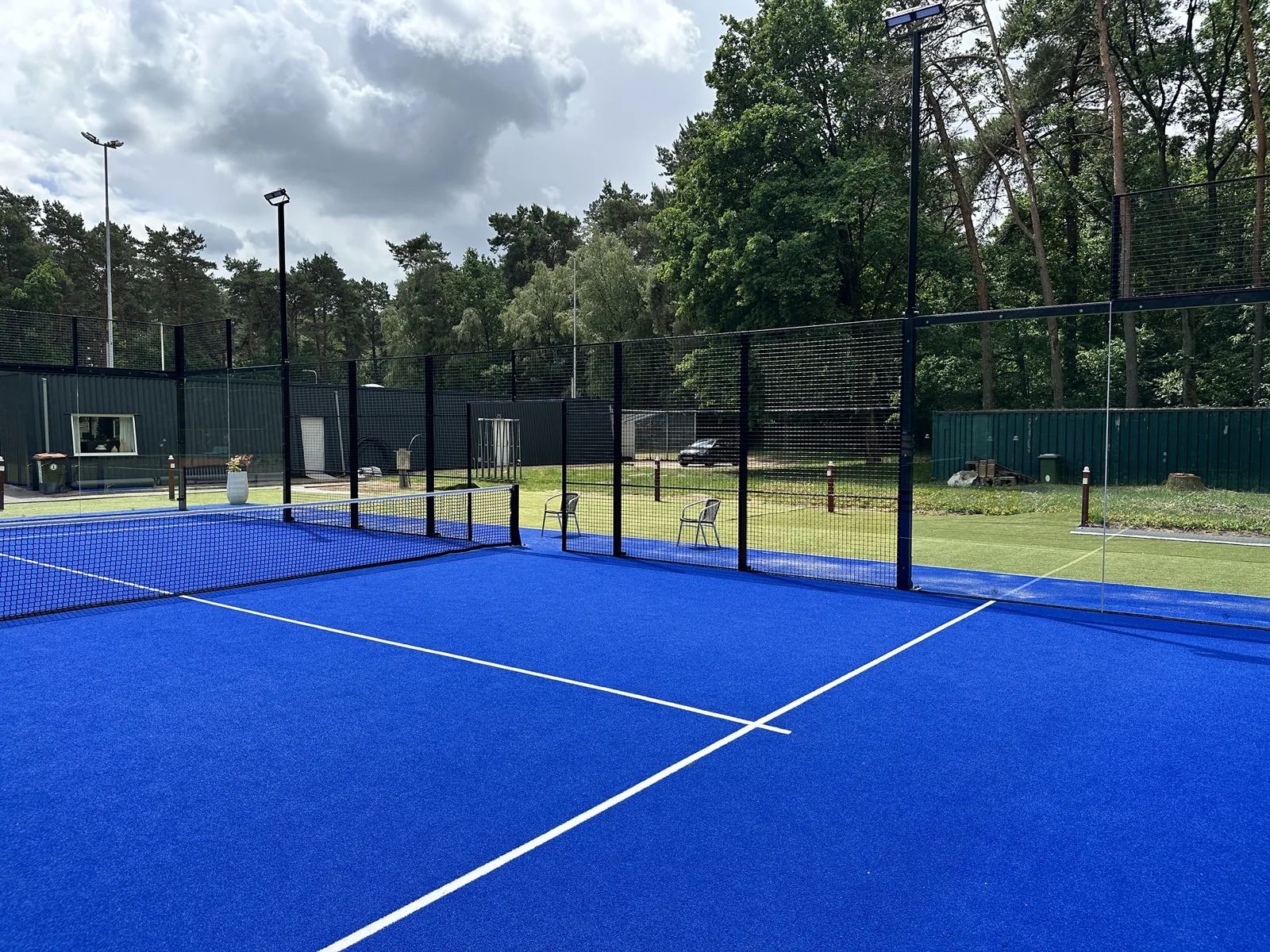
Sound-absorbing panels are acoustic panels mounted on the outside of the cage structure of a padel court. They work as a source measure: the noise created by the racket hitting the ball and by the ball impacting the glass or fencing is absorbed before it spreads to the surroundings. The panels usually contain rock wool, a mineral fibre with an open structure that partially absorbs sound waves.
The distinction between sound absorption and sound insulation is relevant here. Sound absorption means a material takes up sound energy and converts it into heat, which reduces reflections. Sound insulation focuses on limiting the transmission of sound from one side to the other. For sound-absorbing panels on padel courts, both principles play a role, and the final performance depends on the material thickness, density, placement and the specific frequencies of the noise.
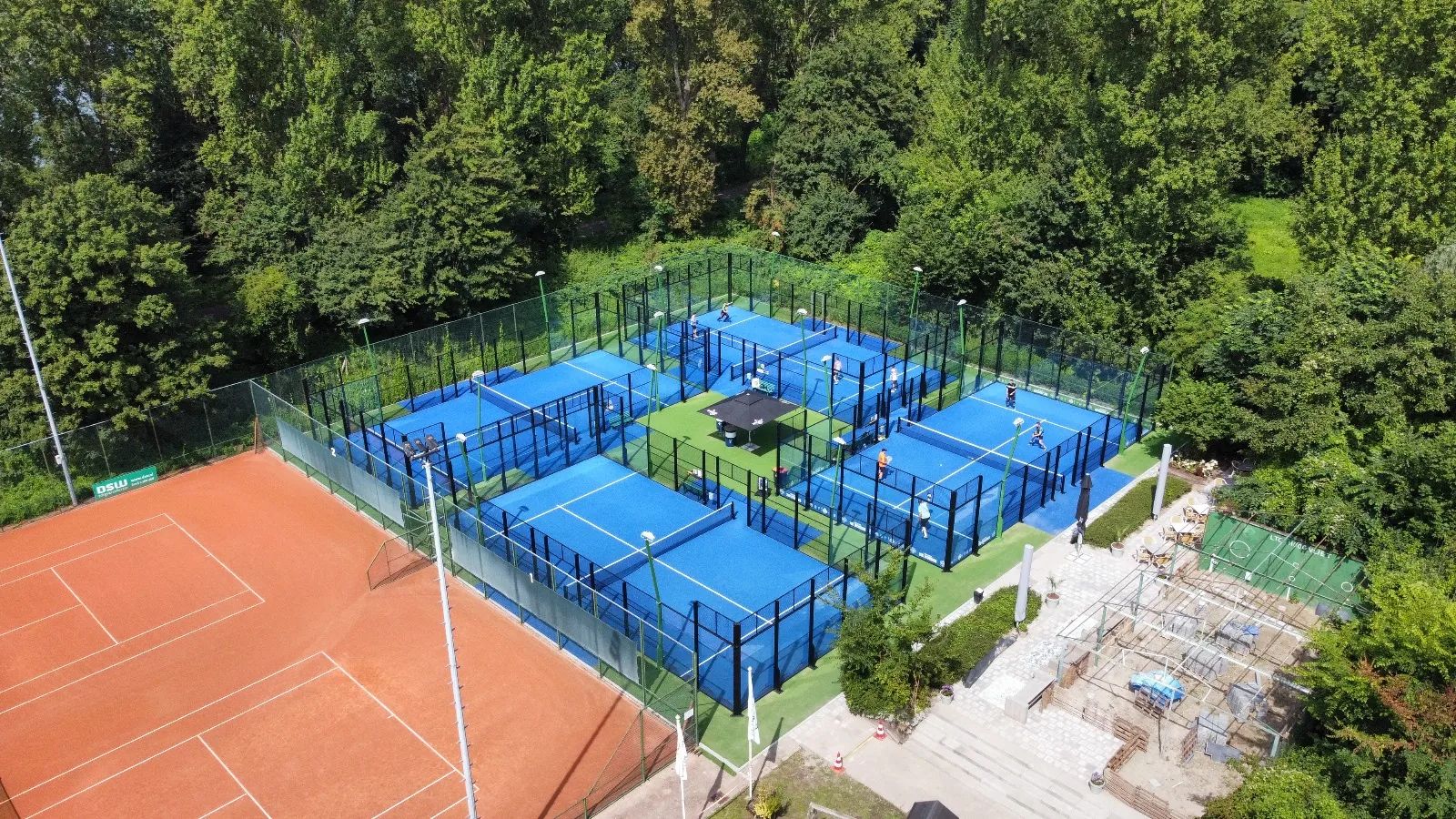
During a practical measurement at LTC Hofgeest in Velserbroek, an indicative noise reduction of approximately 3 dB(A) was measured within the configuration studied, after correction for background noise. These results apply only to the situation studied and must not be regarded as a general performance figure for other projects. Every site has different conditions, so the final results may differ.
Why do integrated panels take up less space than a noise barrier?
Integrated sound-absorbing panels are attached to the existing steel structure of the padel court itself. They add no extra ground area to the project: the panels sit within the contours of the cage structure. A noise barrier or earth berm, by contrast, stands next to the court and needs its own foundation and structure, which always requires extra space outside the playing surface.
At a sports park with limited space, this difference is practically relevant. At a site where the padel court is already close to the plot boundary, or where neighbouring facilities limit the available space, a freestanding noise barrier simply cannot be installed. In such situations, integrated panels offer a more compact solution, because the measure becomes part of the court itself.
An additional advantage is that the panels can be included in the design as early as the engineering phase. This allows the steel structure to be calculated immediately for the extra wind load that the panels cause. This is technically preferable to adding a freestanding structure afterwards, where the interaction with the existing court has to be assessed again.
What effect do sound-absorbing panels have on the structure of the court?
Sound-absorbing panels increase the wind load on the steel structure. Panels close off part of the surface of the cage structure, so the wind can no longer flow as freely through the structure. This increases the force that the wind exerts on the court. The steel structure and foundation must be calculated for this and reinforced if necessary.
In practice, this means the structure may require heavier posts, additional columns or modified connections, depending on the site, the wind zone and the extent of the noise measures. This is not an optional step: it is a technical requirement for the structural safety of the court throughout its entire service life.
Because we produce the steel structure ourselves, structural adjustments can be made as early as the design phase. This prevents adjustments having to be made afterwards to a standard structure, which is technically more difficult and more expensive. You can find more about the relationship between structure and wind load on our structure page.
For existing courts, not every steel structure is automatically suitable for installing sound-absorbing panels. In those cases, a structural assessment is necessary before panels are mounted.
Do I need an acoustic study for an outdoor padel court?
Not in every situation, but when homes or other noise-sensitive buildings are located nearby, an acoustic study is in many cases part of the permit process. The municipality ultimately decides which studies are required when applying for an environmental permit for an outdoor padel court.
Padel mainly produces impulsive noise: short, recognisable peaks created by the racket hitting the ball and by the ball impacting the glass or fencing. This type of noise is often clearly audible to local residents, even when the average noise level remains relatively low. Municipalities are increasingly aware of this and regularly set additional requirements for applications near residential buildings.
An independent acoustic consultant carries out the calculations and measurements. We do not carry out acoustic studies ourselves, but we do supply the technical product specifications, structural data and engineering needed to carry out the calculations correctly. Based on the results of the study, it can then be determined which noise measures are technically necessary and can obtain a permit. You can find more information about applying for a permit for a padel court on our permit page.
Which measure is the most suitable for a site with little space?
On a site with little space, integrated sound-absorbing panels are in many situations the most practical option. They are mounted on the steel structure of the padel court and require no extra ground area. A freestanding noise barrier or earth berm is often not feasible on such sites, because the necessary space next to the court is simply not available.
Even so, there is no universal solution that suits every site with little space. The optimal configuration is determined by the combination of the distance to homes, the direction of sensitive receivers, the available space, the local wind load and the results of a project-specific acoustic study. On some sites integrated panels are sufficient, while on others additional measures remain necessary.
Early cooperation between the padel court producer, an independent acoustic consultant and the municipality helps to map out the feasibility of a project in good time. This way, technical and permit-related bottlenecks are identified in the design phase, rather than only during construction. For a custom padel court on a site with specific spatial constraints, we are happy to think along about the technical possibilities.
Not sure whether outdoor padel is feasible at your site?
We are happy to think along with you about the court configuration, structural preparation and possible noise measures. Together with your acoustic consultant, we look at which solution is technically feasible and suits the project. Get in touch via our page on acoustic solutions for padel for an initial, no-obligation exploration.
Frequently asked questions
Can I also install sound-absorbing panels on an existing padel court afterwards?
In some cases this is possible, but it cannot be taken for granted. An existing steel structure is not always calculated for the extra wind load that sound-absorbing panels cause. Before panels are mounted, a structural assessment of the existing court is therefore necessary. Depending on the results, the structure may first need to be reinforced, which entails extra cost and lead time.
How much noise reduction can I realistically expect from sound-absorbing panels?
The achievable noise reduction differs per site and depends on factors such as the placement of the panels, the material thickness, the distance to homes and the specific frequencies of the noise. During a practical measurement at LTC Hofgeest in Velserbroek, an indicative reduction of approximately 3 dB(A) was measured within the configuration studied. It is important not to rely on general performance figures: always have an independent acoustic consultant calculate the expected reduction for your specific site.
What is the difference between an environmental permit for a noise barrier and for sound-absorbing panels?
A freestanding noise barrier or earth berm is generally regarded by the municipality as an independent building work, for which a separate environmental permit is required, including structural calculations and soil investigation (CPT) data. Sound-absorbing panels integrated into the cage structure of the padel court fall in many cases under the permit for the court itself, although this differs per municipality and situation. It is always wise to consult the municipality in advance about which permit requirements apply to your specific project.
What are the most common mistakes when planning noise measures for a padel court?
A common mistake is that noise measures are only included late in the planning process, so that the steel structure has already been designed without taking into account the extra wind load of panels. Another pitfall is using generic reduction figures without a site-specific acoustic study, which can lead to unrealistic expectations towards the municipality or local residents. Finally, project initiators sometimes underestimate the space requirements of a noise berm, so that the project still gets stuck at a later stage on spatial or permit-related objections.
Should I involve local residents in the choice of noise measures?
Formally this is not always mandatory, but in practice early communication with local residents significantly increases the chance of a smooth permit process. Municipalities attach increasing value to local support, especially for sports facilities near residential buildings. By informing local residents early about the planned noise measures and the results of the acoustic study, you reduce the risk of objections that could delay the project.
When in the project process should I engage an acoustic consultant?
As early as possible, preferably already in the feasibility phase before the choice of site is final. An acoustic consultant can assess at an early stage whether the distance to homes and the surroundings give rise to bottlenecks, and which measures are technically feasible and can obtain a permit. By mapping this out in advance, you avoid discovering only during the permit procedure that additional or costly measures are necessary.
Are there also noise measures specifically aimed at the impulsive character of padel noise?
Padel noise consists mainly of short, sharp impulses from the racket hitting the ball and from impact on the glass or fencing. Sound-absorbing panels with a rock wool filling are also effective for this type of noise because they reduce the reflection of these impulses. Even so, the impulsive character is a reason why a purely average noise level sometimes gives an incomplete picture: local residents experience impulsive noise as more disturbing than continuous noise at the same level. An acoustic consultant explicitly takes this into account in the assessment and advice.