Blog · 15 September 2026 · 12 min read
Which measures can limit noise nuisance from a padel court?
Want to limit noise nuisance from a padel court? Find out which measures work: panels, noise barriers or site layout. Read what suits your situation.

In this article
- What types of noise measures are there for a padel court?
- How do sound-absorbing panels work on a padel court?
- What is the difference between sound-absorbing panels and a noise barrier?
- What effect do sound-absorbing panels have on the structure of a padel court?
- Do I need an acoustic study for an outdoor padel court?
- Are sound-absorbing panels sufficient to obtain a permit?
- What does it cost to apply noise measures to a padel court?
- Not sure whether outdoor padel is feasible at your location?
- Frequently asked questions
Several noise measures are possible to limit noise nuisance from a padel court. The most commonly applied solutions are sound-absorbing panels placed directly on the cage structure, freestanding noise barriers next to the court, and adjustments to the site layout.
Which measure is most suitable always depends on the specific location, the distance to homes and the results of an independent acoustic study. The questions below help you better understand the different options and assess what may be relevant in your situation.
What types of noise measures are there for a padel court?
Three main categories of noise measures are available for a padel court: source measures that tackle the noise directly at the court, transmission measures that block the noise on its way to the surroundings, and spatial measures that adjust the layout of the sports park. The most commonly applied combination in practice is sound-absorbing panels on the cage structure and a freestanding noise barrier on the side facing homes.
Noise nuisance from a padel court arises mainly from the contact of the ball with the glass and the mesh of the cage structure. This impact noise is reflected and spreads over a long distance. An average sound power level of around 91 dB makes padel considerably louder than tennis, which explains the need for targeted measures at locations near residential buildings.
The three most commonly applied measures at a glance:
- Sound-absorbing panels: fixed to the outside of the cage structure and absorbing noise at the source.
- Noise barriers: freestanding structures next to or around the court that block noise towards homes.
- Site layout: the position of the court on the plot, its orientation and the distance to the plot boundary can affect the noise load on surrounding homes.
In many situations, a combination of measures is the most effective. Which combination is suitable is determined by an independent acoustic consultant on the basis of the specific location. You can find more information about the available acoustic solutions for padel on our overview page.
How do sound-absorbing panels work on a padel court?
Sound-absorbing panels are placed on the outside of the mesh of the cage structure. They absorb the noise that passes through the mesh instead of reflecting it back into the surroundings. The noise is converted into heat within the absorbing material, so the amount of noise reaching the surroundings is lower.
The panels have been independently tested in an acoustic laboratory. Within the configuration tested, the following values were measured:
- Sound absorption class: A
- Absorption value αw: 0.80
- Absorption index DLα: 8 dB
- Airborne sound insulation Rw: 22 dB
- Sound insulation index DLR: 19 dB
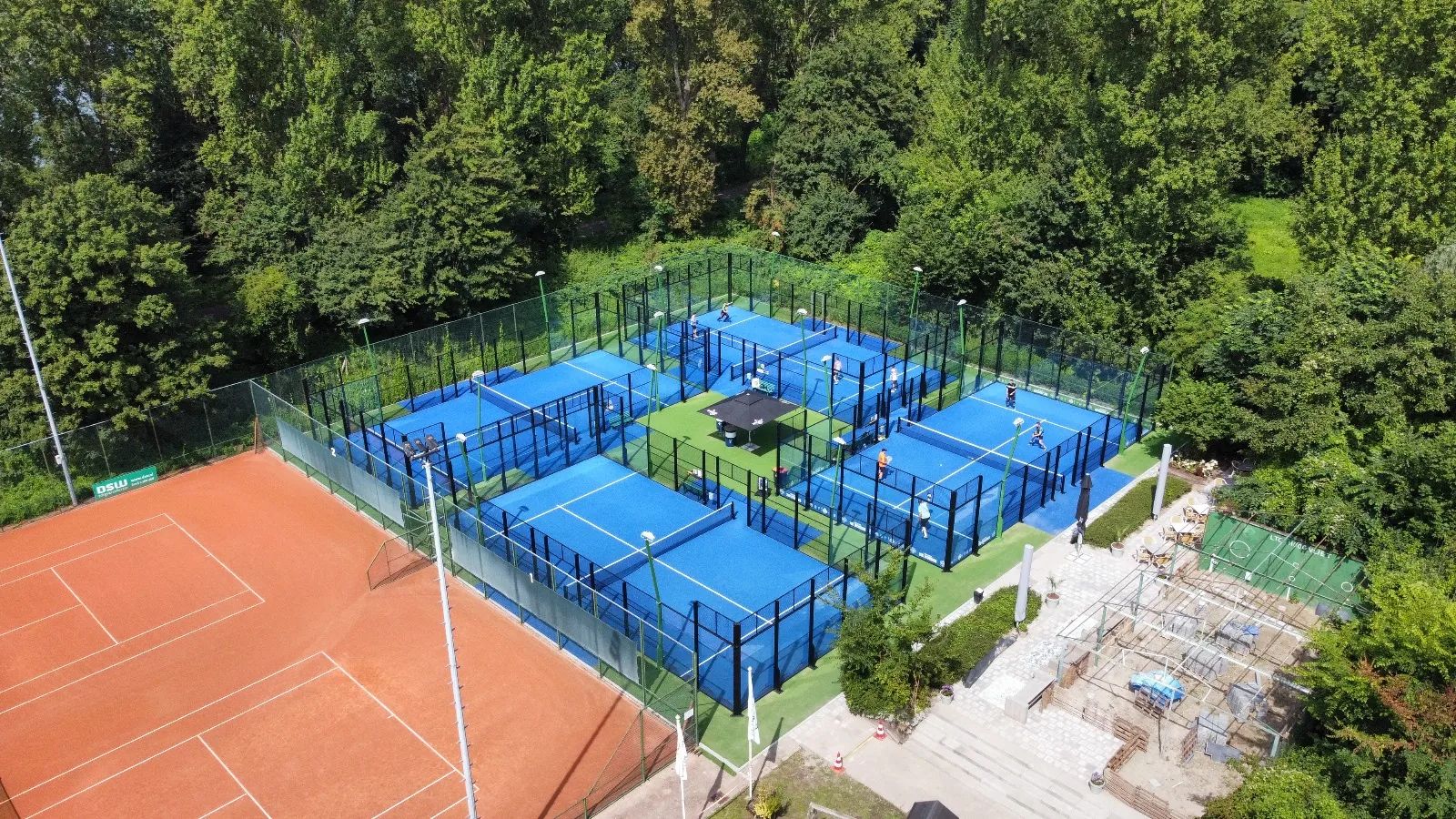
In a field measurement at LTC Hofgeest, an indicative noise reduction of approximately 3 dB(A) was measured for the configuration examined, after correction for background noise. These results apply only to the situation examined and must not be regarded as a generally valid result for every padel court.
The panels can be placed on one side of the court, on several sides, on the lower or upper metres of the cage, or in combination with glass walls. They can also be applied afterwards to existing courts, provided the structure is calculated for the extra load the panels cause. You can read more about how acoustic solutions for padel work and are applied on the product page.
What is the difference between sound-absorbing panels and a noise barrier?
The most important difference is the position relative to the court. Sound-absorbing panels are a source measure: they are fixed directly to the cage structure and tackle the noise where it is created. A noise barrier is a transmission measure: it is placed next to or around the court and blocks the noise on its way from the source to the surroundings.
Both measures have their own area of application, advantages and disadvantages:
Sound-absorbing panels
Panels are compact, integrated into the structure and visually less intrusive than a large wall next to the court. They are suitable when the space around the court is limited or when a freestanding structure is not desirable or permittable. A disadvantage is that the cage structure must be calculated and in many cases structurally reinforced because of the extra wind load the panels cause.
Noise barriers
A noise barrier works at a greater distance from the source and can be effective when noise needs to be blocked from one specific direction. Barriers can be built to heights of 6 to 8 metres and can be tens of metres long.
They require a structural calculation, soil investigation data (CPT) and, in almost all cases, an environmental permit. A noise barrier can also be fitted with planting, which can improve visual integration and acceptance by local residents. Read more about the use of outdoor padel court noise barriers on the relevant page.
In some situations, a combination of both measures is the most effective. Because panels already reduce the noise at the source, a noise barrier can be built lower in those cases, which can save costs and simplify the permit process.
What effect do sound-absorbing panels have on the structure of a padel court?
Sound-absorbing panels reduce the wind permeability of the cage structure. Where the mesh lets most of the wind through, the panels form a closed surface. This leads to extra wind load on the structure. In almost all cases, the cage structure must therefore be structurally reinforced before panels can be applied.
The reinforcement can consist of heavier posts, additional columns or modified connections. Which modifications are needed depends on the wind zone, the position of the panels and the existing structure. A structural engineer must assess the situation and calculate the extra load in accordance with the applicable standards.
For new construction, the extra load caused by panels can be taken into account directly during the engineering phase. This is simpler and cheaper than modifying an existing structure afterwards. Because we produce the steel structure ourselves, columns, connections, base plates and anchors can be adapted project by project when noise measures are part of the design.
Installation on existing courts is also possible, but always requires a structural assessment in advance. Never assume that panels can simply be fixed to an existing cage. The structure and wind load of a padel court are inseparably linked to the choice of noise measures.
Do I need an acoustic study for an outdoor padel court?
For an outdoor padel court near homes, an acoustic study is mandatory in most cases as part of the permit application. Municipalities request this study to assess whether the noise load on surrounding homes stays within the statutory standards. Whether a study is also mandatory in your situation depends on the municipality, the distance to homes and the zoning plan rules.
An acoustic study is carried out by an independent acoustic consultancy. They calculate the expected noise load on the surroundings on the basis of the sound power of the court, the distance to homes, the characteristics of the surroundings and any noise measures. Based on the results, it can be determined which measures are needed to meet the standards.
We do not carry out acoustic studies ourselves. What we can do is supply the technical product specifications, structural data and engineering that an acoustic consultant needs to perform the calculations correctly. This prevents the study from being carried out on the basis of incomplete or incorrect technical information.
An acoustic study is also valuable regardless of the permit requirement. It gives insight into the actual noise load and helps to determine which measures are proportionate and effective for the specific location. You can read more about applying for a padel court permit and the associated documentation on the permit page.
Are sound-absorbing panels sufficient to obtain a permit?
Whether sound-absorbing panels are sufficient to obtain a permit depends on the situation and cannot be assessed in advance without an independent acoustic study. The municipality assesses the permit application on the basis of the calculated noise load on homes. If that load falls within the applicable standards, a permit can be granted. Whether panels are sufficient for that depends on the distance to homes, the number of courts, the intensity of use and the surroundings.
In some situations, panels are a suitable and sufficient measure. In other situations, additional measures are needed, such as a noise barrier, an adjusted site layout or a restriction of the hours of use. There is no standard solution that applies to every location.
Do not make statements about the feasibility of a permit without an acoustic consultant having assessed the situation. A permit is never guaranteed by the choice of a particular noise measure. However, a well-substantiated application with a sound acoustic report and suitable technical measures can make the process considerably smoother.
What does it cost to apply noise measures to a padel court?
The costs of noise measures for a padel court vary widely and depend on the type of measure, the scale of the application and the structural modifications needed. As an indication, sound-absorbing panels on one or more sides of the court require a different investment than a freestanding noise barrier several metres high. An exact price always depends on the project-specific situation.
Factors that influence the costs:
- Type of measure: panels, noise barrier or a combination of both.
- Scale: the number of courts, the number of sides on which panels are placed and the height of the application.
- Structural modifications: when the cage structure has to be reinforced, this brings additional material and production costs.
- Foundation: a noise barrier requires its own foundation, the cost of which depends heavily on the location.
- Acoustic study: this is a separate cost item that is independent of the structure and installation.
For new construction projects, it is more cost-effective to include noise measures in the engineering phase. Modifying an existing structure afterwards usually takes more work and therefore higher costs. The cost of a padel court including any noise measures is always project-specific and calls for a tailor-made quotation.
In some situations, a noise barrier can be built lower when panels already reduce part of the noise at the source. This can limit the total investment in noise measures and simplify the permit process. Whether this is possible in your situation is determined by the outcome of the acoustic study.
Not sure whether outdoor padel is feasible at your location?
We are happy to think along with you about the court configuration, structural preparation and possible noise measures. Together with your acoustic consultant, we look at which solution is technically feasible and suits the project. Get in touch via the page on acoustic solutions for padel for an initial, no-obligation exploration.
Frequently asked questions
Can I apply noise measures to an existing padel court afterwards?
Yes, in principle sound-absorbing panels and noise barriers can also be applied afterwards to existing padel courts. For panels, however, the existing cage structure must always first be structurally assessed and in many cases reinforced because of the extra wind load. Always have this calculated in advance by a structural engineer to prevent unsafe situations.
How high does a noise barrier need to be to be effective at a padel court?
The required height of a noise barrier depends on the distance to the homes, the height of the noise source and the desired noise reduction. In practice, noise barriers at padel courts are built to heights of 6 to 8 metres. An independent acoustic consultancy calculates, based on your specific location, which height is needed to meet the statutory noise standards.
Which permits do I need to install a noise barrier next to a padel court?
A freestanding noise barrier requires an environmental permit in almost all cases. The municipality assesses the application on the basis of height, dimensions, structure and spatial integration. In addition, a structural calculation and soil investigation data (CPT) for the foundation are necessary. Always enquire in good time with the municipality about which documents are required, so that the permit process does not run into delays.
What is the difference in noise reduction between panels on one side and all around the court?
Panels on one side limit noise radiation only in the direction of that side, which is effective when homes are mainly on one side. When homes are located all around the court, or when a higher total reduction is needed, application on several sides or the entire perimeter of the cage can make sense. The exact added value of extending to several sides is determined by an acoustic consultant on the basis of the location-specific situation.
Are there noise measures that do not affect the playing experience or the appearance of the padel court?
Sound-absorbing panels are fixed to the outside of the cage structure and have no effect on the playing surface or the inside of the court. Visually they are visible from the outside, but they are compact and integrated into the structure. A noise barrier can be fitted with planting, which improves visual integration into the surroundings and is generally better received by local residents.
How early in the planning process should I think about noise measures?
As early as possible, preferably in the first design phase of the project. When noise measures are included already during the engineering phase, the cage structure, foundation and site layout can be aligned directly with the required measures. This is technically simpler and more cost-efficient than making modifications afterwards to a structure that has already been built.
What do I need to supply to an acoustic consultant to get a reliable calculation?
An acoustic consultant needs, among other things, the technical specifications of the padel court, the exact location and orientation of the court on the plot, the distance to surrounding homes and the planned intensity of use. As a court developer, we can supply the product specifications, structural data and technical documentation the consultant needs for correct calculations. This prevents the acoustic report from being based on incomplete or incorrect technical information.