


Building a padel court · 27 July 2026 · 11 min read
Which lux values are required for professional LED lighting on a padel court?
Professional LED lighting for padel courts requires 300–1000 lux. Discover the standards, uniformity and luminaire choice for your location.
In this article
- How many lux do you need for a professional padel court?
- What is the difference between lux, lumen and watt for padel court LED lighting?
- What role does light uniformity play in padel court lighting?
- What are the standards for LED lighting at official padel matches?
- How does an indoor versus outdoor location affect the lighting requirements?
- Which LED luminaires are suitable for professional padel court lighting?
- How I-Padel helps with professional LED lighting for padel courts
- Frequently asked questions
For a professional padel court you need at least 300 to 500 lux, depending on the level of use. For recreational play 300 lux is sufficient, but for matches at regional or national level the requirements are higher. The exact lux values are determined by the standards of the international padel organisations and the specific conditions at the location. In this article we answer the most frequently asked questions about LED lighting for padel courts, from technical concepts to practical choices when building a padel court.
How many lux do you need for a professional padel court?
As a guideline for a professional padel court, at least 300 lux applies for recreational use and 500 lux or more for match play at regional and national level. For international matches and television broadcasts the requirements are higher still, towards 750 to 1000 lux. The lighting level is measured on the playing surface, at a height of one metre above the floor.
It is important to realise that lux values are not only about brightness. A court with an average of 500 lux but poor distribution can in practice be less pleasant to play on than a court with 400 lux and excellent uniformity. Both factors count in a professional lighting installation.
- Recreational use: at least 300 lux
- Competitive club play: 400 to 500 lux
- Regional and national matches: 500 to 750 lux
- International matches and TV recordings: 750 to 1000 lux or more
When building a padel court, it is wise to choose straight away a lighting level that suits the location’s long-term ambitions. Scaling up afterwards is technically possible, but more expensive than a well-thought-out installation from the start.
What is the difference between lux, lumen and watt for padel court LED lighting?
Lux, lumen and watt are three different quantities, each measuring something different. Watt says something about the energy consumption of a luminaire. Lumen indicates how much light a luminaire emits. Lux is the amount of light that actually falls on a surface. For the lighting quality of a padel court, lux is the most relevant measure.
A practical example: a 200-watt luminaire can produce a lot of lumens, but if the light is spread widely across a large space, the lux value on the playing surface is low. A well-directed luminaire with fewer watts can deliver more lux on the playing surface. Modern LED lighting is precisely strong in directed light beams, which makes it particularly suitable for padel courts.
The ratio between lumens and watts is called the luminous efficacy, expressed in lumens per watt. High-quality LED luminaires today reach 130 to 180 lumens per watt, which makes them considerably more economical than older lighting technologies such as halogen or fluorescent lighting. For the operator of a padel facility this is directly relevant to operating costs.
What role does light uniformity play in padel court lighting?
Light uniformity describes how evenly the light is distributed across the playing surface. High uniformity means there are no large bright or dark zones on the court. For padel, uniformity is crucial, because players follow the ball at high speed and varying light intensity directly affects reaction time and playing quality.
Uniformity is expressed as a ratio: the minimum lux value on the court divided by the average lux value. A ratio of 0.7 or higher is considered good. That means the darkest spot on the court is at least 70 percent as bright as the average. For match use, a uniformity ratio of 0.8 or higher is recommended.
Poor uniformity arises when luminaires are positioned incorrectly, are too far apart or have too narrow a light beam. When designing a lighting plan for a padel court, a lighting calculation is therefore always made that maps both the average lux value and the uniformity. This is a step that must not be skipped, regardless of the type of location.
What are the standards for LED lighting at official padel matches?
The international padel organisation World Padel Tour and the International Padel Federation (FIP) apply specific standards for lighting installations at official matches. For FIP-certified courts, a minimum of 500 lux horizontally on the playing surface applies, with a uniformity ratio of at least 0.7. For top matches with television broadcasts, values of 1000 lux or more are required.
In the Netherlands, padel courts for official use must also be inspected by Kiwa ISA Sport, the recognised inspection body for sports facilities. Kiwa ISA Sport assesses not only the structure but also the lighting installation for conformity with the applicable standards. An inspection is mandatory for locations that want to organise official competition matches.
In addition to the international standards, the guidelines of the KNLTB and NEN-EN 12193, the European standard for sports lighting, also apply in the Netherlands. This standard divides sports into classes based on the competition level and prescribes minimum lux values and uniformity requirements per class. Padel generally falls into class II or class I, depending on use.
How does an indoor versus outdoor location affect the lighting requirements?
The location, indoor or outdoor, has a direct influence on the lighting requirements and the technical execution of the installation. With an indoor padel court there is no daylight to disturb the measurement, which makes the lighting calculation simpler and more predictable. With an outdoor court daylight plays a role and luminaires must withstand the weather.
Indoor lighting requirements
On an indoor court, the ambient lighting depends entirely on artificial light. The colour of the light, also called colour temperature, plays a major role here. A colour temperature of 4000 to 6000 Kelvin (neutral to cool white) is recommended for sports lighting, because it improves ball visibility and spatial perception. The colour rendering index (CRI) must be at least 80, preferably 90 or higher for match use.
Outdoor lighting requirements
Additional technical requirements apply to outdoor courts. Luminaires must have an IP protection rating of at least IP65, which provides protection against dust and water jets. In addition, light pollution plays a role: municipalities increasingly set requirements for light emission towards the surroundings, especially at locations near residential areas. A lighting study is almost always mandatory in the permit application for an outdoor court.
Which LED luminaires are suitable for professional padel court lighting?
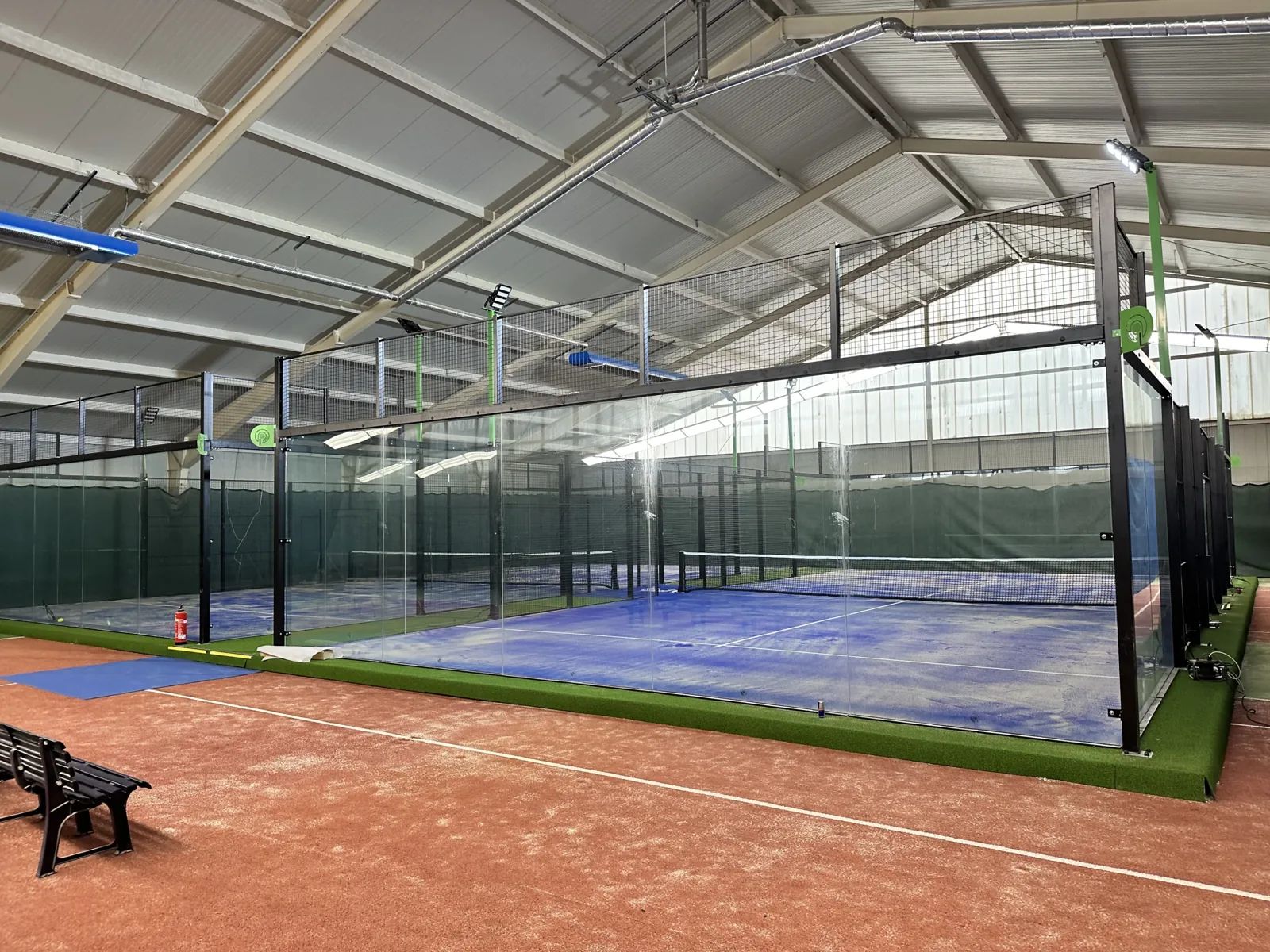
Suitable LED luminaires for padel courts are high-quality sports luminaires with a directed light beam, a high luminous efficacy per watt and a robust housing. They are generally mounted on the cage structure or on separate light poles, at a height of five to eight metres. The choice of luminaire type depends on the location, the desired lux level and the budget.
When selecting luminaires, the following criteria are relevant:
- Luminous efficacy: at least 130 lumens per watt for an energy-efficient installation
- Colour temperature: 4000 to 6000 Kelvin for optimal visibility
- Colour rendering index (CRI): at least 80, preferably 90 or higher
- IP protection: at least IP65 for outdoor use
- Flicker: luminaires must be flicker-free to prevent fatigue and blurred images in video recording
- Dimmable: dimming options provide flexibility in energy consumption outside peak hours
A professional lighting plan is always calculated in advance using lighting simulation software. This checks whether the combination of luminaire type, positioning and height achieves the desired lux values and uniformity before a single luminaire is installed. This prevents costly adjustments afterwards and is a standard step in a serious realisation.
How I-Padel helps with professional LED lighting for padel courts
We supply and install LED lighting as part of our complete package for padel courts. That means the lighting is not purchased separately from an external supplier, but is selected, calculated and installed by us as an integral part of the court. That way there is one responsible party for the entire result.
What we do in concrete terms for the lighting installation:
- We draw up a lighting plan with a lighting calculation per location, including lux values and uniformity ratio
- We select luminaires that meet the requirements for the intended level of use, from recreational to match level
- We take into account the standards of Kiwa ISA Sport and the applicable European sports lighting standards
- We install the lighting as part of the complete court, including cabling and controls
- For outdoor courts we take into account the requirements for the permit application, including the lighting study
The cost of LED lighting is included in our turnkey package. As an indication, a complete turnkey indoor padel court starts from approximately €23,000, including structure, glass, artificial turf, LED lighting and installation. The exact price always depends on the location, the number of courts and the desired lighting specifications. Get in touch for an initial exploration, we will gladly think along with you, without obligation, about the best lighting solution for your location.
Frequently asked questions
How long do LED luminaires for a padel court last on average?
High-quality LED luminaires for sports lighting have an average lifespan of 50,000 to 100,000 burning hours. With average use of five hours a day, this means a lifespan of 25 to 50 years. Bear in mind that the light output gradually decreases over time, a phenomenon called ‘lumen depreciation’. A good rule of thumb is that luminaires need replacing when the light output has fallen below 70 percent of the original value (L70 standard).
What does it cost to upgrade an existing padel court from fluorescent or halogen lighting to LED?
The cost of a retrofit from fluorescent or halogen lighting to LED varies greatly, depending on the number of courts, the existing cabling and the desired lighting level. In many cases, completely replacing luminaires and cabling is more cost-effective than reusing old infrastructure. The investment is generally earned back within three to seven years through lower energy costs, because LED uses up to 60 percent less energy than traditional lighting technologies. Always have a lighting calculation and cost estimate made before you make a decision.
Can I connect my padel court lighting to a timer or smart building system?
Yes, modern LED luminaires for padel courts are almost always suitable for connection to timers, motion sensors or a central management system (DALI or KNX). This offers considerable advantages: outside peak hours the lighting level can be dimmed to 30 to 50 percent, which directly yields energy savings. Some systems also make it possible to switch the lighting per court separately via an app, which is handy for court rental. Discuss these options during construction, because integrating them afterwards is more expensive than including them in the design from the start.
What is flicker in LED lighting and why is it relevant for padel courts?
Flicker refers to rapid, not always visible light fluctuations caused by the alternating current in the power supply of an LED luminaire. In sports lighting, flicker is a serious point of attention: it can lead to eye fatigue, reduced reaction time for players, and blurred images in video recording or livestreams.
Luminaires with a flicker percentage below one percent (in accordance with IEEE 1789) are considered safe for intensive sports use. When selecting luminaires, always ask about the flicker values and check that they are certified for sports lighting.
Do I need a permit to install lighting at an outdoor padel court?
In most cases an environmental permit is required for an outdoor padel court with artificial lighting, especially when the court is newly built or the lighting is significantly expanded. Municipalities increasingly set requirements regarding light nuisance for the surroundings, and a lighting study is almost always part of the file in the permit application. The specific requirements differ per municipality and zoning plan. Make sure you start this process early in the planning phase, because the lead time of a permit procedure can amount to several months.
Which common mistakes should I avoid when planning padel court lighting?
The most common mistakes are: skipping a professional lighting calculation and focusing solely on wattage or price, choosing luminaires with too wide a light beam so that uniformity disappoints, and underestimating the location’s future usage ambitions. Another common mistake is not including dimming options or smart control in the design, which later leads to higher energy costs. Invest in a complete lighting plan before you buy luminaires; this prevents costly adjustments after installation.
What is the difference between a colour temperature of 4000K and 6000K for padel court lighting, and which should I choose?
A colour temperature of 4000K gives neutral white light, comparable to daylight on a cloudy day, while 6000K produces a cooler, bluer white light that resembles bright daylight. For padel courts, 4000K is generally the preferred choice for indoor locations, because it is more comfortable for the eyes during long use and creates a pleasant playing environment.
For outdoor courts or locations with high match requirements, 5000 to 6000K can be considered, because it improves the contrast perception of the ball. Always combine the colour temperature with a high CRI value (90+) for the best visibility.


