


Building a padel court · 16 May 2026 · 11 min read
Which lighting is best for an indoor padel court?
LED lighting for indoor padel courts: find the right lux level, number of fixtures and costs. Play more safely and save up to 70% energy.
In this article
- Why is good lighting so important for an indoor padel court?
- How many lux does an indoor padel court need?
- What is the difference between LED and traditional lighting for padel courts?
- Which LED lighting is best for an indoor padel court?
- How many lamps are needed for a padel court?
- What does LED lighting for an indoor padel court cost?
- Can existing lighting be adapted or replaced?
- Frequently asked questions
For an indoor padel court, good lighting is not an afterthought. It directly determines the playing quality, the safety and the comfort of use of the location. The best choice for an indoor padel court is LED lighting with an illuminance of at least 300 to 500 lux, depending on the level of use.
LED lighting outperforms traditional alternatives on every front: lower energy consumption, a longer lifespan and a better light colour for a sharp, clearly visible game. In this article you will read exactly what you need to know when choosing, planning and installing lighting for an indoor padel court.
Why is good lighting so important for an indoor padel court?
Good lighting on an indoor padel court ensures that players can follow the ball properly, shadows are avoided and the game runs safely. Without sufficient and even light, dark corners, glare and an unevenly lit playing surface arise, which directly affects the playing experience and the safety of the players.
Padel is a fast sport in which the ball rebounds off glass and mesh at high speed. That calls for lighting that is not only bright enough, but also evenly distributed over the entire playing area. A lamp that shines too brightly in one corner and gives too little light in another disrupts the game and increases the risk of injury.
In addition, lighting affects the operation of the location. Players deliberately choose well-lit courts. A hall with quality LED lighting attracts more members and users, can also be used in the evening hours and gives a professional look that suits a serious padel venue. For commercial operators and sports clubs that is directly relevant to the occupancy rate and the return.
How many lux does an indoor padel court need?
An indoor padel court needs at least 300 lux for recreational use. For club competitions 500 lux is recommended, and for professional matches or television broadcasts this can rise to 750 lux or more. Lux is the unit of illuminance on the playing surface, measured at a height of one metre above the floor.
It is not only about the total lux level, but also about the evenness of the light. A lighting installation with a high uniformity ensures that there are no large differences between the brightest and darkest spots on the court. In practice, a uniformity ratio of at least 0.5 to 0.7 is maintained for padel courts. The closer to 1.0, the more even the light.
What is the difference between lux and lumen?
Lumen is the total amount of light that a lamp emits. Lux is the amount of light that actually falls on a surface, taking distance and angle into account. For padel courts lux is the relevant measure, because it indicates how much light the players experience on the court, not how much the lamp emits technically.
What is the difference between LED and traditional lighting for padel courts?
LED lighting uses 60 to 70 percent less energy than traditional halogen or fluorescent lighting at equivalent light levels. In addition, LED lighting has a lifespan of 50,000 hours or more, whereas traditional lamps have to be replaced after only 10,000 to 20,000 hours. For a busy padel hall that makes a big difference in operating costs.
Traditional lighting systems, such as metal halide lamps, used to be widely used in sports halls. They give a warm light, but have a number of drawbacks that are problematic for padel courts. They have a warm-up time of several minutes before they burn at full power, they flicker when switched on and off and they are sensitive to vibrations, which is undesirable in a sports environment.
LED lighting switches on instantly at full power, produces less heat and is easily dimmable. That last point is handy for locations that want to adapt the lighting to the use: less light during training, full strength during matches. In addition, the colour rendering of LED lighting is better, which means that colours on the playing field, such as the lines and the artificial turf, are more clearly and sharply visible.
Which LED lighting is best for an indoor padel court?
The best LED lighting for an indoor padel court is a fixture with a high colour rendering index (CRI of at least 80, preferably 90 or higher), a colour temperature of 4000 to 6000 Kelvin and an IP rating of at least IP54 for protection against dust and moisture. Choose fixtures designed specifically for sports lighting, with a focused light beam that minimises glare.
The colour temperature determines how warm or cool the light feels. For padel courts, neutral to cool white light works best. This improves contrast and makes the ball and the lines more visible. A colour temperature of 5000 to 6000 Kelvin gives a bright, fresh light comparable to daylight.
Also pay attention to the UGR value (Unified Glare Rating) of the fixtures. This is a measure of glare. For sports venues a UGR of at most 22 applies as a guideline. The lower the UGR, the less glare and therefore the more comfortable the play. Fixtures with a low UGR are slightly more expensive, but deliver a noticeably better playing experience.
Does LED lighting for padel courts have to meet certain standards?
For official match use, standards apply that are laid down by sports federations and inspection bodies. In the Netherlands, padel courts for competition use must meet the requirements of the KNLTB and are inspected by Kiwa ISA Sport. That applies not only to the floor and the structure, but also to the lighting installation. Working with certified materials and installations protects you as an operator against problems with inspection and admission to competitions.
How many lamps are needed for a padel court?
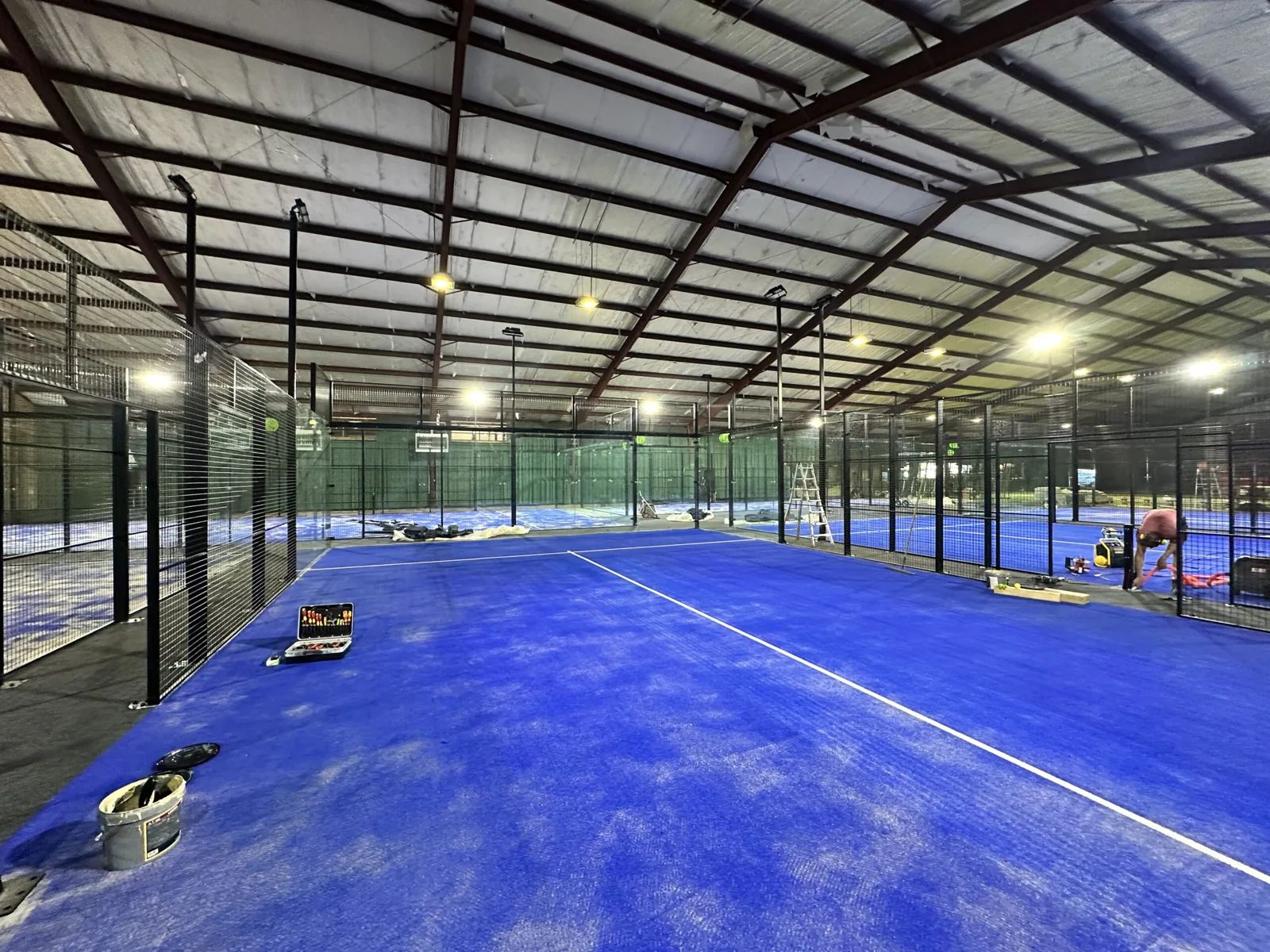
A standard indoor padel court of 20 by 10 metres usually needs four to eight LED fixtures, depending on the power per fixture, the mounting height and the desired lux level. With a hall height of 6 metres and fixtures of 150 to 200 watts each, six fixtures will do nicely for recreational use.
The exact calculation depends on several factors: the height of the hall, the reflection of the walls and the ceiling, the desired uniformity and the intended lux level. A lighting plan, also called a lighting calculation or lighting design, gives an accurate picture per location of the number of fixtures required and the optimal positioning.
With several courts side by side, the lighting can be laid out more efficiently, because fixtures between two courts give light to both sides. That saves fixtures and installation costs per court. This is one of the advantages of a multi-court project compared with a single court.
What does LED lighting for an indoor padel court cost?
As a guide, LED lighting for an indoor padel court including installation comes to €2,000 to €6,000 per court, depending on the chosen system, the number of fixtures and the complexity of the installation. This is an indicative price. The exact costs always depend on the location and the desired quality level.
Cheaper systems are available, but it pays to invest in quality. Lower-quality fixtures lose luminous flux faster, which means the illuminance decreases over time. Quality LED lighting retains its performance much longer and requires less maintenance. Over the full lifespan of the installation that is financially more advantageous.
Also take the energy costs into account. A padel court that is in use for several hours every day consumes considerably more electricity with traditional lighting than with LED lighting. The payback period of the investment in LED lighting is in practice often between two and four years, depending on the use and the energy price.
Can existing lighting be adapted or replaced?
Yes, existing lighting on an indoor padel court can in most cases be replaced by LED lighting without major structural changes. Existing fixtures are replaced by LED versions, the cabling is checked and adapted if necessary, and the lighting plan is recalculated for the new situation. This is a relatively simple intervention with a big effect on quality and energy costs.
When renovating an existing padel hall, it is wise to include the lighting installation in the renovation plan right away. That way work is combined and the court does not have to be out of use twice. An outdated lighting installation that does not meet the standards for competition use can cause a problem during inspection by Kiwa ISA Sport. Timely replacement prevents that.
Want to know the best approach for your location, whether you want to build a new indoor padel court or renovate an existing hall? At I-Padel we supply LED lighting as part of building padel courts, but we are also happy to help you with questions about standalone lighting projects. Get in touch for an initial exploration. We are happy to think along with you, without obligation, about the best solution for your situation.
Frequently asked questions
How long does it take to install LED lighting on an indoor padel court?
Installing LED lighting on an indoor padel court usually takes one to two days per court, depending on the complexity of the installation and the condition of the existing cabling. In new builds the lighting is often combined with other installation work, which does not significantly extend the total construction time. When renovating, it is smart to plan the installation at a time of low occupancy, so that the court is out of use for as short a time as possible.
What is a lighting plan and do I really need one for my padel court?
A lighting plan, also called a lighting calculation or lighting design, is a technical simulation that, based on the dimensions of your hall, the mounting height, the reflection values of the walls and ceiling and the desired lux level, calculates how many fixtures you need and where it is best to place them.
It is not a luxury but a necessity: without a lighting plan you risk installing too few or too many fixtures, or the uniformity falling below the standard. Most specialised suppliers draw up a lighting plan free of charge as part of their quote.
Can I dim LED lighting for a padel court, and what are the benefits?
Yes, modern LED lighting for padel courts is dimmable as standard, provided the fixtures and the switching installation are matched to this. Dimming offers practical benefits: during training or quiet hours you can lower the light level to, for example, 300 lux, while scaling up to 500 lux or more for matches. This delivers a direct saving on energy costs and also extends the lifespan of the fixtures. Some systems can also be linked to a timer or app control for extra ease of use.
What common mistakes should I avoid when choosing lighting for a padel court?
A common mistake is choosing the cheapest fixtures without paying attention to the CRI value, UGR value or the luminous flux retention over time, so the lighting quality drops considerably after a few years. Another common mistake is skipping a professional lighting plan, so that fixtures are positioned wrongly and dark corners or glaring hotspots arise. Finally, many operators underestimate the importance of the IP rating: in a sports environment with moisture and dust, at least IP54 is not a recommendation but a requirement.
Are there subsidies or financing options available for LED lighting on a padel court?
Yes, in the Netherlands there are several schemes that may apply to the purchase of energy-efficient LED lighting for sports venues. The Energie-investeringsaftrek (EIA, energy investment allowance) offers a tax benefit for entrepreneurs who invest in energy-saving technologies, including high-quality LED lighting. Sports clubs and municipal facilities may also qualify for subsidies via the Nationaal Sportakkoord (National Sports Agreement) or municipal sustainability funds. It is wise to ask your municipality or an energy consultant which schemes apply to your specific situation.
What happens if the lighting does not meet the standards during inspection by Kiwa ISA Sport?
If the lighting installation does not meet the set standards during inspection, the court cannot be approved for competition use, which has direct consequences for the operation and the affiliation with the KNLTB. In that case the installation must be adapted or replaced before a re-inspection can take place, which entails extra costs and downtime. This risk is easy to avoid by working with certified materials from the start and an installer who is familiar with the applicable sports standards.
How do I maintain LED lighting on an indoor padel court and how often do I have to replace the fixtures?
Quality LED fixtures have a lifespan of 50,000 hours or more, which under normal use amounts to ten to fifteen years before replacement is needed. Maintenance consists mainly of periodically cleaning the fixtures. Dust and dirt on the glass reduce the light output.
Also regularly check the mountings and cabling. An annual inspection by an installer is sufficient in most cases. If you notice the illuminance decreasing noticeably before the end of the expected lifespan, that may point to lower-quality fixtures or a problem in the installation.


