


Building a padel court · 2 April 2026 · 9 min read
Which glass structure is used for indoor padel courts?
Find out which glass is used for indoor padel courts: thickness, types, safety requirements and fixing. Make the right choice for your sports facility.
In this article
- What is a glass structure on an indoor padel court?
- Which types of glass are used on padel courts?
- How thick should the glass of an indoor padel court be?
- What is the difference between toughened and laminated glass in padel?
- How is the glass fixed to the steel structure?
- Which safety requirements apply to glass in a padel court?
- How long does the glass of an indoor padel court last?
- Frequently asked questions
With an indoor padel court, glass plays a major role, not only for the look of the court but also for safety and playing enjoyment. Yet many people know little about exactly which glass is used, how thick it needs to be and why those choices are made. In this article we answer the most common questions about the glass structure of an indoor padel court, so you know exactly what to look out for.
Whether you want to fit out a sports hall with several padel courts or expand an existing facility, knowing about the glass structure helps you make better decisions about the benefits of an indoor padel court for your sports facility.
What is a glass structure on an indoor padel court?
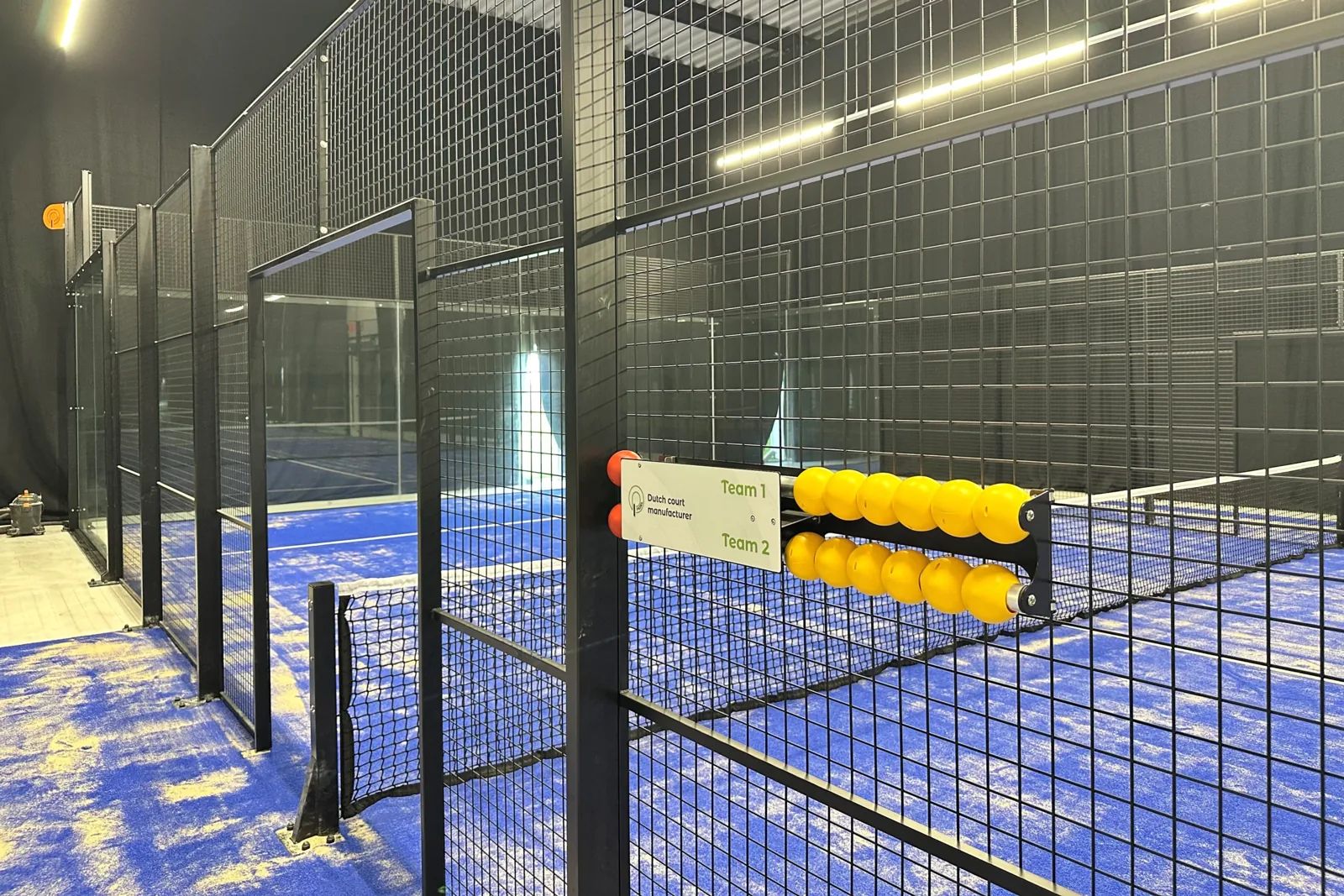
The glass structure on an indoor padel court is the set of glass panels placed around the playing area as part of the cage structure. The glass forms the walls of the court, gives spectators a clear view and at the same time serves as a playing surface. Players deliberately hit the ball against the glass as part of the game.
On a standard padel court of 20 x 10 metres, the back walls and part of the side walls are made of glass. The rest of the cage consists of a steel structure with mesh. The combination of glass and mesh determines both the playing experience and the safety on the court. On indoor padel courts the glass structure plays a slightly different role than on outdoor courts: there is no exposure to the weather, but the requirements for safety and playing quality still apply in full.
Which types of glass are used on padel courts?
Two types of glass are used on padel courts: toughened glass and laminated glass. Toughened glass is by far the most widely used type on both indoor and outdoor padel courts. Laminated glass is used less often, but offers specific advantages in terms of safety if it breaks.
Toughened glass is heat-treated, which makes it much stronger than ordinary flat glass. If it breaks, it falls apart into small, blunt pieces rather than sharp splinters. That makes it safer in a sports environment where players regularly come into contact with the walls.
Laminated glass consists of two layers of glass with a film in between. If it breaks, the glass stays attached to the film and does not fall apart. This type is sometimes used at locations with specific safety requirements or on courts that need extra protection.
How thick should the glass of an indoor padel court be?
The glass of an indoor padel court has a standard thickness of 10 to 12 millimetres. This thickness is needed to absorb the forces of the ball and the players without breaking. Thinner panels do not meet the safety requirements for padel; thicker panels are not necessary in most cases for indoor applications.
On outdoor padel courts, heavier glass specifications may apply because of wind load and temperature changes. Indoor courts are protected from those external forces, which means the standard thickness of 10 to 12 mm is sufficient in most situations. The exact choice depends on the specific structural calculation for each location, something you should always ask about when purchasing.
What is the difference between toughened and laminated glass in padel?
The main difference between toughened and laminated glass in padel lies in how it behaves when it breaks. Toughened glass falls apart into small, blunt pieces that cause relatively little injury. Laminated glass stays attached to the interlayer film when it breaks, so the glass stays in place and no loose pieces fall out.
In practice, toughened glass is used more often on padel courts because it is more cost-efficient and meets the applicable safety standards well. Laminated glass is used when higher requirements apply, for example at locations where children play intensively or when a municipality imposes additional safety requirements. Both types are permitted for use on padel courts, provided they comply with the applicable European standards for safety glass. When purchasing, always ask for the certification that goes with the glass used.
How is the glass fixed to the steel structure?
On a padel court, the glass is fixed to the steel structure using aluminium profiles or special clamping systems. The glass sheets are clamped and secured in these, so that they stay firmly in place without coming into direct contact with the steel. Direct contact would increase vibrations and the risk of breakage.
The fixing method is important for both playing safety and the service life of the glass panels. A poorly fixed glass panel can come loose under intensive use or under unexpected forces. In addition, the connection must allow for slight expansion of the glass with temperature differences, even in an indoor environment. When the glass walls are installed, the structural calculation of the cage structure as a whole is always taken into account.
Which safety requirements apply to glass in a padel court?
Glass in a padel court must comply with the European standards for safety glass, specifically EN 12150 for toughened glass and EN 14449 for laminated glass. In addition, in the Netherlands the requirements of the Bouwbesluit (Dutch Building Decree) and the guidelines of Kiwa ISA Sport for certified padel sports surfaces and structures apply.
Kiwa ISA Sport is the recognised inspection body in the Netherlands for padel sports surfaces and associated structures. For official matches under the auspices of the KNLTB, an inspection by Kiwa ISA Sport is mandatory. This means that not only the artificial turf and the foundation are checked, but also the structure as a whole, including the glass walls.
Working with certified materials is therefore not a luxury but a prerequisite for professional use. Without this knowledge, inexperienced buyers risk purchasing materials that do not meet Dutch standards.
How long does the glass of an indoor padel court last?
With correct use and normal maintenance, the glass of an indoor padel court lasts ten to fifteen years on average, sometimes longer. Indoor glass wears less quickly than on outdoor courts because it is not exposed to the weather, UV radiation or temperature fluctuations. The biggest risk factors are mechanical damage from hard impacts or incorrect fixing.
Regular inspection of the glass walls is advisable. Small hairline cracks or damaged edges can lead to breakage on the next impact. Replace damaged panels in good time, because this is cheaper than waiting until a panel fails completely during play. When renovating or replacing glass walls on an existing padel court, it is wise to check whether the steel structure still meets current standards.
At I-Padel we supply the complete glass structure as part of our all-in package for indoor padel courts. We work exclusively with certified materials that meet the requirements of Kiwa ISA Sport, so you will not face any surprises at an inspection. Would you like to know what a complete indoor padel court costs at your location? Then take a look at our approach to building padel courts or get in touch directly. We are happy to think along with you, without obligation.
Frequently asked questions
Can I replace the existing glass walls of a padel court without replacing the whole cage?
Yes, in most cases it is possible to replace only the glass panels without having to renew the entire steel structure. When replacing them, though, it is wise to check whether the existing steel structure still meets current standards and whether the aluminium profiles or clamping systems are still in good condition. Have a specialist assess the structure before you order individual glass walls, so you can be sure the new panels will fit correctly and can be fixed safely.
How do I recognise poor-quality glass when purchasing a padel court?
When purchasing, always look for a CE marking and the corresponding certification under EN 12150 (toughened glass) or EN 14449 (laminated glass). Suppliers who cannot provide certification documents may be supplying glass that does not meet Dutch and European safety standards. Also ask specifically whether the materials have been approved by Kiwa ISA Sport, especially if you plan to use the court for official matches or competitions.
What should I do if a glass panel on my indoor padel court is damaged?
Close the court for use immediately as soon as you notice a damaged glass panel, even if it is only a small hairline crack or a damaged edge. Mechanical damage can lead to complete breakage on the next hard impact, which is a safety risk for players. Contact a specialist supplier for replacement and, at the same time, check whether the fixing profiles around the damaged panel are still in good condition.
Does it matter whether my padel court is indoor or outdoor when it comes to glass specifications?
Yes, there are relevant differences. On outdoor padel courts the glass must withstand wind load, UV radiation and temperature changes, which sometimes requires heavier glass specifications. On indoor courts these external forces are absent, so the standard thickness of 10 to 12 mm is sufficient in most cases. Even so, the safety standards (EN 12150 and EN 14449) and the requirement for Kiwa ISA Sport certification continue to apply in full, regardless of whether the court is inside or outside.
How often should I have the glass walls of my indoor padel court inspected?
A visual inspection by the facility manager is recommended after every intensive season of use, or at least once a year. Look out for hairline cracks, damaged edges, loose profiles and signs of wear at the fixing points. For locations used for official matches under the auspices of the KNLTB, a periodic inspection by Kiwa ISA Sport is mandatory; take this into account when planning your maintenance cycle.
Can laminated glass also be used if I want to build a padel court for young children or a school?
Yes, laminated glass is in fact an excellent choice for locations where children play intensively, such as schools or youth sports centres. If it breaks, the glass stays attached to the interlayer film, so no loose shards are released and the risk of injury is minimal. Always discuss this choice with your supplier and ask whether the municipality or the school board imposes additional safety requirements, so that the final glass specification meets all local and national standards.
What are the most common mistakes when purchasing glass for an indoor padel court?
The most common mistakes are: buying glass without the correct CE certification, choosing too small a glass thickness to save costs, and not checking whether the supplier works with Kiwa ISA Sport-certified materials. Another common mistake is overlooking the fixing method. Poorly installed profiles or clamping systems shorten the service life of the glass considerably and can create safety risks. Always get advice from a specialist provider who assesses and supplies the complete structure as a whole.


