


Building a padel court · 4 April 2026 · 12 min read
Which factors determine the total investment for a padel venue?
Building a padel court? Discover all cost-determining factors: foundation, permits, noise and turnkey vs. material supply. Calculate your realistic budget.
In this article
- What does a padel court cost on average in the Netherlands?
- Which components determine the price of a padel court?
- What is the difference in cost between an indoor and an outdoor court?
- How much influence does the foundation have on the total investment?
- Why are sound-absorbing panels an extra cost item?
- How do you determine whether a turnkey package or material supply is more cost-effective?
- What are the most common cost mistakes when building a padel venue?
- Frequently asked questions
The total investment for a padel venue depends on more factors than just the price of the court itself. As a guideline: a turnkey indoor padel court costs from around €23,000, while an outdoor padel court including foundation quickly starts from €50,000. But what exactly lies between those amounts? And where does most of the cost go? In this article we set out all the cost-determining factors, so that you can make a decision with realistic figures.
Whether you want to fit out a sports hall with several indoor courts, are a tennis club that wants to convert existing courts, or are a municipality with a piece of land: the cost structure is different for everyone. Below you will find a clear answer on each topic.
What does a padel court cost on average in the Netherlands?
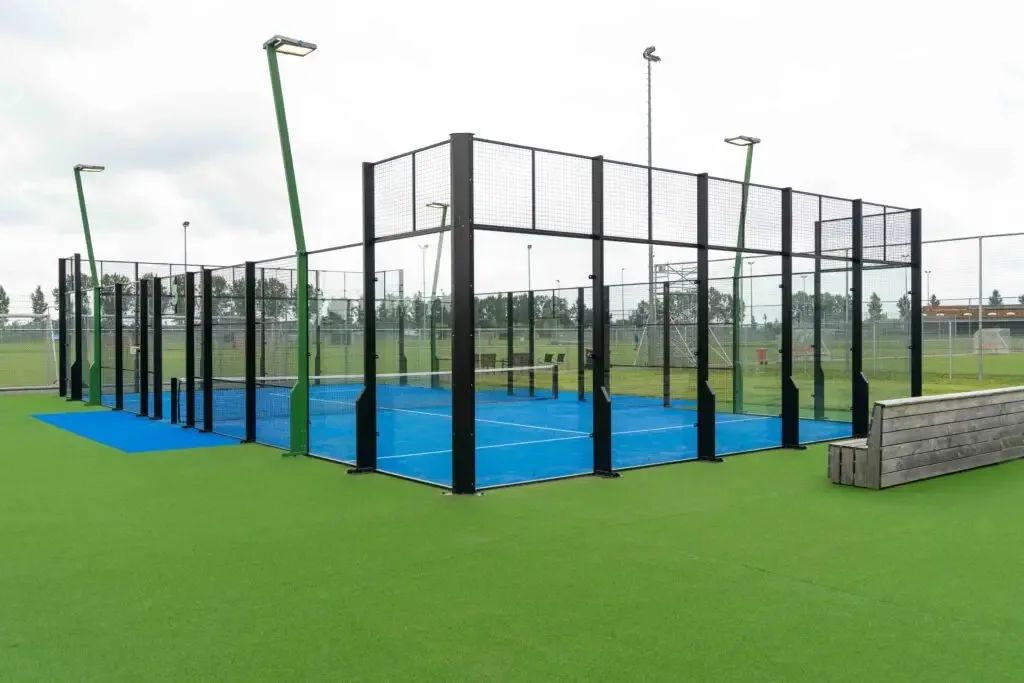
An indoor padel court in the Netherlands costs on average between €23,000 and €35,000 turnkey, that is, including steel structure, glass, artificial turf, LED lighting and installation. An outdoor padel court is more expensive: including foundation, count on an investment from around €50,000 per court. The market average for indoor courts is around €30,000 to €35,000.
That range is wide, and not without reason. The price of a padel court is determined by a combination of factors: the type of court, the number of courts at the location, the accessibility, the desired options and the choice between a turnkey package or separate material supply. Anyone who looks only at the lowest price often misses the complete picture. A court that seems cheaper can cost more in the long run due to lower material quality, limited warranty or poor service.
An important detail: prices for outdoor courts are almost always quoted excluding foundation. The foundation is a separate and sometimes substantial cost item. More on this later in this article.
Which components determine the price of a padel court?
The price of a padel court consists of several components: the steel structure, the glass, the artificial turf, the LED lighting, the foundation and the installation. With a turnkey package, all these components are included. The exact price is further determined by the type of court, the number of courts, the location and any extra options.
Steel structure and glass
The steel structure forms the skeleton of the court. The quality and weight of the steel differ per type of court and per application. For outdoor courts the structure must be heavier than for indoor courts, because of wind load and weather influences. The glass around the court is toughened safety glass of 10 or 12 mm thickness, depending on the chosen model.
Artificial turf and LED lighting
The artificial turf for padel courts is a specialised product. According to the NOC*NSF guidelines, it must be a short-pile artificial turf fibre with an effective length of 11 to 15 mm, infilled with stabilising material on a bound foundation.
Products must be on the sports products list in order to qualify for certification by Kiwa ISA Sport, which is mandatory for official competition use. Cheaper artificial turf that does not meet these standards can lead to rejection at inspection. The LED lighting varies in specification and power, which also influences the price.
Installation and location factors
The accessibility of the location plays a bigger role than many people expect. A hall with narrow access doors, a hard-to-reach construction site or a location far from the production site raises the installation costs. With multiple courts at one location, economies of scale arise: the fixed costs for transport and installation are spread over more courts.
What is the difference in cost between an indoor and an outdoor court?
An indoor court is structurally cheaper than an outdoor court. The biggest difference lies in the foundation and the heavier steel structure needed for outdoor courts. An indoor court starts turnkey from around €23,000. An outdoor court quickly starts from €30,000 excluding foundation, and from €50,000 on average including foundation.
With an indoor court the base is already there, the structure does not have to be as resistant to wind and rain, and permits are generally not needed for the court itself. Different rules apply to an outdoor court. The steel structure must be hot-dip galvanised to protect against the weather. The wind load on open ground is considerably greater than in a hall, which requires heavier posts and connections.
On top of that, outdoor courts almost always incur extra costs for permits, an acoustic study and sometimes a lighting study. An environmental permit is almost always mandatory for outdoor courts in the Netherlands, with an average lead time of 8 to 12 weeks. Take this into account in your planning and budget.
How much influence does the foundation have on the total investment?
For outdoor padel courts, the foundation is the largest single cost item. Foundation costs average between €20,000 and €40,000 per court, depending on the soil conditions, the accessibility of the location and the civil engineering work required. This sometimes makes the foundation more expensive than the court itself.
There are three common foundation types for padel courts:
- Drainage concrete is a water-permeable type of concrete in which rainwater drains directly through the foundation into the ground. It has an average lifespan of 25 to 40 years and is suitable for locations with good soil conditions.
- Supersub is a foundation solution based on foam concrete: lightweight, self-levelling and shock-absorbing. It is water-permeable for outdoor use and in many cases can be poured within a single day. The thickness varies from approximately 10 cm for renovations to 15 cm for new builds.
- ZOAB asphalt (open asphalt concrete) is a porous type of asphalt that lets water through and is a good choice in certain situations.
All foundation components must be approved by Kiwa ISA Sport in the Netherlands. This is a legal requirement for official use, and it protects you as a client against materials that turn out afterwards not to comply. With existing tennis courts, part of the substructure can sometimes be reused, which can considerably lower the foundation costs. A soil survey (penetration test) is always the first step to determine which foundation is needed and what the exact costs are.
Why are sound-absorbing panels an extra cost item?
Sound-absorbing panels are an additional investment on top of the court itself, and they also entail a structural modification. The panels are placed on the outside of the mesh of the cage structure and reduce the wind permeability of the structure. As a result, the steel structure has to be reinforced, which brings extra costs.
Padel produces more noise than tennis. The ball hitting glass and steel, combined with the cage structure acting as a sounding board, results in an average sound power level of approximately 91 dB. For locations near homes, an acoustic study is almost always mandatory, and municipalities are setting ever stricter noise standards.
High-quality sound-absorbing panels achieve absorption class A with an absorption value of 0.80. In practice, this delivers a clearly audible noise reduction at distances of approximately 40 to 100 metres. The structural reinforcement needed when installing panels consists of heavier posts, additional columns or modified connections. This is not an optional measure: it is necessary for the safety and lifespan of the court.
Besides panels, there is also the option of a noise barrier: a freestanding sound-blocking structure next to or around the court. A noise barrier almost always requires an environmental permit and a structural calculation, which raises the costs further. In many situations a combination of panels and a noise barrier is the most effective, where the barrier can sometimes be made lower thanks to the panels, which saves costs.
How do you determine whether a turnkey package or material supply is more cost-effective?
A turnkey package is more cost-effective if you have no installation capacity of your own. Material supply without installation is interesting if you have your own construction crew that can carry out the assembly itself. The cost advantage of material supply quickly disappears if you have to bear the coordination, planning and risks of the installation yourself.
With a turnkey package you arrange everything through one party: from groundwork and foundation to steel structure, glass, artificial turf, LED lighting and delivery. That means one point of contact, one responsibility and one warranty. If something does not fit at the interface between components, there is no discussion about who has to fix it.
Material supply without installation is particularly relevant for customers abroad, for example in Germany, where companies usually have their own construction crews. For Dutch locations without their own installation capacity, the turnkey package is almost always the wisest choice, financially too. Coordinating multiple parties takes time and money, and if something goes wrong, the question of who pays the bill quickly becomes complicated.
What are the most common cost mistakes when building a padel venue?
The most common cost mistakes when building a padel venue are: underestimating the foundation, forgetting the permit costs, thinking about noise too late and selecting solely on the lowest purchase price. Each of these mistakes can lead to unexpected additional costs or delays in the project.
- Underestimating the foundation. Many clients calculate only with the price of the court itself. For outdoor courts the foundation is an equally large, sometimes larger cost item. Without a soil survey you don't know what the ground requires.
- Forgetting permit and study costs. An acoustic study, a lighting study, structural calculations and the permit application itself cost time and money. Always include them in your budget.
- Including noise too late. Adding noise measures afterwards is more expensive than including them in the design straight away. In addition, a municipality can shut the court down if noise standards are exceeded.
- Selecting on the lowest price. Cheaper materials that do not meet the NOC*NSF standards or are not certified by Kiwa ISA Sport can lead to rejection at inspection and high replacement costs.
- Not using economies of scale. With multiple courts at one location, the cost per court falls considerably. Anyone who starts with one court and expands later pays the fixed costs twice.
At I-Padel we regularly see clients starting with a budget that is too tight because they did not have all the cost items in view. Good preparation, including a soil survey and early consultation with the municipality, prevents most surprises. We are happy to think along with you, without obligation, about the set-up of your project and help you put together a realistic total budget. Get in touch or request a non-binding quote for building a padel court straight away.
Frequently asked questions
How many courts do I need at minimum to operate a profitable padel venue?
For a commercially profitable operation, most operators advise a minimum of four courts at one location. Below that threshold, the fixed costs for staff, management and maintenance are relatively high compared with the court revenue. In addition, with four or more courts you benefit from significant economies of scale on construction costs, so the investment per court is considerably lower than with one or two courts.
How long does it take on average before a padel venue is fully operational?
For an outdoor venue, count on a lead time of at least six to nine months from the first consultation to opening. The environmental permit alone takes an average of eight to twelve weeks, and an acoustic study usually has to be completed before the permit application. For an indoor venue with no permit requirement for the court itself, the lead time can be shorter, but here too good preparation, including a soil survey and technical drawings, takes at least a few months.
Can I convert existing tennis courts into padel courts and what does that save in costs?
Yes, converting existing tennis courts into padel courts is possible in many cases and can save considerable costs. If the existing base is of sufficient quality and meets the requirements for padel, part of the foundation can be reused — which directly lowers the largest cost item for outdoor courts. A soil survey and inspection of the existing paving are always the first step to determine what can be reused and what has to be replaced.
What subsidies or financing options are available for building padel courts?
Municipalities, sports federations and provinces sometimes offer subsidies for the construction of sports facilities, including padel courts. The BOSA fund (Stimulering bouw en onderhoud sportaccommodaties) of the national government is a well-known scheme that sports clubs can use. In addition, some banks and leasing companies offer specific financing constructions for sports infrastructure. It is wise to contact your municipality and the Netherlands Enterprise Agency (Rijksdienst voor Ondernemend Nederland, RVO) early in the process to find out which schemes apply to your situation.
What are the annual maintenance costs of a padel court that I need to account for?
Annual maintenance costs for a padel court consist mainly of maintaining the artificial turf (topping up stabilising material, brushing), inspecting and possibly repairing the glass and steel structure, and maintaining the LED lighting. On average, count on an annual maintenance budget of approximately €1,500 to €3,000 per court, depending on use and location. Artificial turf generally has a lifespan of eight to twelve years with intensive use, after which replacement is necessary. This is a cost item you should include in your long-term budget.
Do I also need to apply for an environmental permit for an indoor padel court?
For the padel court itself inside an existing hall, an environmental permit is generally not needed. Permits may, however, be required if the hall itself is renovated, extended or changes its designated use. Always check with your municipality whether the intended activity fits within the applicable zoning plan, and ask in good time whether a notification or permit is needed for any structural modifications to the building.
How do I compare quotes from different padel court suppliers fairly?
Always compare quotes on the basis of a fully identical package: check whether foundation, installation, LED lighting and artificial turf are included, and whether the materials are certified by Kiwa ISA Sport and meet the NOC*NSF standards. Ask each supplier explicitly about the warranty conditions, the lifespan of the materials used and the service arrangements after delivery. A quote that looks cheaper at first glance can turn out considerably more expensive in the long run due to missing components or lower material quality.


