Blog · 2 September 2026 · 13 min read
Which factors determine the noise nuisance of a padel court?
Padel court noise nuisance depends on location, playing behaviour and structure. Discover which factors count and when an acoustic study is mandatory.

In this article
- How loud is a padel court, actually?
- Which types of noise does a padel court produce?
- Why does an outdoor court sound louder than an indoor court?
- Which location factors amplify or reduce the noise?
- How does playing behaviour influence the noise level?
- When is an acoustic study mandatory for a padel court?
- Which measures reduce noise nuisance at the source?
- Not sure whether outdoor padel is feasible at your location?
- Frequently asked questions
The noise nuisance of a padel court is determined by a combination of factors: the type of noise released during play, the location of the court, the surroundings, the distance to homes and the behaviour of the players. There is no fixed noise load that applies to every padel court. Every situation is different, and so is the degree to which local residents experience nuisance. The questions below help you understand which factors play a role and when action is needed.
How loud is a padel court, actually?
A padel court produces an average sound power level of around 91 dB. By comparison, for tennis this sound power level is on average some 10 dB lower. That sounds like a small difference, but in acoustics 10 dB means a clearly audible increase in noise load. This difference makes padel a sport that is perceived in practice as noticeably louder than tennis, especially at short distances.
The measured sound power level does not say everything about the nuisance local residents experience. The actual noise load at a given point depends on the distance to the court, the presence of obstacles, the acoustic properties of the surroundings and the number of courts in use at the same time. At greater distances the noise level drops quickly, but at locations close to homes the load can still exceed the applicable standards.
For outdoor padel court projects near residential areas, it is therefore wise to engage an independent acoustic consultant early in the planning process. Based on the specific location, the consultant can calculate the expected noise load and whether additional measures are needed.
Which types of noise does a padel court produce?
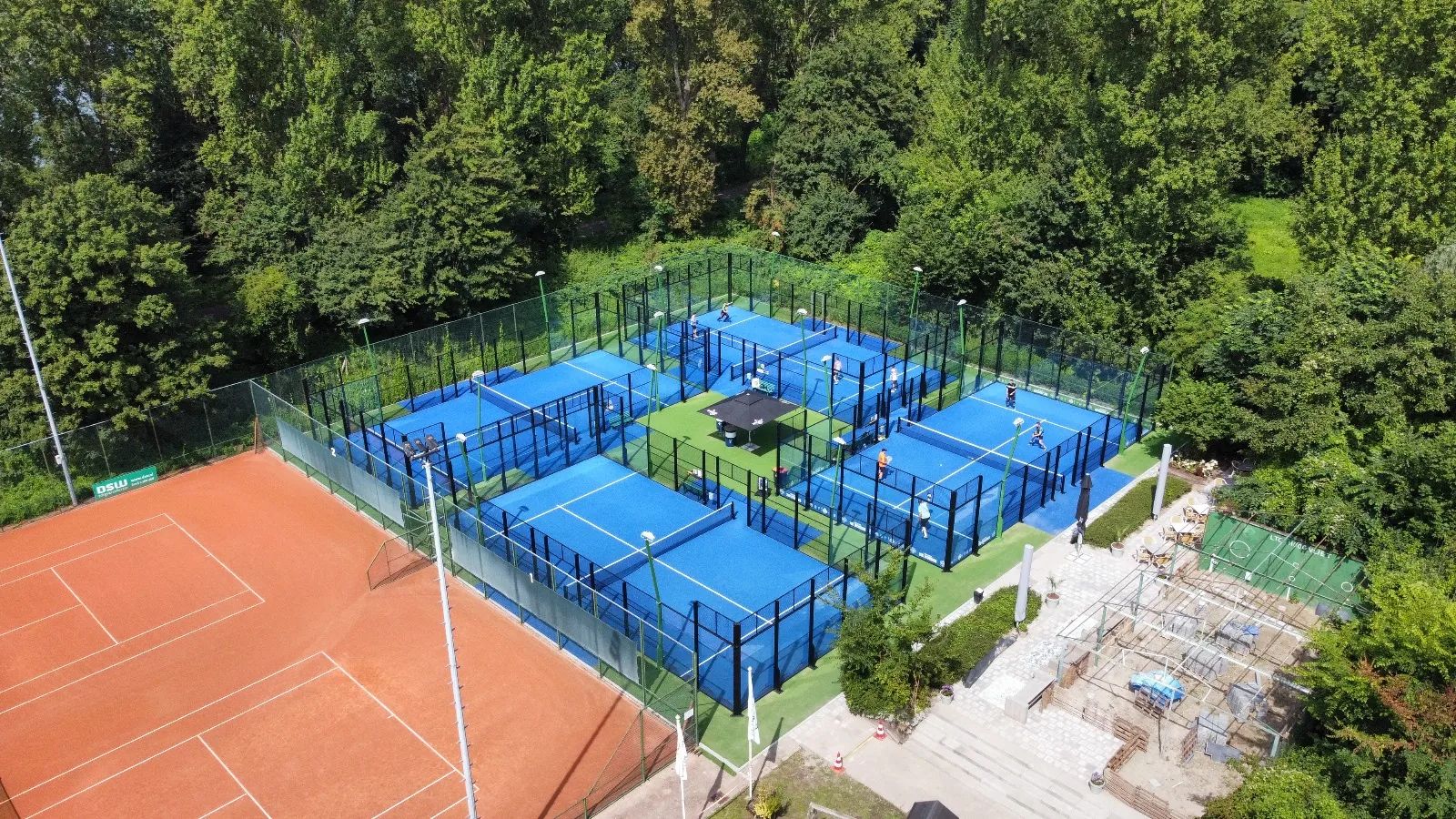
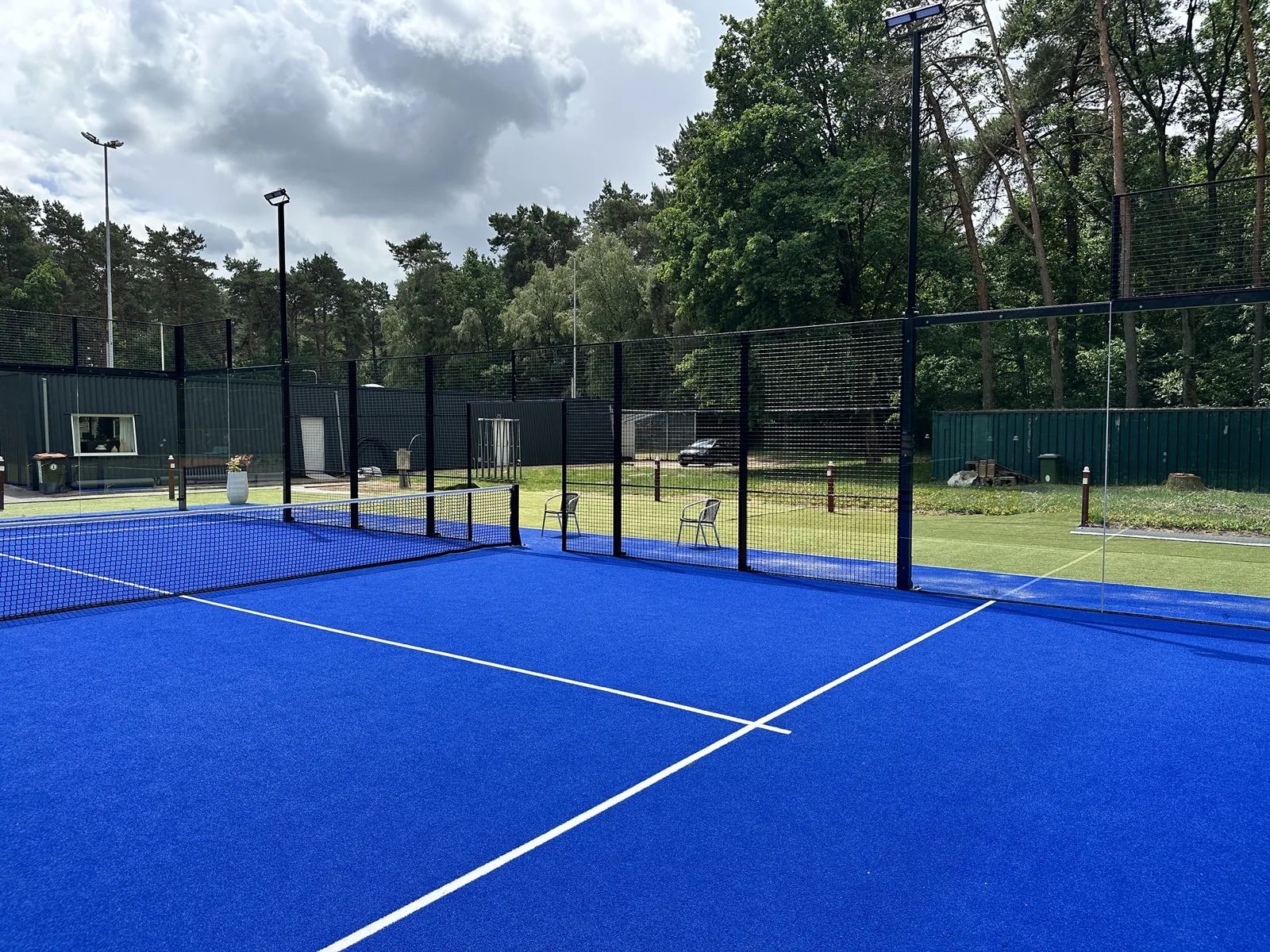
A padel court produces two main types of noise: the impact noise of racket on ball, and the contact noise of the ball hitting the glass walls and the steel mesh. This second type plays the largest role in the nuisance experienced. The glass and steel of the cage structure act as a resonance box: they amplify the sound and spread it to the surroundings.
The impact noise of racket on ball is relatively short and sharp. The contact noise of the ball against the glass is louder, has a higher peak value and carries further through the surroundings. When several courts stand side by side and are played on at the same time, these noise peaks add up. This makes the total noise load at padel locations with several courts considerably higher than with a single court.
Besides the ball, the players themselves are also a noise source. Shouts, encouragement and conversations between points contribute to the total noise level. This type of noise is harder to control with technical measures, but in practice plays a smaller role than ball and structure noise.
Why does an outdoor court sound louder than an indoor court?
An outdoor court sounds louder than an indoor court because there is no enclosing structure that absorbs or holds back the noise. With an indoor court, the walls, ceiling and floor of the hall dampen part of the noise. With an outdoor court, the noise spreads freely in all directions, with no obstacles limiting the emission.
Reflection also plays a role. In a hall, noise is reflected off the walls, but part of that energy is also absorbed by the building materials. Outdoors there is no enclosure with this effect. The noise of the ball against the glass and the steel structure radiates directly into the surroundings.
An additional difference is the background noise level. Indoors the surroundings are often quieter, but the noise is also more contained. Outdoors the background noise is sometimes higher during the day because of traffic or other activities, but in the evening hours it drops sharply. It is precisely then, when people play outdoors, that the ambient noise is low and the padel noise is more noticeable to local residents.
Which location factors amplify or reduce the noise?
The location of a padel court has a major influence on the noise load experienced by local residents. The main factors are the distance to homes, the presence of buildings or planting, the orientation of the courts and the height of surrounding obstacles. The greater the distance to homes, the lower the noise load. But the layout of the site can also amplify or dampen the noise.
Factors that amplify the noise
Hard, reflective surfaces in the surroundings, such as concrete walls, facades or paved paths, can reflect noise towards homes. An open site without planting or buildings offers little natural damping. Courts oriented parallel to homes direct the noise straight at those buildings.
Factors that reduce the noise
Planting, earth banks, buildings and other obstacles between the court and the homes can limit the noise emission. A smart site layout, in which the courts are positioned so that the closed sides of the cage structure face the homes, can already make a noticeable difference. The foundation can also make a small contribution: a porous base such as drainage concrete has some sound-absorbing properties thanks to its open structure, although this effect is limited and not sufficient as a stand-alone measure.
For a reliable assessment of the location-specific situation, an independent acoustic study is the appropriate route. Based on the site layout, the surroundings and the planned court configuration, an acoustic consultant can calculate the expected noise load and which measures are suitable. You can find more information on the possible acoustic solutions for padel on the relevant page.
How does playing behaviour influence the noise level?
The playing behaviour of the players has a direct influence on the noise level of a padel court. Hitting harder means a higher impact speed of the ball on the glass and the mesh, leading to higher noise peaks. Competitive play and intensive recreational play therefore produce more noise than relaxed recreational play or training with beginners.
Besides hitting power, the frequency of the shots also plays a role. In active play, noise peaks follow each other quickly, which raises the average noise load. In training sessions or lessons with beginners, the pace is lower and the shots are less powerful, resulting in a lower noise load.
The time of play is also relevant. During the day, when the background noise is higher because of traffic and other activities, padel noise is less noticeable. In the evening hours the background noise decreases and the noise from the court is experienced as relatively louder. Locations that are also played on after 7 p.m. therefore run a greater risk of complaints from local residents, even if the absolute noise load during the day causes no problems.
This makes the use of the location a factor that must be included in the permit application and the acoustic study. Based on the opening hours, a municipality can set additional requirements for the noise measures.
When is an acoustic study mandatory for a padel court?
In most cases, an acoustic study is mandatory when an outdoor padel court is built near homes or other noise-sensitive uses. Municipalities almost always request this study as part of the environmental permit application. Without this study, a permit cannot be obtained in most situations.
The obligation is linked to the noise standards laid down in environmental law. Padel produces more noise than most other outdoor sports, and municipalities want certainty in advance that the noise load on the facades of nearby homes stays within the applicable standards. An independent acoustic consultancy carries out the calculations and draws up a report that is submitted with the permit application.
When an existing padel location is expanded, a new acoustic study may also be mandatory. This certainly applies if the number of courts increases or if the opening hours are extended. In that case the municipality assesses whether the new situation still meets the applicable standards.
We do not carry out acoustic studies ourselves. Our role is to supply the technical product specifications, structural data and engineering that an acoustic consultant needs to make correct calculations. You can read more about applying for a permit for a padel court on the relevant page.
Which measures reduce noise nuisance at the source?
A source measure is a noise measure applied directly at the noise source, rather than blocking the noise at a distance. At padel courts, sound-absorbing panels fixed to the outside of the cage structure are the most commonly applied source measure. They absorb the noise released when the ball hits glass and mesh, instead of reflecting it back to the surroundings.
Sound-absorbing panels as a source measure
Sound-absorbing panels are placed on the outside of the mesh of the cage structure. They have been independently tested in an acoustic laboratory and have a sound absorption class A, with an absorption coefficient of 0.80 and an absorption index of 8 dB. The airborne sound insulation is 22 dB, with a corresponding sound insulation index of 19 dB. In practice this results in an audible noise reduction at distances of roughly 40 to 100 metres, depending on the situation.
In a practical measurement at LTC Hofgeest, an indicative noise reduction of around 3 dB(A) was measured within the configuration studied, after correction for background noise. These results apply only to the situation studied and must not be presented as generally valid for every location.
An important point of attention when applying panels is the structural consequence. Panels reduce the wind permeability of the cage structure, so the wind load on the structure increases. This means that in almost all cases the steel structure has to be structurally reinforced. Think of heavier posts, additional columns or modified connections. This applies both to new courts and to retrofitting panels on existing courts. You can find more about the structure and wind load of padel courts on the relevant page.
The panels can be applied on one side of the court, on several sides, in the lower or upper metres of the cage, or over the full height. Which configuration is suitable depends on the results of the acoustic study, the position of the court relative to homes and the space available.
Noise barriers as an additional or alternative measure
A noise barrier is a free-standing structure placed next to or around the padel court that blocks the noise towards homes. Unlike panels, a noise barrier works at a greater distance from the source. Noise barriers can be built up to heights of 6 to 8 metres and can be tens of metres long.
In some situations a combination of sound-absorbing panels and a noise barrier is the most effective. The panels reduce the noise at the source, so a noise barrier can be built lower. This can save costs and make the permitting easier, because lower structures have less spatial impact.
Which measure or combination of measures is suitable differs per project. An independent acoustic consultant determines, based on the project situation, which approach is feasible technically and in terms of permits. You can find more about the possibilities of acoustic solutions for padel and noise barriers around padel courts on the relevant pages.
Not sure whether outdoor padel is feasible at your location?
We are happy to think along with you on the court configuration, structural preparation and possible noise measures. Together with your acoustic consultant, we look at which solution is technically feasible and suits the project. Get in touch for an initial exploration via our page on acoustic solutions for padel.
Frequently asked questions
How many padel courts can I place side by side before acoustic measures become mandatory?
There is no fixed number of courts at which measures automatically become mandatory; this depends entirely on the location, the distance to homes and the noise standards that apply in your municipality. Every extra court increases the cumulative noise load, which makes it more likely that the standards are exceeded. Based on the number of courts and the site layout, an acoustic consultant can calculate from which configuration onwards additional measures are needed.
What are the most common mistakes when applying for a permit for an outdoor padel court?
A common mistake is engaging an acoustic consultant too late, so that the choice of location or court orientation is already fixed while simple adjustments could have lowered the noise load considerably. In addition, applicants often underestimate the influence of opening hours: evening use after 7 p.m. sets stricter requirements and in many cases calls for heavier measures. Also make sure the structural data of the cage structure is available to the acoustic consultant, because it is needed for correct calculations.
Can I also retrofit sound-absorbing panels to an existing padel court?
That is technically possible, but almost always requires a structural modification of the existing cage structure. Panels reduce the wind permeability, so the wind load on the structure increases; the posts, columns and connections must be calculated for this and possibly reinforced. Have the existing structure assessed by a structural engineer first, before you order or fit panels.
Which noise standards apply in the Netherlands to outdoor padel courts near homes?
In the Netherlands, the noise standards for sports facilities are determined through the Activities Decree (Activiteitenbesluit) or, under the Environment and Planning Act (Omgevingswet), through the municipality in the environmental permit. Limit values of 50 dB(A) as a 24-hour value on the facade of nearby homes generally apply, but municipalities can deviate from this and apply stricter or more lenient standards.
Because the standards can differ per municipality and per situation, it is essential to contact the municipality at an early stage and to engage an acoustic consultancy that is familiar with the local regulations.
Does placing the padel court in a building or under a roof help to prevent noise nuisance?
A covered or indoor padel court considerably reduces the noise emission to the surroundings, provided the hall is sufficiently insulated and acoustically treated. The walls and roof of the hall act as an extra noise barrier, so the load on nearby homes decreases sharply. Do note that the noise inside the hall itself can be intense; acoustic measures are also advisable for the interior to safeguard playing comfort.
How can I involve local residents early to prevent complaints and objections?
Early communication with local residents considerably reduces the chance of objections during the permit procedure. Organise an information evening before the permit application is submitted, present the planned noise measures and give local residents the opportunity to ask questions. By being transparent about the results of the acoustic study and the measures being taken, you build support and prevent objections from only surfacing late in the process.
What is the difference between sound absorption and sound insulation, and why is that relevant for padel courts?
Sound absorption reduces the reflection of sound by converting it into heat via porous or soft materials; the sound is, as it were, “swallowed up” at the source. Sound insulation blocks the transmission of sound from one space to another via a solid or multi-layer structure.
At padel courts both principles are relevant: absorption panels on the cage structure reduce the emission at the source, while a noise barrier or a closed structure blocks the remaining noise towards homes. A combination of both approaches delivers the best result in most situations.