Blog · 29 September 2026 · 11 min read
Which compact noise solutions are there for padel courts?
Sound-absorbing panels or a noise barrier for your padel court? Find out which compact solution suits your location, permit and budget.
In this article
- What is the difference between a noise screen and sound-absorbing panels?
- How do sound-absorbing panels work as a source measure?
- What effect do sound-absorbing panels have on the structure of the padel court?
- Are sound-absorbing panels effective enough for a permit?
- When is a noise screen the better choice after all?
- Do I need an acoustic study for an outdoor padel court?
- What do compact noise solutions for a padel court cost?
- Not sure whether outdoor padel is feasible at your location?
- Frequently asked questions
For an outdoor padel court, two compact noise solutions are used most often in practice: integrated sound-absorbing panels as a source measure, and freestanding noise barriers. Which solution is appropriate depends on the location, the distance to homes and the results of an independent acoustic study. The questions below give you a clear picture of the differences, how each solution works and the trade-offs that play a role in every project.
What is the difference between a noise screen and sound-absorbing panels?
A noise screen is a freestanding structure placed next to or around the padel court that blocks sound towards the surroundings. Sound-absorbing panels are mounted directly on the steel structure of the padel court and work as a source measure: they absorb sound where it originates, on the outside of the cage structure.
The practical difference lies in placement and working principle. A noise screen stands separately from the court, can be built high (up to 6 to 8 metres) and focuses on shielding sound in a specific direction. Sound-absorbing panels are more compact, are integrated into the existing structure and reduce noise emissions directly at the source. This means less space is needed and the visual impact stays limited.
A freestanding noise screen almost always requires an environmental permit, because it is regarded as an independent structure. Sound-absorbing panels are part of the padel court itself and are included in the permit application for the court. On locations with limited space or strict aesthetic requirements, this can be a relevant difference.
How do sound-absorbing panels work as a source measure?
A source measure is a measure applied directly at the sound source, rather than blocking the sound after it has already spread. Sound-absorbing panels are mounted on the outside of the mesh of the cage structure. The panels contain a sound-absorbing material, such as rock wool, which partly absorbs sound waves instead of reflecting them.
Rock wool has an open fibre structure that converts the kinetic energy of air particles into heat. As a result, part of the incident sound energy is absorbed. The exact performance depends on the material thickness, the density, the finish, the placement and the frequencies of the sound.
The panels have been independently tested in an acoustic laboratory. These tests show sound absorption class A, an absorption value of 0.80 and a sound insulation index DLR of 19 dB. In a practical measurement at LTC Hofgeest, an indicative noise reduction of approximately 3 dB(A) was measured within the configuration studied, after correction for background noise. These results apply only to the situation studied and must not be regarded as a general product guarantee.
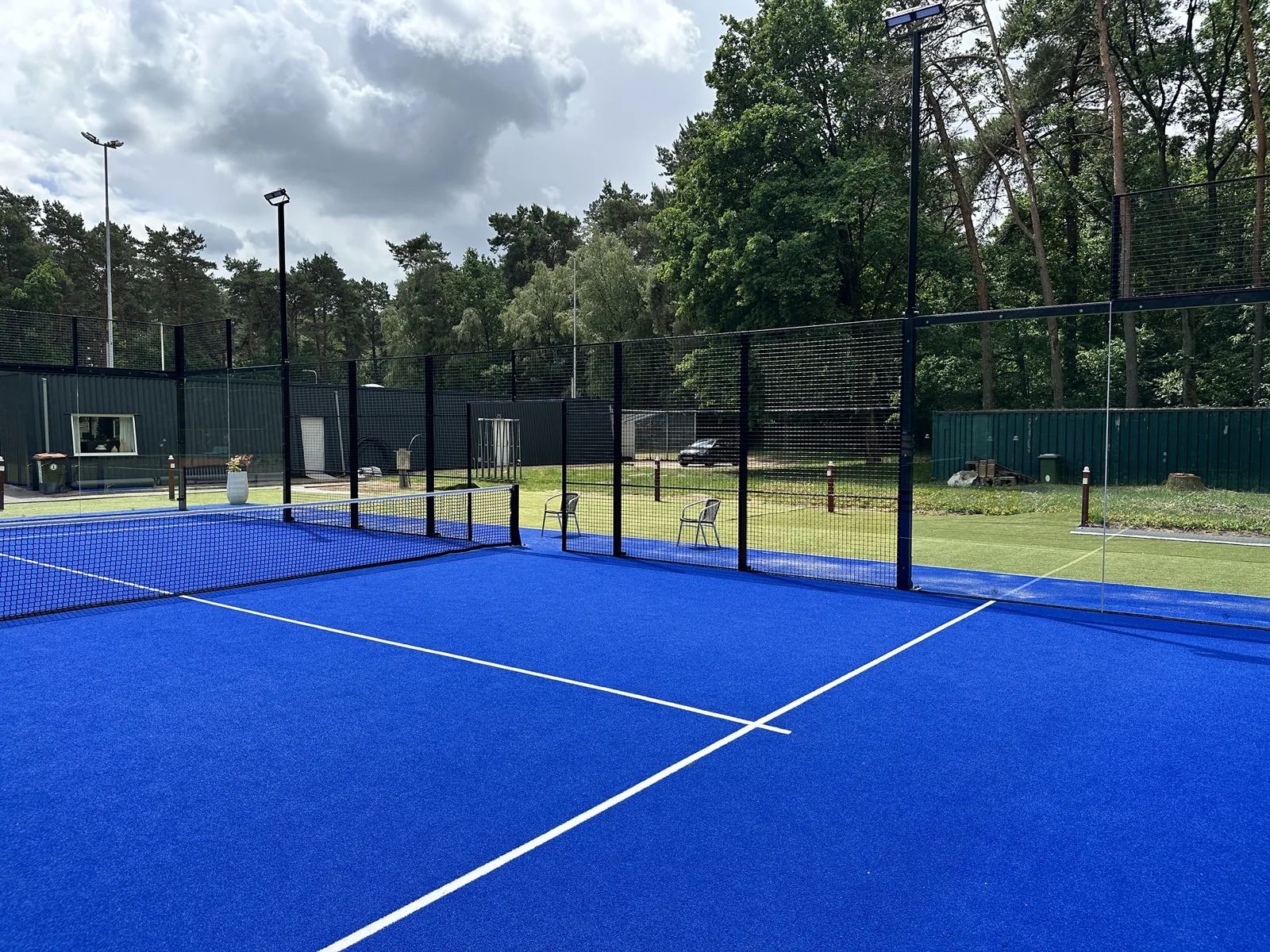
The position of the panels plays a major role. At LTC Hofgeest, the panels were installed above the glass on the two short ends of the court. On other locations it may be necessary to fit panels on several sides, or to use a different configuration altogether.
The optimal placement is determined by the location, the direction of sensitive receptors and the results of the acoustic study. You can find more information about how it works and how it is applied on the page about acoustic solutions for padel.
What effect do sound-absorbing panels have on the structure of the padel court?
Sound-absorbing panels should never be considered separately from the structure they are mounted on. The panels reduce the wind permeability of the cage structure, which causes extra wind load on the steel structure. The structure must be recalculated for this before panels are installed.
In practice, this means that in many cases the steel structure has to be structurally reinforced. This may involve heavier posts, additional columns or modified connections. The exact modifications depend on the location, the wind zone, the number of sides on which panels are fitted and the height of the panels.
For new padel courts, this can be taken into account right away during the engineering phase. For existing courts, a structural assessment is needed before panels are added. In that case, a structural engineer assesses whether the existing steel structure is suitable and which modifications are necessary.
We produce the steel structures in-house, in accordance with EN 1090-1 and up to and including execution class EXC3. This allows columns, connections, base plates and anchors to be adapted per project when additional requirements arise from noise measures or higher wind loads. You can read more about the structural build-up and the influence of wind load on the page about structure and wind load.
Are sound-absorbing panels effective enough for a permit?
Sound-absorbing panels are one possible measure within a broader noise strategy and are no guarantee of obtaining a permit. Municipalities assess permit applications on the basis of the full situation, including noise, structural safety, spatial integration and the underlying studies.
Whether sound-absorbing panels are sufficient depends on the distance to homes, the surroundings, how intensively the court is used and the noise standards applied by the municipality. On some locations, integrated source measures can be enough to meet the requirements set. On other locations, additional measures are needed, such as a noise barrier or adjustments to the site layout.
An independent acoustic consultant determines which measures are needed on a specific location. We supply the technical product specifications, structural data and engineering needed to carry out acoustic calculations correctly. Based on the results of those calculations, a suitable structural solution can then be developed. You can read more about the permit process and the role of the acoustic study on the page about the permit for a padel court.
When is a noise screen the better choice after all?
A freestanding noise screen can, in certain situations, be a better or necessary addition to sound-absorbing panels. This is particularly the case when the distance to homes is small, the noise standards are strict or when noise has to be limited from several directions.
Noise barriers can be built up to heights of 6 to 8 metres and over lengths of tens of metres. They are aimed at one specific direction where reduction is needed. In combination with sound-absorbing panels on the court, a noise barrier can sometimes be built lower, which saves costs and can simplify permitting.
A noise barrier does require more space and almost always needs a permit as an independent structure. Structural calculations, cone penetration test data and an environmental permit are mandatory in most cases. Which measure is suitable depends on the project situation and is determined on the basis of an independent acoustic study.
Do I need an acoustic study for an outdoor padel court?
When homes or other noise-sensitive buildings are located near the planned padel court, an acoustic study is in many cases a mandatory part of the permit process. The municipality ultimately determines which studies are necessary.
Padel produces more noise than tennis. The ball hitting glass and steel, combined with the cage structure acting as a sounding board, results in an average sound power level of approximately 91 dB. That is about 10 dB more than with tennis. When a court is located near homes, an acoustic study is therefore almost always required.
An independent acoustic firm is responsible for the calculations and measurements. We do not carry out acoustic studies ourselves, but we supply the technical product specifications, structural data and engineering needed to carry out acoustic calculations correctly. Together with your acoustic consultant, we make sure the technical information about the court is available for the calculations.
What do compact noise solutions for a padel court cost?
The cost of noise solutions for a padel court depends heavily on the measure chosen, the number of sides on which panels or screens are applied, the dimensions and the structural modifications required. There is no fixed price that applies to every situation.
Sound-absorbing panels that are integrated into the steel structure involve structural costs in addition to the cost of the panels themselves. When the cage structure has to be reinforced because of extra wind load, additional modifications to the steel structure are needed. The exact costs always depend on the location, the wind zone, the number of sides and the project-specific situation.
Besides the structure itself, a freestanding noise barrier also requires a foundation, structural calculations and a permit process. This generally makes a noise barrier a larger investment than sound-absorbing panels, but on some locations it is the most suitable solution.
As an indication, an outdoor padel court including foundation is realised from approximately €50,000 per court. Noise measures come on top of this and are always budgeted per project. The exact price always depends on the situation, the measures chosen and the structural conditions.
Not sure whether outdoor padel is feasible at your location?
We are happy to think along with you about the court configuration, structural preparation and possible noise measures. Together with your acoustic consultant, we look at which solution is technically feasible and suits the project. Get in touch via the page about noise solutions for padel courts for an initial, no-obligation exploration.
Frequently asked questions
Can I add sound-absorbing panels to an existing padel court afterwards?
Yes, that is possible, but it always requires a structural assessment by a structural engineer first. Because the panels reduce wind permeability, the wind load on the steel structure increases, and not every existing structure is suitable for this without modifications. Depending on the outcome, heavier posts, extra columns or modified connections may be needed before the panels can be installed safely.
How do I know which sides of the padel court need noise measures?
This is determined by the position of sensitive receptors, such as homes, relative to the padel court and by the results of an independent acoustic study. An acoustic consultant maps out from which directions the most noise reaches the surroundings and, on that basis, advises on the optimal placement of panels or screens. It is therefore not a standard solution, but always tailor-made for each location.
What is the difference in lead time between a project with sound-absorbing panels and a project with a freestanding noise barrier?
A project with sound-absorbing panels generally runs faster, because the panels are included in the permit application for the padel court itself and do not require a separate permit process. A freestanding noise barrier is regarded as an independent structure and requires a separate environmental permit, including structural calculations and, in many cases, cone penetration test data. This can considerably extend the total lead time of a project.
Are there guidelines for the maximum noise level that a municipality applies to padel courts?
Municipalities generally apply the standards from the Activiteitenbesluit (Environmental Activities Decree) or the Omgevingswet (Environment and Planning Act), under which specific limit values apply to sports facilities for the daytime, evening and night-time periods. Because padel produces approximately 10 dB more noise than tennis, the standard is exceeded sooner on many locations than with other outdoor sports. An independent acoustic consultant determines which standards apply in your specific municipality and situation and whether additional measures are needed.
What common mistake should I avoid when planning noise measures for a padel court?
A common mistake is postponing the acoustic study until late in the planning process. When the results of that study only become known after the structure has already been designed or ordered, necessary modifications, such as a heavier steel structure or an extra noise barrier, can lead to considerable extra costs and delays. By integrating the acoustic study early in the engineering phase, noise measures can be incorporated directly into the structural design.
Can a combination of sound-absorbing panels and a noise barrier together allow a lower noise barrier?
Yes, that is certainly possible in practice. When sound-absorbing panels as a source measure already reduce part of the noise emissions, an additional noise barrier needs to provide less reduction and can in some cases be built lower. This can both save costs and simplify permitting, because a lower barrier has less spatial impact. Whether this combination is feasible in your situation is determined by the acoustic consultant on the basis of calculations.
What do I need to provide to an acoustic consultant to make the study run smoothly?
For a correct acoustic study, the consultant needs, among other things, the site plan of the location, the distance to surrounding homes, the expected usage pattern of the court and the technical product specifications of the padel court. We supply the structural data, engineering documentation and product specifications needed to carry out the calculations correctly, so that the consultant can work with the right input data.