


Building a padel court · 7 April 2026 · 12 min read
Where do you start when you want to have a padel court built?
Want to have a padel court built? Discover costs, foundation types, permits and common mistakes. Plan smartly and avoid expensive errors.
In this article
- What exactly does building a padel court involve?
- What does it cost to have a padel court built in the Netherlands?
- What is the difference between an indoor and an outdoor padel court?
- What type of foundation do you need for a padel court?
- How do you choose a reliable contractor for a padel court?
- What are common mistakes when having a padel court built?
- How long does it take to build a padel court?
- Frequently asked questions
Having a padel court built starts with a few practical questions: what does it cost, what do you need and how do you go about it? This article gives you an honest and complete overview of everything you need to take into account, from the first orientation to delivery. Whether you want to expand a sports hall, modernise a tennis club or open a new padel venue, the steps are largely the same.
Below we answer the most frequently asked questions about building a padel court in the Netherlands, so you go into the conversation with a contractor or supplier well prepared.
What exactly does building a padel court involve?
Building a padel court involves more than just installing a cage structure. A complete project consists of groundwork, foundation, the steel structure, glass, artificial turf, LED lighting and installation. Depending on the location, permits, noise measures and structural calculations are added as well.
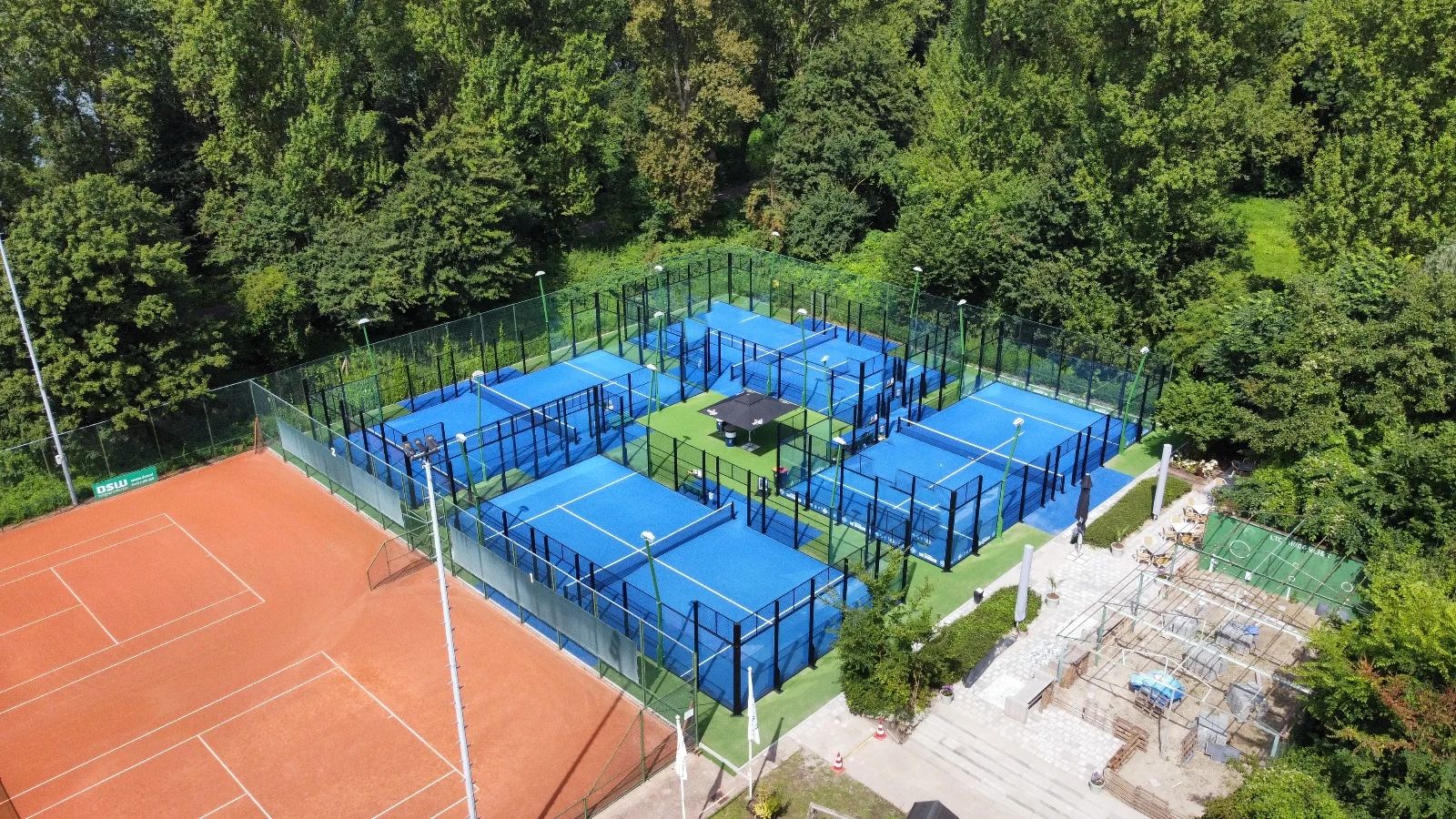
A padel court is an official playing field with fixed dimensions: the playing area itself is 20 by 10 metres. For assembly you need at least 21 by 11 metres, but a recommended working area, including run-off zones, is 21 by 14 metres. That extra space is not only handy during construction, but also makes the court safer and more pleasant to play on.
The cage structure consists of steel posts, mesh panels and safety glass. Artificial turf is laid around the court on a stable base. LED lighting provides sufficient light intensity, including for evening play. For outdoor courts the steel structure is heavier because of weather influences, and the foundation plays an even bigger role than with indoor courts.
Some projects call for additional measures, such as sound-absorbing panels at locations near residential areas. These panels are attached to the outside of the mesh and absorb the sound instead of reflecting it back. This does have consequences for the structure: because wind permeability decreases, the steel structure has to be structurally reinforced.
What does it cost to have a padel court built in the Netherlands?
As a guideline, a turnkey indoor padel court, including cage structure, artificial turf, LED lighting and installation, is possible from around €23,000 per court. An outdoor padel court, including foundation, starts on average from around €50,000, depending on the location and soil conditions. The exact price always depends on the type of court, the number of courts and the site conditions.
What determines the price of an indoor padel court?
The following factors play a role for an indoor padel court:
- The type of court: Pro, Panorama or Single, each with its own appearance and structural build-up
- The number of courts: with multiple courts, economies of scale arise in production and installation
- The accessibility of the location: transport and assembly conditions inside the hall
- Artificial turf and LED lighting: different quality levels are possible
- Extra options, such as run-off zones or alternative lighting systems
Why is an outdoor padel court more expensive?
For an outdoor court, several cost factors are added. The foundation is the largest: depending on the soil conditions, accessibility and the civil engineering work required, foundation costs average between €20,000 and €40,000. On top of that, an outdoor court requires a heavier steel structure that can withstand the weather, and permits are almost always mandatory.
A common mistake is to look only at the lowest price. In practice, this often leads to higher costs in the long run due to lower material quality, limited service or insufficient warranty.
What is the difference between an indoor and an outdoor padel court?
The main difference lies in the structural weight and the foundation requirements. An indoor padel court stands in a protected environment and does not have to take wind, rain or frost into account. An outdoor padel court must withstand all weather conditions, which leads to a heavier steel structure, a more extensive foundation and different material specifications.
For indoor courts the foundation is relatively simple: a flat, stable concrete floor is sufficient in many cases. For outdoor courts, the soil conditions largely determine what the foundation looks like. In addition, the steel structure of an outdoor court is hot-dip galvanised, which prevents rust and considerably extends its lifespan.
There is also a clear difference when it comes to permits. For an indoor padel court in an existing hall, a separate building permit is not always required, although fire safety and usage rules do apply. For an outdoor court, an environmental permit is almost always mandatory, because of the spatial impact, lighting and noise.
What type of foundation do you need for a padel court?
The most commonly used foundation types for padel courts are drainage concrete, Supersub and ZOAB asphalt. Which type fits best depends on the soil conditions, the intended use and the budget. There is no universally best choice: good foundation advice always starts with a site check and preferably with soil penetration test data.
What is drainage concrete?
Drainage concrete is a water-permeable type of concrete in which rainwater drains directly through the foundation into the ground. The open structure of the material makes this possible. It is a stable and durable solution that lasts an average of 25 to 40 years with correct maintenance. Drainage concrete is suitable for heavy loads, including the steel structure and glass walls of a padel court.
What is Supersub?
Supersub is a foundation solution based on foam concrete: a lightweight, self-levelling material that provides a flat and stable base. It is shock-absorbing, which contributes to playing comfort and less strain on the joints. The water-permeable variant for outdoor courts can handle large amounts of rainfall and prevents puddles. Supersub is also fully recyclable and requires less transport than traditional foundations.
What is ZOAB asphalt?
ZOAB asphalt, also known as open asphalt concrete, is a porous type of asphalt that lets water through. It is less common for padel courts, but in certain situations it is a good option, for example at locations where an asphalt surface is already present.
Important to know: all foundation components must be approved by Kiwa ISA Sport in the Netherlands. Working with certified materials is not only a matter of quality, but also protects you against non-conformity that could cause problems later in the inspection of the court.
How do you choose a reliable contractor for a padel court?
You can recognise a reliable contractor for a padel court by transparency about price and working method, demonstrable experience with comparable projects and a willingness to make structural calculations for each location. Always ask for references, certifications and warranty conditions before you accept a quote.
Pay attention to the following when comparing suppliers:
- In-house production or purchasing: suppliers who import their structures depend on foreign lead times and have less control over quality and customisation
- Complete package or coordination: some suppliers coordinate multiple subcontractors, which creates risks if something goes wrong between the parties
- Structural calculation per location: a standard court that is not tailored to wind load, soil conditions or noise requirements can cause problems later
- Warranty conditions: explicitly ask about the warranty on the steel structure, the artificial turf and the lighting separately
- Certification: ask whether the materials meet the requirements of Kiwa ISA Sport and whether the court can be certified for official use after delivery
A good contractor asks questions about your location instead of immediately quoting a standard price. Every location is different, and a serious supplier wants to know that before a quote is put on the table.
What are common mistakes when having a padel court built?
The most common mistakes when building a padel court are: choosing on price too early, underestimating the foundation, not accounting for permits and noise, and working with a supplier who does not make a structural calculation per location. These mistakes are avoidable if you know what to look out for.
Mistake 1: Looking only at the lowest price
A lower price sounds attractive, but may mean savings on material thickness, coating, artificial turf quality or warranty conditions. The investment in a padel court is meant for decades of use. A difference of a few thousand euros at purchase can later be paid back in higher maintenance costs or a shorter lifespan.
Mistake 2: Underestimating the foundation
The foundation determines the stability and lifespan of the court. Without a good foundation, there is a risk of subsidence, uneven settling and damage to the steel structure. Yet the foundation is regularly left out of quotes or treated as an afterthought. Always ask explicitly what is included in the price.
Mistake 3: Tackling permits and noise too late
Applying for an environmental permit takes an average of 8 to 12 weeks. If you plan for that too late, your entire timeline slips. The same applies to noise studies: for locations near residential areas an acoustic report is almost always mandatory, and its result can influence the design of the court.
Mistake 4: No structural calculation per location
Every location has different wind loads, soil conditions and spatial constraints. A supplier who delivers a standard structure without a location-specific calculation may be offering a court that does not meet the applicable standards. This can cause problems at the inspection by Kiwa ISA Sport or at a permit check.
How long does it take to build a padel court?
Building a padel court takes an average of 10 to 12 weeks from first contact to delivery. The assembly itself, including installing the cage structure and laying the artificial turf, takes 3 to 4 days. The remaining time goes to production, delivery, planning and any permit procedures.
A rough timeline looks as follows:
- Week 1 to 2: intake, site check, structural calculation and quote
- Week 2 to 4: permit application (if applicable; takes an average of 8 to 12 weeks at the municipality)
- Week 4 to 8: production of the steel structure and purchasing of other materials
- Week 8 to 10: groundwork and foundation
- Week 10 to 12: assembly of the cage structure (2 days), laying the artificial turf (1 to 2 days), installation of the LED lighting
- After delivery: inspection by Kiwa ISA Sport, if the court is intended for official matches
The permit procedure is often the biggest time variable. If you want to build an outdoor padel court, it is wise to start the permit application as early as possible, in parallel with the production phase. That way you avoid unnecessary delays.
At I-Padel we produce the steel structure entirely ourselves, in our own factory. That gives us direct control over planning and lead times, without depending on foreign production schedules. We handle the entire process, from groundwork to delivery, including support with the permit procedure. Want to know what building a padel court means for your location? Get in touch for an initial exploration and we will think along with you, without obligation.
Frequently asked questions
Can I have a padel court built on an existing concrete floor or asphalt base?
Yes, in many cases an existing base can be reused, but this depends on the condition, thickness and load-bearing capacity of the floor. A site check and, if needed, soil penetration testing are necessary to assess whether the existing base is suitable or needs to be reinforced. Sometimes a thin levelling layer is enough; in other cases a completely new foundation is still the safest choice.
How much space do I need at minimum to build several padel courts side by side?
Per court, allow for a minimum working width of 11 metres and a recommended width of 14 metres including run-off zones. With multiple courts side by side, you can partly combine the run-off zones in between, which saves space. A good rule of thumb is to allow at least 20 to 22 metres of width for two courts side by side, but always have this tailored to your specific location and the desired playing comfort.
Is a permit also needed if I want to place a padel court indoors in an existing sports hall?
Not always, but it depends on the situation. For an indoor padel court in an existing hall a separate building permit is often not required, but fire safety rules, notification of use and any zoning plan changes may apply. It is wise to contact the municipality beforehand to verify what applies in your specific case, so you don't face surprises afterwards.
What are the annual maintenance costs of a padel court?
The annual maintenance costs for a padel court average between €1,000 and €3,000 per court, depending on use, the location (indoor or outdoor) and the material specifications. The biggest cost items are maintaining the artificial turf (topping up sand, brushing), inspecting the steel structure and replacing worn parts such as nets or rubber granules. Outdoor courts generally require more maintenance than indoor courts due to weather influences.
After how many years does the artificial turf of a padel court need to be replaced?
The average lifespan of padel artificial turf is between 8 and 12 years, depending on the intensity of use, the quality of the turf and how well maintenance has been kept up. Regularly topping up the sand and brushing extends the lifespan considerably. With intensive use, such as several hours a day at a commercial location, replacement may be needed sooner.
Can a padel court be certified for official matches and competitions after construction?
Yes, but the court must then meet the requirements of Kiwa ISA Sport, the body that inspects and certifies padel courts in the Netherlands. This means that all materials used, including foundation, steel structure and artificial turf, must be certified and that the court meets the official dimensions and standards. Explicitly ask for an inspection after delivery during construction if official use is a requirement for your location.
What if the soil conditions at my location turn out to be unfavourable after the soil penetration test?
Unfavourable soil conditions, such as soft or uneven ground, do not automatically mean that a padel court is not possible, but they do influence the foundation choice and therefore the costs. In such cases a lighter foundation solution such as Supersub can be chosen, or a heavier structure with a pile foundation. An experienced contractor makes a location-specific calculation based on the penetration test data and advises on the most cost-efficient and durable solution.


