Blog · 15 October 2026 · 11 min read
When do you choose panels and when a noise barrier?
Panels or noise barrier for your padel court? Discover when each measure fits and why a combination is often the most effective.

In this article
- What is the difference between sound-absorbing panels and a noise barrier?
- When are sound-absorbing panels the better choice?
- When is a noise barrier more effective than panels?
- Can panels and a noise barrier be used together?
- What influence do sound-absorbing panels have on the structure of the padel court?
- Do you need an acoustic study before you choose?
- Frequently asked questions
Sound-absorbing panels and a noise barrier are both noise measures for outdoor padel courts, but they work in a fundamentally different way and suit different situations. Panels are fitted directly onto the padel cage and tackle the noise at the source.
A noise barrier stands freestanding next to the court and intercepts sound at a greater distance. Which solution is appropriate depends on the location, the available space, the acoustic study and the structural possibilities. The questions below help you understand the difference and make a well-considered choice.
What is the difference between sound-absorbing panels and a noise barrier?
Sound-absorbing panels are acoustic panels fixed directly to the outside of the padel cage. They work as a source measure: the noise is limited as close as possible to its origin, before it spreads to the surroundings. A noise barrier is a freestanding structure placed next to or around the padel court that blocks or absorbs sound towards homes.
The difference lies in the working principle and the position relative to the noise source. With sound-absorbing panels, the sound of racket, ball and cage structure is absorbed by the panel itself. The material, in most cases rock wool because of its open mineral fibre structure, takes up sound energy instead of reflecting it. As a result, reflections decrease and less sound spreads to the surroundings.
A noise barrier works differently. The barrier stands at some distance from the court and forms a physical barrier between the noise source and the surroundings. Sound that reaches the barrier is blocked or partly absorbed, depending on the chosen material and execution. Noise barriers can be built with greenery or coconut fibre material, which contributes to a natural appearance and broader acceptance by the municipality and local residents.
Both measures have their own area of application. They are not interchangeable and not necessarily competing either. In many projects they are combined.
When are sound-absorbing panels the better choice?
Sound-absorbing panels are a suitable solution in many situations when the space available around the padel court is limited. Because the panels are mounted directly on the cage structure, no extra space is needed outside the court. This makes panels practically applicable at locations where a freestanding noise barrier physically does not fit or would end up too close to the playing area.
Panels are also relevant when the acoustic study shows that the noise needs to be tackled at the source. This principle, known as a source measure, is based on the idea that noise can be limited most effectively before it spreads in all directions. The closer the measure is to the source, the more compact the solution can be compared with a larger structure at a greater distance.
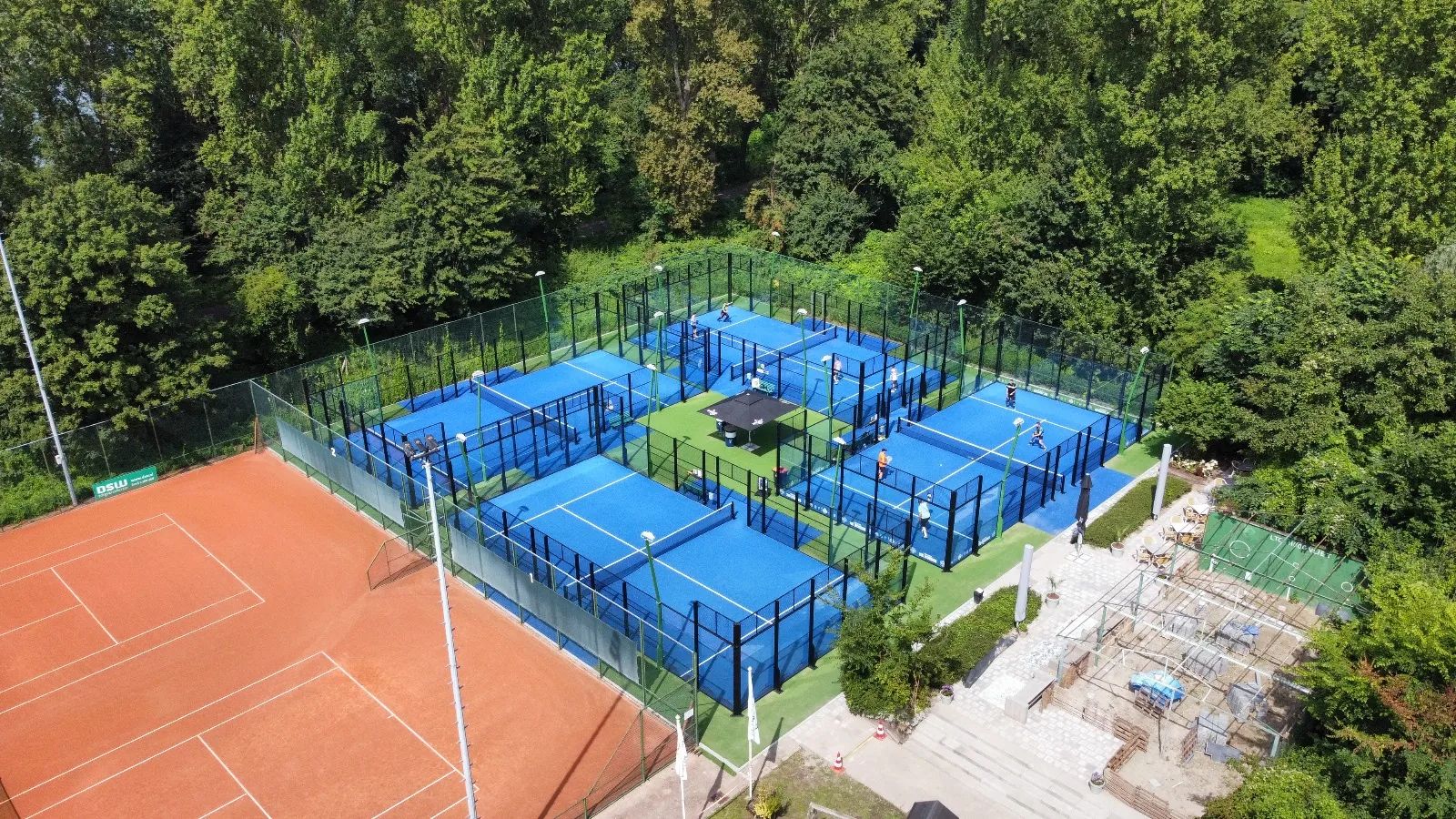
During a practical measurement at LTC Hofgeest, an indicative noise reduction of around 3 dB(A) was measured within the configuration studied, after correcting for background noise. These results apply only to the situation studied and must not be regarded as a general product guarantee. The ultimate noise reduction differs per location, configuration and surroundings.
Panels are also a suitable choice when the visual appearance of the location is important. The court remains open and recognisable as a padel facility, while the noise nuisance is limited. Panels can be placed on one side, in the lower or upper metres of the cage, or around several courts. They can also be applied afterwards to existing courts, provided the structure is calculated for it.
You can find more information about how panels work and how they are applied on our page about acoustic solutions for padel.
When is a noise barrier more effective than panels?
A noise barrier can be more effective than panels when noise from several sources needs to be intercepted at the same time, or when the distance to homes is so small that a freestanding barrier offers more protection than panels on the cage alone. Noise barriers can be built to a height of 6 to 8 metres and can be tens of metres long, so that they can screen a wide area.
A noise barrier can also be an alternative when the padel cage itself is structurally unsuitable for adding panels and reinforcing the structure is not feasible within the project. The barrier then stands freestanding and has no direct structural connection to the padel court.
A noise barrier is also relevant when several noise sources are present on a site, such as several padel courts side by side, and the noise needs to be channelled and screened in one direction. In those situations, a barrier can intercept noise across several courts at once, whereas panels are applied per court.
That said, a noise barrier requires a structural calculation, soil investigation data for the subsoil and, in almost all cases, an environmental permit, because a noise barrier is regarded as a structure. The permit process for a noise barrier is therefore comparable to that of the padel court itself. Whether a noise barrier is feasible in terms of permits depends on the location and the municipality.
Can panels and a noise barrier be used together?
Yes, in many situations a combination of sound-absorbing panels and a noise barrier is the most suitable approach. The panels limit the noise at the source, so that less noise reaches the noise barrier. As a result, the barrier can in some cases be built lower than when panels are absent, which saves costs and can simplify the permit process.
The combination is particularly relevant at locations where the distance to homes is limited and the acoustic study shows that one measure is insufficient. In that case, an independent acoustic consultant calculates which combination of measures is needed to meet the applicable noise standards.
It is important that both measures are included in the engineering phase from the start. When panels and a noise barrier are designed at the same time, the structural requirements of both provisions can be aligned. This prevents costly modifications afterwards and ensures that the overall solution is structurally safe and acoustically effective.
What influence do sound-absorbing panels have on the structure of the padel court?
Adding sound-absorbing panels to a padel cage has direct structural consequences. Panels reduce the wind permeability of the cage structure, which places more wind pressure on the structure. This means that in almost all cases the steel structure must be reinforced before panels can be applied safely.
The reinforcement can consist of heavier posts, additional columns or modified connections, depending on the wind zone of the location and the position and size of the panels. The wind zone, the geographical division that determines the design wind load for a location, differs per region. Locations in coastal areas or on open terrain generally have a higher wind load than locations in built-up areas.
This is also why panels cannot simply be placed on every existing padel cage. The structure must first be calculated for the additional load. We carry out these calculations during the engineering phase, so that the steel structure is suitable for the desired application. For existing courts, it is assessed whether the current structure is sufficient or needs modification.
You can read more about the relationship between structure and wind load for padel courts on our structure page.
Do you need an acoustic study before you choose?
An independent acoustic study is needed in most cases before a well-considered choice can be made between panels, a noise barrier or a combination of both. The study maps the existing noise level, determines the relevant assessment points and calculates which measures are needed to meet the applicable standards.
Without an acoustic study it is not possible to say with certainty which measure is sufficient. Factors such as the distance to homes, the height of surrounding buildings, the number of courts, the intensity of use and the orientation of the courts relative to sensitive uses together determine how the noise is perceived. A solution that works well at one location may prove insufficient at another.
The acoustic study is also an important part of the permit process. In many cases, municipalities ask for a substantiated calculation before an environmental permit is granted for an outdoor padel court. An acoustic consultant is responsible for these calculations and measurements. We do not carry out acoustic studies ourselves, but we supply the technical product specifications, structural data and engineering needed to carry out the calculations correctly.
Cooperation between client, acoustic consultant, structural engineer and producer ensures that noise measures are included in an integrated way from an early stage. This prevents it from turning out afterwards that the chosen solution is not feasible structurally or in terms of permits. You can read more about applying for a permit for a padel court on our permit page.
Not sure whether outdoor padel is feasible at your location?
We are happy to think along with you about the court configuration, structural preparation and possible noise measures. Together with your acoustic consultant, we look at which solution is technically feasible and suits the project. Get in touch via our page about acoustic solutions for padel for an initial, no-obligation exploration.
Frequently asked questions
On average, how long does it take to have sound-absorbing panels installed on an existing padel court?
The lead time depends heavily on the structural condition of the existing cage. First a structural calculation must be carried out to determine whether the steel structure is strong enough or needs reinforcing. If the structure is already suitable or can be modified relatively easily, the actual installation of the panels can usually be done within a few days. For the whole process, including engineering and any structural modifications, allow a few weeks to months, depending on the size of the project.
What are the most common mistakes when choosing a noise measure for an outdoor padel court?
A common mistake is choosing a solution without a prior acoustic study, so that it later turns out the measure has insufficient effect or does not meet the municipal noise standards. Another frequent mistake is not including noise measures in the engineering phase, which leads to costly modifications afterwards. Finally, clients regularly underestimate the structural consequences of adding panels, such as the increased wind load on the cage structure.
Is there a minimum distance to homes at which sound-absorbing panels are always sufficient?
There is no universal minimum distance at which panels are guaranteed to be sufficient, because the acoustic situation differs greatly per location. Factors such as the height of surrounding buildings, the number of courts, the intensity of use and the orientation of the courts all play a role. Only an independent acoustic study can determine for a specific location whether panels alone are sufficient or whether a combination with a noise barrier is necessary.
Does placing a noise barrier affect the permit required for the padel court?
Yes, a noise barrier is regarded as a standalone structure and in almost all cases requires an environmental permit, separate from the permit for the padel court itself. The permit process is therefore comparable in complexity to that of the court itself and requires, among other things, structural calculations and soil investigation data for the subsoil. It is wise to start the permit process for the noise barrier as early as possible, preferably at the same time as the permit application for the padel court, to avoid delays in realisation.
Can sound-absorbing panels also be used on covered or semi-covered padel courts?
Sound-absorbing panels were primarily developed for outdoor padel cages, but the principles of sound absorption at the source are also relevant in covered or semi-covered situations. For covered courts, however, other acoustic factors play a role, such as reflections from the roof and the walls, so the approach and the choice of measures can be different. For covered situations, specific acoustic advice is necessary to determine which solution is most effective.
How do I choose a reliable acoustic consultant for my padel court project?
Choose an acoustic consultant with demonstrable experience in outdoor sports facilities or comparable recreational facilities, because the noise issue with padel requires specific knowledge. Ask for reference projects and check whether the consultant is familiar with the applicable standards from the Activities Decree (Activiteitenbesluit) or the Environment and Planning Act (Omgevingswet) that apply to your location. A good consultant works together with the structural engineer and the producer of the noise measures, so that calculations are based on correct technical product specifications.
What happens if it turns out after completion that the noise measures are insufficient?
If it turns out after completion that the noise standards are not being met, the municipality can take enforcement action, which can lead to restrictions on use or even temporary closure of the court. Additional measures afterwards are always more expensive and more complex than if they had been included in the design phase, because structural modifications then still have to be carried out. This underlines the importance of a thorough acoustic study and integrated cooperation between all parties involved before the court is built.