Blog · 17 August 2026 · 13 min read
When is noise a concern when building a padel court?
Padel court and noise: discover which standards apply, when an acoustic study is mandatory and which measures prevent nuisance.

In this article
- Which noise standards apply to a padel court?
- When is an acoustic study mandatory for a padel court?
- Which location factors determine the noise level of a padel court?
- What is the difference between a noise barrier and sound-absorbing panels?
- How do sound-absorbing panels affect the structure of a padel court?
- How does the permit process work for a padel court with noise measures?
- What does it cost to apply noise measures to a padel court?
- Unsure whether outdoor padel is feasible at your location?
- Frequently asked questions
Noise is almost always a concern when building an outdoor padel court, but the extent varies greatly from one location to another. How close the court will be to homes or other noise-sensitive uses largely determines which measures are needed and whether an acoustic study is mandatory. In this article, we answer the most common questions about noise, standards, measures and the permit process, so you can start a padel project well prepared.
Which noise standards apply to a padel court?
In the Netherlands, there are no separate noise standards drawn up specifically for padel courts. In practice, the standards from the Activiteitenbesluit milieubeheer (Environmental Activities Decree) are applied, supplemented by the requirements that municipalities set through the zoning plan or the environmental permit. The permissible noise level at the facade of homes is generally a maximum of 45 to 50 dB(A) during the daytime, depending on the municipality and the designation of the area.
Padel produces more noise than tennis. The ball striking glass and steel, combined with the cage structure acting as a resonance box, results in an average sound power level of approximately 91 dB(A). That is roughly 10 dB(A) more than with tennis. This difference is the reason why noise nuisance is more often a concern with padel courts than with other outdoor sports.
Which standard exactly applies depends on the location, the surroundings and the permit situation. An independent acoustic consultant assesses which standards apply and whether the expected noise level falls within the permitted limits. I-Padel does not carry out acoustic calculations itself, but supplies the technical product specifications and structural data that an acoustic firm needs for its calculations.
When is an acoustic study mandatory for a padel court?
For outdoor padel courts, an acoustic study is mandatory in most cases, especially when the location is close to homes or other noise-sensitive uses. Municipalities almost routinely request this study as part of the environmental permit application. For indoor padel courts in an existing hall this is less often the case, but even then the municipality may impose additional requirements.
In practice: the smaller the distance to homes, the greater the chance that a municipality will make an acoustic study mandatory. But even at greater distances the situation may justify a study, for example when there are multiple courts, intensive use or surroundings with little background noise.
The acoustic study is carried out by an independent firm. Based on the results, the municipality determines whether additional noise measures are needed and whether the permit can be granted. It is wise to have this study carried out early in the planning process, so that any measures can already be included in the design. You can find more information about the permit process on our page about the permit for a padel court.
Which location factors determine the noise level of a padel court?
The noise a padel court generates in its surroundings is determined by a combination of factors that can differ greatly from one location to another. The distance to homes is the most decisive factor, but the orientation of the courts, the surrounding buildings, the presence of trees or other obstacles and the intensity of use also play a role.
Specifically, the following location factors are relevant:
- Distance to homes or other sensitive uses. The smaller the distance, the higher the expected noise level at the facade.
- Orientation of the courts. The direction of the court's short ends partly determines where most of the sound is radiated.
- Surrounding buildings and vegetation. Buildings and greenery can reflect or dampen sound, depending on their position and properties.
- Background noise level. At a location with little background noise, padel noise is relatively more audible than at a busy location.
- Intensity of use and opening hours. More courts and longer opening hours lead to a higher total noise level over the course of the day.
- Height differences and ground conditions. An elevated site or open terrain can spread sound further than an enclosed location.
Because all these factors play a role at the same time, the noise level of a padel court is always location-specific. A standard statement about the expected nuisance is therefore not possible without a project-specific assessment.
What is the difference between a noise barrier and sound-absorbing panels?
A noise barrier is a freestanding structure placed next to or around the padel court that blocks sound towards homes. Sound-absorbing panels are fixed directly to the cage structure of the padel court and work as a source measure: they absorb sound where it originates, before it spreads. The two solutions work on different principles and are not interchangeable in every situation.
Noise barriers: shielding at a distance
A noise barrier works by shielding sound in a specific direction. The barriers are placed freestanding next to the court and can be built to heights of 6 to 8 metres. They are particularly effective when the source and the receiver are at the same height and there is enough space available for installation.
A noise barrier requires a structural calculation, soil investigation data of the subsoil and, in almost all cases, an environmental permit. You can read more about the possible applications on our page about acoustic solutions for padel.
Sound-absorbing panels: a source measure in the structure
Sound-absorbing panels are fixed to the outside of the cage structure. They work on the basis of sound absorption: the open fibre structure of the material, usually stone wool, converts part of the sound waves into heat, so that less sound is reflected. During a practical measurement at LTC Hofgeest, an indicative noise reduction of approximately 3 dB(A) was measured within the configuration studied, after correction for background noise. These results apply only to the situation studied and must not be regarded as a general product guarantee.
In many situations, a combination of both measures is the most effective. Panels as a source measure can limit the required height of a noise barrier, which can lower both costs and permit-related hurdles. Which approach is appropriate depends on the project-specific situation and the outcome of the acoustic study.
How do sound-absorbing panels affect the structure of a padel court?
Sound-absorbing panels can never be viewed separately from the structure to which they are attached. Because panels partially or completely close off the open surface of the cage structure, wind permeability decreases. This increases the wind load on the structure. The steel structure must be recalculated for this and, in many cases, reinforced.
The reinforcement can consist of heavier posts, additional columns or modified connections. Because I-Padel produces the steel structure itself, columns, connections, base plates and anchors can be adapted project by project when additional requirements arise from noise measures or higher wind loads. This makes it possible to integrate sound-absorbing panels in a structurally sound way, even at locations with higher wind loads such as open terrain or coastal areas.
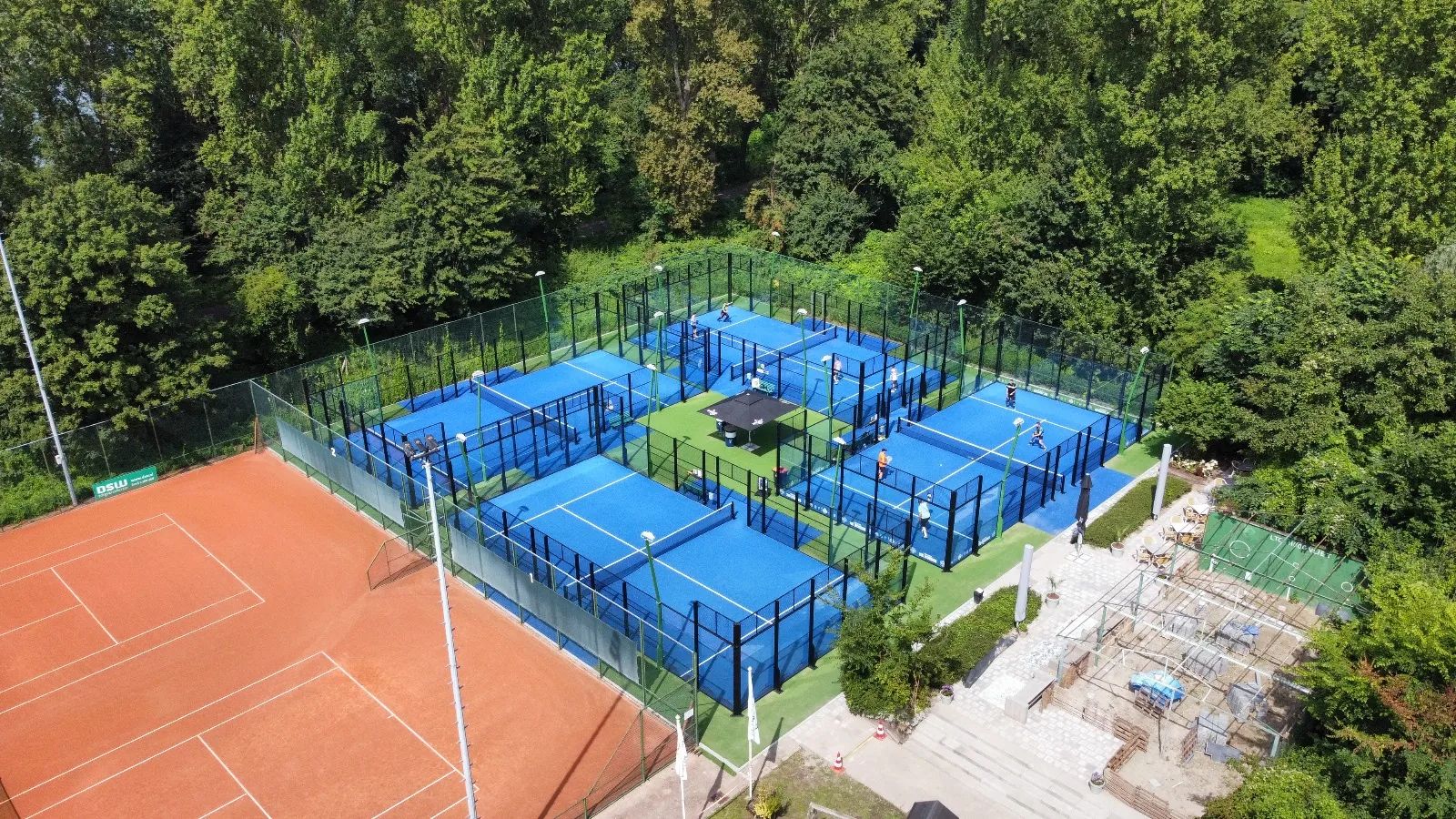
The position of the panels is also important. During the practical measurement at LTC Hofgeest, panels were installed above the glass at the two short ends of the court tested. This configuration was chosen specifically for that project and is not a universal standard solution.
At other locations, it may be necessary to fit panels on several sides or to use a different placement. The optimal configuration is determined by the location, the direction of sensitive receivers and the outcome of the acoustic study. You can read more about the structural aspects on our page about structure and wind load.
How does the permit process work for a padel court with noise measures?
The permit process for an outdoor padel court with noise measures runs in several steps and takes 8 to 12 weeks on average, depending on the municipality and the complexity of the project. Noise measures are part of the permit application and are assessed on the basis of an acoustic study carried out by an independent firm.
A permit application for a padel court with noise measures generally includes the following components:
- Zoning plan check. Assessment of whether the intended location fits within the applicable zoning plan or whether a deviation is needed.
- Acoustic study. An independent acoustic firm calculates the expected noise level and assesses which measures are needed to meet the standards.
- Structural calculations. Calculations in accordance with the Bouwbesluit (Dutch Building Decree), including the influence of noise measures on the wind load of the structure.
- Lighting study. Assessment of the impact of LED lighting on the surroundings, where applicable.
- Site plan and additional documents. Depending on the municipality, an ecological study or an archaeological study may also be requested.
It is wise to contact the municipality early in the planning process to find out which documents are expected. Building without a permit is not an option: the municipality can halt the project, impose fines or require the cage structure to be removed. We can guide the entire permit process, including consultation with the municipality and coordination of the required studies.
What does it cost to apply noise measures to a padel court?
The cost of noise measures for a padel court depends heavily on the situation and cannot be expressed as one fixed price. The choice of sound-absorbing panels, a noise barrier or a combination of both, the scale of the measure, the structural consequences and the location-specific circumstances together determine the final investment.
A number of factors that influence the costs:
- Type of measure. Sound-absorbing panels as a source measure are, in many situations, more compact and more economical than a large freestanding noise barrier, but this depends on the project situation.
- Scale of the application. Panels on one side of a single court require a different investment than panels around several courts.
- Structural reinforcement. When the cage structure has to be modified to absorb the extra wind load, this entails additional costs.
- Foundation and groundwork. Noise barriers require soil investigation data and a separate foundation, which can be a significant cost factor.
- Acoustic study. The cost of an independent acoustic study is a fixed part of the process and differs per firm and project size.
As an indication for an outdoor padel court including foundation, a guide price applies from approximately €50,000 per court. Noise measures come on top of that and are always calculated project by project. The exact price depends on the location, the type of measure and the structural requirements that result from it. You can find more insight into the total investment on our page about the cost of a padel court.
We advise including noise measures in the design phase. Modifying afterwards is technically possible, but generally leads to higher costs than when the structure is calculated for the right load from the start.
Unsure whether outdoor padel is feasible at your location?
We are happy to think along with you about the court configuration, structural preparation and possible noise measures. Together with your acoustic consultant, we look at which solution is technically feasible and fits the project. Get in touch via our page about acoustic solutions for padel for an initial, non-binding exploration.
Frequently asked questions
Can I assess myself whether my location meets the noise standards, without an acoustic study?
A rough estimate is possible based on the distance to the nearest homes and the background noise level, but this does not replace an official acoustic study. Rule of thumb: at a distance of less than 50 to 75 metres from homes, there is a high chance that additional measures will be needed. Have an acoustic firm carry out a quick scan early in the planning process, so you know where you stand in good time and can adapt the design accordingly.
What common mistakes are made regarding noise when building a padel court?
The most common mistake is involving an acoustic consultant too late, so that noise measures have to be added afterwards to a structure that was not calculated for them. This almost always leads to higher costs and sometimes to technical limitations. A second common mistake is underestimating the influence of intensity of use: more courts and longer opening hours considerably increase the cumulative noise level, even if a single court on its own would not be a problem.
What if the municipality rejects my permit application because of noise?
A rejection on the basis of noise does not automatically mean the project is not feasible. In many cases, the municipality offers the opportunity to propose additional measures, such as installing sound-absorbing panels, a noise barrier, changing the court orientation or limiting the opening hours. Discuss the rejection with your acoustic consultant to determine which adjustments can reduce the noise level sufficiently, and then submit a revised application.
Are sound-absorbing panels also suitable for existing padel courts that are already in use?
Yes, sound-absorbing panels can in principle also be retrofitted to an existing cage structure, but this always requires a structural assessment first. Because panels increase the wind load on the structure, it must be determined whether the existing steel structure can handle this extra load or needs to be reinforced. For an existing court, contact the structural engineer or the supplier of the court to have this assessed before panels are ordered or installed.
How long does the acoustic study take and when in the planning process should I have it carried out?
An acoustic study usually takes two to four weeks, depending on the complexity of the location and the availability of the firm. It is strongly advisable to have this study carried out before the final design is fixed, so that any measures such as court orientation, panels or noise barriers can be included directly in the design. Do not wait with this until the permit application has already been submitted, because adjustments afterwards cost time and money.
Does the choice of a certain type of glass or mesh in the cage structure affect noise production?
The type of glass has a limited influence on the total noise production of a padel court; the impact sound of the ball and the resonance of the steel structure are the dominant noise sources. However, the quality of the connections and the stiffness of the structure can influence the reverberation of panels and steel profiles. A structurally well-executed court with sturdy connections and properly fixed glass panels generally produces less resonance noise than a court where components are mounted more loosely.
Do I have to inform local residents about the construction of a padel court, and how do I deal with objections?
With an environmental permit application, the application is generally published and local residents have the opportunity to submit objections during the inspection period. It is wise to inform local residents proactively before the formal procedure, for example through an information meeting. This lowers the threshold for objections and gives you the chance to answer questions about noise, lighting and traffic directly. An acoustic report demonstrating that the standards are met is a strong supporting argument in this regard.