


Building a padel court · 14 April 2026 · 12 min read
What do you need to know before requesting a quote for a padel court?
Requesting a quote for a padel court? Discover costs, foundation types, noise requirements and the questions you really need to ask every supplier.
In this article
- What does a padel court actually cost?
- What is the difference between a turnkey padel court and a supply-only delivery?
- Which foundation types are there for a padel court?
- What do you need to know about noise requirements for a padel court?
- How long does it take to build a padel court?
- Which questions should you ask when requesting a quote?
- What are common mistakes when ordering a padel court?
- Frequently asked questions
Building a padel court is a serious investment. Whether you want to expand a sports hall, modernise a tennis club or open a new padel venue: the decision always starts with the same question. What do you actually need to know before requesting a quote? This article gives you an honest and practical overview of everything that matters: costs, foundation, noise, permits and the questions you really need to ask a supplier.
What does a padel court actually cost?
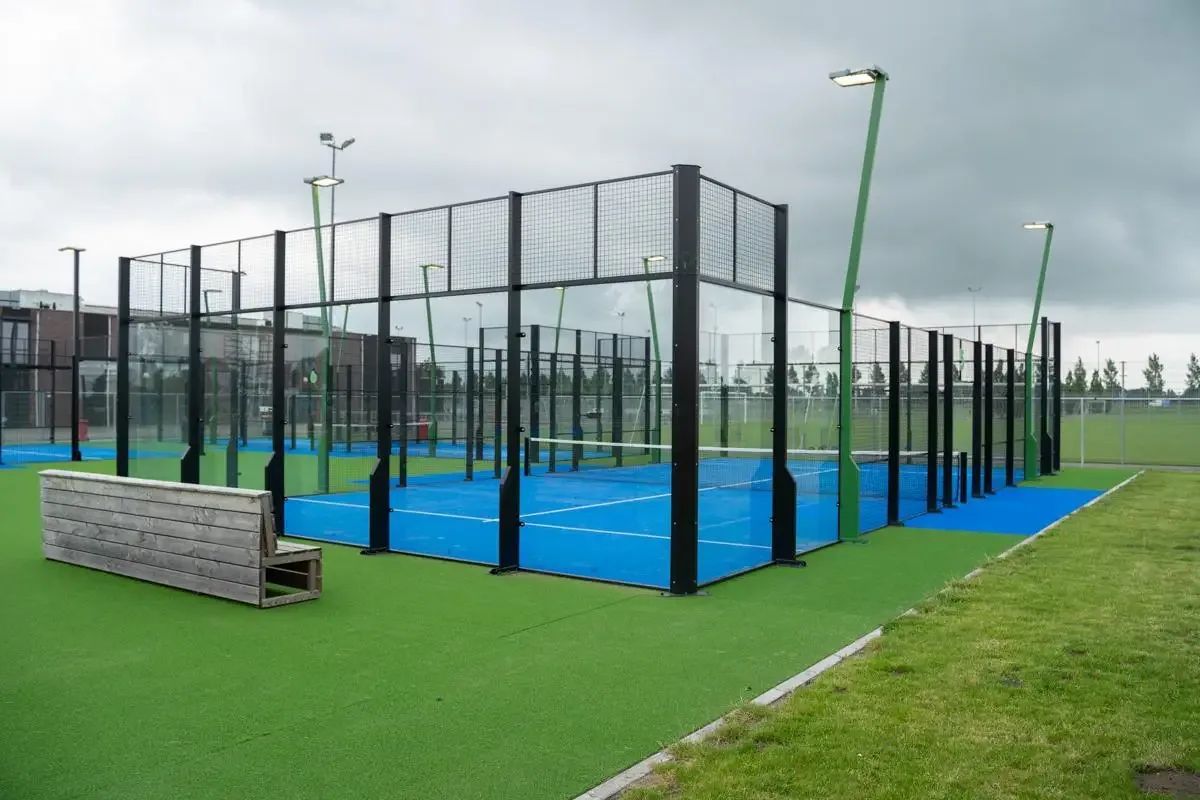
An indoor padel court costs, as an indication, from around €23,000 per court, turnkey. That means: including cage structure, glass, artificial turf, LED lighting and installation. An outdoor padel court is more expensive: the steel structure has to be heavier because of the weather, and the foundation is a separate, large cost item.
For an outdoor padel court excluding foundation, expect around €30,000 per court as an indication. Including foundation, you quickly reach €50,000 or more, depending on the soil conditions, accessibility and the civil works required. Foundation costs can range from €20,000 to €40,000 per court. That is a wide range, and there is a reason for it.
What determines the final price?
The exact price always depends on a combination of factors. The most important are:
- Type of court: a panoramic court has an open back and a different visual appearance than a Pro court. Despite the lighter look, heavier materials are often used, so the price is slightly higher.
- Number of courts: with several courts, you get economies of scale in production and installation.
- Location and accessibility: transport, logistics and installation conditions all play a part.
- Extra options: think of run-off zones, sound-absorbing panels or a specific lighting system.
A common mistake is to look only at the lowest price. In practice, this often leads to higher costs in the long term due to lower material quality, limited service or a shorter warranty. The price per court only means something once you know exactly what is included.
What is the difference between a turnkey padel court and a supply-only delivery?
With a turnkey padel court, the contractor handles the entire process: from groundwork and foundation through to the installation of glass, artificial turf and LED lighting. You don't have to arrange anything. With a supply-only delivery, you receive all the components, but you install the court yourself or have your own construction crew install it.
Supply-only delivery is mainly relevant for parties with their own installation capacity, such as construction companies or international buyers. In the Netherlands, the turnkey package is the most practical choice for most clients: you have one contact person, one responsible party and one warranty. If something isn't right, there can be no discussion about who has to fix it.
The turnkey package usually includes: on-site advice and bespoke work, groundwork and foundation, the steel structure, glass, artificial turf including sand bed and lines, LED lighting and the full installation. Optionally, sound-absorbing panels can be added, which are structurally calculated for each location.
Which foundation types are there for a padel court?
There are three commonly used foundation types for padel courts: drainage concrete, Supersub and ZOAB asphalt. Each type has its own technical properties and suits different situations. You choose the right type based on the soil conditions, the use and the budget of your location.
Drainage concrete
Drainage concrete is a water-permeable type of concrete in which rainwater drains directly through the foundation into the subsoil. It is a proven solution for outdoor padel courts, with an average lifespan of 25 to 40 years. The open structure ensures that the court stays playable quickly, even after heavy rainfall. For padel courts, drainage concrete is often combined with a ring foundation with steel reinforcement, so that the forces from the cage structure and wind load are properly absorbed.
Supersub
Supersub is a foundation solution based on foam concrete: a light, self-levelling material that provides a flat and stable base. It is shock-absorbing, water-permeable and fully recyclable. Because the material is light, it can in many cases be poured within a single day. The thickness varies from around 10 cm for renovation to around 15 cm for new builds, always determined on the basis of the soil conditions.
ZOAB asphalt
ZOAB asphalt, also known as open asphalt concrete, is a porous type of asphalt that lets water through. It is less common for padel courts than drainage concrete or Supersub, but can be a good option in certain situations, depending on the location and the use.
All foundation components used in the Netherlands must be approved by Kiwa ISA Sport. Working with non-certified materials can lead to non-conformity, which causes problems with permitting and official competitions. Always ask every supplier about the certification of the foundation materials used.
What do you need to know about noise requirements for a padel court?
Padel produces more noise than tennis. The ball hitting glass and steel, combined with the cage structure acting as a sound box, results in an average sound power level of around 91 dB, roughly 10 dB more than tennis. At locations near residential areas, an acoustic study is almost always required.
There are two main solutions for noise nuisance from padel courts: sound-absorbing panels and noise barriers. Panels are fitted on the outside of the mesh of the cage structure and dampen the noise at the source. They achieve absorption class A and provide a clearly audible reduction at distances of 40 to 100 metres. A noise barrier is a freestanding structure next to the court that blocks noise towards homes. In many situations, a combination of both is the most effective.
Structural consequences of sound-absorbing panels
Important to know: when you fit sound-absorbing panels, the wind permeability of the cage structure decreases. That means the structure has to be structurally reinforced, in line with the applicable wind zone. This is not a detail; it directly affects the safety and lifespan of the court. The reinforcement consists of heavier posts, additional columns or adapted connections. Not every supplier can carry this out; always ask about it explicitly.
Sound-absorbing panels can also be fitted afterwards to existing courts. In that case, it is first checked whether the structure is suitable or needs to be adapted. A noise barrier almost always requires an environmental permit, because it is regarded as an independent structure.
How long does it take to build a padel court?
Installing a padel court takes an average of 3 to 4 days: 2 days for erecting the cage structure and 1 to 2 days for laying the artificial turf. The total lead time of a project, including production, delivery and installation, averages 10 to 12 weeks.
Those 10 to 12 weeks cover more than just the construction itself. Think of the structural calculation per location, the production of the steel structure, the transport and the scheduling of the installation crew. For outdoor projects, groundwork is added, which depends on the soil conditions and the weather.
Keep in mind that the permit process is separate from this. An environmental permit takes an average of 8 to 12 weeks, depending on the municipality and the complexity of the project. If you want to build an outdoor padel court, you therefore need to start this process well in advance, otherwise the permit will lag behind the construction.
Which questions should you ask when requesting a quote?
When requesting a quote for a padel court, you should ask at least the following questions: what is included in the price, who is responsible for the foundation, which warranty applies to which components, and can the supplier provide structural calculations per location? Without answers to these questions, you are comparing apples with oranges.
A good checklist for your quote request:
- Is the foundation included, and if so, which type and based on which soil conditions?
- What is the warranty period on the steel structure, the artificial turf and the LED lighting separately?
- Is the structure calculated per location, taking wind load and environmental factors into account?
- Are the foundation materials certified by Kiwa ISA Sport?
- Who handles the permit application, and is support with the permit process included?
- What is the lead time from production to handover?
- Can the supplier structurally integrate sound-absorbing panels, including the necessary recalculation of the cage structure?
Always ask about the origin of the steel structure too. Suppliers that import from Spain have to deal with transport costs, delivery times and an import margin, which directly affects the price and delivery speed. A supplier that produces in-house can deliver faster and offer more bespoke work.
What are common mistakes when ordering a padel court?
The most common mistake when ordering a padel court is comparing on price alone, without checking exactly what is included in the quote. A low price without foundation, without warranty on the structure or without certified materials is not an advantage. It is a risk that you will see again later in higher costs.
Other common mistakes are:
- Starting the permit process too late. An environmental permit takes an average of 8 to 12 weeks. If you apply for it too late, the permit lags behind the planned construction date.
- Not taking noise requirements into account. Municipalities impose ever stricter noise requirements on padel courts. If you don't include this in the planning phase, it can lead to extra costs, later adjustments or even limited playing times.
- Assuming a standard court fits everywhere. Every location has different wind load, soil conditions and spatial constraints. A structure that has not been calculated per location may not meet the safety requirements.
- Forgetting to ask about certification. Foundation materials in the Netherlands must be approved by Kiwa ISA Sport. If you work with non-certified materials, your court cannot be approved for official competitions.
- Involving several parties without one party ultimately responsible. If the structure comes from one supplier, the artificial turf from another and the installation from a third, nobody oversees the whole. When problems arise, everyone passes the responsibility on.
At I-Padel, we guide you from the first advisory meeting to handover. We produce the steel structure ourselves, work exclusively with certified materials and can coordinate the entire permit process. Do you want to know what building a padel court means for your location? Get in touch for an initial exploration, and we will gladly think along with you, without obligation.
Frequently asked questions
Do I also need an environmental permit for an indoor padel court?
That depends on the situation. For an indoor padel court inside an existing building, a separate environmental permit is often not needed, provided the building alterations fall within the existing zoning. However, as soon as you put up a new building or change the facade or roof, a permit is usually required. Always check this beforehand with your municipality, because the rules differ by location and zoning plan.
What is the minimum space I need to build a padel court?
A standard padel court has a playing area of 10 by 20 metres, but for a full installation, including run-off zones and structural space, you need at least around 13 by 23 metres. With several courts side by side, you also need to account for the spacing for maintenance and safety. Bespoke advice based on your location is always the most reliable way to determine how much space you actually need.
How long does a padel court last and what are the maintenance costs?
A quality padel court has a lifespan of 15 to 25 years for the steel structure, depending on the type of coating and the environmental conditions. The artificial turf usually lasts 8 to 12 years with intensive use and must then be replaced. The biggest recurring maintenance costs are brushing and topping up the sand bed, checking the glass panels and periodically inspecting the steel connections — relatively limited costs in proportion to the total investment.
Can I convert an existing tennis court into a padel court?
Yes, that is possible in many cases, but it is not as simple as it sounds. The foundation of a tennis court is usually not designed for the specific loads of a cage structure, so adjustments or partial repaving may be necessary. In addition, the size of the available space must fit one or more padel courts including run-off zones. An assessment of the site by a specialist is the first step in determining whether and how a conversion is feasible.
What is the difference between a panoramic court and a Pro court, and which should I choose?
A panoramic court has an open back with more glass and less steel, which gives an airy, visually appealing look that is popular with commercial venues and clubs that want to focus on experience.
A Pro court has a more closed structure with mesh on the sides and is usually the choice for intensive use and competitive play. Despite the lighter look of the panoramic court, heavier materials are often used, so the price is slightly higher — keep this in mind when comparing quotes.
Are subsidies or financing options available for building a padel court?
For sports clubs, subsidies are available in some cases through the Nationaal Sportakkoord (National Sports Agreement), the municipality or provincial funds, especially if the investment contributes to broader sports participation or sustainability. Commercial operators may be eligible for investment deductions through tax schemes such as the KIA (Kleinschaligheidsinvesteringsaftrek, the small-scale investment deduction). It is strongly advisable to consult a financial adviser or the municipality about the options that apply specifically to your situation and location.
What do I need to arrange if I want to operate a padel court for public use?
In addition to the construction and permit aspects, public operation requires you to think about business liability insurance, a booking system for court rental and any hospitality licences if you offer facilities. If you want to organise official competitions, the court must meet the requirements of Padel Nederland, including certified materials and dimensions. It is wise to include these operating requirements in the planning phase, so that you fit out the court correctly from the start.


