Blog · 28 October 2026 · 12 min read
What role does an acoustic consultant play in a padel court project?
An acoustic consultant is required for most outdoor padel courts. Find out what they do, which standards apply and how the report determines your permit.
In this article
- When is an acoustic consultant required for a padel court?
- What does an acoustic consultant concretely do for a padel project?
- How does an acoustic study for a padel court work?
- Which noise values apply to an outdoor padel court?
- What is the difference between a noise barrier and sound-absorbing panels for padel?
- What information does an acoustic consultant need from the padel court builder?
- How does the acoustic report affect the granting of the permit?
- Not sure whether outdoor padel is feasible at your location?
- Frequently asked questions
An acoustic consultant plays an important role in an outdoor padel project: they assess whether the noise load of the padel court on its surroundings meets the applicable standards and record this in a report that municipalities use when assessing a permit application.
For most outdoor projects near homes, this study is not a choice but a requirement. The questions below give a complete picture of what an acoustic consultant does, how the study works and what information they need to do their job properly.
When is an acoustic consultant required for a padel court?
An acoustic consultant is in most cases required when you want to build an outdoor padel court near homes or other noise-sensitive uses. When assessing an environmental permit, the municipality almost always asks for an acoustic report as supporting evidence. Without that report, the application is incomplete.
The reason is technical. Padel produces an average sound power level of around 91 dB, roughly 10 dB more than tennis. The combination of racket contact, ball contact with the glass and the cage structure acting as a resonance box creates a specific noise pattern with clearly recognisable peaks. This type of sound, also known as impulsive noise, is experienced by local residents as more annoying than continuous noise at the same level.
Whether an acoustic study is formally required depends on the municipality, the zoning plan and the distance to homes. In practice, the closer the court is to homes, the greater the chance that the municipality will demand an acoustic report. For locations on open ground or in an urban environment this is almost always the case. You can find more information about the permit process on the page about the permit for a padel court.
What does an acoustic consultant concretely do for a padel project?
An acoustic consultant calculates the expected noise load of the padel court on its surroundings, tests it against the applicable standards and advises on measures if the load turns out too high. The result is an acoustic report that serves as supporting evidence for the permit application.
Specifically, the consultant carries out the following work:
- A site assessment that takes into account the distance to homes, the surroundings and the layout of the sports park.
- An acoustic calculation based on the sound power level of the padel court, the site geometry and the buildings present.
- A test against the noise standards that apply to the location in question, as laid down in the Dutch Activities Decree for the Living Environment (Besluit activiteiten leefomgeving) or municipal policy.
- Advice on possible measures when the calculated noise load exceeds the standard.
- Drawing up a report that can be used as an appendix to the permit application.
The acoustic consultant works independently. They assess the situation on the basis of their own calculations and measurements, not on what a supplier or client would prefer. That makes their report credible in the eyes of the municipality.
How does an acoustic study for a padel court work?
An acoustic study for a padel court consists of a calculation phase and sometimes a measurement phase. The consultant models the location digitally, performs noise calculations and compares the results with the applicable standards. When the situation is complex or when the municipality requires it, additional on-site measurements can be carried out.
The calculation phase starts with collecting input data: the position of the court on the site, the distance to homes, the height of surrounding buildings, the sound power level of the padel court and the planned hours of use. On this basis the consultant calculates the noise level at the facades of nearby homes.
When the calculation shows that the noise load exceeds the standard, measures are calculated. These may be integrated sound-absorbing panels, a freestanding noise barrier, a combination of both or changes to the site layout. Which measure is suitable depends on the location, the space available and the degree of reduction required. You can read more about the available acoustic solutions for padel on the relevant page.
Which noise values apply to an outdoor padel court?
The noise values that apply to an outdoor padel court depend on the regulations applicable at the location in question. In the Netherlands, assessment is generally against the standards in the Dutch Activities Decree for the Living Environment (Besluit activiteiten leefomgeving) or against municipal policy for sports activities. There is no uniform national limit value that is identical for every location.
In practice, work is often done with maximum noise levels at the facade of homes, expressed in dB(A). The permissible values differ per part of the day: during the day higher limit values apply than in the evening or at night. Municipalities sometimes apply additional requirements, for example for impulsive noise or for locations in a quiet residential area.
Because the standards can differ per municipality and per situation, it is advisable to contact the municipality early in the project and to involve an acoustic consultant. They can determine which standards apply and what this means for the feasibility of the project.
What is the difference between a noise barrier and sound-absorbing panels for padel?
A noise barrier is a freestanding structure placed next to the padel court that blocks noise towards homes. Sound-absorbing panels are integrated components of the padel structure itself and work as a source measure by absorbing sound directly at the source. This is the main functional difference between the two solutions.
Integrated sound-absorbing panels
Sound-absorbing panels are fixed to the outside of the cage structure, above the glass. They contain a sound-absorbing material, such as rock wool, that partly absorbs sound waves instead of reflecting them. Because the panels become a direct part of the structure, the engineering phase can take into account the additional wind load that arises. Closed surfaces catch more wind than open mesh, so the structure must be structurally calculated and, where necessary, reinforced.
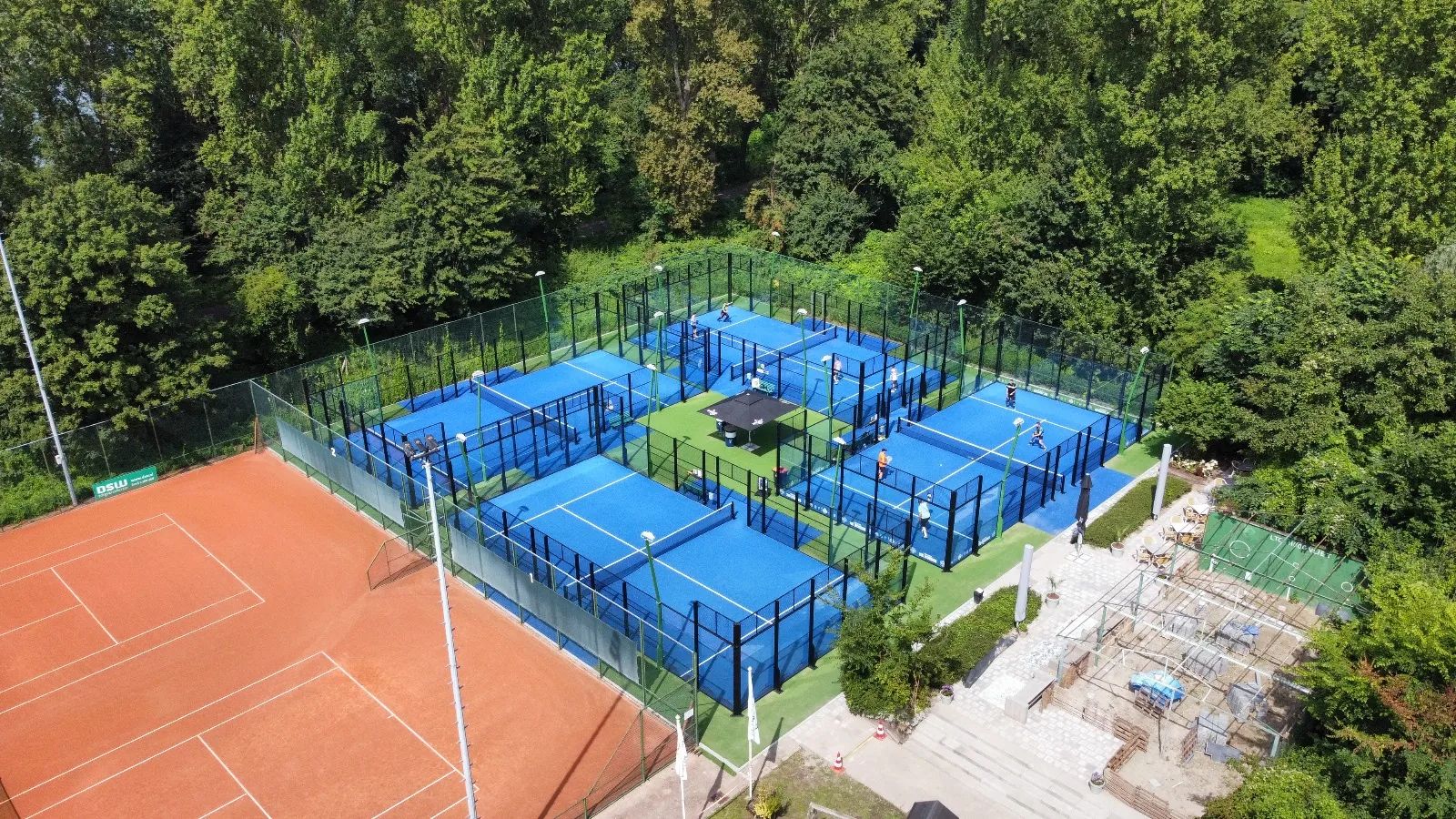
In a practical measurement at LTC Hofgeest, an indicative noise reduction of approximately 3 dB(A) was measured within the configuration studied, after correction for background noise. These results apply only to the situation studied and should not be regarded as a general product warranty. You can find more information about how they work and where they are used on the page about acoustic solutions for padel.
Freestanding noise barriers
A freestanding noise barrier is placed next to or around the padel court and shields noise in a specific direction. Noise barriers can be built to heights of up to 6 to 8 metres and be tens of metres long. They are effective when noise needs to be limited in one particular direction and there is enough space available on the site.
A noise barrier requires a separate structural calculation, soil probing data and, in almost all cases, an environmental permit. In some situations a combination of panels and a noise barrier is the most suitable. The panels reduce the noise at the source, so a noise barrier can be built lower, which saves costs and can simplify the granting of the permit. You can read more about how noise barriers around padel courts work on the relevant page.
What information does an acoustic consultant need from the padel court builder?
An acoustic consultant needs technical product specifications, structural data and information about the court configuration to carry out their calculations correctly. Without reliable input data, the results of an acoustic study are not usable.
The information a consultant generally needs includes:
- The sound power level of the padel court, including the specific noise characteristics of glass, mesh and the cage structure.
- The dimensions and configuration of the court, including the position of glass and mesh.
- Product specifications of sound-absorbing panels, when these are used. Think of absorption values, material thickness and placement.
- Structural data relevant to the wind load calculation when panels are used.
- Information about the foundation build-up, when this is relevant to sound transmission through the ground.
As the producer, we supply the technical specifications, structural data and engineering needed to carry out acoustic calculations correctly. We do not carry out acoustic studies ourselves, but work with independent acoustic consultants who can draw up their calculations on the basis of our product data.
How does the acoustic report affect the granting of the permit?
In many cases the acoustic report is a mandatory part of the permit application for an outdoor padel court. The municipality uses the report to assess whether the noise load on the surroundings stays within the applicable standards. A complete and well-substantiated report considerably increases the chance of a smooth permit process.
When the report shows that the noise load exceeds the standard, there are two possible outcomes. The municipality may require additional measures as a condition for granting the permit, or the application is rejected if no feasible solution is available. In the first case, the proposed measures, such as sound-absorbing panels or a noise barrier, are included as a requirement in the permit.
An acoustic report that also calculates the effects of the proposed measures gives the municipality direct insight into the feasibility of the project. This makes the report not only an assessment document, but also a justification of the chosen approach. The earlier an acoustic consultant is involved in the project, the more room there is to coordinate the court configuration, the site layout and the noise measures before the application is submitted.
The processing time of a permit application averages 8 to 12 weeks, depending on the municipality and the complexity of the project. An incomplete file, for example without an acoustic report, can lead to delays or a request for additional information from the municipality.
Not sure whether outdoor padel is feasible at your location?
We are happy to think along about the court configuration, structural preparation and possible noise measures. Together with your acoustic consultant, we look at which solution is technically feasible and suits the project. Get in touch via the page on acoustic solutions for padel for a first, no-obligation exploration.
Frequently asked questions
How early in the project should I engage an acoustic consultant?
It is strongly advisable to involve an acoustic consultant in the initiative phase, even before the choice of location is final. At that point there is still room to adjust the court position, orientation and site layout on the basis of acoustic considerations, which is much more expensive or even impossible later in the process. Early involvement prevents surprises with the permit application and saves time and money.
What are common mistakes when applying for an environmental permit for an outdoor padel court?
One of the most common mistakes is submitting a permit application without an acoustic report, which means the municipality automatically asks for additional information and the process is delayed. In addition, initiators regularly underestimate the impulsive noise of padel and assume tennis noise standards, whereas padel has a significantly higher sound power level. Finally, the acoustic consultant is sometimes only engaged after the court configuration has already been fixed, which makes changes costly.
Can I reuse an existing acoustic report from another padel court for my project?
No, an acoustic report is always location-specific and cannot be reused for another situation. The calculations are based on the exact site geometry, the distance to homes, the surrounding buildings and the specific court configuration of your project. A report drawn up for another location has no legal value for your permit application and will not be accepted by the municipality.
How many dB(A) of reduction is generally needed to meet the noise standards, and which measure is then most suitable?
How much reduction is needed differs per location and depends on the distance to homes, the applicable standards and the site conditions. In practice, the reduction required varies from a few decibels to more than 10 dB(A) for homes close by. Sound-absorbing panels offer an indicative reduction of approximately 3 dB(A) at the source and are most suitable as a first measure; for larger reduction targets this is combined with a freestanding noise barrier, where the panels can limit the barrier height required.
What happens if the municipality rejects my permit application on the basis of the acoustic report?
A rejection on acoustic grounds does not automatically mean the project is not feasible. In many cases the municipality offers the possibility of submitting an amended application with additional noise measures, such as a higher noise barrier, extra sound-absorbing panels or a different court position. It is wise to consult both the municipality and the acoustic consultant immediately after a rejection to determine which adjustments are needed and whether a reconsideration or objection procedure makes sense.
Are there specific requirements for the independence or qualifications of the acoustic consultant I engage?
Municipalities generally set no formal certification requirements for the acoustic consultant, but they do expect the report to be drawn up by a demonstrably competent party with knowledge of the relevant legislation and regulations, such as the Dutch Activities Decree for the Living Environment (Besluit activiteiten leefomgeving). In practice most municipalities work with consultants who have demonstrable experience with sports acoustics and environmental noise. It is advisable to ask the municipality beforehand whether it sets specific requirements for the consultant or the report.
Do the ground or foundation of the padel court affect the acoustic calculations?
In most cases the influence of the foundation on airborne sound transmission is limited, but in specific situations, such as a court on a raised platform or a structure with a hollow foundation, sound transmission through the ground or structure can certainly play a role. The acoustic consultant assesses per situation whether this is relevant and, in that case, requests foundation data from the padel court builder. It is therefore important that the builder makes all structural and foundation-related information available in good time.