


Building a padel court · 12 May 2026 · 12 min read
What is the difference in playing experience between an indoor and outdoor padel court?
Indoor or outdoor padel court? Discover the differences in playing experience, cost and base construction, and make the right choice for your location.
In this article
- What is the difference between an indoor and outdoor padel court?
- How does wind affect the playing experience on an outdoor padel court?
- What are the differences in base construction between indoor and outdoor padel courts?
- Which court is better for beginners: indoor or outdoor padel?
- How does the lighting differ on an indoor and outdoor padel court?
- Is an outdoor padel court more expensive than an indoor court?
- When do you choose an indoor padel court instead of an outdoor court?
- Frequently asked questions
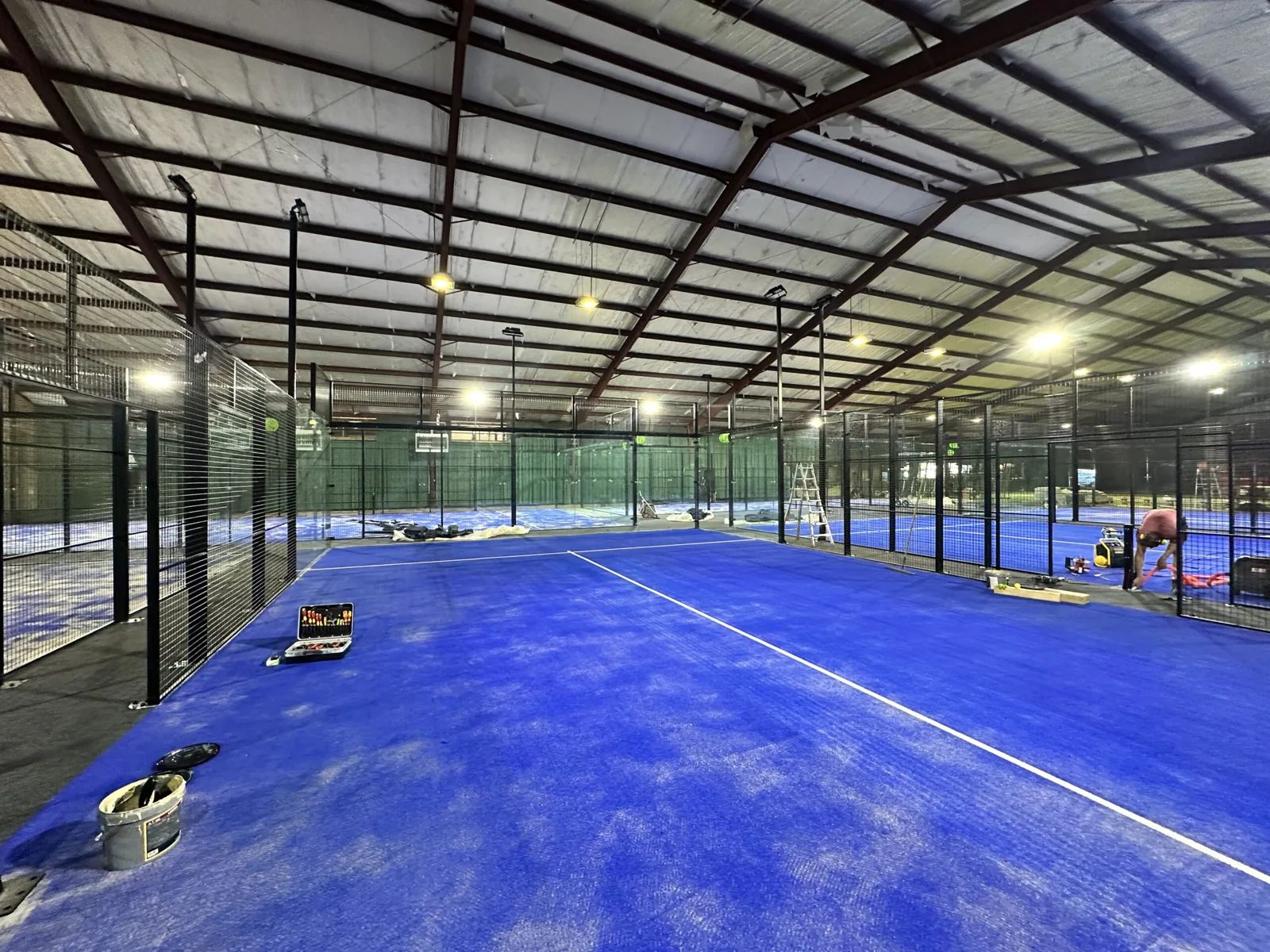
An indoor padel court and an outdoor padel court are both padel courts, but the playing experience differs considerably. Outdoors you play with wind, changing light and a different surface. Indoors you get constant conditions, but also different acoustics and atmosphere. Whether you want to open a venue or simply want to know what to expect, this article explains the differences between the two types of padel court, one aspect at a time.
What is the difference between an indoor and outdoor padel court?
The biggest difference between an indoor and outdoor padel court lies in the environmental factors. On an outdoor court, wind, rain and sunlight are variables. On an indoor court the conditions are always the same: no wind, stable light and a sheltered environment. This has a direct effect on how the game flows, on technique and on comfort.
The construction itself also differs. An outdoor padel court requires a heavier steel structure that can withstand wind load, rain and temperature fluctuations. An indoor court is sheltered and does not have to meet those additional structural requirements. This difference in construction also affects the cost, the foundation and the maintenance needs of the court.
In terms of playing experience, both variants are full-fledged padel. The court dimensions are identical: 20 by 10 metres, with the same glass walls, the same artificial turf and the same net height. It is the environmental conditions that influence playing style and enjoyment, not the court itself.
How does wind affect the playing experience on an outdoor padel court?
Wind is the biggest variable on an outdoor padel court. Even a moderate wind noticeably changes the flight path of the ball, which calls for adjustments in timing, shot direction and positioning. Players who are used to indoor padel notice this immediately when they start playing outside.
A crosswind pushes the ball off its line, so a straight passing shot suddenly goes wide. A headwind slows the ball down and gives your opponent extra time. A tailwind does the opposite: the ball arrives faster than expected, and errors caused by overestimating its speed are quite common.
Experienced players actually use the wind as a tactical tool. They play with the wind behind them for extra speed, or hit the ball high so that the wind carries it out of the opponent’s reach. For beginners this is difficult and requires extra adjustment. On an indoor padel court this element is completely absent, which makes the game more predictable but also technically purer.
A good outdoor steel structure is calculated for the wind load of the specific location. Open sites, coastal locations and tall surrounding buildings each call for a different structural approach. This is not something you can solve with an off-the-shelf court.
What are the differences in base construction between indoor and outdoor padel courts?
The base construction of indoor and outdoor padel courts differs mainly in the foundation solution. Outdoors, water drainage is a requirement, so water-permeable foundations such as drainage concrete or Supersub are used. Indoors, drainage is not relevant, and the foundation is matched to the indoor environment and the floor construction of the hall.
Outdoor: water-permeable foundation
For outdoor courts, drainage concrete is a commonly used solution. This is a water-permeable type of concrete in which rainwater drains straight through the foundation into the subsoil. The open structure of the material prevents puddles and means the court is quickly playable again after a downpour. A drainage concrete foundation lasts 25 to 40 years on average with correct use and maintenance.
Supersub is an alternative foundation solution based on foam concrete. It is shock-absorbing, water-permeable and extremely flat, which contributes to a consistent ball bounce and a more comfortable playing experience. The water-permeable version of Supersub can handle large amounts of rainfall and dries quickly after rain.
Indoor: stable base without drainage requirements
Indoors, the foundation is matched to the existing floor of the hall. In many cases there is already a concrete floor that serves as the base. Supersub is used here in a non-permeable version, matched to the indoor environment. The emphasis is on flatness and stability, not on drainage.
All foundation components used in the Netherlands must be approved by Kiwa ISA Sport. This applies to both indoor and outdoor projects. Working with certified materials is not only a quality choice, but also a safeguard for clients who do not always know which requirements apply.
The artificial turf itself is comparable for both court types: special padel turf with a sand bed that provides the right ball bounce and grip. The playing experience on the top layer therefore barely differs, provided the foundation has been laid properly.
Which court is better for beginners: indoor or outdoor padel?
For beginners, an indoor padel court is better in most cases. The constant conditions, the stable light and the absence of wind make it easier to learn the basic techniques. You do not have to adapt to external factors and can focus entirely on the game itself.
On an outdoor padel court, additional variables slow down the learning process. Wind changes the ball’s path, changing daylight makes it harder to see the ball properly, and the court can feel different after rain. These are challenges that are easier to take on as a beginner once you have mastered the basics.
That said, playing outdoors is not wrong for beginners. It is simply different. If you start outdoors right away, you also get used to the variable conditions more quickly. Many players also enjoy playing outside more because of the atmosphere and the daylight. In the end it is a matter of preference and availability.
For clubs and venues that want to attract and retain beginners, an indoor padel court offers an advantage. The threshold is lower, the learning curve is less steep and players come back sooner for their next session.
How does the lighting differ on an indoor and outdoor padel court?
On an indoor padel court, artificial light is always present and always the same. There is no sun, no shadow and no changing incidence of light. This provides optimal and consistent visibility during play, regardless of the time of day. On an outdoor padel court, lighting is only needed for evening and night play; during the day, daylight takes the leading role.
Daylight on an outdoor court has advantages and disadvantages. At the start and end of the day the sun is low, which can cause glare when serving or tracking a high lob. Cloud cover changes the light intensity during a match. These are factors that indoor players do not have to take into account.
For evening play on an outdoor court, good LED lighting is indispensable. The light masts must be positioned so that they do not cause glare and illuminate the entire court evenly. When applying for a permit for an outdoor court, a lighting study is almost always required, because light nuisance for local residents is a point of attention for municipalities.
Indoor LED lighting is technically less complex than outdoor lighting, but the quality of the installation matters here too. Poor light distribution or lux levels that are too low reduce playing enjoyment and safety. A well-lit indoor padel complex is also a visually appealing venue, which adds to the image of your facility.
Is an outdoor padel court more expensive than an indoor court?
Yes, in most cases an outdoor padel court is more expensive than an indoor padel court. The higher costs come from the heavier steel structure, the more complex foundation and the additional requirements for weather resistance and permits. As an indication, an outdoor padel court including foundation quickly starts from around € 50,000, whereas an indoor court turnkey is possible from around € 23,000.
The foundation is the biggest cost factor for an outdoor court. Soil conditions, drainage and wind load determine which type of foundation is needed and how deep and heavy it has to be. Foundation costs average between € 20,000 and € 40,000, depending on the location and the situation on site. That makes it virtually impossible to quote a fixed price without a site check.
The steel structure of an outdoor court must be hot-dip galvanised and structurally calculated for the wind load of the specific location. On open sites or coastal locations that wind load is higher than in a sheltered urban environment, which affects the weight of the structure and therefore the price.
On the other hand, an outdoor padel court does not require a hall. You need no building, no roof and no climate control. For locations with sufficient outdoor space, an outdoor court is therefore sometimes the most feasible option, even though the direct construction costs are higher. The total investment depends heavily on what is already present on the site.
When do you choose an indoor padel court instead of an outdoor court?
An indoor padel court is the best choice when you want to play all year round without depending on the weather, when you have an existing hall available, or when you want to achieve higher court occupancy. Playing indoors attracts more regular players because the conditions are always good, regardless of the season or time of day.
For commercial venues, an indoor padel court is often more attractive from an operating perspective. You can rent out courts all year round, even on rainy winter days when outdoor courts stay empty. A higher occupancy rate leads to a better return per court, which pays back the investment faster.
Tennis clubs that are seeing falling membership and want to introduce padel regularly choose to convert existing covered tennis courts. This is an efficient way to create indoor padel courts quickly without putting up a new building. In many cases part of the existing substructure can be reused, which keeps costs down.
An outdoor padel court is a better fit for locations with plenty of outdoor space, a summer-focused offering, or a limited budget for the superstructure. Municipalities and sports parks often opt for outdoor courts because the space is available and the investment per court is lower if you leave the hall out of the equation.
Not sure which variant best suits your location and plans? At I-Padel we are happy to think along with you, without obligation. We look at your specific situation, the available space and the intended use to advise you on the most suitable choice. Want to know more about building padel courts and the options per location? Get in touch for an initial exploration, entirely without obligation.
Frequently asked questions
Can I convert an outdoor padel court into an indoor court later?
Technically this is not straightforward, because an outdoor steel structure is calculated differently from an indoor structure. Converting an outdoor court to indoor in most cases means building a hall around the existing court, which requires a considerable additional investment. It is wiser to decide during the initial planning whether you want to go indoor or outdoor, so that the structure and foundation are matched to that choice from the start.
How much maintenance does an outdoor padel court need compared with an indoor court?
An outdoor padel court structurally needs more maintenance than an indoor court, because the structure and the artificial turf are continuously exposed to weather and wind. Think of regularly brushing the artificial turf, checking for algae growth in damp weather, and periodically inspecting the steel structure for corrosion. An indoor court is less affected by these factors, so maintenance costs over the years are generally lower.
Which permits do I need to build an outdoor padel court?
For an outdoor padel court, an environmental permit is required in most cases, and for evening play also a lighting study to assess light nuisance for local residents. Depending on the location, additional requirements may apply regarding noise, the zoning plan and drainage. It is strongly recommended to have this checked in advance by a specialist, so that you do not face surprises during the construction process.
What is the average lifespan of the artificial turf on a padel court, and does it differ between indoor and outdoor?
Padel artificial turf lasts 8 to 12 years on average, depending on the intensity of use and the quality of the material. On an outdoor court the turf wears faster due to exposure to UV radiation, rain and temperature fluctuations. Indoor turf generally stays in good condition for longer because it is protected from these external influences. Regular brushing and an annual inspection considerably extend the lifespan for both court types.
How much space do I need around the court for an indoor padel installation?
A standard padel court has a playing area of 20 by 10 metres, but for a comfortable indoor installation you need at least 22 by 12 metres of free floor area, plus a clear height of at least 7 to 8 metres. Also allow for space for access paths, any stands and technical installations. When converting an existing hall, it is wise to have the available dimensions checked in advance by a specialist, so that the court fits optimally within the space.
Can I place an indoor padel court in a temporary or modular hall?
Yes, a modular or temporary hall is a realistic option for locations that do not yet have a permanent covered space but do want to offer indoor padel. Think of a truss hall, a membrane hall or a modular steel structure that can be erected and relocated relatively quickly. This solution is often cheaper than a permanent hall and still offers all the advantages of indoor padel, such as independence from the weather and stable playing conditions. Do pay attention to the required permits, because temporary structures are also subject to regulations.
Which common mistakes should I avoid when building a padel court?
A common mistake is underestimating foundation costs and requirements, so that the budget turns out to be insufficient afterwards. In addition, clients sometimes choose non-certified materials to save money, which later causes problems with quality and warranties. The site check is also regularly skipped, even though soil conditions, wind load and drainage determine the right structural choice. Always get advice from a specialist builder who assesses the full situation on site before you make a decision.


