


Building a padel court · 11 April 2026 · 13 min read
What is included in the price of a padel court?
Price of a padel court? Indoor from €23,000, outdoor from €50,000. Find out what is and isn't included, and avoid expensive surprises.
In this article
- What exactly is included in the price of a padel court?
- What does an indoor padel court cost on average in the Netherlands?
- Why are outdoor courts more expensive than indoor courts?
- Which foundation options are there and what do they cost?
- What are the hidden costs of building a padel court?
- What are sound-absorbing panels and what do they do to the price?
- When is a complete package cheaper than buying materials separately?
- Frequently asked questions
The price of a padel court consists of more components than most people expect. Whether you want to expand a sports hall, renovate a tennis club or build an outdoor facility, the total investment depends on the type of court, the foundation, the location and the options you choose.
As a guideline, a turnkey indoor padel court is possible from around € 23,000 per court. For an outdoor court including foundation, you should count on an average of € 50,000 or more. But what exactly is included in that price, and what isn't? We explain it step by step below.
What exactly is included in the price of a padel court?
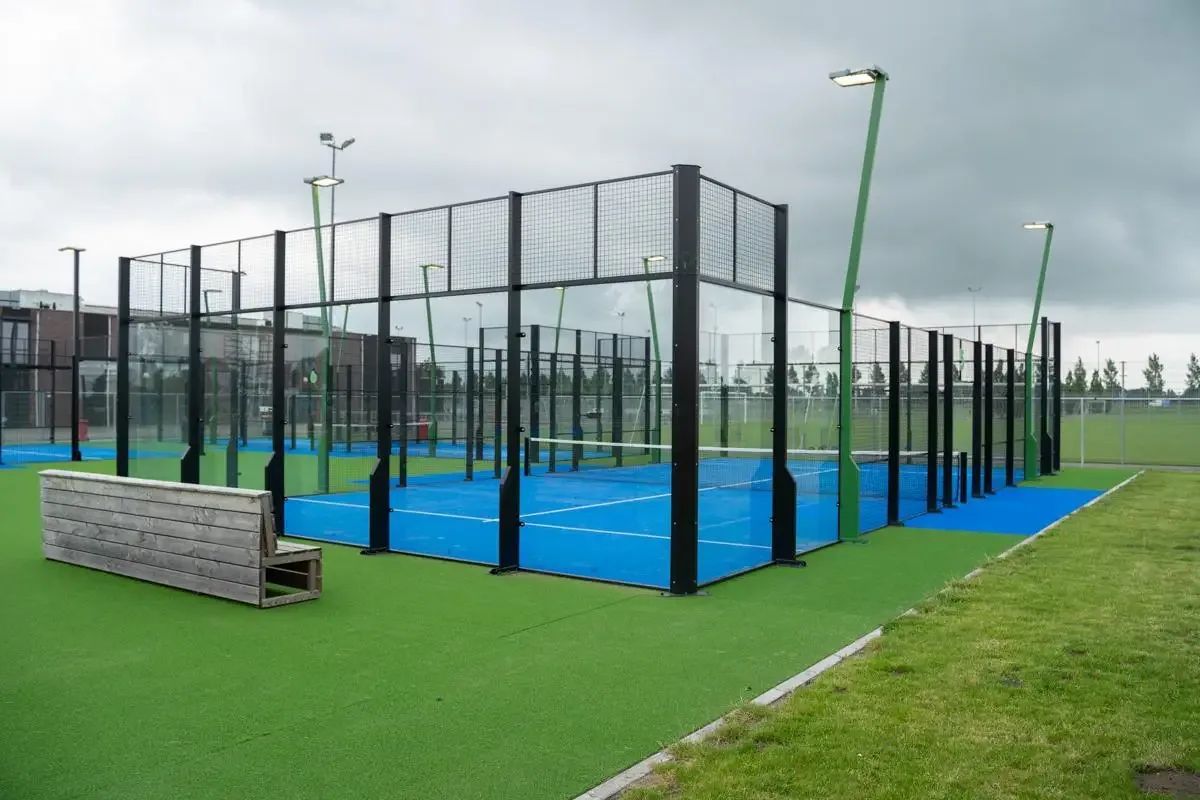
A complete padel court consists of six main components: the steel structure (cage structure), the safety glass around the court, the artificial turf including sand bed and line markings, the LED lighting, the foundation and the installation. With a turnkey package, all of these components are included and the court is delivered without you having to coordinate anything yourself.
In practice, what is and isn't included in the price differs per supplier. Some prices you come across cover only the superstructure, meaning the cage structure without foundation, artificial turf or lighting. That makes comparing difficult. So always make sure you know whether a quote includes the foundation, the artificial turf, the LED lighting and the installation. A low price for the structure alone can end up considerably more expensive once you add up all the separate components.
Optional extras that are not standard in every quote, but can be relevant:
- Sound-absorbing panels (priced per location)
- Run-off zones with artificial turf around the court
- Ball catchers on the sides
- Sliding doors or extra screening
- Additional fencing
What does an indoor padel court cost on average in the Netherlands?
In the Netherlands, an indoor padel court costs between € 23,000 and € 35,000 per court on average, depending on the specification, the number of courts and the location. The price of € 23,000 is a guideline for a standard indoor court including cage structure, glass, artificial turf, LED lighting and installation. The Dutch market average is usually higher, around € 30,000 to € 35,000.
What determines the final price of an indoor padel court:
- The type of court: a panoramic court has an open back wall with a different visual appearance than a pro court. Despite the lighter look, heavier materials are often used, which makes the price slightly higher.
- The number of courts: with multiple courts, economies of scale arise in production and installation. Six courts in one hall cost less per court than a single court on its own.
- The accessibility of the location: a hall with limited access or low doors requires more logistics, which affects the installation costs.
- The quality level of the artificial turf and lighting: different specifications are available, each with its own performance characteristics and price points.
A common mistake is to look only at the lowest price. In practice, this often leads to higher costs in the long run due to lower material quality, limited warranty or poor service after delivery.
Why are outdoor courts more expensive than indoor courts?
An outdoor padel court is more expensive than an indoor court because the steel structure has to be heavier, the foundation is a large and location-dependent cost factor, and an environmental permit is almost always required. As a guideline, the price starts at around € 30,000 for the court excluding foundation, and from around € 50,000 for a complete project including foundation.
The three main reasons for the higher costs of outdoor courts:
Heavier steel structure
An outdoor court is exposed to wind, rain, frost and temperature fluctuations. The cage structure has to withstand all of this. That means heavier steel, a hot-dip galvanised finish as protection against corrosion, and a structure calculated for the wind load at the specific location. On an open site or a coastal location, these requirements are even higher.
Foundation as a major cost item
For indoor courts, the existing floor is often already the foundation. For outdoor courts, a full foundation always has to be built. Foundation costs average between € 20,000 and € 40,000, depending on soil conditions, accessibility and the civil engineering work required. When an existing tennis court is converted, part of the substructure can sometimes be reused, which saves costs.
Permits and additional studies
Outdoor padel courts almost always require an environmental permit. This calls for structural calculations, an acoustic study and a lighting study. The processing time for a permit application averages 8 to 12 weeks, depending on the municipality and the complexity of the project.
Which foundation options are there and what do they cost?
There are three commonly used foundation types for padel courts: drainage concrete, Supersub and ZOAB asphalt. The right choice depends on the soil conditions, the intended use and the available budget. In the Netherlands, all foundation components must be approved by Kiwa ISA Sport before they may be used.
Here is an overview of the three options:
Drainage concrete
Drainage concrete is a water-permeable concrete floor in which rainwater drains directly through the foundation into the ground. It is one of the most commonly used solutions for outdoor courts. Drainage concrete is stable, bears heavy loads (up to approximately 5 tonnes), is sound-absorbing thanks to its porous structure and lasts an average of 25 to 40 years with correct use and maintenance. Drainage concrete is often combined with a ring foundation with steel reinforcement to properly absorb the forces from the cage structure and wind load.
Supersub
Supersub is a foundation solution based on foam concrete: a lightweight, self-levelling type of concrete that provides a flat and stable base. It is shock-absorbing, water-permeable (outdoor variant) and in many cases can be poured within a single day. Supersub is also sound-dampening, which is relevant for locations near residential areas. The thickness varies from approximately 10 cm for renovations to approximately 15 cm for new builds, depending on soil conditions and project requirements.
ZOAB asphalt
ZOAB stands for Zeer Open Asfalt Beton (very open asphalt concrete). It is a porous type of asphalt that lets water through. It is less common for padel courts than drainage concrete or Supersub, but in certain situations it is a good choice, for example at locations where asphalt is already present or where specific requirements apply.
Besides these three options, ring foundations and plastic plates are also used as an alternative to poured concrete, depending on the situation. Foundation advice is always drawn up on the basis of soil penetration tests. Without that data, a reliable cost estimate is not possible.
What are the hidden costs of building a padel court?
The hidden costs of building a padel court are the items that are not in a standard quote but that you almost always encounter in practice: permit costs, acoustic study, groundwork, possible soil contamination and electrical connections. Together, these items can raise the total investment considerably.
The most common additional costs at a glance:
- Environmental permit: the application itself incurs fees (depending on the municipality), but the required studies (acoustic, lighting, structural) also come with costs.
- Groundwork and removal: at outdoor locations, the ground has to be raised, levelled or remediated. The costs depend heavily on the current condition of the site.
- Electrical connection: LED lighting requires a proper power connection. If one is not yet in place, installation costs are added.
- Inspection after delivery: for official matches, an inspection by Kiwa ISA Sport is mandatory. This requirement follows from the NOC*NSF quality requirements for artificial turf padel sports floors.
- Noise measures: if the municipality imposes additional requirements, sound-absorbing panels or a noise barrier may be needed. These are extra investments that are not included in the base price as standard.
Tip: always ask for an itemised quote that clearly states what is and isn't included. That way you avoid surprises afterwards.
What are sound-absorbing panels and what do they do to the price?
Sound-absorbing panels are special panels that are placed on the outside of the mesh of the cage structure. They absorb the sound of balls and rackets instead of reflecting it back. In practice, this results in a clearly audible noise reduction at distances of approximately 40 to 100 metres. They increase the price of a padel court, but at locations near residential areas they are often necessary to meet municipal noise standards.
What many people don't know: installing sound-absorbing panels has a direct structural consequence. The panels reduce the wind permeability of the cage structure, which puts extra wind load on the structure. The steel structure must therefore be structurally reinforced with heavier posts, additional columns or modified connections. This is not an option but a safety requirement. A supplier who does not include this in the calculation delivers a structure that does not comply with building regulations.
The panels can be installed on one side of the court (for example facing homes), on multiple sides, or in combination with a noise barrier. In some situations, a combination of panels and a noise barrier is the most effective. A noise barrier works over a greater distance and blocks sound towards homes, while panels tackle the noise at the source.
Sound-absorbing panels can also be retrofitted to existing courts, provided the structure is suitable or is modified accordingly. Whether a noise solution is sufficient to meet the applicable standards always depends on the situation and requires an acoustic report.
When is a complete package cheaper than buying materials separately?
A complete package is cheaper than buying materials separately if you don't have your own construction crew, if you are building multiple courts at once, or if you want to avoid the risks of coordinating between different suppliers. With a turnkey approach, you pay one price for the entire process, from groundwork to delivery, with one responsible party.
When buying materials separately, you are responsible for coordinating between the suppliers of the structure, glass, artificial turf and lighting. If something goes wrong at the interface between these parties, the question is who is liable. That risk disappears with a complete package: one party stands behind the whole.
Buying materials separately can be interesting if you have your own experienced construction crew and want to handle the installation yourself. This is particularly relevant for international customers, such as in Germany, where companies usually have their own installation teams and only want to source the material from a reliable supplier.
With multiple courts at one location, there is also an economy of scale: the fixed costs for transport, logistics and assembly are spread over more courts, so the price per court is lower. That makes a complete package even more attractive for larger projects.
Would you like to know the best approach for your specific location and situation? At I-Padel, we are happy to think along with you, without obligation, about building padel courts. Whether you want to build a single indoor court or a complete outdoor facility with multiple courts, we look at your situation and prepare a quote that transparently shows what is and isn't included.
Frequently asked questions
How long does it take on average to have a padel court built?
The construction time of an indoor padel court is usually 2 to 5 days per court, depending on the complexity and the number of courts. For an outdoor padel court you need to allow for a longer lead time: the permit procedure alone takes an average of 8 to 12 weeks, followed by the foundation work and the installation of the cage structure. So plan at least 4 to 6 months ahead if you want to build an outdoor court, including the permit phase.
What warranties can I expect when purchasing a padel court?
A reliable supplier offers a warranty on at least the steel structure, the glass, the artificial turf and the LED lighting. When comparing quotes, pay close attention to the warranty periods per component: artificial turf usually has a warranty of 5 to 8 years, while a well-built steel structure can last 15 to 25 years. Also ask explicitly about service arrangements after delivery, because a quick response to any problems is at least as important as the warranty period itself.
Can I convert an existing tennis court into padel courts, and what does that cost?
Yes, in many cases an existing tennis court can be converted into two or three padel courts, depending on the dimensions. The big advantage is that the existing substructure can be partly reused, which considerably lowers the foundation costs. The total costs of such a conversion depend heavily on the condition of the existing base and which modifications are needed, but in most cases it is more cost-efficient than new construction on a bare site.
What are the annual maintenance costs of a padel court?
The annual maintenance costs of a padel court consist mainly of regularly topping up and levelling the sand bed in the artificial turf, cleaning the glass and inspecting the structure. As a rough guide, count on an annual maintenance budget of € 500 to € 1,500 per court, depending on use and location. Outdoor courts generally require more maintenance than indoor courts due to weather influences such as falling leaves, algae growth and temperature fluctuations.
How do I know if my location is suitable for an outdoor padel court without requesting a quote straight away?
You can make a first assessment of your location's suitability yourself by looking at the available space (a standard padel court including run-off zones needs at least approximately 20 x 11 metres), the distance to homes and the soil conditions.
Keep in mind that an open or windy location, such as near the coast, places extra demands on the steel structure. A soil survey is ultimately necessary for reliable foundation advice, but an initial exploratory conversation with a supplier can already provide a lot of clarity without you having to request a quote straight away.
What should I ask when comparing quotes from different suppliers?
Ask each supplier explicitly whether the quote includes the foundation, the artificial turf, the LED lighting, the installation and the inspection by Kiwa ISA Sport. Also check which warranty periods apply per component and whether the steel structure has been structurally calculated for the wind load at your specific location. An itemised quote with a clear line-by-line breakdown is the only way to compare suppliers fairly and to avoid hidden costs afterwards.
Is a padel court a profitable investment for a sports club or commercial operator?
Yes, provided the occupancy rate is sufficient. With an hourly rate of € 15 to € 30 per court and an average occupancy of 4 to 6 hours per day, a padel court can pay for itself within 3 to 6 years, depending on the total investment and the operating costs.
For sports clubs, padel also offers the opportunity to attract a new target group and make better use of the existing facilities. A realistic operating calculation based on your location and expected occupancy is an essential step before investing.


