Blog · 14 September 2026 · 12 min read
What is a source measure for padel noise?
A source measure for padel noise tackles sound at the source. Find out how panels (αw 0.80) work, what they mean for the structure and when they are enough for a permit.

In this article
- How does a source measure work on a padel court?
- What is the difference between a source measure and a noise barrier?
- Which source measures are possible for an outdoor padel court?
- How much noise reduction does a source measure deliver?
- Is a source measure enough for a permit?
- What effect does a source measure have on the structure of the padel court?
- When is an acoustic study mandatory for padel?
- Not sure whether outdoor padel is feasible at your location?
- Frequently asked questions
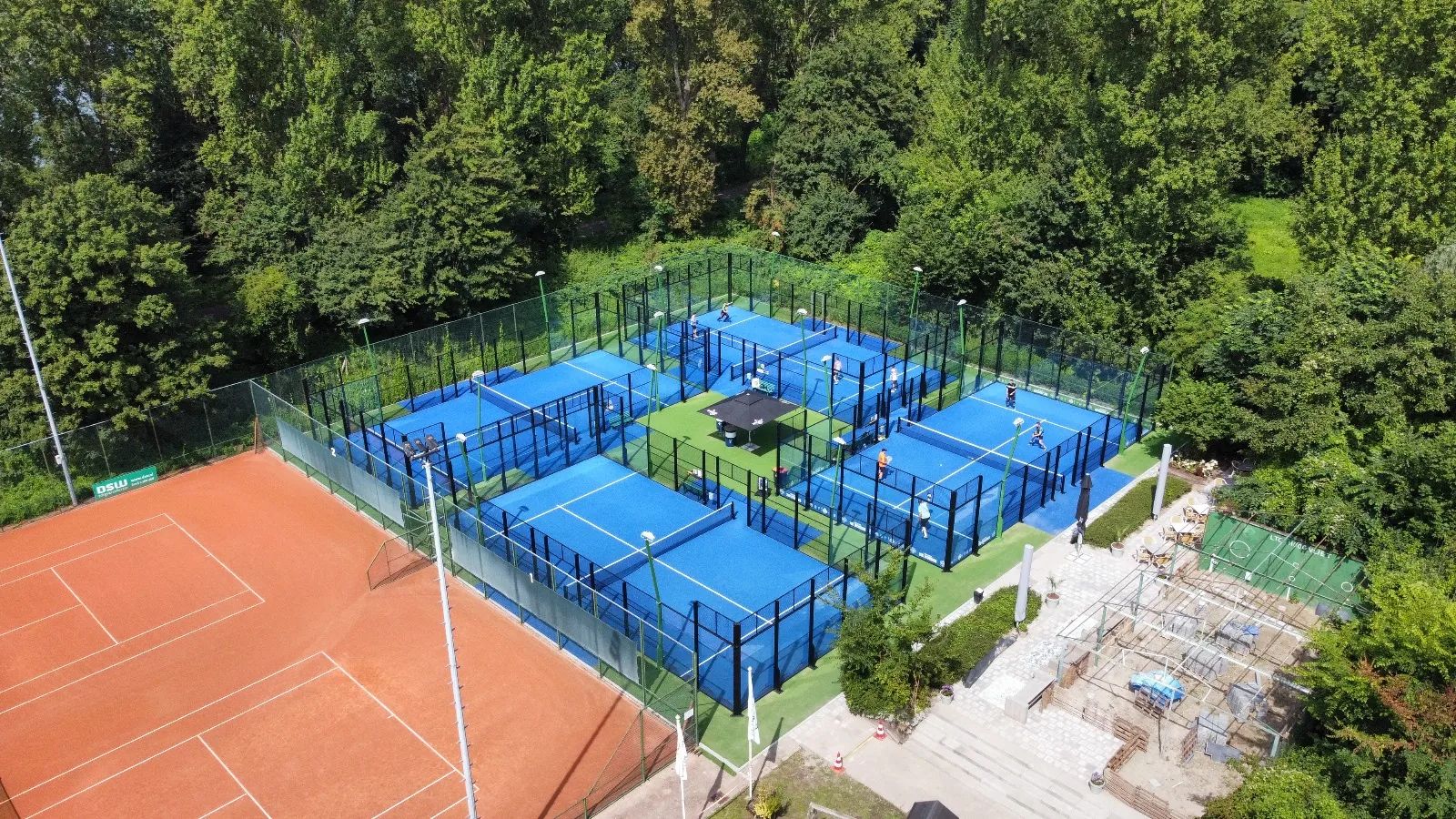
A source measure for padel noise is a measure that tackles the sound directly at the source, that is, on or at the padel court itself. Think of sound-absorbing panels fitted to the outside of the cage structure. They absorb the noise before it spreads to the surroundings.
This is a fundamentally different approach from a noise barrier, which only tries to block the sound at a distance from the court. In this article we answer the most frequently asked questions about source measures for padel courts, from how they work to the structural implications and their role in a permit process.
How does a source measure work on a padel court?
A source measure tackles noise where it is generated. On a padel court this means that sound-absorbing materials are fitted directly on or to the cage structure, so that sound is absorbed instead of reflected back into the surroundings. The noise therefore reaches local residents at a lower intensity.
Padel courts mainly produce impulsive noise. These are short, sharp peaks of sound created when the ball hits the racket, the glass or the fencing. Because the cage structure can act as a kind of sound box, this noise travels a relatively long way. An average sound power level of around 91 dB is measured in practice, which is considerably more than with tennis.
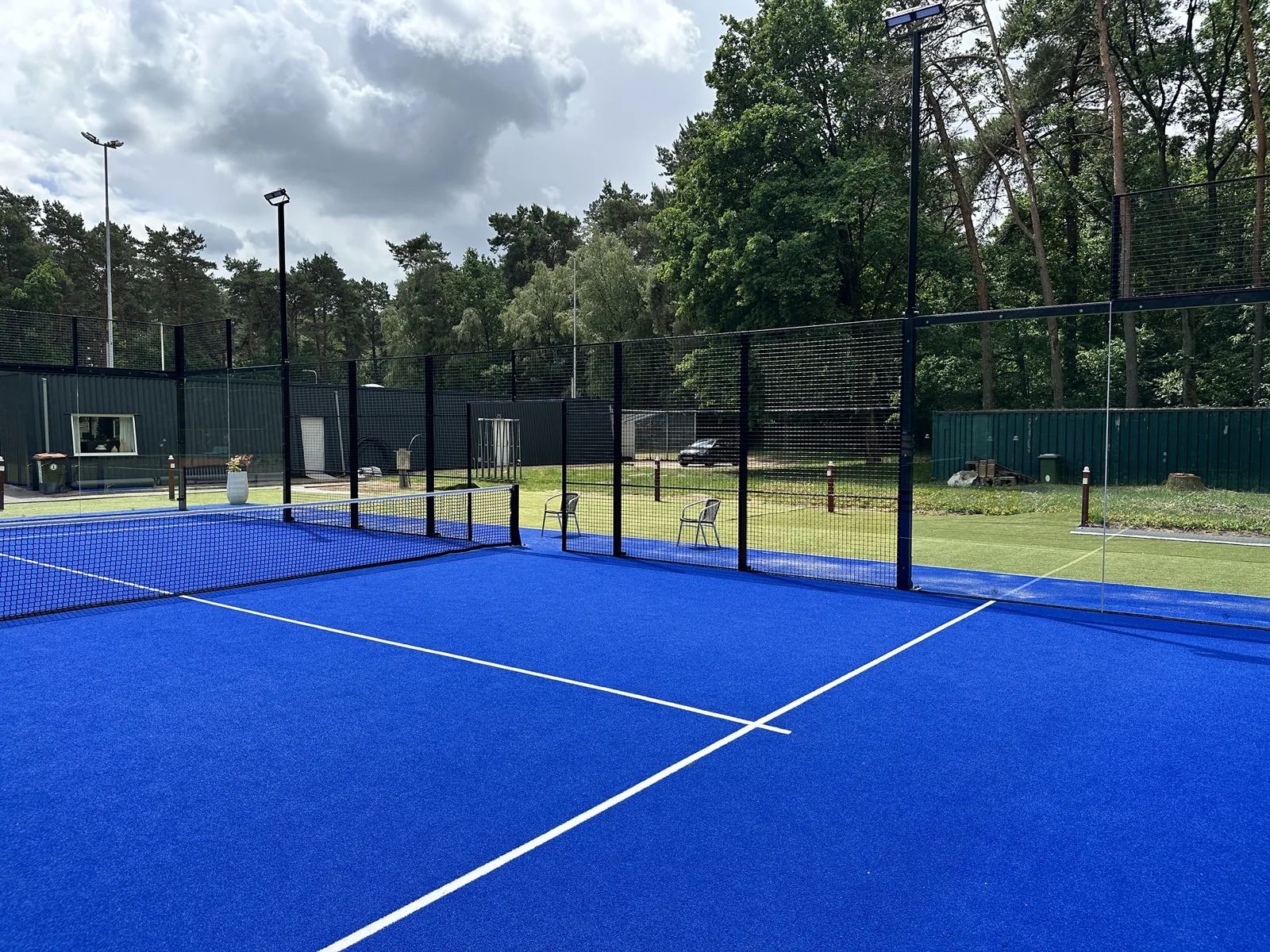
With a source measure, sound-absorbing panels are fitted to the outside of the mesh of the padel cage. The panels absorb the sound that passes through the fencing, so less noise is reflected outwards. The dynamics of play inside the court are preserved. The court stays visually open and the quality of play is not affected.
An important distinction: a source measure reduces the noise at the source. That is not the same as completely eliminating noise nuisance. How much reduction is achievable depends on the configuration, the position of the panels, the surroundings and the distance to homes. Every situation calls for a project-specific assessment.
What is the difference between a source measure and a noise barrier?
The difference lies in the position relative to the sound source. A source measure is applied directly on or at the padel court and tackles the noise before it spreads. A noise barrier or noise embankment stands next to or around the court and tries to block or absorb the sound after it has already left the court.
A noise embankment is a freestanding structure placed next to the padel court. Such embankments can be built up to heights of 6 to 8 metres and can be tens of metres long. They are effective when sound has to be stopped in a specific direction, for example towards a residential area on one side of the sports park.
A source measure in the form of sound-absorbing panels is more compact and takes up less space. The panels become part of the cage structure itself. In some situations that makes them more practical, particularly when the space around the court is limited or when a freestanding barrier is difficult to realise structurally or in terms of permits.
In practice, a combination of both measures is sometimes the most suitable. The panels reduce the noise at the source, after which a noise embankment can possibly be built lower because the remaining sound has already been partly dampened. This can both save costs and simplify the permit process. Which combination is suitable always depends on the specific location and the results of an independent acoustic study.
Which source measures are possible for an outdoor padel court?
The most commonly applied source measure for an outdoor padel court is sound-absorbing panels fitted to the outside of the cage structure. In addition, the choice of certain foundation types and the layout of the site can help to limit noise nuisance, although these are less direct source measures.
Sound-absorbing panels can be applied in different ways, depending on the situation:
- On one side of the court, facing the direction where homes are located
- In the lower metres of the cage, where most ball contact takes place
- On several sides or around several courts at once
- In combination with glass walls or other noise measures
- Retrofitted to existing courts, provided the structure is recalculated for this
The panels we use have been independently tested in an acoustic laboratory. The measured absorption value is αw 0.80, which corresponds to sound absorption class A. The airborne sound insulation Rw is 22 dB. These are laboratory values. Performance in practice depends on the configuration and the surroundings.
Besides panels, the choice of a sound-dampening foundation can also make a contribution. Supersub, a foundation solution based on foam concrete, has a certain sound-absorbing effect thanks to its porous structure. This is not, however, a replacement for specific acoustic measures, but it can be part of a broader approach. For more information on foundation options, see our page on padel court including groundwork.
How much noise reduction does a source measure deliver?
The amount of noise reduction a source measure delivers differs per situation and cannot be given as a general guarantee. In a practical measurement at LTC Hofgeest, an indicative noise reduction of around 3 dB(A) was measured within the configuration studied, after correcting for background noise. These results apply only to that specific situation.
A reduction of 3 dB(A) sounds modest, but it has a noticeable effect in practice. In acoustics, a reduction of 3 dB equals a halving of the sound energy. For local residents at distances of around 40 to 100 metres, this can make a clearly audible difference.
Whether this reduction is sufficient to meet the applicable noise standards depends on the starting situation. Factors that determine the required reduction include:
- The distance between the padel courts and the nearest homes
- The background noise level at the location
- The number of courts and the expected intensity of use
- The applicable noise standards based on the zoning plan or the environmental permit
- The orientation of the courts relative to the surroundings
An independent acoustic consultant determines, on the basis of calculations and measurements, what reduction is needed and whether a source measure is sufficient for that, or whether additional measures are required. We supply the technical product specifications, structural data and engineering needed to carry out acoustic calculations correctly. The acoustic solutions for padel that we apply are based on tested products and project-specific engineering.
Is a source measure enough for a permit?
Whether a source measure is enough for a permit cannot be said in advance. That depends on the location, the applicable noise standards, the distance to homes and the results of an acoustic study. A source measure can contribute to a feasible permit process, but offers no guarantee that a permit will be granted.
In the Netherlands, an outdoor padel court is regarded as a structure. In most cases an environmental permit is mandatory. When the location is close to homes, an acoustic study almost always forms part of the permit application. The municipality assesses on the basis of that study whether the proposed measures are sufficient.
An acoustic study is carried out by an independent acoustic firm. That firm calculates the expected noise load on the façades of nearby homes and tests it against the standards arising from the Activiteitenbesluit (Dutch Environmental Activities Decree) or the environmental permit. On the basis of those calculations, it is determined which measures are needed.
If the study shows that a source measure alone is insufficient, a combination with a noise embankment or adjustments to the site layout may be needed. Sometimes the positioning of the courts on the site is also a factor that contributes to the feasibility of the permit. More information about the permit process can be found on our page about permit for a padel court.
What effect does a source measure have on the structure of the padel court?
Sound-dampening panels have a direct effect on the structural load of the padel court. Because the panels partly close off the surface of the cage structure, wind permeability decreases. This creates extra wind load on the structure. The steel structure has to be recalculated for this and, in most cases, reinforced.
The reinforcement can consist of heavier posts, additional columns or adapted connections, depending on the configuration and the wind zone in which the court is placed. This is not an optional step, but a structural requirement for the safety and service life of the court.
Because we produce the steel structure ourselves, structural adjustments can already be made during the engineering phase. Columns, connections, base plates and anchors can be adapted project by project based on the desired noise measures and the local wind load. This is a concrete advantage over standard imported cages, where structural changes are often limited or impossible.
For existing courts, retrofitting sound-dampening panels is also possible, but it always requires a structural reassessment. The existing structure has to be checked against the extra wind load that the panels cause. Without that assessment, fitting panels is not structurally sound. More about the relationship between structure and wind load can be found on our structure page.
When is an acoustic study mandatory for padel?
For outdoor padel courts, an acoustic study is almost always mandatory when the location is close to homes. The municipality usually requests this study as part of the permit application. For indoor padel courts in an existing hall, this depends on the situation and local regulations.
The reason municipalities ask for an acoustic study is that padel produces considerably more noise than tennis. The impulsive noise of the ball on glass and fencing, combined with the cage structure acting as a sound box, results in a sound power level averaging around 91 dB. This is roughly 10 dB more than with tennis. When located close to residential buildings, there is a high chance that the noise load on the façades of homes will exceed the applicable standards without additional measures.
An acoustic study is carried out by an independent acoustic firm. We do not carry out acoustic studies ourselves, but we do supply the technical product specifications, structural data and engineering needed to carry out the calculations correctly. Think of the absorption values of the panels, the dimensions of the structure and information about the court configuration.
It is wise to involve an acoustic consultant at an early stage of project preparation. That way you avoid noise measures being designed late in the process, which can affect the feasibility and cost of the project. A timely site analysis helps to map out the technical and permit-related conditions before irreversible decisions are made about the construction of an outdoor padel court.
Not sure whether outdoor padel is feasible at your location?
We are happy to help you think through the court configuration, structural preparation and possible noise measures. Together with your acoustic consultant, we look at which solution is technically feasible and suits the project. Get in touch via our page on acoustic solutions for padel for an initial, no-obligation exploration.
Frequently asked questions
Can I decide on which side of the padel court the sound-dampening panels are placed?
Yes, the positioning of the panels is project-specific and is tailored to the location and the direction of the nearest homes. In most cases the panels are placed on the side(s) of the court that face sensitive uses most directly. An acoustic consultant determines on the basis of calculations which configuration is most effective for your specific situation.
What does a source measure on a padel court cost?
The cost of sound-dampening panels depends on the number of courts, the desired coverage (one side, several sides or all around), the structural adjustments required and the local wind load. Because the structure is calculated per project and reinforced where necessary, the investment differs per situation. A no-obligation exploration via our contact page quickly gives insight into what is feasible within your project and budget.
How long do sound-absorbing panels last and is a lot of maintenance needed?
Quality sound-absorbing panels are designed for long-term outdoor use and withstand weather influences such as rain, UV radiation and temperature changes. The maintenance is generally minimal and limited to periodic inspection and cleaning. It is wise, however, to ask about the specific warranty conditions and the expected service life of the chosen product when purchasing.
What if the acoustic calculations show that the source measure alone is not enough?
In that case a combined approach is recommended, in which the sound-dampening panels are combined with additional measures such as a noise embankment, an adjusted site layout or a different positioning of the courts. The advantage of the source measure is that the remaining sound has already been partly dampened, so that any noise embankment can be built lower. This can reduce both the cost and the complexity of the permit process.
Can I have sound-dampening panels fitted afterwards on an existing padel court?
That is possible, but it always requires a structural reassessment of the existing cage structure. Because the panels reduce wind permeability, the wind load on the structure increases. The existing steel structure has to be checked against this extra load and reinforced if necessary. Without this assessment, fitting panels is not structurally sound and possibly unsafe.
What role does the choice of location play in preventing noise nuisance from padel?
The choice of location is one of the most decisive factors for the feasibility of a padel court near homes. A greater distance to residential buildings, a favourable orientation of the courts and the presence of natural sound buffers such as greenery or buildings can considerably limit the noise measures required. It is therefore strongly advisable to involve an acoustic consultant for an early site analysis before the location is finally fixed.
How can I, as the initiator, make the permit process for a padel court go as smoothly as possible?
The key to a smooth permit process is early preparation: engage an independent acoustic firm in the initiative phase, before final choices are made about the location, number of courts and court configuration. Also make sure the supplier of the padel courts provides the necessary technical data in good time, such as absorption values, structural specifications and court dimensions, so that the acoustic calculations can be carried out correctly and completely. A well-substantiated permit application with a thorough acoustic report considerably increases the chance of swift approval.