Blog · 1 September 2026 · 11 min read
What is a sound-absorbing padel cage?
A sound-absorbing padel cage tackles noise nuisance at the source. Discover how it works, what it costs and when it is the right choice.

In this article
- How exactly does a sound-absorbing padel cage work?
- What is the difference between sound-absorbing panels and a noise barrier?
- What effect do sound panels have on the structure of a padel court?
- Are sound-absorbing padel cages effective enough for a permit?
- When is a sound-absorbing padel cage the right choice?
- How much more does a sound-absorbing padel cage cost than a standard court?
- Not sure whether outdoor padel is feasible at your location?
- Frequently asked questions
A sound-absorbing padel cage is a padel court in which sound-absorbing panels are integrated directly in or on the cage structure. Instead of screening the noise with a free-standing noise barrier next to the court, the noise is tackled at the source. This makes the sound-absorbing padel cage a so-called source measure. The following questions explain how such a cage works, what it delivers and when it is the most suitable choice for your project.
How exactly does a sound-absorbing padel cage work?
A sound-absorbing padel cage works by fixing sound-absorbing panels to the outside of the mesh of the cage structure. When a ball hits the glass or the mesh, the noise that would normally be reflected is absorbed by the panel. The noise level that reaches the surroundings is therefore lower than with a standard padel cage.
The principle is that of a source measure: the noise measure is applied as close as possible to the place where the noise originates. That is different from a noise barrier, where the noise is only blocked at some distance from the court.
The panels can be fitted in various positions, depending on the situation at the location. Think of one side of the court facing homes, the lower metres of the cage where most ball contacts take place, or several sides at once. The court remains visually open and the dynamics of play are preserved.
The sound-absorbing panels we use have been independently tested in an acoustic laboratory. These tests show a sound absorption class A, with an absorption coefficient of 0.80 and an absorption index of 8 dB. The airborne sound insulation is 22 dB, with a corresponding sound insulation index of 19 dB. These values apply to the configuration tested and form the basis for calculations by an independent acoustic consultant.
What is the difference between sound-absorbing panels and a noise barrier?
The main difference is the position relative to the noise source. Sound-absorbing panels are placed directly on the cage structure and tackle the noise at the source. A noise barrier or noise wall is a free-standing structure next to or around the court that blocks the noise towards the surroundings at a greater distance.
Both measures have a different area of application and different advantages and disadvantages.
Sound-absorbing panels as a source measure
Panels are compact, are integrated into the existing or new cage structure and require no extra space next to the court. They can also be retrofitted to existing padel courts. A drawback is that the structure must be recalculated for the extra wind load created because the panels reduce the wind permeability of the cage. This requires a structural modification, but is technically well manageable when it is included already in the engineering phase.
Noise barrier as screening at a distance
A noise barrier can reach a height of 6 to 8 metres and be tens of metres long. That makes a barrier suitable for situations in which the noise has to be screened over a larger area. Drawbacks are the greater space requirement, higher costs and the environmental permit that is almost always required because of the size of the structure.
In many projects a combination of both measures is the most effective. The panels reduce the noise at the source, so any noise barrier can be built lower and more compactly. This can save costs and simplify the permitting process. Which combination is suitable always depends on the project-specific situation and the results of an independent acoustic study.
What effect do sound panels have on the structure of a padel court?
Sound-absorbing panels have a direct influence on the structural load of the padel court. Because the panels reduce the wind permeability of the cage, the structure catches more wind. This leads to a higher wind load on the posts, connections and foundation. The cage structure must be recalculated for this and, in most cases, reinforced.
The reinforcement can consist of heavier posts, additional columns or modified connections. How drastic the modification is depends on the wind zone of the location, the position and surface area of the panels and the existing structure.
Because we produce the steel structure ourselves, we can adapt columns, connections, base plates and anchors to the specific project when noise measures require it. That gives technical freedom that importers of standard courts generally cannot offer. For existing courts, an assessment by a structural engineer is necessary before panels are fitted. You can read more about the structure and wind load of a padel court on our structure page.
Another point of attention is the foundation. Extra wind load on the structure is transferred to the foundation. For new-build projects this is taken into account directly in the foundation design. For existing courts, an additional assessment of the foundation is advisable.
Are sound-absorbing padel cages effective enough for a permit?
Whether a sound-absorbing padel cage is sufficient for a permit depends on the location, the distance to homes, the applicable noise standards and the assessment by the municipality. There is no universal answer. An independent acoustic study is in most cases necessary to determine this.
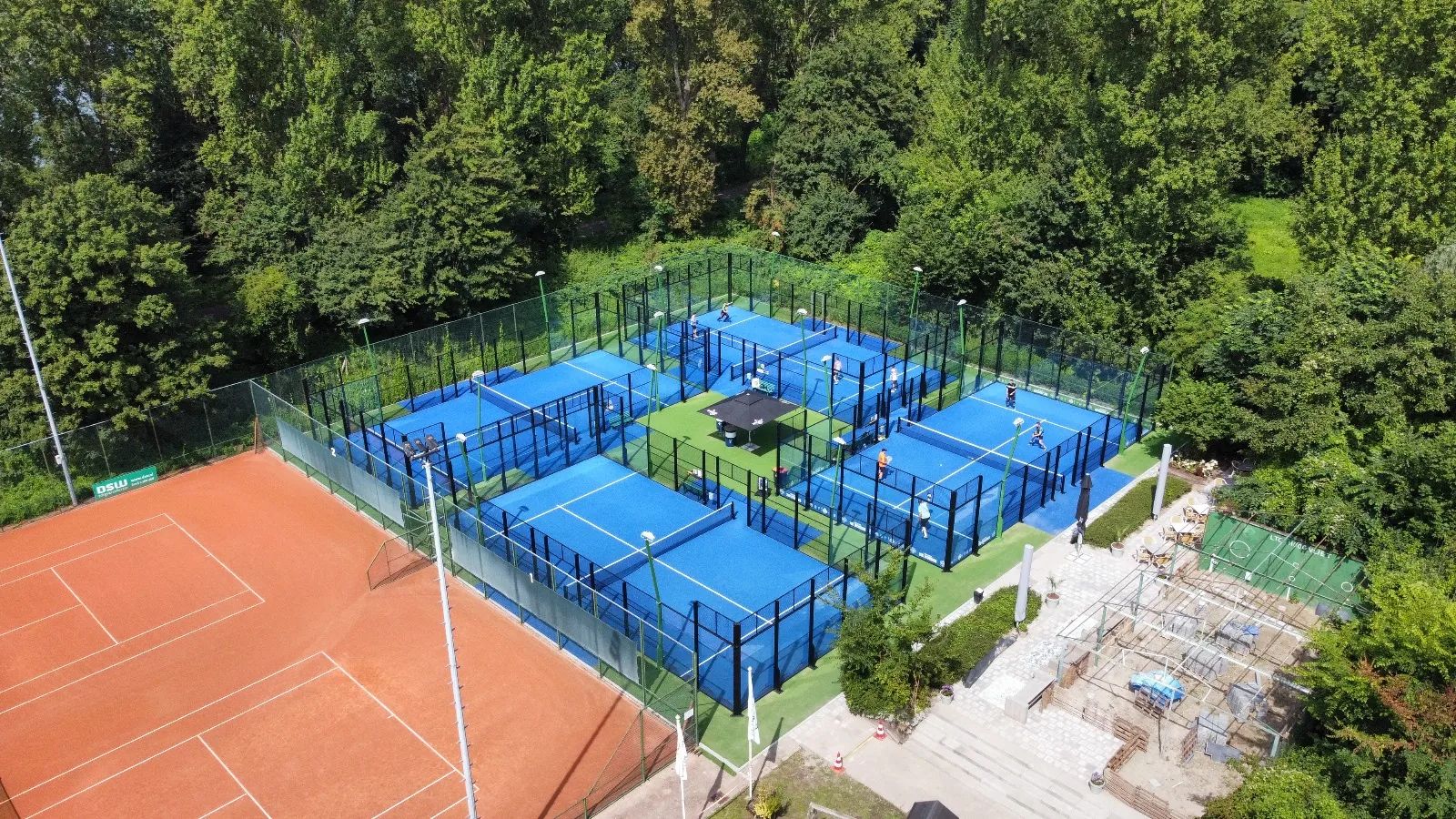
What is known are the measured values of the panels we use. In a practical measurement at LTC Hofgeest, an indicative noise reduction of around 3 dB(A) was measured within the configuration studied, after correction for background noise. These results apply only to the situation studied and must not be translated to other locations or configurations.
A reduction of 3 dB(A) is noticeable in acoustic terms, but whether this is sufficient for a specific location is determined by an acoustic consultant on the basis of calculations. Factors such as the distance to the nearest home, the background noise levels and the requirements of the municipality play a decisive role in this.
We do not carry out acoustic studies ourselves. What we do supply are the technical product specifications, structural data and engineering needed to carry out acoustic calculations correctly. On the basis of those calculations, it can be assessed whether the sound-absorbing cage, alone or in combination with other measures, contributes to a feasible permit for a padel court.
When is a sound-absorbing padel cage the right choice?
A sound-absorbing padel cage can be a suitable solution when noise nuisance towards local residents is a point of attention, but there is insufficient space available for a free-standing noise barrier. Also when a compact, integrated solution is preferred over a large screening structure, the sound-absorbing cage is worth considering.
Situations in which this approach is relevant in many cases:
- Locations close to residential neighbourhoods where noise standards play a role in the permit application.
- Tennis clubs or sports parks with limited space around the courts.
- Projects in which objections from local residents are expected and a visible, technically substantiated measure supports the dialogue with the municipality.
- Situations in which a noise barrier would be too high or too expensive and a source measure offers a more compact alternative.
The sound-absorbing cage is not a solution that is sufficient in every situation. At locations with a very short distance to homes or with strict noise standards, a combination with a noise barrier may be necessary. An independent acoustic consultant determines which measures are needed in a specific situation. You can find more about the possibilities for an outdoor padel court on our page about outdoor courts.
How much more does a sound-absorbing padel cage cost than a standard court?
A sound-absorbing padel cage costs more than a standard padel court, because there are two additional cost items: the sound-absorbing panels themselves and the structural reinforcement needed because of the higher wind load. The exact additional cost depends on the number of panels, their position, the wind zone and the scale of the structural modification.
As an indication, the additional cost of sound-absorbing panels varies greatly per project. Factors that determine the price include:
- The number of sides on which panels are placed.
- The height of the panels over the cage structure.
- The degree of structural reinforcement needed.
- Whether it concerns a new-build project or a modification to an existing court.
For new-build projects, integrating sound-absorbing panels is generally more economical than for existing courts, because the structural modifications are included in the design. For existing courts, additional assessments and modifications are needed, which raises the cost.
Against the additional cost stand potentially lower costs elsewhere in the project. When panels improve the noise situation sufficiently, a noise barrier can become smaller or even unnecessary. In some cases the additional cost of the panels more than outweighs the saving on a large free-standing noise barrier. A project-specific comparison gives insight into the total investment. You can find more about the cost of a padel court including noise measures on our costs page.
Always request a tailor-made quote based on the location, the acoustic study and the desired configuration. A fixed price without that context cannot realistically be given.
Not sure whether outdoor padel is feasible at your location?
We are happy to think along with you on the court configuration, structural preparation and possible noise measures. Together with your acoustic consultant, we look at which solution is technically feasible and suits the project. Take a look at our page on acoustic solutions for padel or get in touch for an initial, no-obligation exploration.
Frequently asked questions
Can I also add sound-absorbing panels to an existing padel court afterwards?
Yes, in many cases sound-absorbing panels can also be added afterwards to an existing padel cage. A structural assessment by a structural engineer is, however, mandatory before panels are fitted, because the higher wind load has consequences for posts, connections and foundation. Existing courts often need additional modifications, which makes the cost higher than for a new-build project where everything is included in the design.
On which sides of the cage are the panels most often placed, and does that choice make much difference?
The position of the panels is determined by the direction of the noise-sensitive objects, such as nearby homes. In most cases panels are placed on the side(s) directly facing local residents, and often in the lower metres of the cage where most ball contacts take place. The choice of position and surface area has a direct influence on the acoustic effectiveness and on the structural load, so a project-specific trade-off is always necessary.
Do I always need an environmental permit for a sound-absorbing padel cage?
Whether an environmental permit is required depends on the municipality, the location and the overall scale of the project, not only on the sound-absorbing panels themselves. The panels are integrated into the cage structure and require no extra space, which generally makes the permit process simpler than with a large free-standing noise barrier. Always consult the municipality and an acoustic consultant at an early stage to determine which permits are needed and which measures are required for them.
What is the lifespan of the sound-absorbing panels, and what maintenance do they need?
The sound-absorbing panels are designed for outdoor use and are resistant to weather influences such as rain, wind and UV radiation. Regular maintenance consists mainly of periodic visual inspection and cleaning to keep the absorption properties up to standard. If you are in doubt about the condition of the panels after, for example, storm damage, an inspection by the supplier or a structural engineer is advisable.
What if the acoustic study shows that the sound-absorbing cage alone is not sufficient?
If an independent acoustic consultant concludes that the panels alone offer insufficient reduction, a combination with additional measures, such as a noise barrier, is the most obvious step. The advantage is that the panels, as a source measure, can make the noise barrier smaller and more compact, which saves costs and can simplify the permitting process. A combined approach is in many situations technically and financially more efficient than a single measure that has to solve everything.
What information do I need to request a good quote or acoustic advice?
For a meaningful quote or acoustic advice, at least the following information is useful: the location of the court, the distance to the nearest homes, the wind zone of the location, the desired number of courts and whether it concerns a new build or an existing situation. The more context is available, such as a site plan or an earlier acoustic report, the more targeted the technical and financial elaboration can be.
Do the sound-absorbing panels affect the playing experience or the view of the court?
The panels are fixed to the outside of the mesh and have no influence on the playing surface, the glass walls or the dynamics of play inside the cage. The court remains visually open from the players' perspective, and spectators on the sides without panels keep a clear view of the game. Only on the side(s) where panels are placed is the direct view from outside limited, which in most situations is no practical objection.