


Building a padel court · 12 April 2026 · 15 min read
What does the process of building a padel court look like from A to Z?
Building a padel court takes 10–12 weeks and covers 6 phases. Discover everything about permits, foundation and costs — and avoid expensive mistakes.
In this article
- What does the process of building a padel court involve exactly?
- How long does it take to build a padel court from start to finish?
- Which phases are part of the process of building a padel court?
- Which type of foundation is best for a padel court?
- What is the difference between an indoor and an outdoor padel court when building?
- How are sound-absorbing panels incorporated into a padel court?
- What does it cost to build a padel court in the Netherlands?
- What should you look out for when choosing a padel court builder?
- Frequently asked questions
Building a padel court is a bigger project than many people initially think. You have to deal with permits, foundation choices, structural calculations and several specialists who need to be well coordinated. In this article, we explain the entire construction process step by step, so you know what to expect: from the first exploration to the day you hit the first ball.
Whether you want to expand a sports hall with padel courts, have a tennis club that wants to make the switch, or are looking for a location for a commercial padel centre: the questions you have are largely the same. We answer them all below.
What does the process of building a padel court involve exactly?
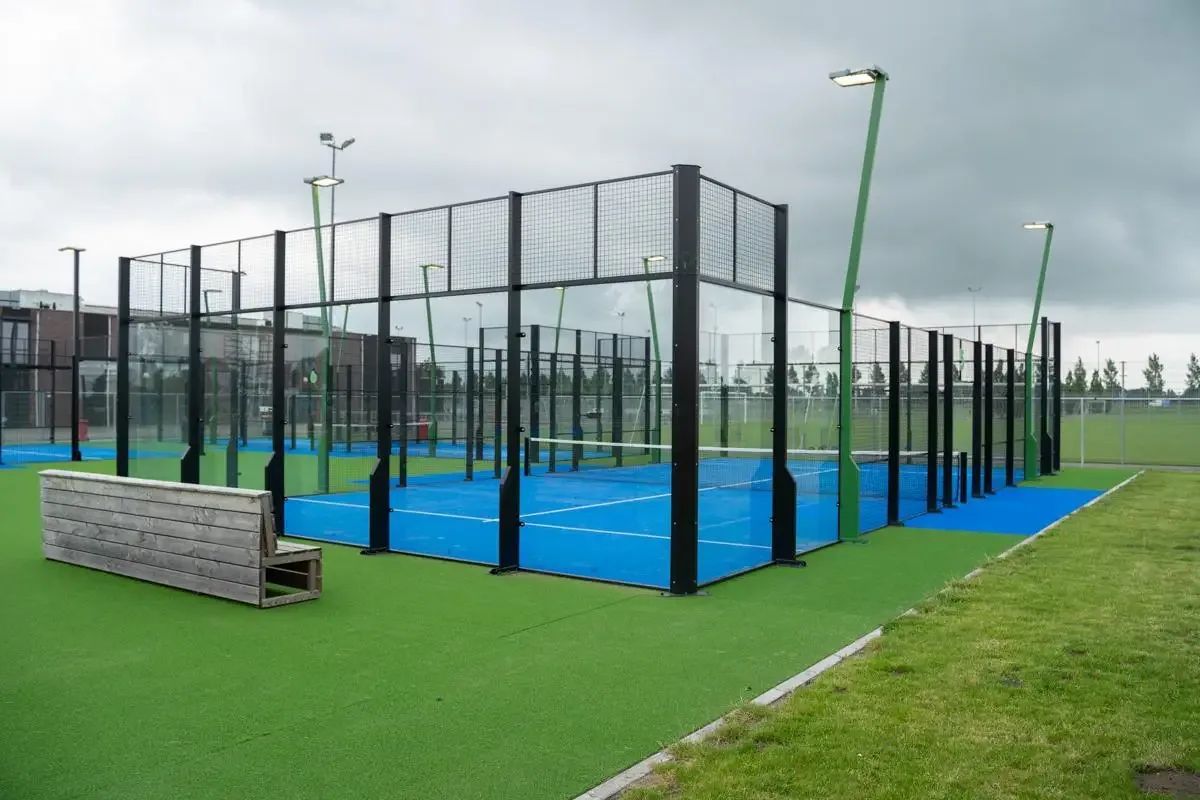
The process of building a padel court covers everything from the first site exploration to the final handover. That means: groundwork, foundation, installation of the steel structure, mounting of the glass, laying of the artificial turf, installation of the LED lighting and any noise measures. The total process takes an average of 10 to 12 weeks.
A padel court is not a ready-made product that you order and have put in place. Every location calls for its own approach. The soil conditions determine which foundation you need. The position relative to homes determines whether you need to take noise measures. The wind load at the location determines how heavy the steel structure must be. All these factors come together in a structural calculation that is drawn up for each project.
That sounds complex, but in practice you don't have to arrange everything yourself as a client. A good construction partner takes that off your hands and makes sure all the components fit together. The difference lies in whether you are dealing with a party that has everything in its own hands, or with a coordinator who manages several suppliers.
How long does it take to build a padel court from start to finish?
The total lead time of a padel court, from first contact to handover, averages 10 to 12 weeks. The actual installation on site takes 3 to 4 days: the cage structure is up in about 2 days, and laying the artificial turf takes another 1 to 2 days. Most of the time goes into preparation and production.
The schedule looks roughly like this:
- Site exploration and structural calculation: 1 to 2 weeks
- Permit process (for outdoor): 8 to 12 weeks, this often runs in parallel with production
- Production of the steel structure: 4 to 6 weeks
- Groundwork and foundation: 3 to 5 days, depending on the type
- Installation of the structure, glass, artificial turf and LED lighting: 3 to 4 days
A common mistake is to start the permit application only when production has already begun. Smart planning means starting the permit process as early as possible, so that no delay arises at the moment the court is ready to be installed. For an indoor project in an existing hall, this is less urgent, because an environmental permit is not always needed there.
Which phases are part of the process of building a padel court?
The process of building a padel court consists of six consecutive phases: exploration and advice, permit process, groundwork and foundation, production and delivery of the steel structure, installation of the court and handover. Each phase has its own lead time and points of attention.
Phase 1: Site exploration and structural calculation
Everything starts with a visit to the site. What are the soil conditions? How much space is available? What are the wind load requirements for this area? A structural calculation is made on the basis of that information. For a padel court you need at least 21 by 11 metres; with run-off zones, 21 by 14 metres is the recommended size.
Phase 2: Permit process
For outdoor padel courts, an environmental permit is almost always needed. The application requires structural calculations, an acoustic study, a lighting study and a site plan. Allow a lead time of 8 to 12 weeks, depending on the municipality. Building without a permit is not an option: the municipality can halt the project or even require you to remove the structure.
Phase 3: Groundwork and foundation
The foundation is the base for everything that follows. Depending on the location and the use, drainage concrete, Supersub or ZOAB asphalt is chosen. This is combined with a ring foundation that absorbs the forces from the steel structure and wind load. All foundation components in the Netherlands must be approved by Kiwa ISA Sport.
Phase 4: Production and delivery of the steel structure
The steel structure is produced to measure on the basis of the structural calculation. This includes all tubular profiles, columns, glass frames and connections. After production, everything is transported to the site, ready for installation.
Phase 5: Installation
On site, the steel structure is erected first, then the glass is mounted, the artificial turf is laid and the LED lighting is installed. Any sound-absorbing panels are also fitted in this phase.
Phase 6: Handover and inspection
Once everything is finished, the court is handed over. For official competitions, an inspection by Kiwa ISA Sport is mandatory. This checks, among other things, the ball bounce, the dimensions and the visual condition of the artificial turf.
Which type of foundation is best for a padel court?
There is no single best foundation type for a padel court. The right choice depends on the location, the soil conditions and the use. The three most commonly used options are drainage concrete, Supersub and ZOAB asphalt. Each has its own technical properties and areas of application.
Drainage concrete
Drainage concrete is a water-permeable type of concrete in which rainwater drains directly through the foundation into the ground. It is suitable for outdoor locations with good soil conditions, has a high load-bearing capacity and lasts an average of 25 to 40 years. For padel courts, drainage concrete is always combined with a ring foundation with steel reinforcement to properly absorb the forces from the steel structure.
Supersub
Supersub is a foundation solution based on foam concrete. It is light, self-levelling and can in many cases be poured within a single day. Supersub is shock-absorbing, which contributes to playing comfort and less strain on joints. The water-permeable variant for outdoor use handles up to 500 mm of rainfall per hour. When renovating an existing tennis court, the thickness is usually around 10 cm; for new builds around 15 cm.
ZOAB asphalt
ZOAB asphalt, also known as open asphalt concrete, is a porous type of asphalt that lets water through. It is less common for padel courts than the other two options, but in certain situations a good choice, for example when an existing asphalt base can be partly reused.
The advice is always: let the choice be determined by the specific circumstances at the location, not by what a supplier happens to offer as standard. All foundation components must be certified by Kiwa ISA Sport, the recognised certification body for sports infrastructure in the Netherlands.
What is the difference between an indoor and an outdoor padel court when building?
The biggest difference between an indoor and an outdoor padel court when building lies in the weight of the structure, the foundation and the permit process. An outdoor court calls for a heavier steel structure because of the weather and wind load, a more complex foundation and, in almost all cases, an environmental permit. An indoor court is technically simpler and cheaper to build.
Indoor padel court
For an indoor padel court in an existing hall, a separate building permit is not always needed, although rules on fire safety and use do apply. The steel structure does not need to be as heavy, because there are no wind or weather influences. The minimum clear height in the hall must be at least 6 metres; the higher, the better the playing quality. As an indication, an indoor padel court is possible from around €23,000 per court, including steel structure, glass, artificial turf, LED lighting and installation.
Outdoor padel court
An outdoor court calls for a heavier steel structure that can withstand wind, rain and temperature fluctuations. The foundation is more complex and highly dependent on the location. On top of the structural costs come the foundation costs, which can range from €20,000 to €40,000, depending on the soil conditions and accessibility. As an indication, a complete outdoor padel court including foundation starts from around €50,000. An environmental permit is almost always needed, including an acoustic study and a lighting study.
With existing tennis courts, part of the existing substructure can sometimes be reused, which can lower the foundation costs. This always requires an on-site assessment.
How are sound-absorbing panels incorporated into a padel court?
Sound-absorbing panels are fitted on the outside of the mesh of the cage structure. They absorb the sound of balls and rackets instead of reflecting it back. Independently tested in an acoustic laboratory, they achieve sound absorption class A, with an absorption value of 0.80 and a measurable effect at distances of 40 to 100 metres.
Important to know: fitting sound-absorbing panels always has structural consequences. The panels reduce the wind permeability of the cage structure, which increases the wind load on the structure. This means the steel structure must be structurally reinforced, with heavier posts, additional columns or adapted connections. This applies both to new courts and to existing courts where panels are added afterwards.
The panels can be used in different ways:
- On one side of the court, facing the homes in the surrounding area
- In the lower or upper metres of the cage
- On several sides or on several courts at once
- In combination with a noise barrier for maximum reduction
A noise barrier is a freestanding structure next to the court that blocks and absorbs noise towards homes. In situations where panels alone are not enough, a combination of panels and a noise barrier is often the most effective. A noise barrier almost always requires an environmental permit, because it is regarded as an independent structure.
Whether noise measures are sufficient to meet the municipal standards always depends on the location, the distance to homes and the results of an acoustic study. Never assume that a panel or barrier is automatically sufficient without it having been tested.
What does it cost to build a padel court in the Netherlands?
The cost of building a padel court in the Netherlands varies greatly, depending on the type of court, the location and the desired specification. As an indication, an indoor padel court starts turnkey from around €23,000 per court. An outdoor padel court including foundation starts, as an indication, from around €50,000 per court.
The exact price always depends on a number of factors:
- Indoor or outdoor (outdoor requires a heavier structure and foundation)
- The number of courts (with several courts, economies of scale arise)
- The type of foundation and the soil conditions at the location
- The accessibility of the location for transport and installation
- Noise measures, if needed
- Extra options such as ball catchers, sliding doors or run-off zones
For outdoor padel courts, the foundation is the biggest cost factor. Foundation costs average between €20,000 and €40,000, depending on the situation. That makes it difficult to quote a fixed price for an outdoor court without a site exploration.
A common mistake is to look only at the lowest price. In practice, this often leads to higher costs in the long term, due to lower-quality materials, limited service or warranty and technical limitations. When comparing quotes, always check exactly what is included: is the foundation included? Are artificial turf and LED lighting included? Who is responsible if something goes wrong?
What should you look out for when choosing a padel court builder?
When choosing a builder for your padel court, you look at four things: who is responsible for the whole, where the materials come from, which warranties are given and whether the builder has demonstrable knowledge of permits and structural requirements. A builder who has everything in their own hands gives you more certainty than a party that coordinates several suppliers.
One party, one responsibility
Many builders are in fact coordinators: they buy the structure abroad, hire an installation team and source the artificial turf from another supplier. That means that you, as the client, carry the risk if the interface between those parties doesn't work. A builder who handles everything themselves, from groundwork to handover, offers one point of contact and one warranty for the whole.
Materials and certification
Always ask whether the foundation components used have been approved by Kiwa ISA Sport. In the Netherlands, this is the recognised certification body for sports infrastructure, and the inspection is mandatory for official use. Inexperienced buyers risk purchasing materials that do not meet these standards, which causes problems at handover and at any competition inspection.
Structural knowledge and bespoke work
A padel court is not a standard product. Ask whether the builder makes a structural calculation for each location. This is particularly relevant if you want to add sound-absorbing panels, are building at a location with high wind load or are working with non-standard dimensions. Builders who only import standard courts usually cannot offer this kind of bespoke work.
Warranty and lifespan
Ask explicitly about the warranty terms and what exactly they cover. A warranty on the steel structure is different from a warranty on the artificial turf or the coating. A warranty period of 15 years on the steel structure is a good indicator of confidence in their own product quality.
At I-Padel, we produce the steel structure entirely in-house, handle the complete construction process from A to Z and also guide the permit process. That makes the process clear and predictable for you. Do you want to know what building a padel court costs for your location and what it all involves? Get in touch for an initial exploration and we will think along with you, without obligation.
Frequently asked questions
Can I build a padel court on an existing tennis court?
Yes, that is possible in many cases and can even bring cost advantages. If the existing substructure of the tennis court is still in good condition, it can sometimes be partly reused as the foundation for the padel court. This considerably lowers the foundation costs. However, an on-site assessment is always needed to determine whether the existing subsurface meets the requirements for a padel court, including Kiwa ISA Sport certification.
How early should I start the permit application for an outdoor padel court?
Start the permit application as early as possible, preferably at the same time as the design phase and structural calculation. The permit process takes an average of 8 to 12 weeks, and if you wait until production has already started, you run the risk that the court is ready while you are still waiting for approval. By running the permit process in parallel with production, you avoid unnecessary delay and keep the total lead time as short as possible.
What happens if my location does not meet the municipality's noise standards?
If an acoustic study shows that the location does not meet the municipal noise standards, several solutions are possible: sound-absorbing panels on the cage structure, a freestanding noise barrier next to the court, or a combination of both. Which solution is sufficient depends on the distance to homes, the specific standards of your municipality and the results of the acoustic study. Never assume that a standard solution is automatically enough — always have this tested by a specialist.
How many padel courts can I place side by side, and does that affect the cost?
There is no legal maximum on the number of padel courts you can place side by side, provided the location offers enough space and the permit allows it. With several courts side by side, economies of scale arise: shared walls between courts reduce the material costs, and the installation can be planned more efficiently. The more courts you build in a single project, the lower the average cost per court. This makes a multi-court project financially more attractive than building individual courts in phases.
What are the most common mistakes when building a padel court?
The three most common mistakes are: starting the permit application too late (which delays handover), choosing the cheapest supplier without checking exactly what is included, and not having a bespoke structural calculation carried out. In addition, many clients underestimate the impact of sound-absorbing panels on the steel structure: adding panels without adapting the structure is a common and costly mistake.
How long does a padel court last and what maintenance is needed?
A quality steel structure lasts an average of 25 years or longer with good maintenance. The artificial turf has a shorter lifespan and needs to be replaced on average after 8 to 12 years, depending on usage and maintenance frequency. Regular maintenance, such as topping up the infill sand, cleaning the glass and checking the connections, considerably extends the lifespan. When purchasing, always ask for maintenance advice and the warranty terms per component.
Is a Kiwa ISA Sport inspection mandatory, and what exactly is checked?
A Kiwa ISA Sport inspection is mandatory if the padel court is used for official competitions. During the inspection, the ball bounce, the dimensions of the court, the condition and quality of the artificial turf and the structural safety are checked, among other things. The foundation components must also have been certified by Kiwa ISA Sport beforehand. Without a valid inspection, the court may not be used for competition. For recreational use, the inspection is not legally required, but it is advisable as quality assurance.


