


Building a padel court · 26 April 2026 · 10 min read
What does an indoor padel court cost on average?
An indoor padel court costs from €23,000 turnkey. Discover all cost factors, what is included and how to compare smartly.
In this article
- What is included in the price of an indoor padel court?
- What are the biggest cost differences between padel court suppliers?
- Which factors determine the final price of a padel court?
- What is the cost difference between an indoor and an outdoor padel court?
- When is a turnkey padel court the smartest choice?
- How do you make sure you do not pay too much for a padel court?
- Frequently asked questions
An indoor padel court costs from around €23,000 per court on average, turnkey, including cage structure, glass, artificial turf, LED lighting and installation. This is the lower limit for a standard indoor court. The final price depends on the number of courts, the location, the chosen type and any extra options. Outdoor courts are structurally more expensive due to heavier structural requirements and foundation costs.
Whether you want to turn a sports hall into a padel venue, are a tennis club considering an expansion, or are a property owner looking to give vacant real estate a new purpose: the question of what a padel court costs always comes first. In this article we give you an honest and complete picture of what an indoor padel court costs, what is included and what to look out for.
What is included in the price of an indoor padel court?
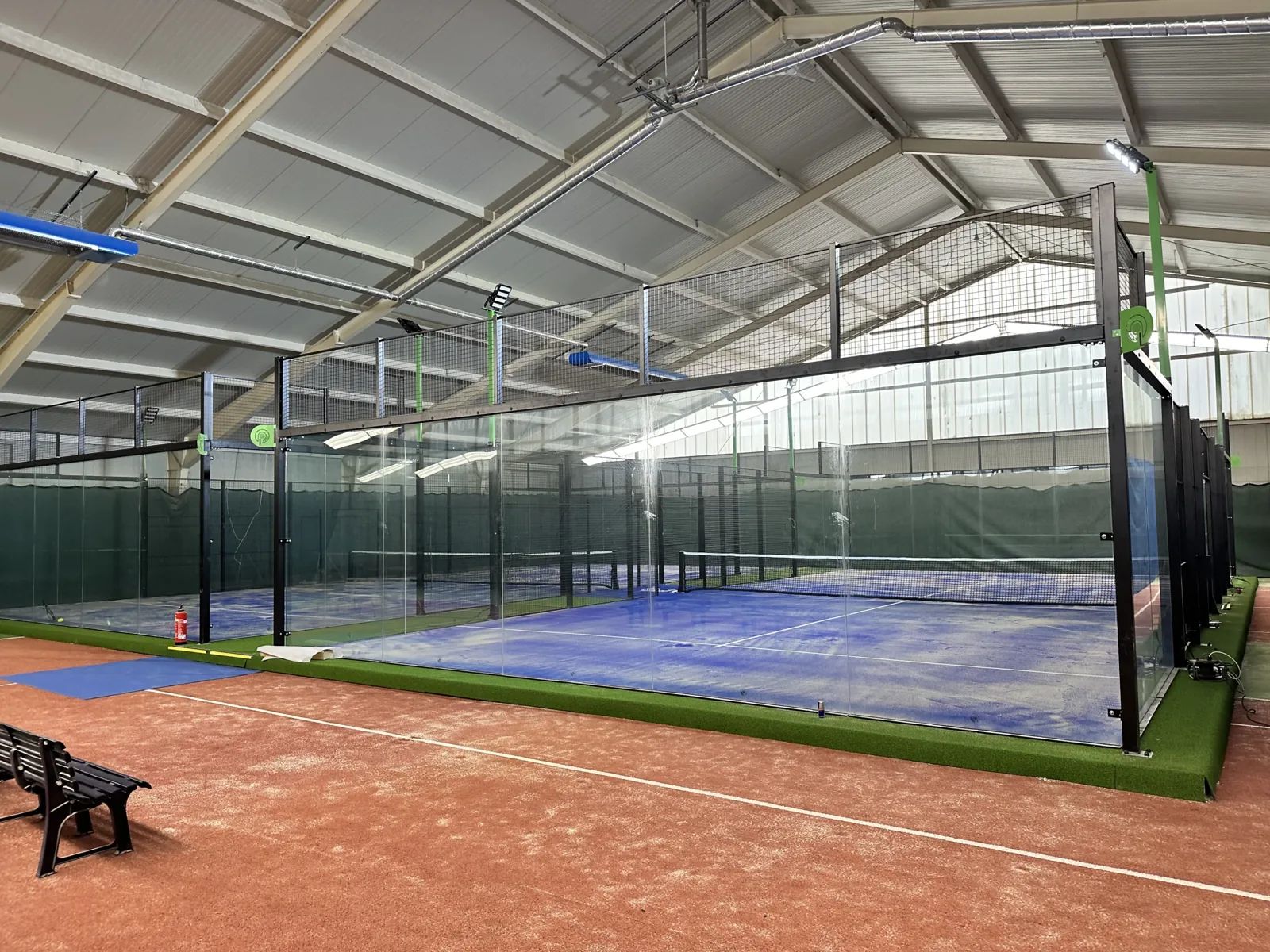
A complete indoor padel court consists of the cage structure, safety glass, padel-specific artificial turf, LED lighting and the complete installation. With a turnkey package, the foundation is also included in the price, as well as on-site advice and structural calculations. As a client, you do not have to arrange anything yourself.
Specifically, this covers the following components:
- Cage structure, the steel structure that encloses the court, including posts, connections and mesh panels
- Safety glass, tempered glass around the court; the thickness depends on the type of court
- Artificial turf, short-pile, polymeric artificial turf with sand infill, certified for padel
- LED lighting, including light poles and fittings, matched to the hall space
- Foundation, depending on the location: drainage concrete, Supersub or ZOAB asphalt
- Installation, assembly of all components, completion and final inspection
What is not included as standard are extras such as sound-absorbing panels, artificial-turf run-off zones outside the court or non-standard lighting systems. These are priced separately based on the specific situation.
What are the biggest cost differences between padel court suppliers?
The biggest cost difference between suppliers lies in where the steel structure comes from. Most providers import their courts from Spain, the country where most of the world’s padel courts are produced. That import process brings transport costs, lead times and an import margin. Suppliers who produce in-house can price more sharply on a structural basis.
There are also differences in how the overall package is put together. Some providers supply only the superstructure and leave the foundation, artificial turf and lighting to other parties. That seems cheaper, but you end up paying several margins and bear the risk yourself if the interface between those parties does not fit.
Also look at the type of warranty. A supplier who gives a 15-year warranty on the steel structure is clearly in a different position from a provider who makes no commitment on that. Warranty terms say something about the confidence a producer has in its own materials.
Which factors determine the final price of a padel court?
The final price of an indoor padel court is determined by the type of court, the number of courts, the location, the chosen foundation and any extra options. No two projects are identical, and the price always follows the specific situation.
The main factors at a glance:
- Type of court, a panoramic court has an open rear and a different visual look from a pro court. Despite the lighter appearance, heavier materials are often used, making the price slightly higher
- Number of courts, with several courts, economies of scale arise in production and installation. Anyone who has six courts built pays less per court than someone who orders one
- Accessibility and logistics, transport to the location, accessibility of the hall and installation conditions also help determine the installation costs
- Quality level of artificial turf and LED lighting, various specifications are possible, each with its own price tag
- Extra options, think of sound-absorbing panels, run-off zones or non-standard lighting systems
A common mistake is to look only at the lowest price. In practice, that often leads to higher costs in the long term due to lower material quality, limited service or technical limitations that end up costing you dearly later.
What is the cost difference between an indoor and an outdoor padel court?
An outdoor padel court is structurally more expensive than an indoor court. The steel structure has to be heavier because of wind load and weather influences, and the foundation is a large, location-dependent cost factor that is much simpler for an indoor court. As an indication, an outdoor padel court including foundation starts at around €50,000 on average.
What makes an outdoor padel court more expensive?
With an outdoor court, several factors come into play that hardly matter, if at all, for an indoor court. The steel structure has to be made of hot-dip galvanised steel to prevent rust. The structural calculations take into account the wind zone, surrounding buildings and open terrain. That requires heavier posts, connections and sometimes additional columns.
The foundation is the biggest variable for an outdoor court. Foundation costs average between €20,000 and €40,000, depending on ground conditions, accessibility and the civil engineering work required. The most widely used solution is a ring foundation combined with a water-permeable sports floor. Drainage concrete (a water-permeable type of concrete in which rainwater drains straight through the foundation into the subsoil) and Supersub (a foundation solution based on foam concrete) are the most commonly used options. ZOAB asphalt, a porous type of asphalt, is also suitable in certain situations.
In the Netherlands, all foundation components must be approved by Kiwa ISA Sport. Working with certified materials is not only a quality choice; it also protects you against unintended non-conformity in official use or inspections afterwards.
Can an existing tennis court save costs?
Yes. When converting an existing tennis court into padel courts, part of the substructure can sometimes be reused. That saves on foundation costs. Whether this is possible depends on the condition and type of the existing foundation. A site check beforehand will settle the matter.
When is a turnkey padel court the smartest choice?
A turnkey padel court is the smartest choice if you want a single point of contact for the entire process, from design to completion. You carry no coordination risk, and there is one responsible party and one warranty. For commercial venues and clubs that want to start quickly without arranging everything themselves, this is the most efficient approach.
With a turnkey approach, as the client you do not have to think about which artificial turf suits which foundation, which lighting level meets the standards or how the structure is calculated for your specific location. All of that is arranged and coordinated for you by a single party.
The alternative route, in which you buy materials yourself from different suppliers and arrange an installation team, can look cheaper on paper. But then you pay in time, risk and coordination. If something does not fit at the interface between supplier A and installer B, the question is who is responsible. With a turnkey package, that answer is always clear.
How do you make sure you do not pay too much for a padel court?
You avoid paying too much for a padel court by comparing quotations carefully on what is actually included, not just on the final amounts. Always ask what is included, which foundation solution is used, who is responsible for the installation and what warranty is given on the structure. A lower price without foundation, installation or warranty is not an advantage.
Concrete steps to stay sharp:
- Compare like with like, ask for each quotation exactly what is included. A superstructure excluding foundation is something quite different from a complete turnkey package
- Look at the warranty terms, a supplier who gives a 15-year warranty on the steel structure is clearly more confident in its product than a provider who makes no commitment on that
- Ask about certification, artificial turf and foundation must meet the requirements of Kiwa ISA Sport in the Netherlands. Materials that are not certified can cause problems in official use and inspections
- Think about scale, with several courts, economies of scale arise. If you already know that expansion will be desirable later, you can factor that into the planning
- Ask for a structural calculation per location, a standard court that has not been calculated for your specific location (wind load, ground conditions, surrounding buildings) can cause problems over time
At I-Padel, we produce the steel structure entirely ourselves, in our own factory. That removes transport costs and import margins, which translates directly into a lower price per court. We guide you from the first advisory meeting to completion, including structural calculations per location and all certified materials. Want to know what a padel court costs at your location? Request a no-obligation quotation for building a padel court and we will be happy to think along with you.
Frequently asked questions
How long does it take on average to have an indoor padel court built?
The lead time of an indoor padel court depends on the complexity of the project, but expect 4 to 8 weeks on average from final order to completion. The production of the steel structure, delivery of materials and the actual installation on site follow one another. With several courts at once, the installation time can be relatively shorter thanks to the efficiency of the installation process.
Which permits do I need to build an indoor padel court?
For an indoor padel court inside an existing building, an environmental permit is in many cases not needed, but this depends on the municipality and the type of use of the premises. In the case of a change of zoning or structural alterations to the building itself, a permit is generally required. It is wise to contact the municipality beforehand and ask a specialist supplier to help think through the permit situation at your location.
What are the payback periods of a commercial padel venue?
The payback period of a padel venue depends heavily on court occupancy, the court rate charged and the operating costs. With an average court rate of €15 to €25 per hour and an occupancy rate of 60-70%, a venue with several courts can recoup the investment within 3 to 6 years. Drawing up a realistic business case before investing, including operating costs such as energy, maintenance and staff costs, is essential for a well-founded decision.
How often does artificial turf on a padel court need to be replaced and what does it cost?
Padel-specific artificial turf has an average lifespan of 8 to 12 years under normal use, depending on the intensity of use and the quality of the material. Replacing the artificial turf on one court costs between €3,000 and €6,000 on average, including removal of the old turf and re-filling with sand. Regular maintenance, such as topping up sand and removing dirt and leaves on outdoor courts, extends the lifespan considerably.
Can I make an existing sports hall or vacant building suitable for padel courts without major renovation?
In many cases an existing sports hall or vacant industrial building is well suited to building padel courts, provided the clear height is at least 6 to 7 metres and the floor area is sufficient. Also consider the available clearance for transport and accessibility for installation. A site check beforehand by a specialist supplier quickly maps out which adjustments, if any, are needed and whether the existing floor can be reused.
What are the most common mistakes in building a padel court that I should avoid?
The most common mistake is choosing on price without checking what is actually included in the quotation, so that costs for foundation, installation or certification are incurred afterwards after all.
A second common mistake is not having a custom structural calculation carried out, which means the court may not meet local requirements for wind load or ground conditions. Finally, many clients underestimate the importance of certified materials: non-certified artificial turf or foundation can cause problems in official use, rental or future inspections.
Is it possible to build padel courts in phases and expand later?
Yes, phased construction is certainly possible and is regularly applied in practice. It is wise, though, to include the expansion in the initial planning, so that the foundation, lighting and spatial layout are matched to the final situation from the start. By planning expansion in advance, you avoid incurring extra costs later for changes to the existing infrastructure and you also benefit from economies of scale in production and installation.


