Blog · 7 October 2026 · 11 min read
What does a padel court including groundwork cost?
A padel court including groundwork costs from €50,000 on average. Discover all cost items, foundation types and tips for comparing quotes.
In this article
- What determines the price of a padel court?
- What do the groundwork and foundation of a padel court cost?
- What is the difference in cost between an indoor and an outdoor padel court?
- What does a complete padel court including installation cost?
- What additional costs are involved in building a padel court?
- How do you compare quotes from different padel court builders?
- Curious what a complete padel court costs?
- Frequently asked questions
The total cost of a padel court including groundwork averages from around €50,000 per court for an outdoor court. This amount covers the steel structure, the glass, the artificial turf, the LED lighting, the installation and the foundation. The foundation is the largest and most variable cost item, depending heavily on the soil conditions and the location. In this article we answer the most frequently asked questions about price, groundwork, foundation types and what you need to know when comparing quotes.
What determines the price of a padel court?
The price of a padel court is determined by a combination of factors: the type of court, the location, the number of courts, the chosen materials and whether it is an indoor or outdoor court. There is no fixed price that applies to every situation. The exact price always depends on the project-specific circumstances.
The main factors that influence the price are:
- Type of court: a Pro court has a different structure and price than a Panorama court. Panorama courts have an open back and, despite their lighter appearance, often require heavier materials to meet structural requirements.
- Indoor or outdoor: outdoor courts are more expensive than indoor courts, due to heavier structural requirements, weather protection and foundation.
- Number of courts: with several courts there are economies of scale in production and installation, which can lower the price per court.
- Location and accessibility: transport, logistics and installation conditions have a direct effect on the installation costs.
- Quality level of artificial turf and LED lighting: several versions are available, each with its own price range.
- Extra options: think of sound-absorbing panels, ball catchers, sliding doors or additional fencing.
A common mistake is to look only at the lowest price. In practice this regularly leads to higher costs in the long term, due to lower material quality, limited service or a shorter service life of the structure.
What do the groundwork and foundation of a padel court cost?
The foundation costs for an outdoor padel court average between €20,000 and €40,000 per court. This is the largest and most variable cost item for an outdoor project. The exact costs depend heavily on the soil conditions, the accessibility of the site and the chosen foundation type.
There are three commonly used foundation types for padel courts, each with its own characteristics:
- Drainage concrete: a water-permeable type of concrete in which rainwater drains straight through the foundation into the soil. Suitable for sites with good soil conditions and an average service life of 25 to 40 years.
- Supersub: a foundation solution based on foam concrete. Light, self-levelling and shock-absorbing. The water-permeable version is suitable for outdoor applications and can in many cases be poured within one day.
- ZOAB asphalt (open asphalt concrete): a porous asphalt variant that lets water through. Less common for padel courts, but in certain situations a suitable option.
In addition to these three types, we also work with ring foundations and strong plastic plates as an alternative to poured concrete. Which type is most suitable depends on the location, the use and the budget. All foundation materials in the Netherlands must be approved by Kiwa ISA Sport, the recognised quality mark for sports surfaces. We work exclusively with certified materials.
With existing tennis courts, part of the existing sub-base can sometimes be reused, which can considerably reduce the foundation costs. You can find more information about the different options on our page about a padel court including groundwork.
What is the difference in cost between an indoor and an outdoor padel court?
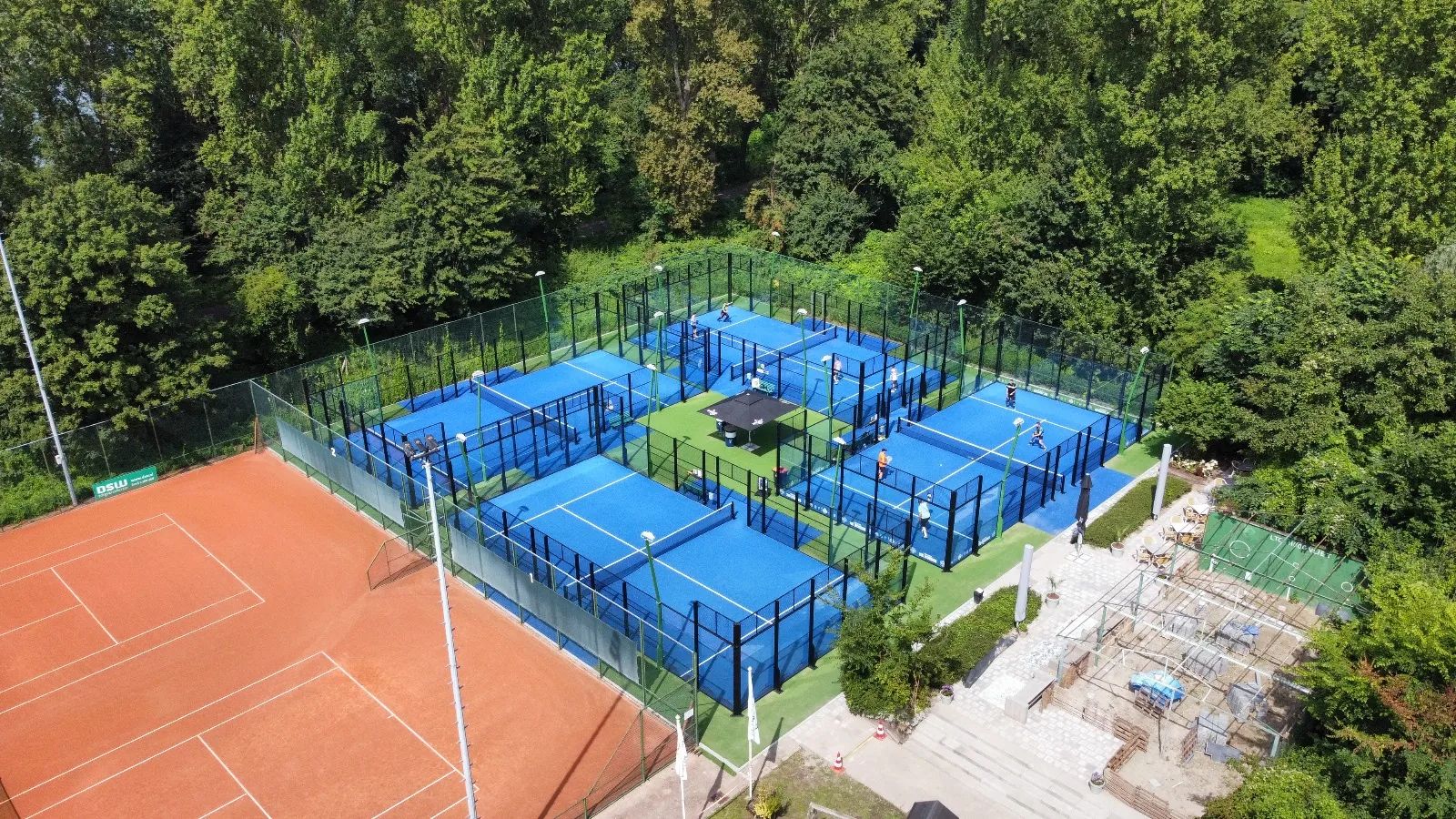
An indoor padel court is generally cheaper than an outdoor padel court. As an indication, a standard indoor padel court, turnkey including steel structure, glass, artificial turf, LED lighting and installation, is possible from around €23,000 per court. An outdoor padel court excluding foundation starts from around €30,000, and a complete outdoor project including foundation averages from around €50,000 per court.
The price difference has three concrete causes:
- Heavier steel structure: an outdoor court must withstand wind, rain, frost and UV radiation. This requires heavier posts, a duplex protection system (hot-dip galvanising followed by powder coating) and a higher execution class.
- Foundation: indoor courts are placed on an existing concrete floor. Outdoor courts require a full foundation, including groundwork and civil preparation.
- Permits and additional requirements: outdoor projects almost always require an environmental permit, an acoustic study and sometimes a lighting study. This entails extra cost and lead time.
With outdoor courts it is also harder to name a fixed price in advance. The foundation costs depend heavily on the location and can vary greatly per project. A custom quote is therefore always necessary for outdoor projects.
What does a complete padel court including installation cost?
A complete indoor padel court, including steel structure, glass, artificial turf, LED lighting and installation, costs from around €23,000 as an indication. A complete outdoor padel court including foundation and installation costs from around €50,000 on average. These are guide prices; the exact price differs per project and location.
What is included in a turnkey padel court? With a full package from A to Z, the following is covered by the delivery:
- Advice and structural calculation per location
- Groundwork and foundation (drainage concrete, Supersub or ZOAB asphalt, depending on choice and situation)
- Production and delivery of the steel structure (own manufacture)
- Installation of the glass around the court
- Laying of the artificial turf including sand bed and lines
- Installation of LED lighting
- Complete installation and handover
Sound-absorbing panels can optionally be added. These are calculated and produced on a project-specific basis, because they cause extra wind load on the structure. The steel structure must be structurally calculated for this and reinforced where necessary. You can read more about this process on the page about structure and wind load.
Installing a padel court takes three to four days on average. The total lead time of a project, including production, delivery and installation, averages ten to twelve weeks.
What additional costs are involved in building a padel court?
Besides the court itself, building a padel court regularly involves extra costs that are not always included in an initial indication. Especially with outdoor projects, these costs can add up considerably. It is wise to take them into account when budgeting.
Common additional cost items are:
- Permit costs: an environmental permit for an outdoor padel court involves permit fees. In addition there are costs for an acoustic study (almost always mandatory for outdoor courts near homes) and sometimes a lighting study or ecological study.
- Noise measures: when the site borders residential buildings, sound-absorbing panels or a noise berm may be necessary. The cost of these varies greatly per situation. You can find more information about this on our page about acoustic solutions for padel.
- Ball catchers: a practical addition for outdoor courts, with an indicative price of around €1,200 per side.
- Sliding doors and fencing: lockable doors or additional screening are optional, but are regularly used at commercial sites.
- Inspection after completion: for official matches, an inspection by Kiwa ISA Sport is mandatory. This involves inspection costs.
- Civil engineering work: think of modifying an existing car park, installing drainage around the court or relocating cables and pipes.
For tennis clubs that want to convert existing tennis courts into padel courts, part of the existing sub-base can sometimes be reused. This can considerably reduce the foundation costs, but always calls for a site assessment in advance.
How do you compare quotes from different padel court builders?
Comparing quotes from padel court builders is harder than it seems, because not every supplier includes the same components in their price. A low price says little if the foundation, the artificial turf or the installation are not included. A good comparison requires a detailed specification per quote.
When comparing quotes, pay attention to the following points:
- What is included? Ask explicitly whether the foundation, the artificial turf, the LED lighting and the installation are part of the price. Some suppliers quote only the superstructure, without groundwork.
- Origin of the steel structure: many Dutch suppliers import their structures from Spain. This entails transport costs, dependence on foreign production planning and limited options for adaptation. We produce the steel structure entirely in-house, which results in shorter lead times and more custom options.
- Warranty conditions: ask about the warranty period on the steel structure. We offer a fifteen-year warranty on the steel structure, in accordance with the product specifications. This is longer than is usual in the market.
- Certifications: check whether the materials used have been approved by Kiwa ISA Sport. This applies to both the artificial turf and the foundation materials. Non-certified materials can cause problems with permit granting and official matches.
- Structural calculation per location: ask whether the supplier adapts the structure to the specific conditions of your site, such as wind load, soil conditions and any noise measures. A standard structure does not fit every site.
- Responsibility when problems occur: with a complete package from a single source, there is one point of contact and one responsibility. With suppliers who engage multiple subcontractors, it is less clear who is responsible when something goes wrong.
Would you like a good idea of what a realistic budget is for your project? Then take a look at our page on the cost of a padel court for a detailed overview per situation.
Curious what a complete padel court costs?
Request a project-based quote for a complete padel court including installation, artificial turf, LED lighting, foundation or groundwork and any preparation for sound-absorbing panels. We look at the specific situation at your site together with you and give you an honest and complete picture of the expected investment. We are happy to think along with you, without obligation.
Frequently asked questions
How long does a padel court last on average and what are the maintenance costs?
A well-built padel court has a service life of 20 to 30 years for the steel structure, provided it has the right protection such as hot-dip galvanising and powder coating. The artificial turf has a shorter service life and is replaced after 8 to 12 years on average, depending on the intensity of use and maintenance. Annual maintenance mainly consists of topping up the sand bed, cleaning the glass and a periodic inspection of the structure and lighting.
Do I always need an environmental permit for an outdoor padel court?
In most cases an environmental permit is required for an outdoor padel court, especially when lighting is installed or the court borders residential buildings. The exact permit requirement depends on the municipality, the zoning plan and the specific site conditions. It is wise to have this checked early, because the permit procedure can considerably affect the lead time of your project.
Can I convert an existing tennis court into a padel court and what does that cost?
Yes, converting an existing tennis court into one or more padel courts is in many cases entirely possible and can save costs. If the existing sub-base is still in good condition, it can sometimes be reused, which considerably lowers the foundation costs. A site assessment in advance is however always necessary to determine whether the existing foundation is suitable for the specific requirements of a padel court.
What is the minimum space I need to build a padel court?
A standard padel court has a playing area of 20 by 10 metres, but for the complete structure including fencing and safety space around the court, a total space of at least around 22 by 12 metres is needed. Also allow for extra space for access paths, ball catchers and any noise measures on the sides. With several courts side by side, the distance between them and the accessibility for maintenance are also points of attention.
How do I finance the construction of a padel court and are subsidies available?
For sports clubs, subsidies are in some cases available through municipalities, provinces or national funds such as the Nationaal Sportakkoord (National Sports Agreement) or the Fonds voor Cultuurparticipatie. Commercial parties can generally finance the investment through a business loan or lease arrangement. It is advisable to ask your municipality and the national sports federations about current subsidy options, because these schemes can differ per region and per year.
What is the difference between a Pro court and a Panorama court, and which should I choose?
A Pro court has a fully closed back wall of glass and steel, while a Panorama court has an open or partially open back, which gives spectators a better view of the game. The Panorama court looks lighter, but because of the open structure it often requires heavier materials to meet the structural requirements for wind load.
The choice depends on the intended use: a Pro court is suitable for intensive competitive play, while a Panorama court is more popular at commercial sites and clubs that want to offer a spectator experience.
What about noise nuisance from a padel court and what can I do to limit it?
Because the ball hits glass and steel, padel produces a specific type of noise that carries further than with tennis. For outdoor courts near homes, an acoustic study is almost always mandatory as part of the permit procedure. Sound-absorbing panels, noise barriers or a strategic placement of the court can considerably limit the nuisance; the exact measures are calculated on a project-specific basis from the location and the distance to surrounding buildings.