Blog · 3 September 2026 · 12 min read
What causes the characteristic sound of a padel court?
Padel courts produce ~91 dB because glass walls reflect sound. Discover which factors amplify nuisance and which measures really work.
In this article
- Which parts of a padel court produce the most noise?
- Why does a padel court sound louder than a tennis court?
- How far does the sound of a padel court carry?
- What role does the steel structure play in spreading sound?
- What is the difference between structure-borne sound and airborne sound at padel courts?
- Which location factors amplify noise nuisance?
- How effective are sound-absorbing panels as a source measure?
- Not sure whether outdoor padel is feasible at your location?
- Frequently asked questions
The characteristic sound of a padel court is caused mainly by the hard impact of the ball against glass walls and the steel structure. That combination of materials produces a sharp, penetrating sound that behaves differently from the sound of a tennis court. How exactly this works, which factors amplify noise nuisance and which measures are possible, you can read in this article.
Which parts of a padel court produce the most noise?
The glass walls are responsible for the largest share of the noise nuisance experienced at a padel court. When the ball hits glass, a hard, high-pitched crack is produced that absorbs little energy and reflects strongly. The mesh and the steel structure contribute to a lesser extent, but amplify the sound through resonance and transmission.
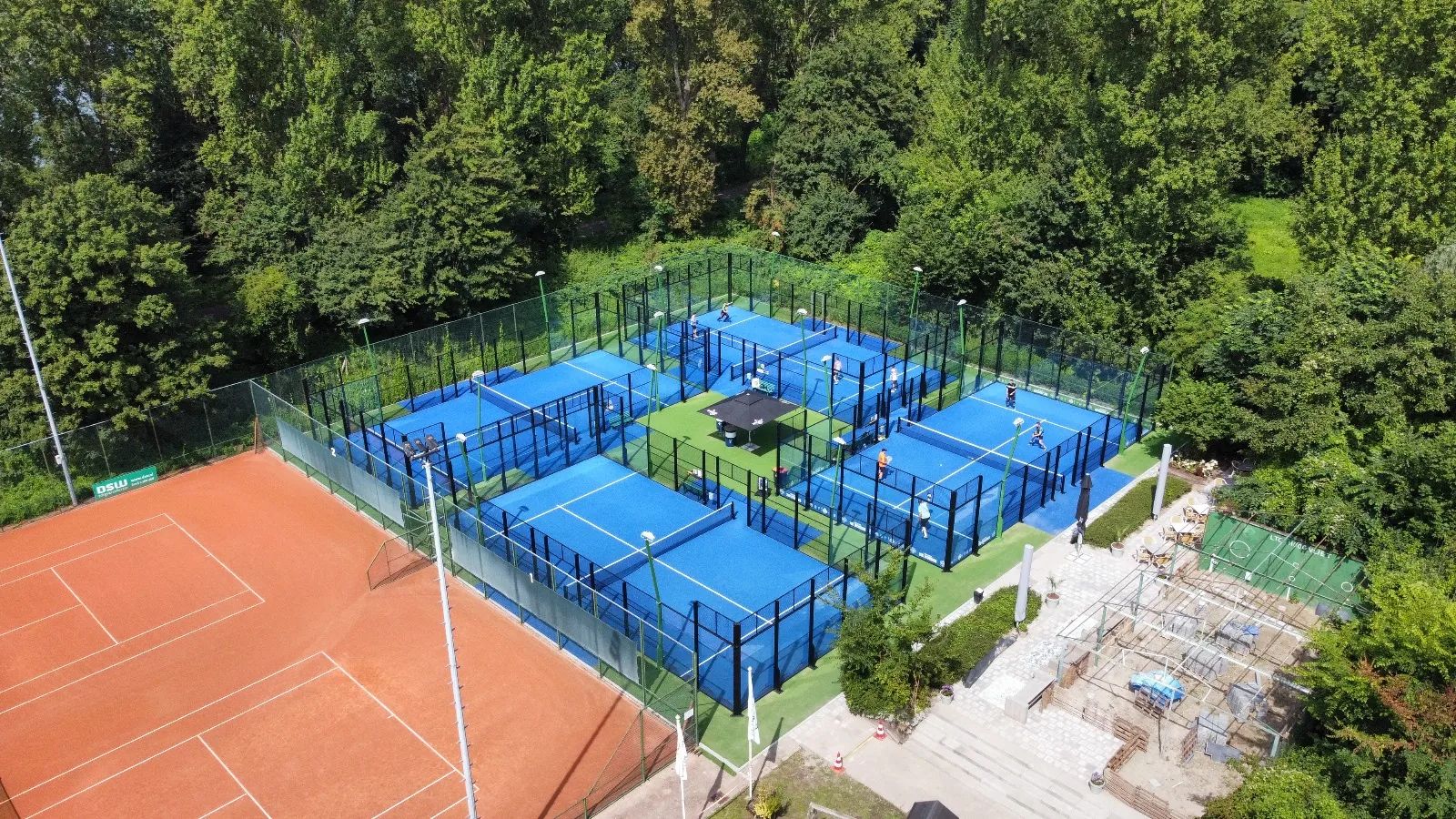
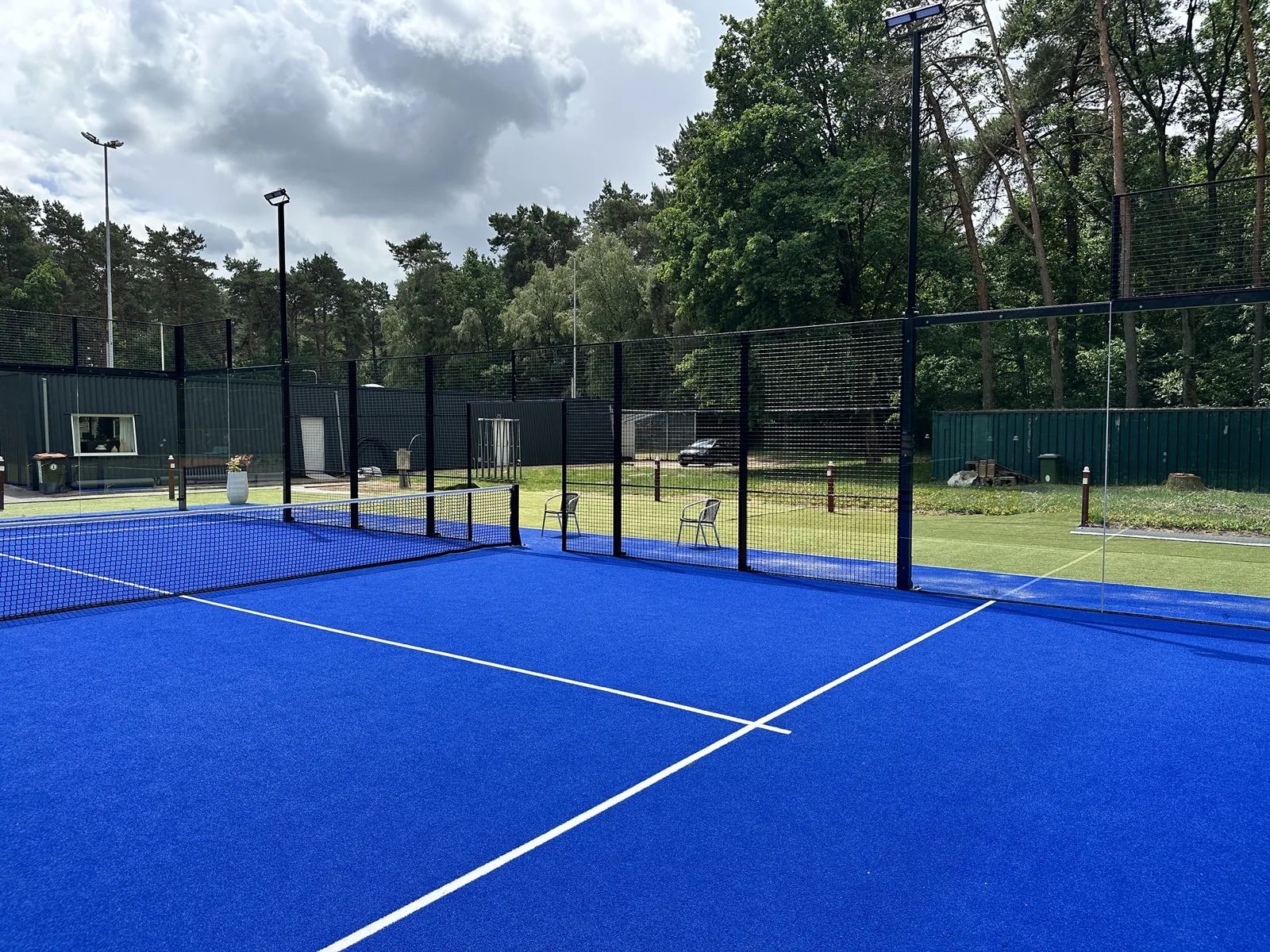
A padel court consists of several components, each playing a different acoustic role. The glass back walls and side walls form the largest noise source. Glass is a hard, non-absorbing material: the ball bounces off it with a sharp crack and the sound energy is largely reflected rather than absorbed. On a tennis court this element is completely absent.
The mesh around the upper half of the court behaves differently. Mesh has an open structure and lets most sound through, but does not dampen it. The steel structure itself produces little noise as a primary source, but plays a role in the transmission of vibrations. You can read more about this later in this article.
Besides the structure, the racket also plays a role. The crack of racket on ball contributes to the total sound power level. Permit practice shows that a padel court has an average sound power level of around 91 dB, which is roughly 10 dB more than a tennis court. That difference can be explained largely by the interaction of the ball with the glass walls.
Why does a padel court sound louder than a tennis court?
A padel court sounds louder than a tennis court because in padel the ball regularly hits hard glass walls, whereas in tennis the ball only hits the racket and the surface. Glass hardly absorbs any sound and strongly reflects the sound energy, resulting in a sharper sound that carries further.
In tennis, the ball is played largely in the open air. The force of the shot is partly absorbed by the net, the surface and the surroundings. In padel, the court is enclosed by a structure of glass and mesh. The ball actively bounces off the walls as part of the game, so the noise sources are activated several times per rally.
In addition, the cage structure acts as a kind of resonance box. The steel structure and glass panels together form an enclosed space that not only lets sound waves through, but also amplifies and reflects them. This effect is comparable to the difference between an open and a closed space: the enclosed structure keeps sound trapped longer before it escapes.
As a result, the noise load experienced at a padel court is already noticeably higher at shorter distances than at a tennis court. For locations near residential neighbourhoods this is a relevant point of attention in the permit application and in the choice of noise measures. You can find more about acoustic solutions for padel on the relevant page.
How far does the sound of a padel court carry?
How far the sound of a padel court carries depends on several factors: the distance to the court, the presence of buildings, the wind direction, the site layout and the height of surrounding obstacles. There is no fixed distance at which noise always drops to an acceptable level. This differs by location and by situation.
Sound spreads in all directions from the source. As the distance increases, the noise level decreases, but the degree of decrease is strongly influenced by the surroundings. On an open site without buildings, sound carries further than at a location surrounded by buildings or trees. Reflections off facades or walls can, conversely, amplify the sound in certain places.
Wind direction also plays a role. Sound carries further with the wind than against it. At locations near residential neighbourhoods, this can mean that residents experience more nuisance with certain wind directions than with others. This is one of the reasons why an acoustic study for outdoor padel courts with homes nearby is a useful part of the preparation.
In practice, at distances of around 40 to 100 metres the sound of a padel court can still be clearly audible, depending on the conditions. Whether this is also experienced as a nuisance depends on the background noise level at that location and the applicable noise standards.
What role does the steel structure play in spreading sound?
The steel structure of a padel court plays a role in spreading sound because vibrations from the glass walls and the mesh are passed on to the rest of the structure via the connections and columns. This phenomenon is called structure-borne sound transmission and can contribute to a wider spread of sound from the court.
When the ball hits the glass, a vibration is produced that not only radiates away as airborne sound, but also travels through the structure as structure-borne sound. The steel profiles, connections and base plates carry these vibrations further. To what extent this contributes to the total noise nuisance depends on the structural build-up, the way the glass is fixed and the foundation.
A self-supporting steel structure, in which all loads are transferred via the steel profiles, connections and foundation, in principle offers the possibility of controlling vibration transmission structurally. This requires precise engineering, in which the fixing of the glass panels and any sound-absorbing measures are also included in the design.
The steel structure is therefore not only a load-bearing structure, but also a component that is acoustically relevant. When sound-absorbing panels or other source measures are applied, the structure must be recalculated for this. You can read more about structure and wind load on the structure page.
What is the difference between structure-borne sound and airborne sound at padel courts?
Airborne sound is sound that spreads through the air, such as the crack of the ball against the glass. Structure-borne sound arises when a vibration is passed on directly through a solid structure, such as vibrations that travel on through the steel profiles or foundation. Both forms play a role at padel courts, but airborne sound is generally the dominant source of nuisance for local residents.
The distinction is relevant for the choice of noise measures. Airborne sound can be limited by sound-absorbing or sound-insulating measures on the outside of the court, such as sound-absorbing panels. These panels work on two principles: sound absorption, in which sound energy is taken up by the material so that reflections decrease, and sound insulation, in which the transmission of sound from one side to the other is limited.
Structure-borne sound requires a different approach. Limiting vibration transmission through the structure requires attention to the way glass and mesh are fixed, the connections in the steel structure and the coupling with the foundation. In practice, structure-borne sound is less dominant than airborne sound at padel courts, but at specific locations it can contribute to the nuisance experienced.
An independent acoustic consultant can determine which type of sound causes the most nuisance at a specific location and which measures are most suitable for it. The right measure always depends on the project-specific situation.
Which location factors amplify noise nuisance?
Noise nuisance from a padel court is amplified by a combination of location factors: the distance to homes, the presence of reflective facades, an open site without natural buffers, the wind direction and the intensity of use of the court. No two locations are the same, so the noise load experienced can differ greatly from project to project.
An open site without buildings, trees or other obstacles offers no natural damping. Sound spreads in all directions without being interrupted or absorbed. Hard facades of buildings in the surroundings can, conversely, reflect sound towards homes, which increases the nuisance in certain places.
The distance to noise-sensitive uses, such as homes, schools or care facilities, is one of the most decisive factors. The smaller the distance, the greater the likelihood of nuisance and the stricter the requirements a municipality can set as part of the permitting process. For an outdoor padel court near a residential neighbourhood, an acoustic study is therefore in many situations part of the preparation.
Intensity of use also plays a role. A court that is used intensively every day produces more noise load over a longer period than a court that is played on only occasionally. When assessing a permit application, municipalities look not only at the peak noise, but also at the duration and frequency of the noise production.
Finally, the orientation of the court can have an influence. The position of the glass walls relative to homes partly determines in which direction most of the noise is radiated. This is a factor that can already be taken into account in the design phase.
How effective are sound-absorbing panels as a source measure?
As a source measure, sound-absorbing panels can help limit noise nuisance at padel courts. They are fixed directly to the steel structure and work by absorbing or insulating noise at the source, so less noise escapes to the surroundings. Their effectiveness always depends on the project-specific configuration and cannot be generalised.
Sound-absorbing panels work on the basis of sound absorption and sound insulation. Materials such as rock wool, a mineral fibre with an open structure, absorb sound waves because the kinetic energy of air particles is converted into heat. As a result, part of the incident sound energy is taken up rather than reflected. The exact performance depends on the material thickness, density, finish and the frequencies of the sound presented.
A practical measurement at LTC Hofgeest measured an indicative noise reduction of around 3 dB(A) within the configuration studied, after correction for background noise. These results apply only to the situation studied and must not be regarded as a general product guarantee. Other locations have different distances, weather conditions and site layouts, so results may differ.
An important point of attention when applying sound-absorbing panels is the influence on the structure. Panels reduce the wind permeability of the cage structure, so the wind load increases. The structure must be recalculated for this. This can mean that heavier steel profiles, additional columns or modified connections are necessary. An acoustic solution for padel therefore always requires an integrated assessment of both the acoustics and the structural safety.
Sound-absorbing panels are not sufficient in every situation. At some locations additional measures are needed, such as a noise barrier or adjustments to the site layout. The optimal solution is always determined by an independent acoustic study and a project-specific assessment.
Not sure whether outdoor padel is feasible at your location?
We are happy to think along with you on the court configuration, structural preparation and possible noise measures. Together with your acoustic consultant, we look at which solution is technically feasible and suits the project. Get in touch via the page on acoustic solutions for padel for an initial, no-obligation exploration.
Frequently asked questions
Do I always need an acoustic study for an outdoor padel court?
An acoustic study is not legally mandatory in every case, but in most situations it is strongly recommended. For permit applications for outdoor padel courts near homes, schools or other noise-sensitive uses, municipalities almost routinely ask for acoustic substantiation. An early study prevents surprises in the permit process and gives insight into which measures are needed before the court is built.
What are the most common mistakes when tackling noise nuisance at padel courts?
A common mistake is applying noise measures without a prior acoustic study, so that the solution chosen does not match the actual noise problem at the location. Another common mistake is underestimating the structural consequences of sound-absorbing panels: because of the reduced wind permeability, the wind load on the structure increases, which requires modifications to the steel profiles and foundation. An integrated approach in which acoustics and structure are assessed together prevents costly modifications afterwards.
Can the orientation of the padel court reduce noise nuisance for local residents?
Yes, the orientation of the court is one of the few measures that can be included at no cost already in the design phase. By positioning the glass back walls so that they do not face homes or other noise-sensitive uses directly, the noise emission in that direction can be limited. This is not a replacement for other measures, but in combination with sound-absorbing panels or a noise barrier it can make a noticeable difference.
Is a noise barrier always more effective than sound-absorbing panels around the court?
Not by definition. Sound-absorbing panels work directly at the source and are therefore efficient at reducing the radiated noise in all directions. A noise barrier is effective for screening a specific direction, but offers no protection for local residents located outside the screened area. In practice both measures are sometimes combined, depending on the location, the distance to homes and the applicable noise standards. An acoustic consultant determines which combination is the most effective.
How many dB(A) of reduction do I need to meet the municipal noise standards?
This differs by municipality and by location and depends on the applicable zoning plan, the environmental permit and the noise standards that apply. In the Netherlands, sports activities are generally tested against the VNG guidelines or the standards from the Activities Decree (Activiteitenbesluit), where limit values vary depending on the time of day and the area category. Based on the source strength of the court and the distance to homes, an acoustic consultant calculates how much reduction is needed to meet the standards.
Does it make a difference for noise nuisance to the outside whether the padel court is covered or placed in a hall?
A covered or indoor padel court can considerably limit noise nuisance to the outside environment, provided the hall has sufficient sound insulation. Inside the hall itself, however, the noise level can rise high because of the hard walls and ceiling, which calls for acoustic measures on the inside. With an indoor situation, the focus therefore shifts from noise nuisance for local residents to the indoor climate and the acoustic quality for players and visitors.
When in the construction process is the best moment to plan noise measures?
The earliest stage of plan development is the most effective moment to integrate noise measures. Choices about the location, the orientation of the court, the distance to homes and the type of structure can then still be made freely and have the greatest influence on the final noise load. When noise measures are only considered after the structure has already been designed or built, the options are more limited and the costs are generally higher.