


Building a padel court · 5 April 2026 · 12 min read
What are the trends in the padel market for 2026?
Discover the padel market trends for 2026: costs, innovations and opportunities for operators. Invest smartly in padel courts with our concrete market insights.
In this article
- How big is the padel market in the Netherlands in 2026?
- Why is padel growing so fast in popularity?
- Which new locations are choosing padel courts in 2026?
- What are the latest innovations in padel court construction?
- What does it cost to build a padel court in 2026?
- How does the Dutch padel market differ from the German market?
- When is the right time to invest in a padel court?
- Frequently asked questions
The padel market in Europe is growing fast. The Netherlands is leading the way: the number of padel courts has risen sharply in recent years and that growth continues in 2026. Whether you operate a sports hall, run a tennis club or manage real estate with unused space, padel is currently one of the most concrete opportunities in sports infrastructure. In this article we answer the most frequently asked questions about the padel market, the costs and the trends for 2026.
How big is the padel market in the Netherlands in 2026?
The Netherlands now has thousands of padel courts and is still growing. In 2026 the Dutch padel market is among the largest in Europe, apart from Spain and Sweden. The number of registered padel players at the KNLTB has multiplied in recent years, and at many locations the demand for new courts still exceeds the supply.
What that growth means in concrete terms: not only are new padel venues opening, but existing sports facilities are also expanding. Tennis clubs are adding padel courts to their complex, sports halls are being converted and municipalities are using padel as an instrument for broader sports use. The market is mature enough to justify serious investments, but young enough to still offer plenty of opportunities for new locations.
For investors and operators, the occupancy rate at existing padel venues is a good yardstick. In many places in the Netherlands, courts are fully booked months ahead at popular times. That is a signal that demand is nowhere near having been caught up by supply.
Why is padel growing so fast in popularity?
Padel is growing fast because it is easy to learn, social by nature and needs little space compared with tennis. The sport suits all ages and levels, which creates a broad audience that quickly becomes active. That makes padel attractive for both players and operators.
A number of factors further strengthen that popularity:
- Low barrier to entry: the basic rules are quickly learned and the first rallies already work in the first lesson.
- Social character: padel is always played in pairs, which makes it a distinctly social sport.
- Compact format: a padel court is considerably smaller than a tennis court, so more courts fit on the same area.
- High turnover: a match lasts an average of 60 to 90 minutes, which makes commercial operation easier.
- Media attention: professional padel competitions are gaining visibility in Europe, which further normalises the sport.
For tennis clubs, the growth of padel is also an answer to a declining membership base. Younger generations choose padel more often than traditional tennis. Clubs that make that shift see in practice that their membership picks up again.
Which new locations are choosing padel courts in 2026?
In 2026, an increasingly diverse range of locations is choosing padel courts. Besides the classic tennis club, fitness centres, hotels, corporate campuses, shopping centres and municipal sports parks are now adding padel to their offering. The sport fits in many places because the space requirement is relatively limited.
Commercial operators and hall owners
Owners of sports halls or vacant commercial buildings are discovering padel as an attractive use. A hall of 1,000 m² has room for four to six indoor padel courts, which makes a solid operating model possible. The combination of court rental, food and beverage revenue and lessons makes it financially interesting.
Municipalities and real estate parties
Municipalities use padel as an instrument for community sports participation. Vacant sports halls or unused sports grounds are given a new purpose. Real estate parties see padel as a way to make a location more attractive to tenants or visitors. In both cases, the combination of social value and commercial feasibility is decisive.
Tennis clubs
Tennis clubs remain a large group. They increasingly opt to convert existing tennis courts into padel courts. A double tennis court has room for two padel courts, which uses the space more efficiently. Sometimes part of the existing foundation can be reused, which lowers the investment.
What are the latest innovations in padel court construction?
The main innovations in padel court construction in 2026 focus on noise solutions, more sustainable foundation techniques and structural customisation per location. Standard courts are increasingly being replaced by courts specifically calculated for the environment in which they will stand.
Sound-absorbing panels
Noise is one of the biggest challenges with padel courts, especially in urban environments. New generations of sound-absorbing panels are attached to the outside of the cage structure and absorb the contact noise of the ball against glass and mesh. Independently tested in an acoustic laboratory, they achieve sound absorption class A, with an absorption value of 0.80 and a sound insulation index of 19 dB. In practice, the reduction is noticeable at distances of 40 to 100 metres.
Important to know: installing panels reduces the wind permeability of the structure. That means the cage structure must be structurally reinforced, with heavier posts or additional columns. This is not a detail, it is a safety requirement. Not every supplier can deliver this, because it requires a new structural calculation per location.
Innovative foundation solutions
Supersub is a foundation solution based on foam concrete that is being used more and more often. It is lightweight, self-levelling and, in the outdoor variant, water-permeable. In many cases the installation can be completed within a single day. Drainage concrete remains the most commonly used solution for outdoor courts thanks to its high water permeability and a long lifespan of 25 to 40 years on average. All foundation components used in the Netherlands must be approved by Kiwa ISA Sport. That is not a choice, but a requirement for certification and competition use.
Artificial turf and certification
The requirements for artificial turf for padel courts have been tightened. NOC*NSF has introduced a quality assurance system for artificial turf sports floors, under which products must be on a sports products list in order to be used in certified facilities. From 2025, stricter measurement methods apply to both new builds and renovations. This protects clients against substandard products and ensures a level playing field in the market.
What does it cost to build a padel court in 2026?
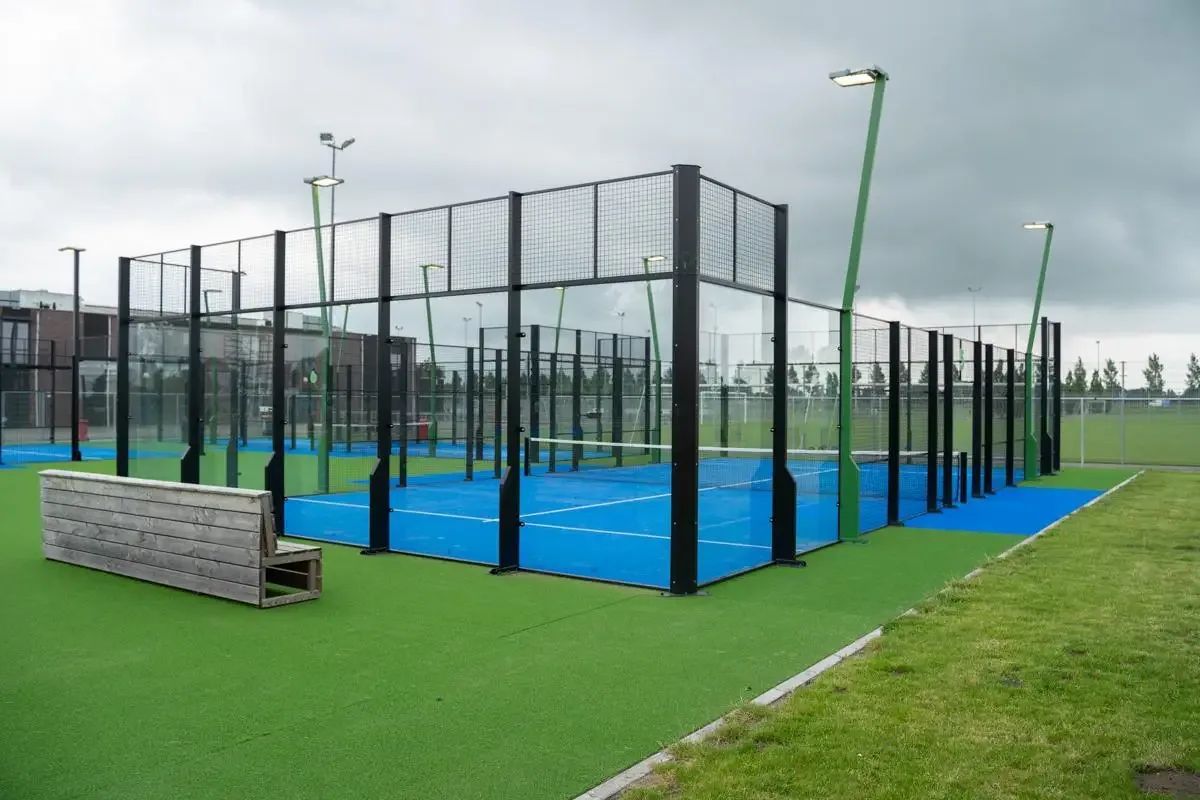
As a guideline, a turnkey indoor padel court is possible from around €23,000 per court, including cage structure, glass, artificial turf, LED lighting and installation. An outdoor padel court usually costs more: the court itself starts from around €30,000, and a complete project including foundation averages around €50,000.
These price differences have a concrete cause. Outdoor courts require a heavier steel structure because of wind load and weather influences. The foundation is also highly location-dependent: soil conditions, accessibility and the civil engineering work required together determine the final foundation costs, which can vary between €20,000 and €40,000.
Factors that further determine the price of an indoor padel court:
- Type of court: Pro, Panoramic or Single courts each have their own appearance and construction. A panoramic court has an open back and, despite the lighter look, sometimes requires heavier materials.
- Number of courts: with multiple courts, economies of scale arise in production and installation.
- Accessibility: transport and assembly conditions inside a hall influence the installation costs.
- Extra options: run-off zones, sound-absorbing panels or alternative lighting systems count towards the total price.
A common mistake is to look only at the lowest price per court. In practice, cheaper materials or limited warranty conditions lead to higher costs in the long run. For every quote, ask what exactly is included and what warranty is given on the structure.
How does the Dutch padel market differ from the German market?
The Dutch padel market is more mature and larger than the German one. The Netherlands has considerably more padel courts per capita and a higher percentage of active padel players. Germany is at an earlier stage of growth, which brings both opportunities and challenges for companies serving both markets.
A practical difference lies in the way projects are carried out. In the Netherlands, most customers buy a turnkey solution: one party arranges everything from foundation to delivery. In Germany, customers more often have their own construction crews and look for a reliable supplier who delivers the complete material package without handling the installation. That calls for a different approach to the collaboration.
There are also differences in regulations. In the Netherlands, the requirements around artificial turf, certification and inspection are tightly regulated via NOC*NSF and Kiwa ISA Sport. In Germany, different standards apply and the market is less consolidated. For international suppliers, this means that local knowledge of regulations and certification requirements is indispensable to deliver responsibly in terms of quality.
What both markets have in common: demand is growing and the pressure on price and quality is increasing. Customers in both countries are becoming more selective and expect transparency about what they are buying.
When is the right time to invest in a padel court?
The right time to invest in a padel court is when the location is available, the financing is in place and demand at your specific location is demonstrable. The market is growing, but investing in a padel court is only sensible once the operation has been realistically calculated based on your situation.
A few concrete considerations that determine whether the time is right:
- Availability of space: an indoor padel court requires at least 21 x 11 metres of floor area and a clear height of at least 6 metres. An outdoor court requires a comparable space plus sufficient distance to surrounding buildings because of noise and lighting.
- Permit procedure: outdoor padel courts require an environmental permit in almost all cases. The lead time averages 8 to 12 weeks. Factor this into your planning.
- Lead time for realisation: the total lead time of a project, including production, delivery and assembly, averages 10 to 12 weeks. Plan ahead if you want to open on a specific date.
- Demand in the region: are there already padel venues nearby and are they full? Then there is room for more supply. Is there hardly any supply yet? Then it is more likely that you will have to build up the demand yourself.
Don't wait too long. The venues that invest now build a head start in brand awareness and a loyal customer base. New entrants who come in later find a market with more competition and higher player expectations.
At I-Padel we help you make the feasibility of a project concrete. Together we look at the location, the possibilities and a realistic investment, without obligation. Get in touch for an initial exploration and we will gladly think along with you, without obligation, about what padel can mean for your location.
Frequently asked questions
How many courts do I need at minimum for a profitable operation?
For a profitable operation, a minimum of two to four courts is generally assumed. With a single court, revenue is often too limited to cover fixed costs such as rent, staff and maintenance. From two courts you can set up a realistic operating model, especially if you combine court rental with lessons and possibly food and beverage. Preferably have an operating calculation made based on your specific location, occupancy rate and local competition.
What are the most common mistakes when building a padel court?
A common mistake is paying too little attention to the foundation and structural requirements, especially for outdoor courts with sound-absorbing panels, which require a heavier steel structure. Other common mistakes are underestimating the permit procedure, starting the planning too late and choosing the cheapest supplier without checking whether materials meet NOC*NSF and Kiwa ISA Sport certifications. In the long run these choices lead to higher costs and possible problems at inspection.
Can I convert an existing tennis court into padel courts and what does that deliver?
Yes, that is one of the most cost-efficient options. One double tennis court has room for two full padel courts, and in some cases the existing foundation can be partly reused, which lowers the investment. For tennis clubs, this conversion offers a direct way to grow membership and attract younger target groups. It is wise, however, to have a structural assessment carried out beforehand to determine what can be reused and what has to be replaced.
Which permits do I need and how long does the permit procedure take?
For outdoor padel courts an environmental permit is required in almost all cases. The average lead time is 8 to 12 weeks, but this can differ per municipality, especially if objections are filed because of noise or visual impact. Indoor courts in an existing building sometimes fall under a lighter permit procedure, depending on the nature of the renovation. Start the permit procedure as early as possible, in parallel with the quotation phase, so that you don't run into delays in the overall project planning.
How do I keep the maintenance costs of my padel courts low in the long term?
The key lies in choosing certified materials at construction: artificial turf on the NOC*NSF products list and a foundation with Kiwa ISA Sport approval last considerably longer than non-certified alternatives. Regular maintenance of the artificial turf, such as levelling the sand and removing dirt, extends the lifespan significantly. Also make sure there is a clear warranty arrangement with your supplier and record who is responsible for structural maintenance of the cage structure and glass parts.
Is padel also interesting as a supplementary concept within an existing fitness centre or hotel?
Absolutely. Fitness centres and hotels increasingly see padel as a way to differentiate their offering and attract new visitors. Padel fits well in a broader sports concept because it is a social activity that is also suitable for groups and company outings. For hotels, a padel court offers an extra facility that increases length of stay and guest experience. The key is good integration into the existing offering, with clear options for reservations, lessons and possibly competitive play.
How do I determine whether there is enough demand at my specific location before I invest?
Start with a simple market exploration: look at how many padel venues are already active within a radius of 10 to 15 kilometres and whether they are fully booked at popular times. In addition, you can use a short survey among existing members, customers or local residents to gauge whether there is concrete interest. Municipal sports data and population data on age structure and sports participation provide extra insight. Combine this information with a realistic operating calculation to determine whether the investment is sound.


