


Building a padel court · 17 May 2026 · 11 min read
What are the steps in building an indoor padel court?
Build an indoor padel court in 10–12 weeks: discover all the steps, costs from €23,000 and smart tips for your location.
In this article
- What is the difference between an indoor and an outdoor padel court?
- What foundation options are there for a padel court?
- How is the steel structure of a padel court made?
- What does it cost to build an indoor padel court?
- Why are sound-absorbing panels important for a padel court?
- What is included in a turnkey padel court package?
- How long does it take to build an indoor padel court?
- Frequently asked questions
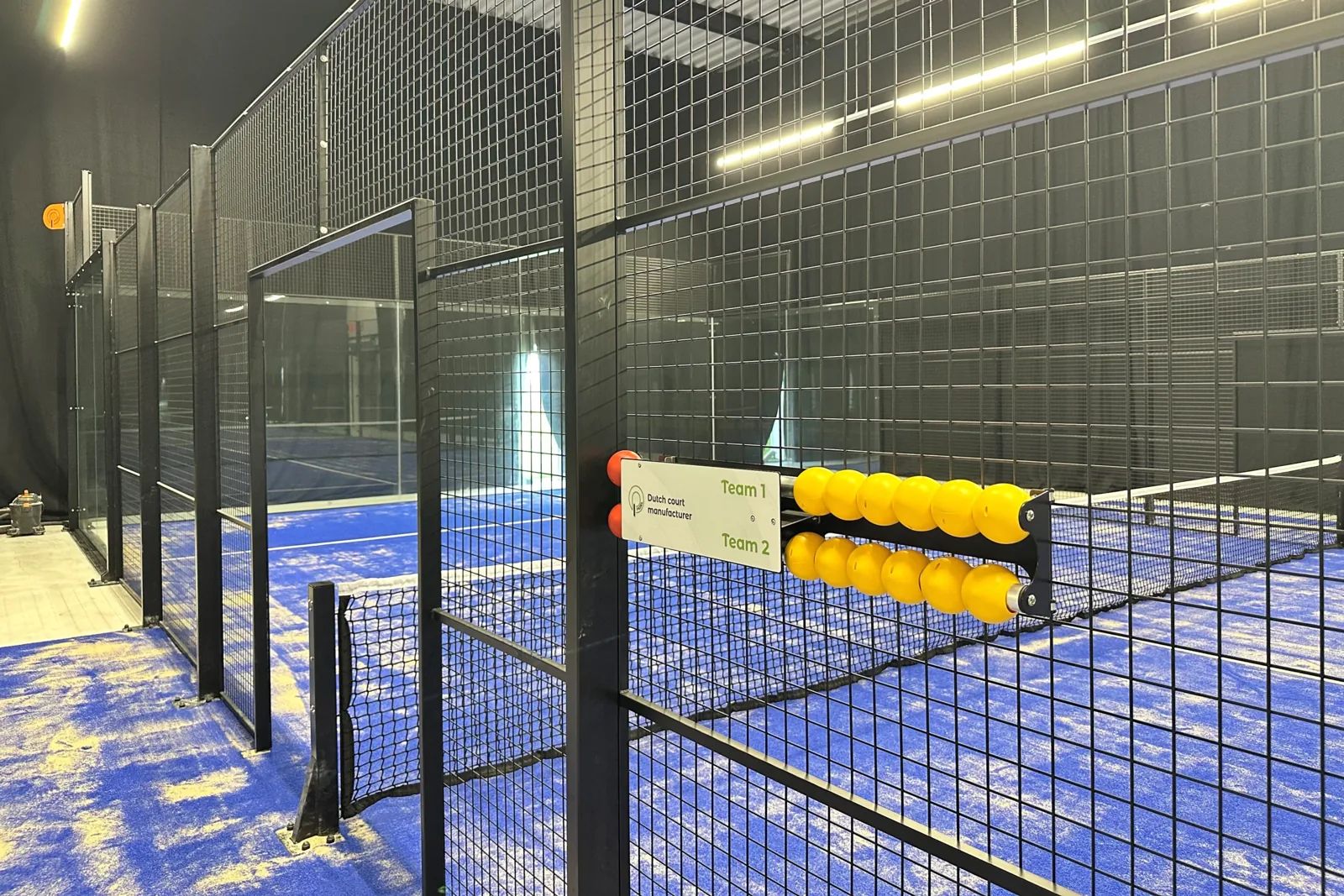
Building an indoor padel court broadly goes as follows: first the foundation, then the steel structure, followed by the glass, the artificial turf and the LED lighting. For an indoor location in an existing hall, a separate building permit is often not needed, although this depends on the situation. The total lead time of a project, from the first conversation to completion, averages 10 to 12 weeks.
Whether you want to expand a sports hall with padel courts, give a vacant building a new purpose or, as a tennis club, are considering the switch to padel: it helps to understand the construction process well before you make a decision. In this article we answer the most frequently asked questions about building a padel court, step by step.
What is the difference between an indoor and an outdoor padel court?
The biggest difference between an indoor and an outdoor padel court lies in the structural requirements and the foundation. An outdoor court must withstand wind, rain, frost and temperature swings. That calls for a heavier steel structure, a water-permeable foundation and extra protection of the steel. An indoor court stands in a protected environment and has less demanding structural requirements.
In practice this also means a price difference. As a guide, an indoor padel court is possible turnkey from around €23,000 per court. An outdoor padel court usually costs more, especially if you include the foundation. For outdoor courts the foundation is the biggest cost item and highly location-dependent. Think of soil conditions, water drainage and wind load.
Height also plays a role at indoor locations. The recommended clear height for a padel hall is at least 6 metres. The higher the hall, the better the playing quality. With an existing hall it is therefore wise to check the available height early in the process.
What foundation options are there for a padel court?
There are three commonly used foundation types for padel courts: drainage concrete, Supersub and ZOAB asphalt. The right choice depends on the location, the soil conditions, the use and the budget. Indoor courts have different requirements than outdoor courts, where water drainage plays a central role.
Drainage concrete
Drainage concrete is a water-permeable concrete floor where rainwater drains straight through the foundation into the subsoil. It is one of the most widely used solutions for outdoor courts. The foundation is stable, flat and, with good maintenance, lasts 25 to 40 years on average. For padel courts, drainage concrete is often combined with a ring foundation with steel reinforcement, so that the forces of the steel structure and the wind load are properly absorbed.
Supersub
Supersub is a foundation solution based on foam concrete. The material is lightweight, self-levelling and shock-absorbing. That last point is pleasant for players: less strain on joints and muscles. The thickness of a Supersub foundation is usually between 10 and 15 cm, depending on the situation. For outdoor use, a water-permeable version is available that can handle up to 500 mm of rainfall per hour. Supersub is also fully recyclable.
ZOAB asphalt
ZOAB asphalt, also known as open asphalt concrete, is a porous type of asphalt that lets water through. It is used less often for padel courts, but is a good option in certain situations, for example at locations with specific soil conditions or an existing asphalt base.
Important to know: all foundation components must be approved by Kiwa ISA Sport in the Netherlands. Anyone working with non-certified materials risks not meeting Dutch standards. Always ask your contractor about this.
How is the steel structure of a padel court made?
The steel structure of a padel court is designed based on the specific location requirements: wind load, soil conditions, surrounding buildings and any extra options, such as sound-absorbing panels. The steel profiles are then cut to size, welded and treated. After production, the structure is transported to the location and assembled on site.
Assembling the cage structure itself takes two days on average. The glass, the artificial turf and the LED lighting follow afterwards. Every court requires a structural calculation per location, because standard dimensions don't fit everywhere. Think of halls with limited width or height, or outdoor locations with a high wind load.
A point many people don't expect: if you want to add sound-absorbing panels, the steel structure must be structurally reinforced. The panels reduce the wind permeability of the cage, so more wind pressure is placed on the structure. That calls for heavier posts, additional columns or modified connections.
What does it cost to build an indoor padel court?
As a guide, a standard indoor padel court is possible turnkey from around €23,000 per court. This includes the steel structure, the glass, the artificial turf, the LED lighting and the installation. The exact price always depends on the type of court, the number of courts, the accessibility of the location and any extra options.
For comparison: the Dutch market average for an indoor padel court is between €30,000 and €35,000 per court, where foundation and installation are sometimes not even included. It therefore pays to compare carefully what exactly is included in a quote.
A common mistake is to look only at the lowest price. In practice this sometimes leads to higher costs in the long term due to lower-quality materials, limited service or uncertainty about the warranty. Also pay attention to the number of courts: with larger projects, economies of scale arise in production and installation, which can lower the price per court.
Why are sound-absorbing panels important for a padel court?
Sound-absorbing panels are important because padel produces considerably more noise than tennis. The ball hitting glass and steel, combined with the cage structure acting as a sound box, leads to an average sound power level of around 91 dB. That is roughly 10 dB more than in tennis. At locations near homes, that quickly becomes a source of nuisance and a stumbling block in the permit process.
Sound-absorbing panels are placed on the outside of the mesh of the cage structure. They absorb the sound instead of reflecting it back. Independently tested in an acoustic laboratory, high-quality panels achieve absorption class A, with an absorption value of 0.80 and a sound insulation index of 19 dB. In practice this results in a clearly audible noise reduction at distances of roughly 40 to 100 metres.
Panels can be placed on one side of the court, on several sides, or in combination with a noise barrier. They can also be added to existing courts afterwards, although the structure must first be assessed for suitability. Keep in mind that adding panels almost always requires structural reinforcement of the cage structure.
What is included in a turnkey padel court package?
A turnkey package for a padel court includes the complete process: from advice and custom work on location through to completion. As a client you don't have to arrange anything yourself. All components are supplied and installed by one party, which means one contact person and one point of contact.
Specifically, a turnkey package includes the following components:
- Advice and structural calculation per location
- Groundwork and foundation (drainage concrete, Supersub or ZOAB asphalt, depending on the situation)
- Production and delivery of the steel structure
- Installation of the glass around the court
- Laying of the artificial turf, including sand bed and lines
- Installation of the LED lighting
- Optional: sound-absorbing panels
- Complete installation and completion
The advantage of a complete package is that no discussion can arise about who is responsible if something is wrong. With providers who buy different components from different suppliers, you as the customer bear the risk yourself if the connection between those parties is not right. With a turnkey package, that risk lies entirely with the builder.
How long does it take to build an indoor padel court?
The total lead time of an indoor padel court project averages 10 to 12 weeks, from the first conversation to completion. The installation itself takes 3 to 4 days: the cage structure is up in about two days, and laying the artificial turf takes another one to two days. Most of the lead time lies in production planning and logistics.
For indoor locations in an existing hall, a separate building permit is not always needed. That saves time compared with outdoor projects, which almost always need an environmental permit. The average processing time for such a permit application is 8 to 12 weeks, depending on the municipality and the complexity of the project.
If you plan several courts at once, the installation period is slightly longer, but production and preparation time largely run in parallel. That makes larger projects relatively more efficient to plan. In the overall project planning, also allow for the time for the groundwork and the foundation, which precede the assembly of the cage structure.
At I-Padel we guide the entire process from A to Z, including the structural calculations, the groundwork, the foundation and completion. We work exclusively with certified materials approved by Kiwa ISA Sport, so your court meets Dutch standards and is ready for official use. Want to know what building a padel court means for your location? Get in touch for an initial exploration. We are happy to think along with you, without obligation.
Frequently asked questions
Do I need a building permit for an indoor padel court in an existing hall?
In many cases no separate building permit is needed if you place a padel court in an existing, permitted hall, but this is not always guaranteed. It depends on the municipality, the zoning of the building and whether structural changes are made to the building itself. Always contact the municipality in advance to verify this, so you don't run into surprises during or after construction.
What should I check before choosing a location for an indoor padel court?
The three most important points of attention are: the clear height (at least 6 metres recommended), the available floor area per court including safety margins, and the load-bearing capacity of the existing floor. Also check the accessibility of the hall for transport and installation, and find out whether a suitable electrical connection is already available for the LED lighting. The earlier you map these points out, the smoother the project runs.
Can I also add sound-absorbing panels to an existing padel court afterwards?
Yes, that is possible, but not without further ado. Before panels are installed, the existing steel structure must be assessed for suitability. Panels reduce the wind permeability of the cage, which causes extra wind pressure on the structure. In some cases structural reinforcement is necessary before the panels can be safely mounted. Always have this assessed by a specialist before you make a decision.
What maintenance work is involved with an indoor padel court?
An indoor padel court requires relatively little maintenance compared with an outdoor court. The main recurring tasks are: regularly topping up and levelling the sand in the artificial turf, checking the glass panels for damage or loose fixings, and inspecting the steel structure for any corrosion or wear. Also make sure the LED lighting is checked periodically and that defective fixtures are replaced in good time to safeguard playing quality.
How many padel courts fit in a standard sports hall?
A standard padel court has a playing area of 10 x 20 metres, but including the necessary safety space around the cage you need to allow for at least 12 x 22 metres per court. In an average sports hall of around 40 x 25 metres, two courts side by side generally fit, provided the clear height of at least 6 metres is available. With a larger or irregularly laid-out hall, custom work and a site visit are always the best way to determine the exact layout.
What is the difference between a cheap and a more expensive padel court, and where does that difference lie?
The difference lies mainly in the quality of the steel and the glass panels, the thickness and certification of the materials, and the service and warranty a provider offers. Cheaper courts sometimes use non-certified materials that do not meet the Kiwa ISA Sport standards, which can cause problems with official use or a permit application. In the long term, higher replacement and maintenance costs can completely wipe out the initial saving. Always compare quotes on what exactly is included, not just on the final price.
Is it financially attractive to have several padel courts built at once?
Yes, with larger projects, economies of scale arise in both production and installation. The fixed costs for transport, groundwork and installation are spread over several courts, which lowers the price per court. Moreover, a large part of the preparation and production time runs in parallel, so the total lead time is proportionally shorter than when building individual courts in phases. If you are hesitating between two or four courts, it is worth having both scenarios calculated side by side.


