


Building a padel court · 24 April 2026 · 14 min read
What are the costs of a permit application for a padel court?
Padel court permit costs: €5,000–€15,000 in total. Discover fees, studies and lead times, and avoid costly delays.
In this article
- Do you always need a permit for a padel court?
- What is an environmental permit and when is it required?
- What are the costs of an environmental permit for a padel court?
- Which documents are needed for a permit application?
- How long does a permit application for a padel court take?
- What are the most common reasons for a permit being refused?
- What does an acoustic study for a padel court cost?
- What is the total cost of a padel court including the permit?
- Frequently asked questions
A permit application for a padel court costs you between €2,000 and €8,000 on average in fees, depending on the municipality and the construction cost. On top of that come the costs of mandatory studies, such as an acoustic study and a lighting study, which together quickly add up to an extra €3,000 to €8,000. Add everything up, and you should allow for a total permit process cost of €5,000 to €15,000, depending on the complexity of your project and the location.
Whether you are a tennis club making the switch to padel, run a sports hall or are developing an outdoor location: the permit process is a part of the project you should not underestimate. In this article we explain step by step what you can expect. We start with the question of whether you need a permit at all and end with the total cost of a padel court, including the permit.
Do you always need a permit for a padel court?
Not always, but in most cases you do. Whether you need a permit depends on the location (indoor or outdoor), the structural work you carry out and the impact on the surroundings. For outdoor padel courts, an environmental permit is almost always mandatory. For indoor placement in an existing hall, it can sometimes be done without a separate building permit, but rules apply even then.
The rule of thumb is simple: as soon as a padel court affects its surroundings through noise, lighting or spatial integration, you need a permit. And with padel that is almost always the case, because padel produces more noise than tennis.
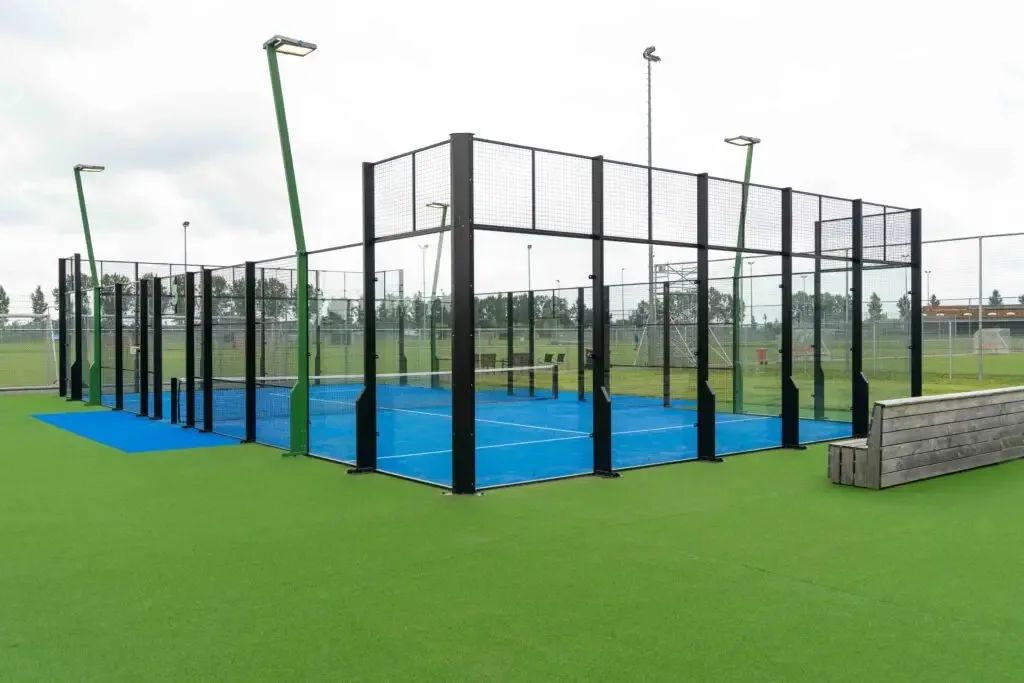
The ball hitting glass and steel, with the cage structure acting as a resonance box, produces an average sound power level of around 91 dB. That is roughly 10 dB more than in tennis. Municipalities are increasingly aware of this and set higher requirements.
An indoor padel court in an existing sports hall, without structural alterations, sometimes falls outside the building permit requirement, but even then you have to take fire safety and use rules into account, which are handled through the municipality. In doubt? Always start with a zoning plan check with the municipality before you plan any further.
What is an environmental permit and when is it required?
An environmental permit is official permission from the municipality to build, renovate or use something that affects the physical living environment. For a padel court, this permit is required as soon as the court is placed outdoors, structural work takes place, or noise and lighting affect the surroundings. For outdoor padel courts, that is almost always the case.
In the Netherlands, the environmental permit replaces several older permits (such as the building permit and the environmental permit) and is applied for via the Omgevingsloket (the national permit portal). The municipality assesses your application on the basis of the zoning plan, the building regulations and the impact on the surroundings.
When is an environmental permit mandatory for a padel court?
For a padel court, an environmental permit is mandatory at least if:
- The padel court is placed outdoors
- Structural work takes place (foundation, steel structure)
- The lighting affects the surroundings (LED lighting for evening use)
- The location is close to residential buildings
- The zoning plan does not automatically allow sports use
If in doubt, it is always smart to have an informal conversation with the municipality first. That prevents you from making plans that later run into objections.
What are the costs of an environmental permit for a padel court?
The costs of an environmental permit for a padel court consist of municipal fees and depend on the construction cost of your project. On average, the fees are between €2,000 and €8,000 per application. Larger projects with a higher construction cost pay more, because municipalities generally calculate their fees as a percentage of the investment.
Each municipality uses its own fee schedule. A padel court with a construction cost of €50,000 results in a fee invoice of €2,500 in one municipality, while another municipality charges €6,000 for the same project. It therefore pays to look up your municipality’s fee schedule or enquire directly at the permits department.
Are there additional costs besides the fees?
Yes, and they are sometimes higher than the fees themselves. Besides the municipal fees, in most cases you also have costs for mandatory studies and documents. Think of:
- Acoustic study: €1,500 to €4,000
- Lighting study: €500 to €1,500
- Structural calculations: €500 to €2,000 (depending on complexity)
- Site plans and construction drawings: €500 to €1,500
- Any ecological or archaeological study: €1,000 to €3,000
Add this to the fees and you quickly arrive at a total of €5,000 to €15,000 for the entire permit process. For complex locations, close to homes, in protected areas or with special structures, the costs can be higher.
Which documents are needed for a permit application?
For a permit application for a padel court, you need at least the following documents: structural calculations in accordance with the Dutch Building Decree (Bouwbesluit), an acoustic study, a lighting study and a site plan. Depending on the location, an ecological study or archaeological study may also be required.
Below is an overview of what you need to know about each document:
- Structural calculations: These demonstrate that the cage structure meets the requirements of the Building Decree. Think of wind load, stability and anchoring in the foundation. For an outdoor padel court, these calculations are location-specific. A court on open polder land requires different calculations from a court in a sheltered city centre.
- Acoustic study: Mandatory near homes. The study calculates the noise load on the nearest homes and tests it against the applicable noise standards.
- Lighting study: Required if you want to play in the evening with LED lighting. The study shows that the lighting does not cause nuisance to local residents.
- Site plan: An overview drawing of the location, showing the exact position of the court in relation to its surroundings.
- Ecological study: Mandatory if the location borders nature or protected areas. Think of bats, birds or protected plants.
- Archaeological study: Sometimes required in areas with archaeological expectation value. The municipality will indicate whether this is necessary.
It is smart to check beforehand which documents your municipality specifically requires. If you submit an incomplete application, it will not be processed and you lose valuable time.
How long does a permit application for a padel court take?
A permit application for a padel court takes 8 to 12 weeks on average after the complete application has been submitted. This is the statutory decision period for a regular procedure. For an extended procedure, which sometimes applies to more complex projects or objections from local residents, the lead time can rise to 6 months or more.
Those 8 to 12 weeks are purely the processing time at the municipality. Preparing the application, including having the studies carried out, drawing up the drawings and supplying the calculations, also takes time. Allow at least 4 to 8 weeks of preparation before you can submit a complete application.
What delays a permit application?
The most common causes of delay are:
- An incomplete application: the municipality asks for additional information, which restarts the clock
- Objections from local residents during the inspection period
- Municipalities extending the decision period because the application is complex
- Uncertainty about the zoning plan: is sports use allowed at that location?
In your project planning, keep in mind that the permit process can take up at least 3 to 6 months of your total lead time. So start the process as early as possible, in parallel with the rest of your preparation.
What are the most common reasons for a permit being refused?
The most common reason for refusing a permit for a padel court is noise nuisance. If the acoustic study shows that the noise load on nearby homes exceeds the applicable standards and no measures are taken, the municipality refuses the permit. Other common grounds for refusal are conflict with the zoning plan and insufficient substantiation of the structure or lighting.
Below are the most common grounds for refusal at a glance:
- Noise nuisance: Padel is loud. If the noise load on homes is too high and no noise measures are planned, the municipality will not give permission.
- Zoning plan: Sports facilities are not allowed at every location. If the zoning plan does not allow the activity, you need a deviation procedure, which brings extra time and costs.
- Light nuisance: Evening lighting can cause nuisance for local residents. If the lighting study is insufficiently substantiated or the standards are exceeded, that is a ground for refusal.
- Incomplete or incorrect structural calculations: Calculations that do not meet the Building Decree lead to refusal or a request for additional information.
- Ecological objections: Building in or near protected nature without an ecological study or exemption leads to refusal.
Many grounds for refusal can be prevented by doing proper research beforehand and taking the right measures, such as sound-absorbing panels or adapted lighting fittings. A refusal is rarely final, but it does cost extra time and money.
What does an acoustic study for a padel court cost?
An acoustic study for a padel court costs between €1,500 and €4,000 on average, depending on the complexity of the location, the number of courts and the firm you engage. For locations close to homes or in urban areas, the price is generally higher, because the study has to be more extensive.
The acoustic study calculates the noise load on the nearest homes on the basis of the padel court’s source level, the distance to the homes and any screening measures. It tests the result against the noise standards laid down in the Activities Decree (Activiteitenbesluit) or the environmental permit.
When is an acoustic study mandatory?
An acoustic study is almost always mandatory for outdoor padel courts close to residential buildings. For indoor locations with evening use where the hall borders homes, the municipality can also require this study. It is not something you can skip: without an acoustic report, the municipality will in most cases not accept your application.
A good tip: have the acoustic study carried out by a firm with experience in sports locations. They know the specific characteristics of padel noise and can also advise straight away on measures if the noise load turns out too high.
What is the total cost of a padel court including the permit?
The total cost of a padel court including the permit is from around €25,000 to €30,000 per court for an indoor padel court, and for an outdoor padel court including foundation and permit from around €55,000 to €65,000 per court. The permit process adds €5,000 to €15,000 on average to the total project costs, depending on the location and complexity.
To give you a realistic picture, here is an indicative cost breakdown for a standard outdoor padel court:
- Padel court superstructure (cage structure, glass, artificial turf, LED lighting): from around €30,000
- Foundation (drainage concrete, Supersub or ZOAB asphalt, depending on the location): €20,000 to €40,000
- Environmental permit (fees): €2,000 to €8,000
- Acoustic study: €1,500 to €4,000
- Lighting study: €500 to €1,500
- Structural calculations and drawings: €1,000 to €3,500
For indoor padel courts the costs are lower because the foundation and permit are less complex. An indoor court in an existing hall starts, as an indication, from around €23,000 per court for the superstructure including installation, and the permit process is in many cases simpler or not even mandatory.
Padel court subsidy for a club: are there options?
Yes, there are subsidy options for a padel court if you are a club. Tennis clubs and sports clubs in the Netherlands can apply for various subsidy schemes, such as the National Sports Agreement, municipal subsidy pots for sports infrastructure and funds via the province. The KNLTB also has schemes for affiliated clubs that want to invest in padel. The exact options depend heavily on your municipality and region. It pays to enquire with your municipality and sports federation before drawing up a final budget.
Want to know what a padel court including the complete permit process will cost you in concrete terms? At I-Padel we guide the whole process, from the zoning plan check to supplying the structural calculations and coordinating the noise and lighting studies. That way you know exactly where you stand. Take a look at how we work on the page about building padel courts or get in touch for an initial discussion. We are happy to think along with you, without obligation.
Frequently asked questions
Can I already start building while the permit application is still pending?
No, that is not legally allowed. You may only start construction work once the environmental permit has become irrevocable, that is, after the six-week objection period has passed without any objections being filed. Anyone who starts earlier anyway risks a stop-work order, a penalty payment or even an obligation to demolish what has been built. Always schedule your construction phase after the permit process is complete.
What is a deviation procedure and when do I need one for a padel court?
A deviation procedure is needed if the zoning plan at your location does not automatically allow sports use. In that case you ask the municipality to deviate from the zoning plan, which is a more extensive procedure than a regular permit application.
This procedure generally takes longer, up to six months or more, and brings extra costs. Always check the zoning plan of your location first before taking further steps, so that you know whether a deviation procedure is needed and what that means for your schedule and budget.
Which noise measures can I take if the acoustic study turns out unfavourable?
If the acoustic study shows that the noise load is too high, there are various measures you can take to still meet the standards. Think of installing sound-absorbing panels in the cage structure, building a noise-reducing earth bund or barrier around the court, or limiting the opening hours (for example, no evening use).
The acoustic firm can advise straight away which measure is the most effective and cost-efficient in your situation. It is smart to include these options early in the design process, so that you do not have to make expensive adjustments afterwards.
How do I know whether my location is suitable for a padel court before I incur costs?
The first step is a zoning plan check: use Ruimtelijkeplannen.nl to check whether the zoning plan allows sports use at your location. It is also wise to make informal contact with the municipality — many municipalities offer a so-called pre-consultation, in which you can test your plans without having to submit a formal application. This takes little time and prevents you from spending money on studies for a location that turns out not to be feasible from the outset.
Do I have to apply for a separate permit for each extra padel court?
Not necessarily. If you want to build several padel courts at the same location at once, you can include them in a single environmental permit application. That is more efficient and saves costs. If you later want to add an extra court to an already permitted location, in most cases a new or amended permit is needed, because the noise load and spatial impact increase. Always discuss your expansion plans with the municipality beforehand.
Can I submit a permit application myself or do I need an adviser?
Technically you can submit a permit application yourself via the Omgevingsloket. In practice, however, it is strongly advisable for a padel court to engage an adviser or specialist party.
The application requires specific technical documents — such as structural calculations, an acoustic report and a lighting study — that have to be drawn up by recognised firms. An incomplete or incorrect application leads to delay or refusal. An experienced party that coordinates the whole process ultimately saves you time, money and frustration.
Are there differences in the permit process between municipalities that I should take into account?
Yes, and they can be considerable. Each municipality applies its own fee rates, assessment criteria and lead times. One municipality has ample experience with padel permits and handles applications swiftly, while another has few precedents and works with extra care.
The strictness of noise and light standards can also differ per municipality. It always pays to contact the municipality beforehand to gauge what they specifically expect, so that you can align your application accordingly.


