


Building a padel court · 31 March 2026 · 13 min read
What are the benefits of indoor padel courts for a tennis club?
Discover the benefits of indoor padel courts for tennis clubs: year-round occupancy, lower costs and more members. See costs, construction and payback period.
In this article
- What exactly is an indoor padel court?
- Why are tennis clubs increasingly choosing padel?
- What are the concrete benefits of an indoor padel court compared with an outdoor court?
- How much does an indoor padel court cost for a tennis club?
- How is an indoor padel court built and how long does it take?
- Which foundation options are there for an indoor padel court?
- What about noise from an indoor padel court in a sports hall?
- When is an indoor padel court a good investment for a tennis club?
- Frequently asked questions
An indoor padel court gives a tennis club the chance to offer padel all year round, whatever the weather. Members do not have to cancel bookings because of rain or cold, and the court is available evening after evening without noise or lighting causing problems for the surrounding area. In this article we answer the most common questions about indoor padel courts for tennis clubs, from what they actually are to when the investment really pays off.
What exactly is an indoor padel court?
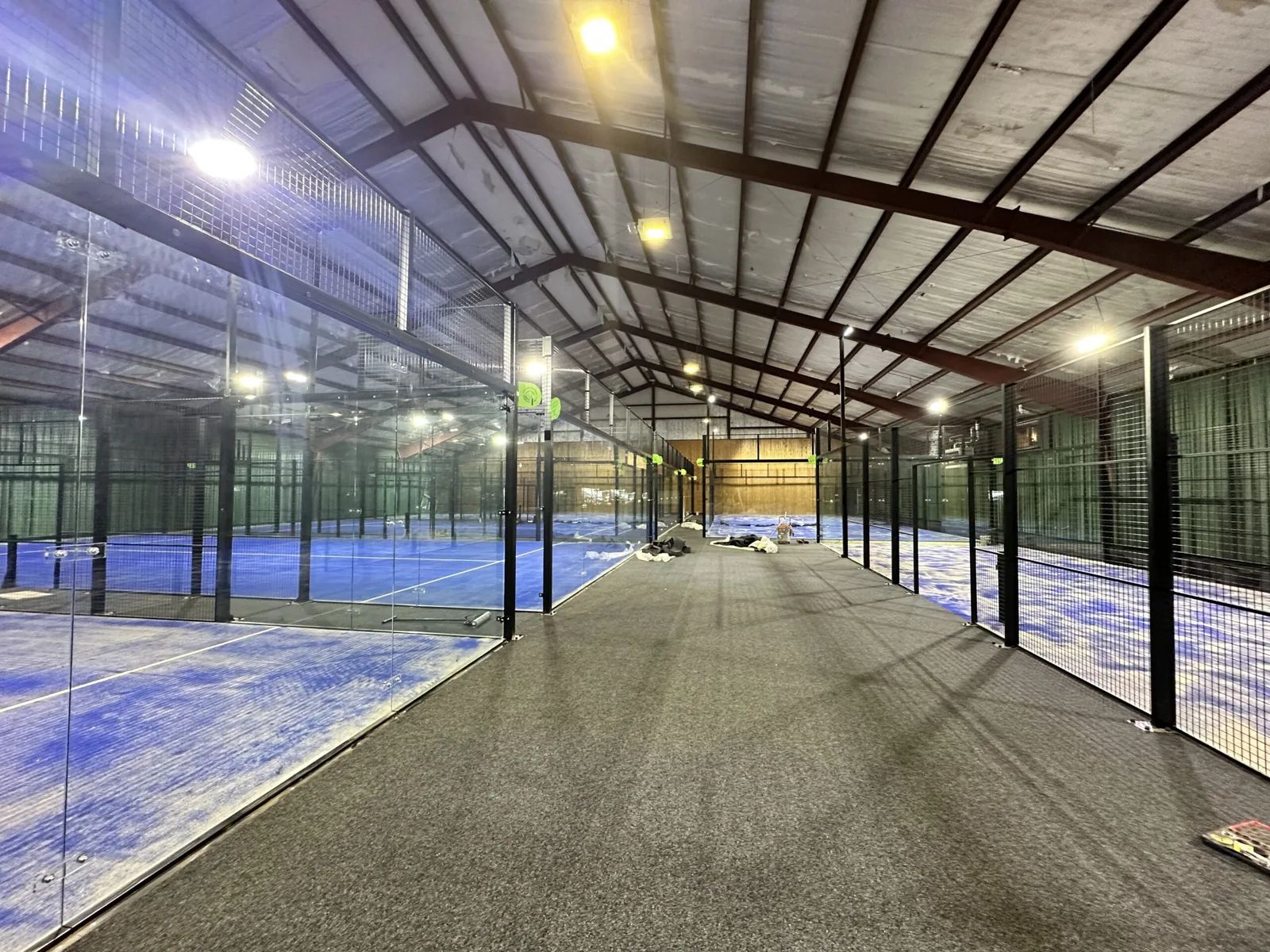
An indoor padel court is a fully covered padel court installed in an existing sports hall or one that is yet to be built. The court consists of a steel structure with glass walls, artificial turf as the playing surface and LED lighting. The standard size is 20 by 10 metres, with a minimum clear height of 6 metres.
The steel structure forms the skeleton of the court. The glass walls are fixed to it and the mesh is tensioned on it. The artificial turf consists of a short-pile polymer fibre of 11 to 15 mm, filled with stabilisation sand. This is not an arbitrary choice: the KNLTB and NOC*NSF set specific requirements for the sports surface, and only courts that meet those requirements may be used for official matches. Inspection by Kiwa ISA Sport is mandatory for this.
Inside a hall you need at least 21 by 11 metres per court. With run-off zones at the short ends, 21 by 14 metres is the ideal size. That extra space provides safety and a better playing experience. The higher the hall, the better the game feels. 6 metres is the minimum, but more height is always welcome.
Why are tennis clubs increasingly choosing padel?
Tennis clubs choose padel because the sport attracts a large group of new members who did not play tennis, or hardly did. Padel is easier to learn, more social by nature and appeals both to young people and to people who find tennis too technical. For clubs facing declining membership numbers, padel offers a concrete way to reverse that trend.
Combining tennis and padel at one location also strengthens occupancy. Existing members play tennis, new members come for padel, and the catering and facilities perform better. For many clubs that makes padel not a threat to tennis, but a complement.
In addition, padel is relatively quick to learn. New members feel reasonably competent after just a few lessons, which leads to higher retention. For a club that depends on membership fees and court rental, that is a relevant advantage.
What are the concrete benefits of an indoor padel court compared with an outdoor court?
An indoor padel court offers certainty of play all year round. Rain, wind, cold and dark evenings have no effect on occupancy. That makes the court structurally better occupied than an outdoor court, which directly contributes to more income and higher member satisfaction.
The benefits of an indoor padel court at a glance:
- Year-round occupancy: no cancelled training sessions or competitions due to bad weather
- Lighting is not a problem: LED lighting is already part of the court, without neighbours being bothered by it
- Fewer noise issues: the hall dampens sound considerably, which makes permit procedures simpler
- No wind load: the steel structure does not need to be heavier because of weather influences, which keeps costs down
- Simpler foundation: indoor foundations are less complex and less location-dependent than outdoor foundations
- Less maintenance: artificial turf indoors wears less quickly and does not need to be watered before play
An outdoor court also has advantages. Think of lower initial construction costs for the superstructure and a different experience for the player. But for a tennis club that wants to maximise occupancy and limit hassle with permits for noise and lighting, an indoor padel court is in most cases the better choice.
How much does an indoor padel court cost for a tennis club?
As an indication, an indoor padel court can be had turnkey from approximately € 23,000 per court. That includes the steel structure, the glass, the artificial turf, the LED lighting and the complete installation. The final price always depends on the number of courts, the location and the desired specification.
Factors that influence the price:
- Number of courts: with several courts there are economies of scale in production and installation
- Accessibility of the hall: transport and installation conditions play a role
- Type of court: a panoramic court has a different look from a pro court and sometimes requires heavier materials
- Extra options: run-off zones, non-standard lighting systems or sound-absorbing panels
What you should not do: look only at the lowest bidder. In practice a lower price often goes hand in hand with lower material quality, limited warranty or less service. A court that lasts ten years instead of fifteen is more expensive in the long run. Also pay attention to exactly what is included, because some providers charge separately for the foundation or installation.
How is an indoor padel court built and how long does it take?
The construction of an indoor padel court follows a fixed sequence: first the foundation, then the steel structure, then the glass and finally the artificial turf and the LED lighting. Installation on site takes an average of 3 to 4 days per court. The total process, including production and delivery, takes an average of 10 to 12 weeks.
Step by step: what the construction process looks like
It starts with a site check and a structural calculation. Every location is different. The soil conditions, the dimensions of the hall and the accessibility determine exactly how the court is built. Production of the steel structure then starts.
On site, the foundation is laid first. The cage structure is then installed, which takes an average of 2 days. The artificial turf is then laid, including the sand bed and the line markings. That takes another 1 to 2 days. Finally, the LED lighting is installed and the court is handed over.
What does the club arrange itself?
With a turnkey approach the contractor arranges everything: from design and production to installation and completion. In that case the club only has to make the hall available and apply for any permits in good time. Indoor courts in an existing hall do not always need a separate building permit, but that always depends on the specific situation and the municipality.
Which foundation options are there for an indoor padel court?
For an indoor padel court the most commonly used foundation options are drainage concrete, Supersub and ZOAB asphalt. Indoors, water drainage is less urgent than outdoors, but the flatness and stability of the foundation remain important for consistent ball bounce and the safety of the steel structure.
Drainage concrete
Drainage concrete is a water-permeable type of concrete with an open structure. It is stable, flat and load-bearing, suitable for the heavy load of a steel structure with glass walls. Outdoors it is valued mainly for its water drainage, but indoors too it offers a solid and durable base. A drainage concrete foundation lasts 25 to 40 years on average with correct use.
Supersub
Supersub is a foundation solution based on foam concrete. It is lightweight, self-levelling and shock-absorbing. That shock absorption reduces the load on joints and muscles, which increases playing comfort. In many cases Supersub can be poured within a single day and is fully recyclable. The thickness varies between 10 and 15 cm, depending on the soil conditions and the project.
ZOAB asphalt
ZOAB asphalt, also known as open-graded asphalt concrete, is a porous type of asphalt that lets water through. It is less common for indoor padel courts, but can be a good choice in specific situations. For example, if an asphalt base is already present that can be reused.
Important: in the Netherlands, all foundation components must be inspected by Kiwa ISA Sport. If you work with a supplier who is not familiar with this, you run the risk that the court does not meet the regulations and cannot be certified for competition use.
What about noise from an indoor padel court in a sports hall?
An indoor padel court in a sports hall causes less noise nuisance for the surroundings than an outdoor court, because the hall absorbs most of the sound. Even so, noise inside the hall itself can be a point of attention, especially if there are several courts next to each other or if the hall is also used for other activities.
Padel produces more noise than tennis. The ball hitting glass and steel, combined with the cage structure acting as a sound box, results in an average sound power level of approximately 91 dB. That is about 10 dB more than tennis. Inside a hall, that sound is partly absorbed by the walls and the roof, but with several courts the build-up of sound can become disruptive.
Sound-absorbing panels as a solution
Sound-absorbing panels are placed on the outside of the mesh of the cage structure. They absorb sound rather than reflecting it back. When independently tested, high-quality panels achieve absorption class A, with an absorption value of 0.80 and a sound insulation index of 19 dB. In practice that means a clearly audible reduction.
Please note: if you install sound-absorbing panels, the wind permeability of the cage decreases. That increases the wind load on the structure. The steel structure must then be structurally reinforced, with heavier posts, additional columns or adapted connections. This also applies to indoor situations where the hall is not fully enclosed. Always have this calculated by a party that actually modifies the structure as well.
When is an indoor padel court a good investment for a tennis club?
An indoor padel court is a good investment for a tennis club when a hall or space is available, there is demand for court time or it is expected, and the club is prepared to earn back the investment over several years through court rental, memberships and lessons. The threshold is lower than many boards think.
Concrete situations in which the investment pays off:
- The club has an existing hall or can rent one and wants to increase occupancy
- Members or the local community want padel, but an outdoor court is not possible because of lack of space or permits
- The club wants to attract younger members and stabilise its membership numbers
- The municipality or a property developer is prepared to co-invest or to make a hall available
What works less well: building an indoor padel court purely on the basis of hype, without a concrete plan for occupancy and payback period. A court that stands empty costs money. Make a realistic estimate of demand, the court rental price and the operating costs before you make a decision.
Would you like to know what an indoor padel court concretely means for your location, in terms of space, costs and planning? We at I-Padel are happy to think along with you, without obligation. We look at your club’s specific situation and give honest advice, even if the timing is not right yet. Take a look at our page on building padel courts or get in touch directly for an initial exploration.
Frequently asked questions
Do I need a building permit to install an indoor padel court in an existing sports hall?
That depends on the municipality and the specific situation of the hall. In many cases, installing a padel court inside an existing, permitted sports hall does not require a separate building permit — the court is then regarded as an internal modification. Even so, it is always wise to contact the municipality beforehand, so that you are not faced with surprises. An experienced turnkey supplier can guide you through this and often already knows what is customary locally.
How many members or bookings do I need to earn back the investment?
As a rule of thumb, with an average court rental rate of €15–€25 per hour and an occupancy rate of 60–70% over a 14-hour playing day, an indoor padel court can quickly achieve a positive operating result. For a concrete payback period it is important to also include membership contributions, lesson income and any tournament fees. Draw up a realistic business plan with three scenarios — pessimistic, realistic and optimistic — before you make a final decision.
Can an existing tennis hall be converted to install an indoor padel court?
Yes, in many cases it can — provided the hall meets the minimum dimensions of 21 by 11 metres per court and has a clear height of at least 6 metres. Points of attention are the condition of the floor (is there a suitable or adaptable foundation?), accessibility for transport and installation, and any structural modifications to the hall itself. A site check by a specialist supplier quickly provides clarity on feasibility and the additional costs.
What are the main maintenance costs I should take into account after construction?
The biggest recurring maintenance item is the artificial turf: depending on the intensity of use, an indoor padel court needs a new top layer after 8–12 years on average. In addition, regular inspection of the steel structure and glass walls, topping up or levelling the stabilisation sand and checking the LED lighting are standard maintenance tasks. When purchasing, always ask about a maintenance contract or service subscription, so that you are not faced with unexpected costs.
What common mistakes do tennis clubs make when purchasing an indoor padel court?
The most common mistake is choosing the cheapest provider without paying attention to material quality, warranty conditions and certification by Kiwa ISA Sport. A second common mistake is underestimating the space required: a court of 20 by 10 metres needs at least 21 by 11 metres of hall space, but without run-off zones the playing experience and safety are suboptimal. Finally, some clubs start without a concrete operating plan, so that an empty court quickly becomes a cost item instead of a source of income.
Can I apply for subsidies or external financing for an indoor padel court?
Yes, there are several options. The municipality can contribute to the investment through the Sportakkoord (Dutch national sports agreement) or local sports stimulation funds, especially if the court is also accessible to the wider community. In addition, the Waarborgfonds Sport (WSF) offers sports clubs the option of taking out loans on favourable terms. The KNLTB member network and regional sports service organisations can point you to current subsidy schemes that apply to your situation.
How long does an indoor padel court last on average and what determines its service life?
A quality indoor padel court has a service life of 15 to 20 years for the steel structure and the glass, provided regular maintenance is carried out. The top layer of the artificial turf has a shorter service life of 8–12 years, depending on the intensity of use.
Factors that influence service life are the quality of the materials used, the accuracy of the installation, the quality of the foundation and how consistently maintenance is carried out. Investing in a certified court from a reliable supplier always pays off in the long run.


