


Building a padel court · 9 May 2026 · 12 min read
What are the advantages of an indoor padel court compared to outdoor?
Indoor padel court from €23,000 vs. outdoor from €50,000. Discover the advantages in cost, occupancy and maintenance for operators.
In this article
- What is the difference between an indoor and outdoor padel court?
- Why is weather-independent play a reason to choose an indoor padel court?
- What are the advantages of an indoor padel court for operators?
- Is an indoor padel court more expensive than an outdoor court?
- Which foundation types are suitable for an indoor padel court?
- What about noise requirements for an indoor padel court?
- When do you choose outdoor rather than indoor padel?
- Frequently asked questions
An indoor padel court and an outdoor padel court are both full-fledged playing venues, but they differ fundamentally in use, cost and operating options. The choice between the two has major consequences for your investment, your occupancy rate and the construction requirements your location imposes. In this article we set out the most important questions and answers, so you can make a well-informed decision.
What is the difference between an indoor and outdoor padel court?
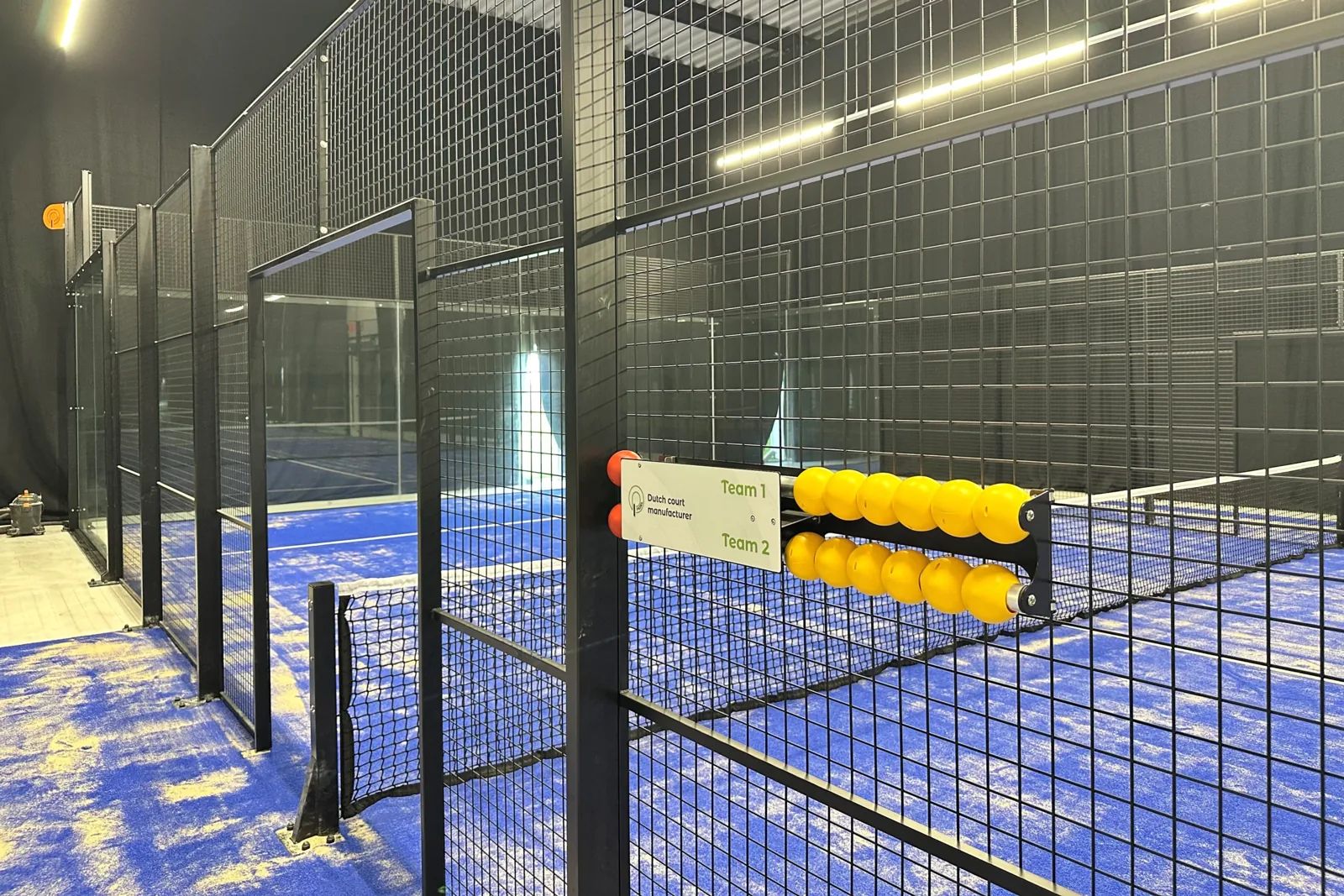
The biggest difference lies in the environment and the structural requirements that follow from it. An indoor padel court stands in a hall and is protected from the weather. An outdoor padel court is located outside and has to withstand wind, rain, frost and temperature fluctuations. That difference has a direct effect on the steel structure, the foundation and the total investment.
For an outdoor padel court the steel structure has to be built heavier. The wind load on a free-standing court outdoors is considerably greater than in a hall. That means thicker steel profiles, extra connections and a foundation specifically calculated for the location. For an indoor court these requirements are less strict, which makes the structure lighter and cheaper.
The foundation also plays a different role. Outdoors, the base must be water-permeable and frost-resistant. Indoors that is less of an issue, although the floor must still be flat, stable and suitable for the weight of the cage structure. The choice of foundation type is therefore directly linked to whether the court is placed indoors or outdoors.
Why is weather-independent play a reason to choose an indoor padel court?
An indoor padel court is weather-independent because the hall offers protection against rain, wind and cold. Players can play all year round, regardless of the season or the weather conditions. For operators this means a stable occupancy rate and predictable income, without the downtime that is unavoidable with outdoor courts in autumn and winter.
In the Netherlands, the weather is a serious factor. An outdoor padel court can be played on well in the summer months, but from October through March there are regularly days when the court cannot be used because of rain, wind or cold. With an indoor venue that problem disappears entirely. Players book their court and do not have to worry about last-minute cancellations due to bad weather.
For tennis clubs or commercial operators who depend on court rental, this is a relevant advantage. Less downtime means more revenue per court per year. In many cases that makes the higher investment in an indoor venue easy to justify, especially if the hall houses several courts and the fixed costs are spread over more courts.
What are the advantages of an indoor padel court for operators?
The advantages of an indoor padel court for operators are stable income all year round, lower structural costs per court, less maintenance on the steel structure and less dependence on permit procedures for noise and lighting. Moreover, the playing experience for members and customers is consistent, which increases customer satisfaction.
Besides weather independence, there are other practical advantages. Inside a hall you have more control over the environment: the lighting is always good, the temperature is more pleasant and there is no wind interfering with play. That also attracts players who find outdoor padel less pleasant in the colder months.
From a management and maintenance perspective, an indoor court is also easier. The steel structure is not exposed to the weather, which benefits the lifespan of both the structure and the artificial turf. The artificial turf of an indoor padel court needs cleaning less often and wears less quickly from UV radiation and precipitation. That lowers maintenance costs in the long term.
Is an indoor padel court more expensive than an outdoor court?
An indoor padel court is generally cheaper than an outdoor padel court, if you look purely at the court itself. The steel structure for an indoor court is lighter and less costly, and the foundation is less complex. As an indication, an indoor padel court turnkey is possible from around €23,000 per court. An outdoor padel court including foundation starts at around €50,000 on average.
The big cost difference lies in the foundation and the heavier structural requirements outdoors. The foundation of an outdoor court depends heavily on the location: soil conditions, wind zone and accessibility together determine the final price. Foundation costs for outdoor courts average between €20,000 and €40,000, depending on the situation. That makes it difficult to give an exact price in advance.
On the other hand, an indoor venue also brings the cost of the hall itself, if it is not already there. If you have an existing hall available, the threshold is much lower. If you need a new hall, the bill obviously changes. The court itself is then not the big cost item, but the building around it is. It is therefore important to map out the total investment carefully for each situation.
Which foundation types are suitable for an indoor padel court?
For an indoor padel court, the most commonly used foundation types are Supersub and drainage concrete, depending on the existing floor situation. With a new hall or an existing concrete floor, the foundation is matched to the bearing capacity and flatness of the base. Water permeability is less of a requirement for indoor courts, but flatness and stability are all the more important.
Supersub is a foundation solution based on foam concrete. The material is lightweight, self-levelling and provides a flat and stable base. For indoor applications, a non-water-permeable build-up is used, matched to the indoor environment. Supersub is also shock-absorbing, which contributes to playing comfort and less strain on the joints. The thickness is usually around 10 to 15 cm, depending on the soil conditions and project requirements.
Drainage concrete is a water-permeable type of concrete that can also be used indoors, although water permeability is less relevant inside. The strength of drainage concrete lies in its high stability and bearing capacity, which makes it suitable for the heavy steel structure and glass walls of a padel court. A drainage concrete foundation lasts 25 to 40 years on average with correct use and maintenance. For padel courts, drainage concrete is often combined with a ring foundation with steel reinforcement to absorb the forces of the structure properly.
Important to know: all foundation components used in the Netherlands must be approved by Kiwa ISA Sport. This is a requirement for official competition use under the KNLTB. Working with certified materials also protects you as a buyer against non-conformity during a later inspection of the court.
What about noise requirements for an indoor padel court?
For an indoor padel court, noise requirements are generally less strict than for outdoor courts, because the hall already contains most of the sound. Even so, noise can also be a problem indoors, particularly if the hall is close to homes, if several courts are side by side, or if the hall structure amplifies the sound rather than dampening it.
Padel produces more noise than tennis. The ball hitting glass and steel, combined with the cage structure acting as a sounding board, results in an average sound power level of around 91 dB. That is roughly 10 dB more than tennis. Inside a hall, that sound is not radiated outwards in the same way as with an outdoor court, but the acoustics inside the hall itself can be a challenge.
Sound-absorbing panels can also be used on indoor courts, mainly to improve the acoustics inside the hall and reduce reverberation. This is relevant in large halls with many hard surfaces. Note: if panels are placed on the outside of the cage structure, the wind catch of the structure changes. The steel structure then has to be structurally reinforced. This also applies indoors if the hall is open or semi-open.
For indoor venues in an existing hall without structural modifications, a separate building permit is not always needed. However, fire safety and use regulations do apply. It is wise to check this per municipality, because the rules can differ from situation to situation.
When do you choose outdoor rather than indoor padel?
You choose an outdoor padel court if you do not have a hall available, if the location offers enough space and if use may be seasonal. Outdoor courts are also interesting if you want to avoid the investment in a hall and the location already has a good base, such as an existing tennis court that can be converted.
Tennis clubs often choose outdoor padel courts because they already have outdoor facilities and can partly reuse existing foundations. That saves costs and makes the switch from tennis to padel financially feasible. With an existing tennis court, part of the substructure can sometimes be reused, which lowers the total investment.
Outdoor courts are also attractive because of their open atmosphere and visibility. A padel court outside attracts passers-by and is visible to people who are not actively visiting the venue. That has a promotional effect on new members or customers. Especially in the summer months, outdoor padel is a popular activity that appeals to a wide audience.
The downside is that outdoor courts place higher demands on the structure, the foundation and the permit process. Noise and lighting are almost always the subject of the permit application for outdoor locations, and an acoustic study is virtually mandatory when the site is near homes. That makes the process longer and more complex than for an indoor venue in an existing hall.
Want to know which type of padel court best suits your location and plans? At I-Padel we are happy to think along with you, without obligation. We look at your specific situation, the available space and the budget, and give you honest advice on the most suitable solution. Take a look at our options for building padel courts or get in touch right away for an initial exploration.
Frequently asked questions
How long does it take on average to have an indoor padel court built?
The lead time for building an indoor padel court depends on the condition of the existing hall and the chosen foundation solution. In a hall that is already finished, installing the court itself can usually be done within one to two weeks.
On top of that, allow time for preparation, such as measuring the location, drawing up construction drawings and any modifications to the hall. In total, with smooth preparation, you can expect a total lead time of four to eight weeks.
Can I convert an existing sports hall or industrial building into an indoor padel venue?
Yes, in many cases this is perfectly possible and is precisely a cost-efficient solution. The minimum clear height for an indoor padel court is 8 to 9 metres, and the floor must offer sufficient bearing capacity and flatness for the cage structure. Also check whether the hall meets the municipality’s fire safety and use regulations, because this can differ from situation to situation. A structural quick scan of the hall at the start of the process prevents surprises afterwards.
Which common mistakes should I avoid when choosing between indoor and outdoor?
A common mistake is that operators underestimate the total investment by looking only at the court price and leaving out foundation costs, permit procedures or hall costs. Another pitfall is overestimating the occupancy rate of outdoor courts in autumn and winter, so that the payback period turns out longer in practice than planned. Always make sure you have a realistic business case that takes seasonal downtime, maintenance costs and the specific location-related costs into account.
Is a building permit always required for an indoor padel court in an existing hall?
Not always, but it depends heavily on the municipality and the specific situation. If the hall already has a sports zoning designation and no structural modifications are made to the building itself, in some cases no separate building permit is needed for the padel court itself. Even so, fire safety and use requirements that the space must meet always apply. It is strongly recommended to check this in advance with the municipality, so that you do not face surprises afterwards.
How many padel courts fit in a standard sports hall?
A standard sports hall of around 40 by 20 metres can usually fit two padel courts side by side, provided the clear height is at least 8 to 9 metres. In larger halls or specifically designed padel complexes, four to six courts or more can be accommodated. The more courts you place in one hall, the more favourable the fixed costs per court become, which makes operation financially more attractive. Always have the hall measured by a specialist to determine the optimal layout.
What about the long-term maintenance costs of an indoor padel court?
The maintenance costs of an indoor padel court are structurally lower than those of an outdoor court, because the structure and the artificial turf are not exposed to UV radiation, rain and frost. The artificial turf of an indoor court lasts longer on average and needs to be cleaned less frequently.
The main recurring cost items are topping up and levelling the infill sand, periodic cleaning of the artificial turf and a visual inspection of the steel structure and glass walls. Schedule this maintenance annually to maximise the lifespan of the court.
What influence does the choice of location have on the payback period of an indoor padel venue?
The location has a major influence on the payback period, because population density, local competition and accessibility directly determine the occupancy rate. An indoor padel venue in an urban environment with little competition and good parking can be profitable within three to five years. In a less densely populated region or with fierce competition, the payback period can be considerably longer. For the business case, always have a market analysis carried out for your specific region before you make the final investment decision.


