Blog · 3 August 2026 · 11 min read
Padel noise nuisance: what solutions are there?
Noise nuisance from a padel court? Discover which solutions work: from absorbing panels to noise barriers. Read what suits your location.
In this article
- What causes noise nuisance from a padel court?
- What is the difference between a noise barrier and sound-absorbing panels?
- How does a source measure work for a padel court?
- How do sound-absorbing panels affect the structure?
- Do I need an acoustic study for a padel court?
- Which noise solution is suitable for my location?
- Not sure whether outdoor padel is feasible at your location?
- Frequently asked questions
Noise nuisance from a padel court is a common problem, but in many situations it is technically manageable. The most commonly used solutions are sound-absorbing panels as a source measure and freestanding noise barriers. Which approach is suitable depends on the location, the distance to homes and the results of an independent acoustic study. The questions below give you a clear overview of the options, the technical consequences and the steps needed to make an outdoor padel project feasible in terms of permits.
What causes noise nuisance from a padel court?
Noise nuisance from a padel court arises mainly from impulse noise: short, clearly recognisable peaks released when the ball hits the racket, the glass and the fencing of the cage structure. This type of noise carries far and is experienced by residents as more annoying than continuous background noise. Measurements show that the average sound power level of a padel court is around 91 dB, which is considerably higher than for tennis.
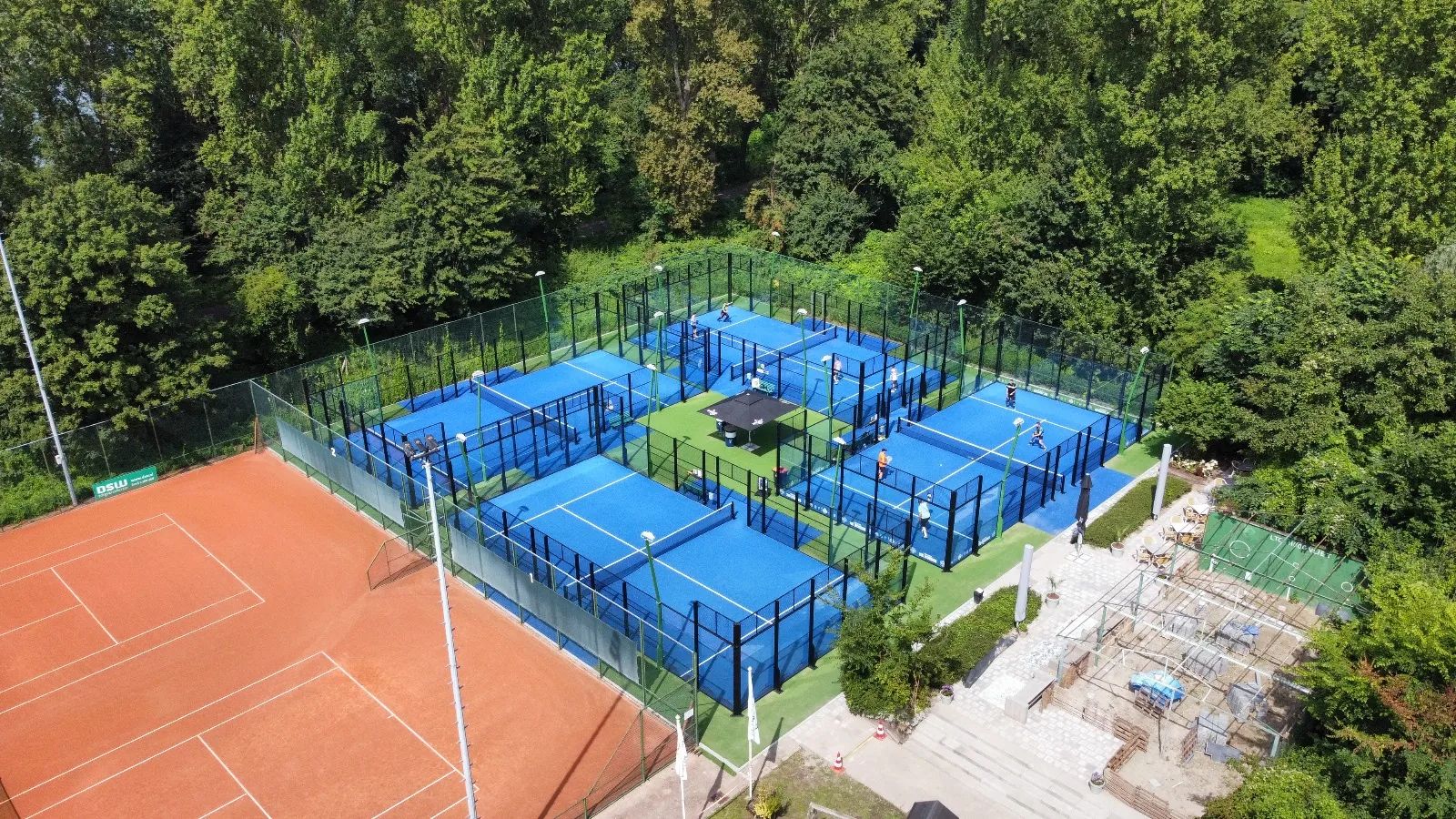
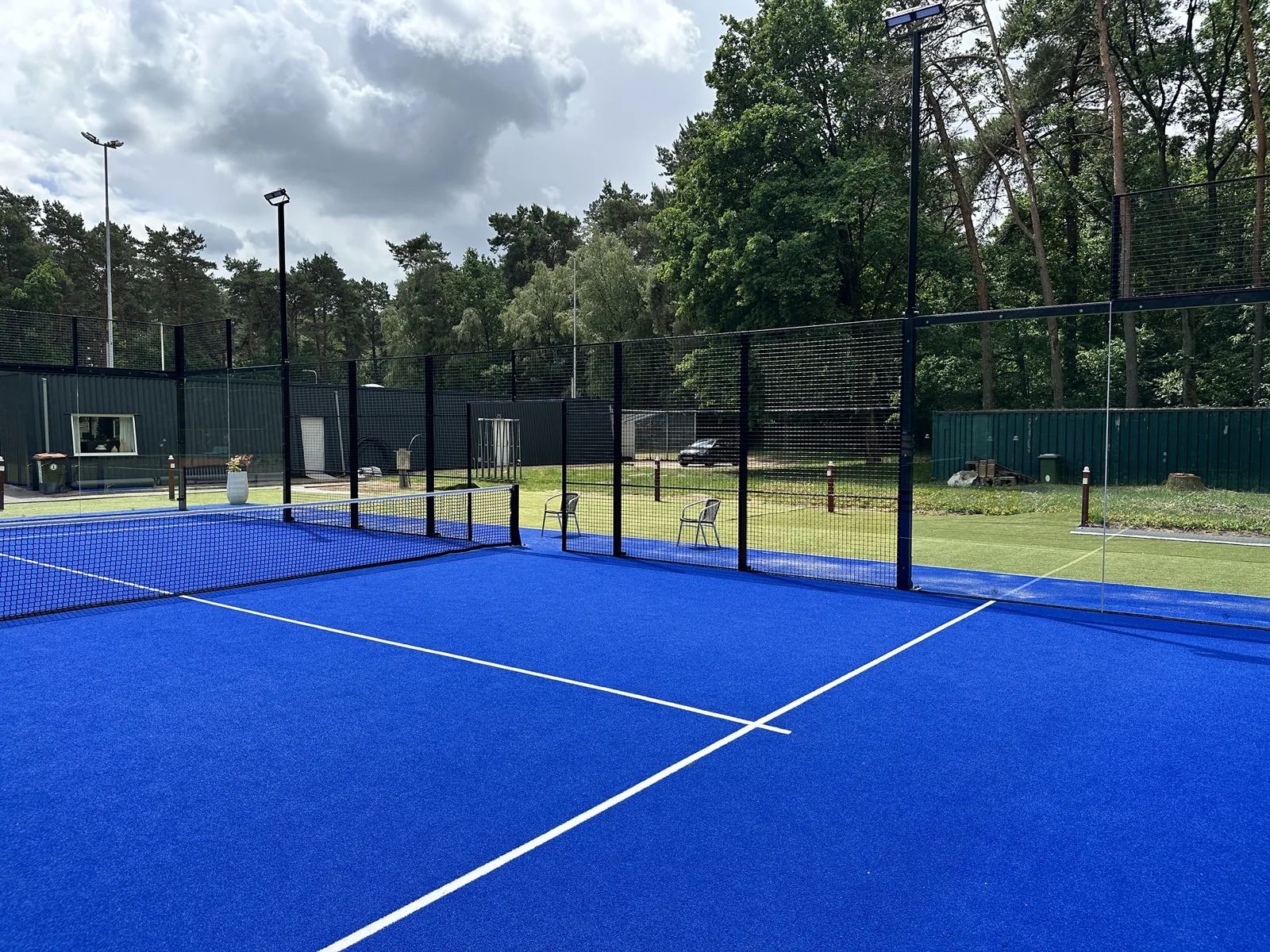
The cage structure plays a special role here. The combination of steel profiles, glass panels and metal fencing causes sound to be reflected and amplified. The cage acts as a resonance box, so that noise not only goes directly outwards but is also reflected within the structure and reaches the surroundings along several paths.
How strongly the nuisance is experienced depends heavily on the location. Factors such as the distance to homes, the presence of surrounding buildings, the wind direction and the intensity of use of the court all play a role. A court at an open sports park on the edge of a residential area behaves very differently, acoustically, from a court enclosed by buildings. That is why a project-specific assessment is always the starting point.
What is the difference between a noise barrier and sound-absorbing panels?
A noise barrier is a freestanding structure placed next to or around the padel court that blocks noise towards homes. Sound-absorbing panels are fitted directly to the outside of the cage structure and absorb the noise as close to the source as possible. The fundamental difference lies in where they work: a noise barrier works at a distance from the court, panels work directly at the source.
How does a noise barrier work?
A noise barrier, also known as a noise wall, is placed next to or around the padel court. The barrier blocks and absorbs sound waves before they reach the surroundings. Noise barriers can be built to heights of 6 to 8 metres and can be tens of metres long.
They are particularly effective when noise needs to be limited in one specific direction. Because a noise barrier is regarded as a structure, an environmental permit is almost always needed for its installation. You can find more information about the application and design of noise barriers around padel courts on the relevant page.
How do sound-absorbing panels work?
Sound-absorbing panels are fitted on the outside of the mesh of the cage structure. They absorb the noise instead of reflecting it back, which reduces the amount of noise reaching the surroundings. The playing dynamics of the court are retained and the court remains visually open. Independent laboratory research shows that the panels achieve sound absorption class A, with an absorption value of 0.80 and a sound insulation index of 19 dB.
In a field measurement at LTC Hofgeest, an indicative noise reduction of approximately 3 dB(A) was measured within the configuration studied, after correction for background noise. These results apply only to that specific situation and are not automatically applicable to other locations.
In many cases a combination of both measures is the most effective. Panels limit the noise at the source, while a noise barrier further reduces the remaining noise transmission towards homes. An additional advantage is that, when panels are used, the noise barrier can sometimes be built lower, which saves costs and can simplify the permit process.
How does a source measure work for a padel court?
A source measure is a noise measure applied directly at the noise source, in this case the padel cage itself. Instead of blocking the noise at a distance, the noise is limited as close as possible to where it originates. For padel courts, the most commonly used source measure is fitting sound-absorbing panels to the outside of the cage structure.
The principle is simple: the panels absorb the sound waves radiated outwards through the cage before they can spread further. Because the noise is tackled at the source, the measure is compact and takes up relatively little space compared with a large freestanding noise barrier.
In suitable situations, a source measure can be more compact and cheaper than a freestanding noise barrier, but whether a source measure is sufficient depends entirely on the project situation. The distance to homes, the noise reduction required under municipal standards and the results of an independent acoustic study together determine whether panels are enough as a source measure or whether additional measures are needed. An independent acoustic consultant determines which measures are needed at a specific location. For that, we supply the necessary technical product specifications and structural data.
How do sound-absorbing panels affect the structure?
Fitting sound-absorbing panels has direct structural consequences for the cage structure. Because the panels partly or fully cover the open fencing, the wind permeability of the structure decreases. This means the wind load on the steel structure increases. The structure must be recalculated for this before panels are used.
In practice, this means that in many cases the steel structure has to be structurally reinforced. This can consist of heavier posts, additional columns or adapted connections. The exact modifications depend on the wind zone, the position of the panels and the number of sides on which they are applied. You can find more information about the relationship between structure and wind load on the structure page.
Because we produce the steel structure ourselves, columns, connections, base plates and anchors can be adapted project by project when additional requirements arise from noise measures or a higher wind load. This makes it possible to integrate panels in a structurally responsible way, even on existing courts. Panels cannot simply be fitted to any existing cage structure. An assessment by a structural engineer is always needed.
Sound-absorbing panels can be applied on one side of the court, in the lower or upper metres of the cage, on several sides or in combination with glass walls. Each configuration requires its own structural calculation.
Do I need an acoustic study for a padel court?
For outdoor padel courts built near homes, an acoustic study is in most cases mandatory as part of the permit application. Municipalities generally require this study as a condition for assessing whether the padel court meets the applicable noise standards under the Besluit activiteiten leefomgeving (Environment Activities Decree) or the zoning plan.
An acoustic study is carried out by an independent acoustic firm. Based on the location, the distance to homes, the use and the planned noise measures, they calculate the expected noise impact. Based on those results, it is determined which measures are needed to meet the standards. We do not carry out acoustic studies ourselves, but we do supply the technical product specifications, structural data and engineering needed to carry out the calculations correctly.
Even when an acoustic study is not formally required, it can be wise to have one carried out anyway. It gives advance insight into the expected noise impact and helps to prevent objections from residents. A well-substantiated report can also smooth the permit process. You can read more about applying for a permit for a padel court on the permit page.
Which noise solution is suitable for my location?
There is no universal noise solution suitable for every padel court. Which measure is appropriate depends on the location, the distance to homes, the available space, the noise reduction required and the results of an independent acoustic study. Every location requires a project-specific assessment.
As a general guideline, the following applies. Sound-absorbing panels are particularly suitable when the available space is limited, the noise source needs to be tackled directly at the cage structure and the required reduction falls within the technical possibilities of panels. They can be applied on one or more sides of the court and can also be added later to existing courts, provided the structure has been calculated for this and, if necessary, reinforced.
A noise barrier is particularly suitable when a greater reduction is needed, when the noise needs to be screened in one specific direction or when panels are insufficient. Noise barriers can be built with planting, which contributes to better acceptance by the municipality and residents. The drawback is that a noise barrier requires more space and almost always needs a separate environmental permit because of the size of the structure.
In many situations a combination of both measures is the most effective and sometimes also the most cost-efficient, because panels can make the noise barrier lower and more compact. The acoustic solutions for padel that we use are always designed project by project, in cooperation with the acoustic consultant and structural engineer involved in the project. There is no standard configuration that works for every location.
Costs also play a role in choosing a noise solution. Noise measures are an additional investment on top of the cost of the padel court itself. The size of that investment differs greatly from situation to situation and depends on the type of measure, its scale and the structural modifications required. A custom padel court with an integrated noise solution always requires a quote based on the specific project situation.
Not sure whether outdoor padel is feasible at your location?
We are happy to think along with you about the court configuration, structural preparation and possible noise measures. Together with your acoustic consultant, we look at which solution is technically feasible and suits the project. Get in touch via the page on acoustic solutions for padel for an initial, no-obligation exploration.
Frequently asked questions
How much noise reduction is realistically achievable with sound-absorbing panels?
The achievable noise reduction differs per location and configuration. Laboratory research shows sound absorption class A with an absorption value of 0.80 and an insulation index of 19 dB, but in practice the measured reduction depends on the situation. At LTC Hofgeest, an indicative reduction of approximately 3 dB(A) was measured under specific conditions. Whether this is sufficient for your location is determined by an independent acoustic consultant on the basis of the municipal standards and the project situation.
Can I also fit sound-absorbing panels to an existing padel court afterwards?
In principle this is possible, but not automatically. Because panels reduce the wind permeability of the cage structure, the wind load on the steel structure increases. A structural engineer must first assess the existing structure and determine whether reinforcement is needed, for example through heavier posts, extra columns or adapted connections. Without that assessment, installation is structurally irresponsible.
What permits do I need if I want to build a noise barrier at my padel court?
A noise barrier is regarded as a structure, so an environmental permit is almost always required. The exact requirements depend on the height, the size and the zoning plan of the location. It is wise to coordinate this with the municipality early, so that the permit application can be well supported with an acoustic report and structural data.
What is a common mistake when tackling noise nuisance from a padel court?
A common mistake is choosing a noise solution without a prior acoustic study. Without measurement and calculation, it is impossible to determine how much reduction is needed and which measure is suitable. This regularly leads to situations in which the chosen solution proves insufficient, the permit is refused or expensive modifications are needed afterwards. Bringing in an independent acoustic consultant at the start of the project avoids this.
How long does the permit process take for an outdoor padel court with noise measures?
The permit process varies greatly by municipality and project situation, but allow on average a few months, sometimes more than a year, when an extensive acoustic study and an environmental permit for a noise barrier are needed. A well-prepared file with an independent acoustic report, structural data and a clear justification of the noise measures can considerably speed up the process and reduce objections from residents.
Do sound-absorbing panels affect playing comfort or the experience of the court?
Sound-absorbing panels are fitted to the outside of the mesh, so the playing dynamics and sight lines within the court are largely retained. The court remains visually open and the playing surface is not affected. Players inside the cage generally notice little difference in the playing experience, while the noise to the surroundings is indeed reduced.
What are the first concrete steps if I want to build an outdoor padel court at a location near homes?
Start by bringing in an independent acoustic firm for a preliminary study based on the site data, the distance to homes and the planned intensity of use. At the same time, contact the municipality to find out the permit requirements and the applicable noise standards. Only then, based on the results of the acoustic study, can a suitable noise solution be designed and budgeted in cooperation with a structural engineer and the padel court supplier.