Blog · 22 September 2026 · 12 min read
Padel court next to homes: what do you need to consider?
Padel court next to homes? Find out which noise standards apply, when an acoustic study is mandatory and how to prevent objections.
In this article
- How much noise does a padel court actually produce?
- Which noise standards apply to a padel court next to homes?
- Do you need an acoustic study for a permit?
- What is the difference between a noise barrier and sound-absorbing panels?
- What effect do sound-absorbing panels have on the structure of the court?
- How does the permit process for an outdoor padel court work?
- What can you do if local residents object?
- Not sure whether outdoor padel is feasible at your location?
- Frequently asked questions
A padel court next to homes always raises questions about noise, permits and the technical feasibility of the project. The distance to surrounding homes, the layout of the sports park and the intensity of use together determine how real a concern noise nuisance is. This article answers the most frequently asked questions about padel noise, noise measures, permit procedures and what you can do if local residents object.
How much noise does a padel court actually produce?
A padel court produces an average sound power level of around 91 dB. That is roughly 10 dB more than a tennis court. The difference lies not only in the sound of the ball being hit, but above all in the impact noise created when the ball strikes the glass or the fencing of the cage structure. The cage amplifies this sound, much like a resonance box.
Padel mainly produces impulse noise: short, sharp peaks that are clearly recognisable in the surroundings. Local residents often find this type of noise more annoying than continuous background noise, even when the absolute noise level is relatively low. That makes padel noise a specific point of attention at locations close to residential areas.
The extent to which noise actually causes nuisance depends heavily on the situation. Factors such as the distance to homes, the presence of buildings or vegetation, the wind direction and how intensively the courts are used all play a role. A court 100 metres from the nearest home requires a different assessment than a court 30 metres away.
Which noise standards apply to a padel court next to homes?
In the Netherlands, noise standards for sports facilities are determined by the Activities Decree (Activiteitenbesluit milieubeheer) or the environmental permit. The standards are expressed in dB(A) and apply at the façade of nearby homes. Which limit values apply differs per municipality, time of use and the zoning of the surrounding area.
As a general starting point, the Activities Decree sets a maximum long-term average rating level for sports facilities of 45 dB(A) during the day, 40 dB(A) in the evening and 35 dB(A) at night. For impulse noise, such as that of padel, additional assessment methods apply in which peak values are tested separately.
In specific situations, municipalities can deviate from the standard norms, both stricter and more lenient. This depends on the zoning plan, the environmental vision and the local situation. It is therefore not possible to determine whether a particular location meets the standards without a location-specific study. An independent acoustic consultant calculates the expected noise load and assesses whether additional measures are necessary.
Do you need an acoustic study for a permit?
For outdoor padel courts near homes, an acoustic study is mandatory in most cases as part of the permit application. Municipalities request this study to assess whether the new facility complies with the applicable noise standards. Without this study, obtaining a permit is not feasible in most situations.
The acoustic study is carried out by an independent acoustic consultancy. It maps the existing noise situation, determines the relevant assessment points on the façades of nearby homes and calculates the noise level the padel courts cause at those points. The consultancy then assesses whether additional measures are needed to meet the standards.
The results of the acoustic study partly determine which noise measures are included in the design. In this, I-Padel works with the acoustic consultancy by supplying technical product specifications, structural data and information on available noise measures. Based on this information, the consultancy can correctly calculate the effects of the measures. You can find more information about the permit process on our page about the permit for a padel court.
What is the difference between a noise barrier and sound-absorbing panels?
A noise barrier is a freestanding structure placed next to or around the padel court to block noise towards homes. Sound-absorbing panels are mounted directly on the cage structure of the padel court and work as a source measure: they limit the spread of noise right at its origin.
Noise barriers: how they work and where they are used
Noise barriers can be built to heights of up to 6 to 8 metres and over lengths of tens of metres. They are particularly suitable when noise needs to be limited in one specific direction and when there is enough space for placement and foundation. A noise barrier requires a structural calculation, soil investigation data (CPT) and, in almost all cases, an environmental permit, because it is regarded as a standalone structure.
On existing sports parks, the space available for freestanding barriers is often limited. In addition, large barriers require extra groundwork and their own foundation, which increases cost and lead time. You can read more about how noise barriers around padel courts work and where they are used on our overview page.
Sound-absorbing panels: a source measure directly on the cage
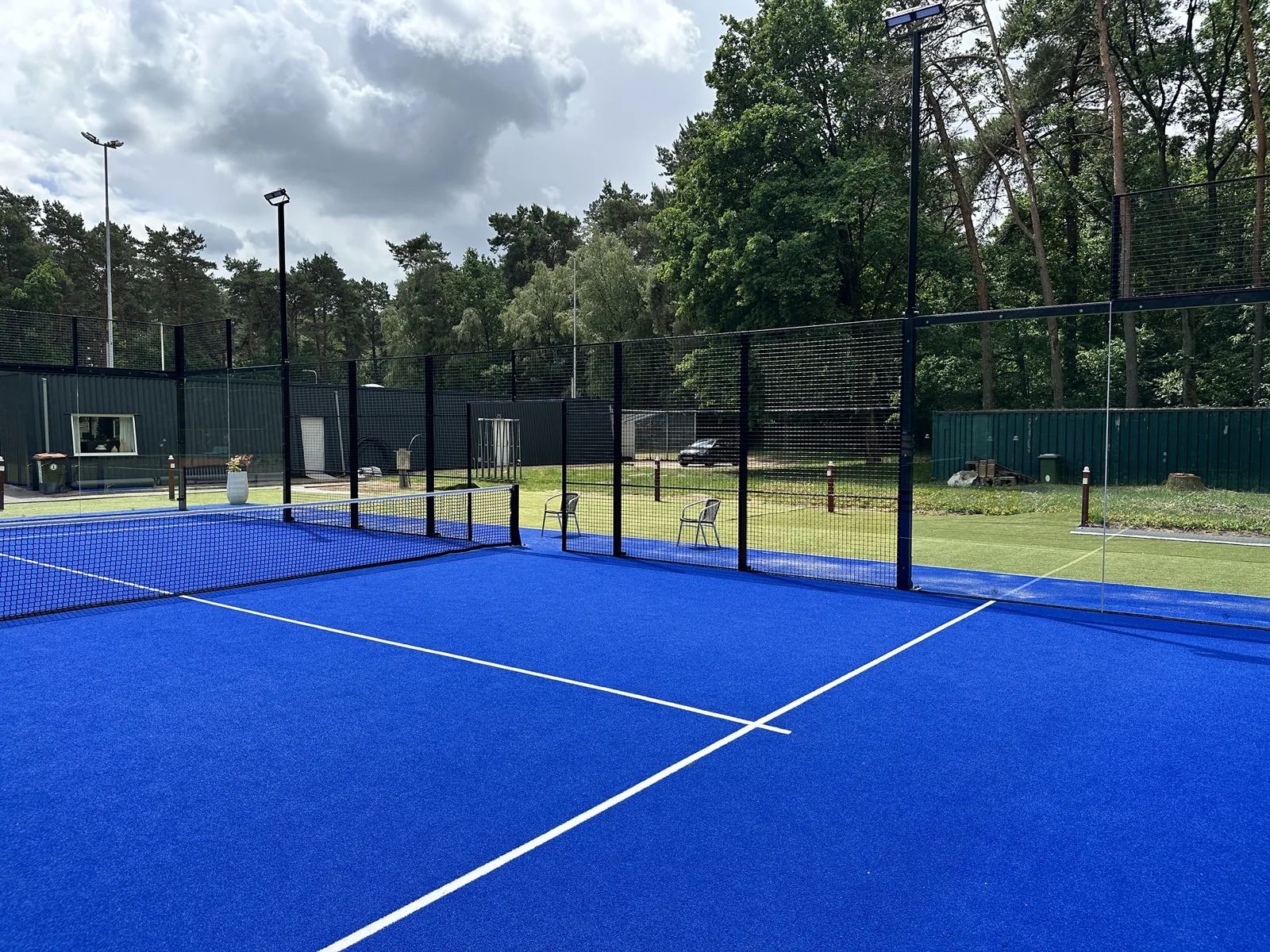
Sound-absorbing panels are mounted on the outside of the cage structure. They absorb sound instead of reflecting it back, thereby limiting its spread at the source. An important advantage is the small footprint: no extra ground area is needed, and the panels can be applied on specific sides of the court, depending on where the homes are located.
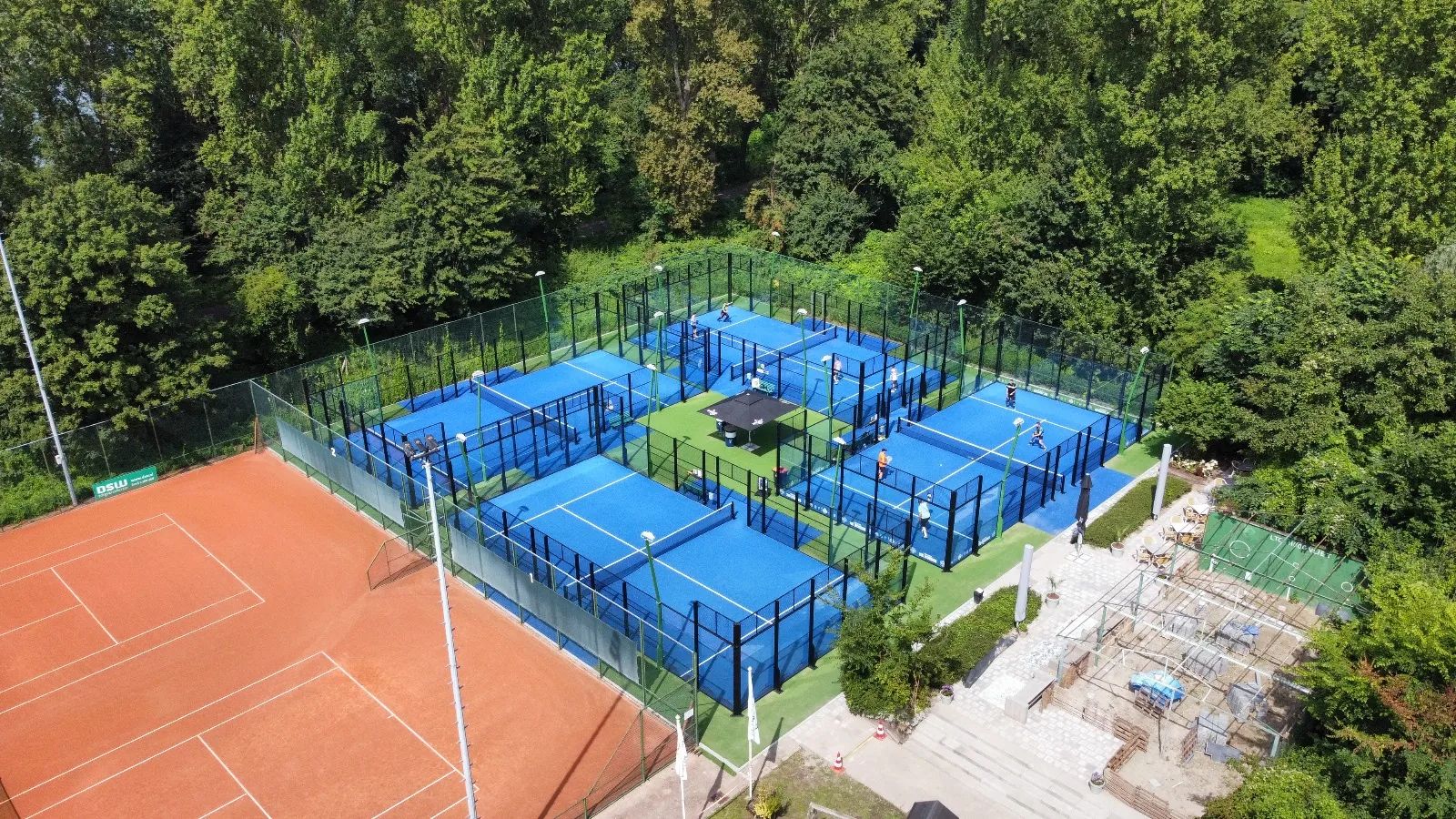
In the field study carried out at LTC Hofgeest in Velserbroek, an indicative noise reduction of approximately 3 dB(A) was measured for the configuration examined, after correction for background noise. This value applies only to the situation examined and must not be used as a general performance figure for other projects. The final effectiveness of panels always depends on location-specific conditions.
In many situations, a combination of sound-absorbing panels and a noise barrier is the most suitable. The panels reduce the noise load at the source, which means any noise barrier can be built lower. This makes the overall solution more compact and can simplify the permit process.
What effect do sound-absorbing panels have on the structure of the court?
Sound-absorbing panels increase the wind load on the steel structure. Panels partly close off the cage, so wind no longer flows freely through the structure but is caught by the panels. The forces this creates are transferred through the steel structure to the foundation. The structure must be calculated for this before panels are mounted.
This means an existing padel court cannot simply be fitted with sound-absorbing panels. First, it must be assessed whether the existing steel structure is suitable to safely absorb the additional loads. In many cases, a structural assessment by a structural engineer is necessary. Depending on the outcome, the structure may need to be reinforced, for example with heavier posts, additional columns or modified connections.
For new padel courts, the placement of panels can be taken into account directly during the engineering phase. Because we produce the steel structure ourselves, structural adjustments can already be made in the design phase. This prevents costly modifications afterwards and ensures that structural safety and acoustic measures are optimally aligned. You can read more about the relationship between structure and wind load on our structure page.
The installation of the panels also requires attention. The panels are mounted gap-free, so that unwanted openings between the panels and the structure are avoided. Small openings can negatively affect the acoustic performance, because sound can still spread through them.
How does the permit process for an outdoor padel court work?
In the Netherlands, an outdoor padel court is regarded as a structure. In most cases, an environmental permit is mandatory. The permit process usually includes a zoning plan check, the submission of structural calculations, an acoustic study, a lighting study and sometimes an additional ecological or archaeological study.
The average processing time of a permit application is 8 to 12 weeks, depending on the municipality and the complexity of the project. Municipalities may impose additional requirements, for example on the maximum height of the court, the lighting installation or the noise measures included in the design. It is therefore wise to contact the municipality at an early stage to map out the conditions.
Building without a permit is not an option. The municipality can halt the project, impose fines or require the cage structure to be removed. We can guide and coordinate the entire permit process, including the zoning plan check, consultation with the municipality and the submission of structural calculations and technical documentation.
After completion, an inspection by Kiwa ISA Sport is mandatory for official competitions. Kiwa ISA Sport is the recognised certification institute for sports facilities in the Netherlands. All materials we use meet the requirements of Kiwa ISA Sport, so you can start the inspection application directly after completion.
What can you do if local residents object?
When local residents object to a padel court next to homes, the most effective approach is a combination of transparent communication and technically substantiated information. In most cases, objections are based on concerns about noise nuisance, lighting or the visual impact of the facility. By taking these concerns seriously and substantiating how they will be addressed, you increase the chance of a constructive outcome.
From a technical point of view, it is important to have an independent acoustic study carried out before objections escalate. This study maps the actual noise situation and makes clear which measures are necessary. An objective report from an independent consultancy is more persuasive than your own estimate and gives the municipality concrete information to base its assessment on.
Noise measures included in the design can contribute to a realistic permit process. Think of sound-absorbing panels as a source measure, a noise barrier on the side facing the homes, or a combination of both. Which measure is suitable depends on the location-specific situation and the results of the acoustic study. There is no standard solution that delivers the same result at every location.
Once objections have been submitted to the municipality, it is wise to seek legal advice on the objection procedure. We can support the technical substantiation of the project, but the legal and administrative side of an objection procedure requires specialised legal guidance. For a complete overview of the acoustic solutions for padel we can deploy, please see our noise solutions page.
Prevention is in most cases more effective than remediation. By taking the location of homes, the intensity of use and the available noise measures into account as early as the design phase, you increase the chance that the project is both technically feasible and widely supported by the surrounding community.
Not sure whether outdoor padel is feasible at your location?
We are happy to think along with you about the court configuration, structural preparation and possible noise measures. Together with your acoustic consultant, we look at which solution is technically feasible and suits the project. Get in touch via our page on acoustic solutions for padel for an initial, no-obligation exploration.
Frequently asked questions
How many courts can I build before an acoustic study becomes mandatory?
There is no fixed threshold based on the number of courts; the permit requirement and the associated study requirement depend on the location, the distance to homes and the zoning plan. Even a single outdoor padel court near homes may require an acoustic study. Contact the municipality at an early stage to determine which studies are necessary for your specific situation.
What are the most common mistakes when applying for a padel court permit?
A common mistake is submitting a permit application without first consulting the municipality about the local conditions, as a result of which applications are declared incomplete or inadmissible. In addition, initiators regularly underestimate the lead time and start the acoustic study and structural calculations too late. Start the process at least six months before the desired construction start date to avoid delays.
Can I add sound-absorbing panels to an existing padel court afterwards?
In principle that is possible, but it first requires a structural assessment of the existing steel structure. Panels increase the wind load on the cage, and not every existing structure is suitable to safely absorb these extra forces without modifications. Have a structural engineer assess the existing court before you proceed to installation, so that you know whether, and which, reinforcements are needed.
Are there also measures to limit noise nuisance during evening use?
Yes. In addition to acoustic measures such as sound-absorbing panels and noise barriers, you can also use operational measures, such as limiting the hours of use in the evening and switching off public address systems after a certain time. The noise standards for the evening period (40 dB(A)) are stricter than during the day, which means a combination of technical and organisational measures is often necessary in the evening. Preferably, record these agreements in the permit conditions or a code of use.
What is the difference between dB(A) and the peak values measured for padel noise?
The long-term average rating level in dB(A) reflects an average noise level over a longer period and is the primary test standard for sports facilities. Padel noise, however, consists mainly of impulse noise: short, sharp peaks that temporarily exceed the average level considerably. When assessing padel noise, peak values are tested separately, because this type of noise is perceived as more annoying than continuous noise at the same average level.
How does the orientation of the padel court affect noise nuisance for local residents?
The orientation of the court directly influences the direction in which most noise is radiated. The sides of a padel court (along the net) generally produce more impact noise because the ball hits the glass and fencing more often. By positioning the court so that these sides do not face nearby homes, the noise load on façades can be limited as early as the design phase. An acoustic consultant can include this in the calculations and advise on the optimal court orientation.
What happens if the padel court turns out not to meet the noise standards after completion?
If it is established after completion that the noise standards are being exceeded, the municipality can take enforcement action and impose additional measures or restrict the hours of use. In that case, structural modifications are still needed, such as installing a noise barrier or adding sound-absorbing panels, which is considerably more expensive afterwards than if this had been included in the design phase. This underlines the importance of a thorough acoustic study before the permit application and construction.