Blog · 19 October 2026 · 13 min read
How do you determine whether an existing padel cage is suitable for sound absorption?
Not every padel cage is suitable for sound-absorbing panels. Discover which structural factors are decisive and when replacement is necessary.

In this article
- Which structural characteristics determine whether a padel cage can carry panels?
- What is the difference between a noise barrier and sound-absorbing panels on a padel court?
- How is the wind load recalculated when sound panels are added?
- What information do you need for a structural assessment of an existing padel cage?
- When is an existing padel cage not suitable for sound absorption?
- Do you need an acoustic study before fitting sound-absorbing panels?
- Who assesses whether an existing padel cage is suitable for noise measures?
- Not sure whether outdoor padel is feasible at your location?
- Frequently asked questions
Whether an existing padel cage is suitable for sound-absorbing panels depends on the structural build-up of the cage, the quality of the foundation and the wind load at the location. Not every existing cage structure is automatically suitable. A structural assessment by a certified structural engineer is needed in almost all cases before panels can be fitted. The questions below help you understand which factors are decisive and what is involved technically.
Which structural characteristics determine whether a padel cage can carry panels?
Whether an existing padel cage can carry sound-absorbing panels is determined first and foremost by the profile thickness of the steel structure, the connections between the posts and the horizontal beams, the quality of the base plates and the anchoring in the foundation. The heavier the structure, the greater the chance that additional panels can be integrated without the cage having to be replaced structurally.
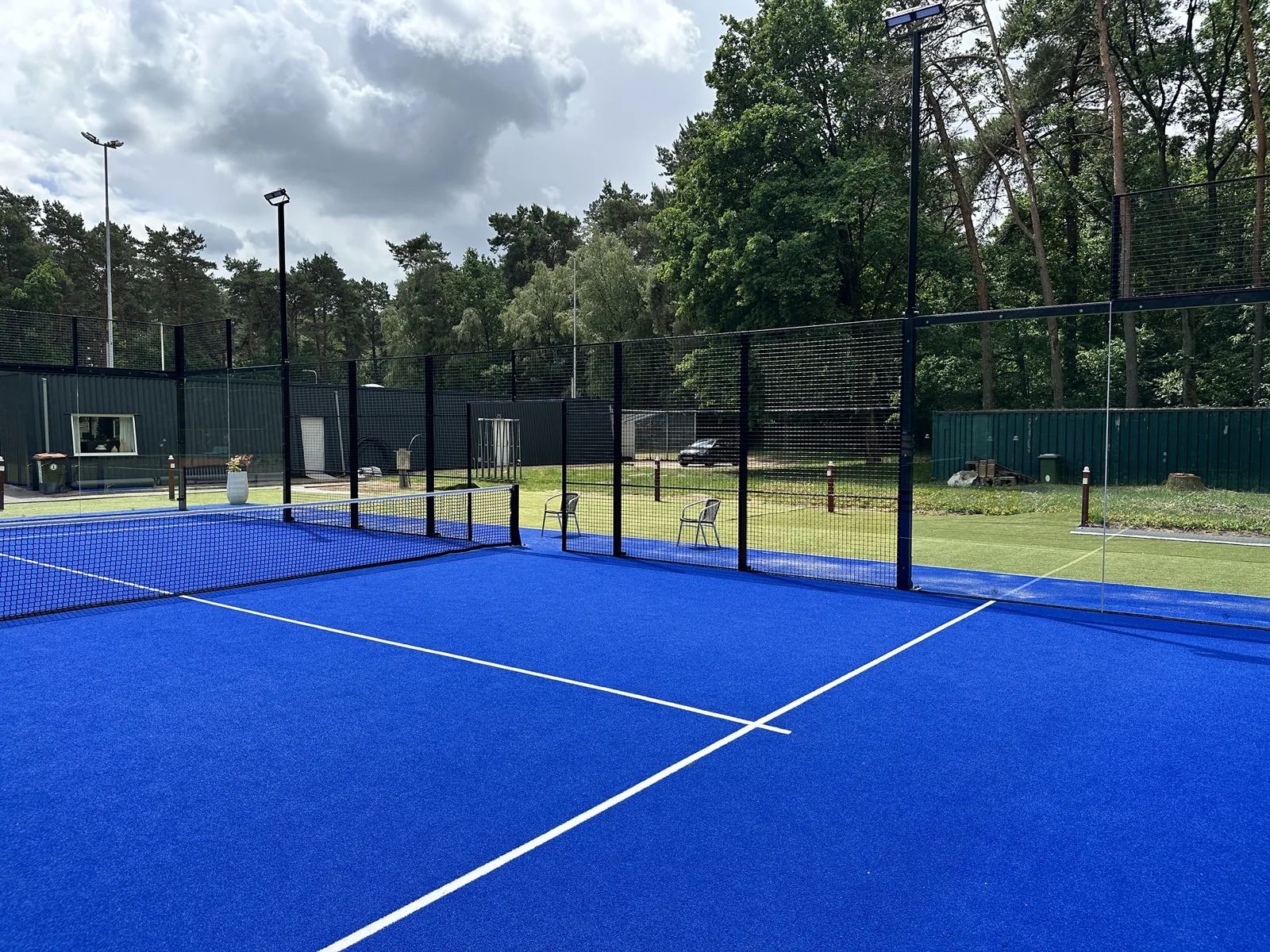
Sound-absorbing panels are fixed to the outside of the mesh of the cage structure. They close off the surface partly or fully, so that the wind no longer flows freely through the cage. This changes the wind exposure of the structure considerably. The posts, connections and base plates must be able to absorb this additional load and transfer it to the foundation.
With a standard imported cage structure, the profiles are often calculated for the minimum structural requirements of an open, wind-permeable court. Heavier profiles, additional columns or reinforced connections are then not present. Whether an existing cage has sufficient load-bearing capacity cannot be judged visually. That requires a structural recalculation based on the original specifications of the structure and the wind load at the location.
We produce our steel structures from S350 structural steel and, for outdoor applications, use a duplex protection system, combining hot-dip galvanising with high-quality powder coating. Structures built without this level of material quality may also be more prone to corrosion, which further affects load-bearing capacity in the long term.
What is the difference between a noise barrier and sound-absorbing panels on a padel court?
A noise barrier is a freestanding structure placed next to or around the padel court to block sound towards the surroundings. Sound-absorbing panels are mounted directly on the cage structure of the padel court and work as a source measure: they absorb the sound as close as possible to where it originates.
This difference has practical consequences for their application. A noise barrier works at a greater distance from the court and can be deployed in specific directions. It is a separate building structure with its own foundation, wind load and permit requirement. Noise embankments can be built to heights of six to eight metres and can be tens of metres long. You can find more information about how they work and where they are used on the page about noise embankments around padel courts.
Sound-absorbing panels as a source measure work on a different principle. They absorb the sound before it spreads to the surroundings. Independent laboratory testing has established the following values for the panels we use:
- Sound absorption class: A
- Absorption value αw: 0.80
- Absorption index DLα: 8 dB
- Airborne sound insulation Rw: 22 dB
- Sound insulation index DLR: 19 dB
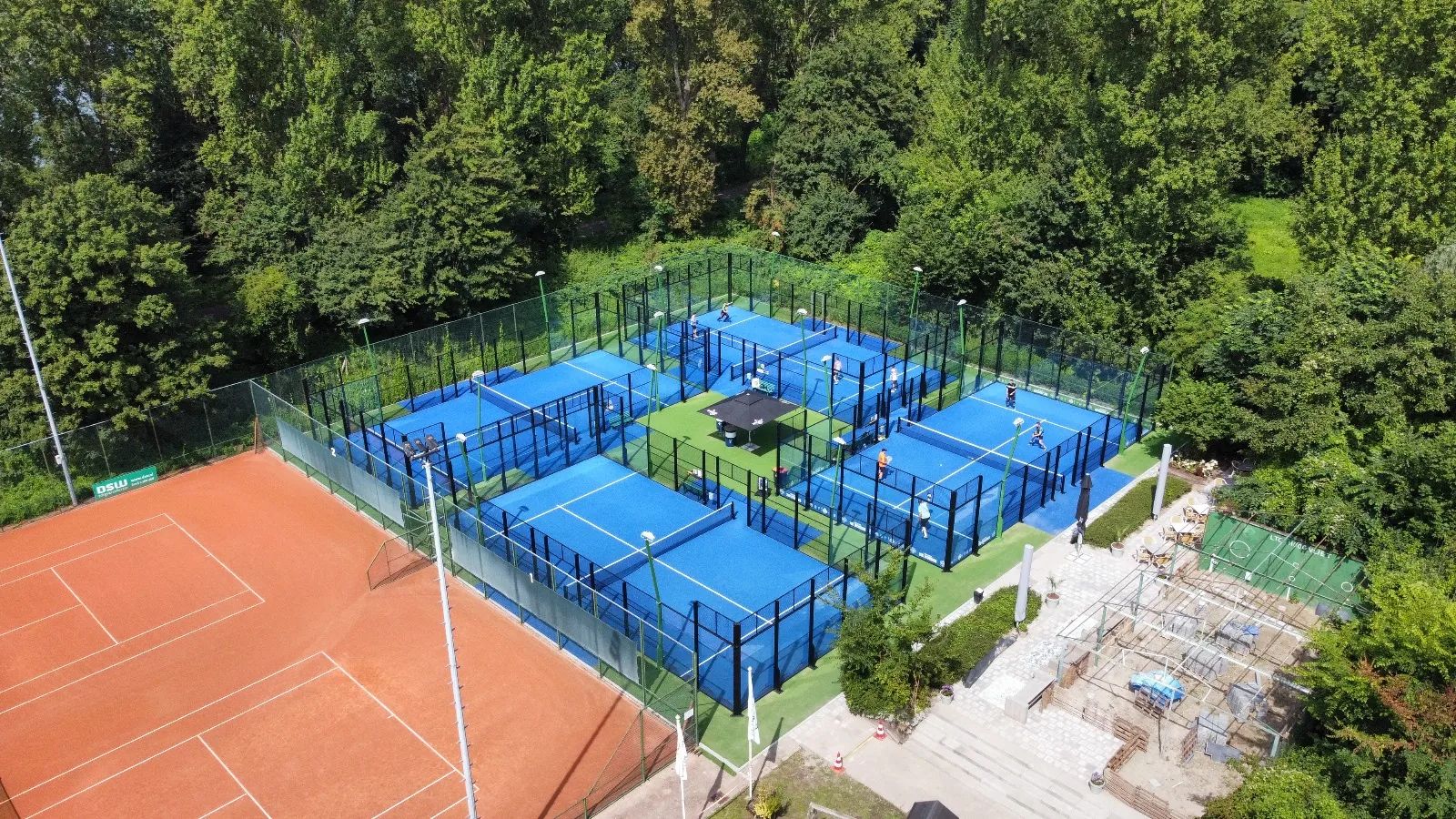
In practice, this can result in an audible noise reduction at distances of around 40 to 100 metres. During a practical measurement at LTC Hofgeest, an indicative noise reduction of around 3 dB(A) was measured within the configuration studied, after correcting for background noise. These results apply only to the situation studied and must not be translated into a general product guarantee.
Which measure is suitable depends on the project situation. In many cases a combination of sound-absorbing panels and a noise embankment is the most effective. The panels reduce the noise at the source, so that any noise embankment can be built lower. That saves costs and in some situations makes obtaining a permit more accessible.
How is the wind load recalculated when sound panels are added?
When sound-absorbing panels are added to an existing padel cage, the wind permeability of the structure decreases. An open cage structure lets most of the wind pass, but panels close off the surface partly or fully. This creates a larger wind-catching surface and the wind load on the structure increases. The structure must be calculated for this.
The recalculation is carried out by a structural engineer on the basis of the location-specific wind zone, the height and position of the panels, the percentage of closed surface and the original structural specifications of the cage. The Netherlands is divided into wind areas in accordance with the European standards. Locations in open areas, on the coast or on higher ground are subject to a higher wind load than locations in built-up surroundings.
This recalculation may show that the existing structure needs to be reinforced. This can mean that heavier posts are needed, that additional columns are placed, or that connections and base plates are modified. In some cases the existing structure is not suitable for reinforcement and replacement is the only technically sound option.
You can find more background on the relationship between structure and wind load for padel courts on our structure page. For new projects, we already take into account during the engineering phase the additional wind load that sound-absorbing panels cause, so that the structure is produced to measure right away.
What information do you need for a structural assessment of an existing padel cage?
For a structural assessment of an existing padel cage, a structural engineer needs at least the following information: the original structural drawings or product specifications of the cage, the profile dimensions and material type of the steel structure, the anchoring and base plate dimensions, and the soil investigation data for the foundation.
In practice, part of this information is missing for existing courts. Courts imported from Spain have sometimes been supplied without complete technical documentation. In that case a structural engineer must measure and assess the structure on site. This is a more time-consuming and costly process than working with available drawings, but it is the only way to make a reliable statement about the suitability of the cage.
In addition to the structural data of the cage itself, the site data are also relevant:
- The wind zone of the location in accordance with the applicable standards
- The presence of surrounding buildings or open terrain
- The ground conditions and the type of foundation
- The desired position and height of the sound-absorbing panels
On the basis of all this data, a structural engineer can determine whether the existing cage is suitable, which modifications may be needed and whether the foundation has sufficient bearing capacity for the additional load. You can find more about the role of the padel court foundation in structural assessments on our foundation page.
When is an existing padel cage not suitable for sound absorption?
An existing padel cage is not suitable for sound-absorbing panels when the steel structure is dimensioned too lightly to absorb the additional wind load, when the foundation has insufficient bearing capacity, or when the cage shows visible signs of corrosion, deformation or structural damage.
Lightweight structures designed as a minimal cage structure for indoor use are in many cases not suitable for outdoor application with additional panels. The same applies to courts where the base plates are insufficiently anchored or where the foundation has not been calculated for the load that sound-absorbing panels bring with them.
Corrosion is another point to consider. Steel structures that are not hot-dip galvanised or that have an insufficiently protective coating can, after only a few years outdoors, be so badly affected that the load-bearing capacity can no longer be reliably established without destructive testing. In that case, replacing the cage is generally the wiser choice.
Spatial constraints at the location can also play a role. When there is not enough space to reinforce the structure, or when the surroundings impose additional requirements on the execution, an alternative measure such as a freestanding acoustic solution for padel may fit the situation better.
Do you need an acoustic study before fitting sound-absorbing panels?
An acoustic study is not always legally required before fitting sound-absorbing panels, but in many situations it is necessary to determine whether the panels deliver the desired noise reduction and whether they meet the requirements the municipality sets in the context of the environmental permit.
When a location borders homes or other noise-sensitive uses, municipalities almost always require an acoustic study for permit applications. That study determines which noise levels are expected at the facades of surrounding homes and which measures are needed to meet the applicable standards. Sound-absorbing panels can be part of the proposed measures, but the choice for them is made on the basis of the results of the study.
An independent acoustic consultant is responsible for the calculations and measurements. We do not carry out acoustic studies ourselves, but we supply the technical product specifications, structural data and engineering needed to carry out acoustic calculations correctly. On the basis of that data, an acoustic firm can calculate the expected reduction and assess whether panels are a suitable measure in the specific situation.
It is also possible that an acoustic study shows that sound-absorbing panels on their own are insufficient and that additional measures are needed, such as a freestanding noise embankment or changes to the site layout. The outcome differs per location and depends on factors such as the distance to homes, the intensity of use of the courts and the acoustics of the surroundings.
Who assesses whether an existing padel cage is suitable for noise measures?
Assessing whether an existing padel cage is suitable for sound-absorbing panels or other noise measures is a task for a certified structural engineer. The structural engineer assesses the load-bearing capacity of the existing structure, recalculates the wind load based on the desired panel configuration and determines which modifications are needed.
Besides the structural engineer, other parties also play a role in the overall assessment process:
- An independent acoustic consultant determines which noise reduction is needed and whether the proposed measures are suitable for it.
- The municipality assesses whether the modifications require a permit and which requirements apply to the surroundings.
- The producer or supplier of the sound-absorbing panels supplies the technical specifications needed for both the structural and the acoustic calculations.
In practice, these parties work best together when they are involved early in the process. A structural engineer who is only brought in after the panels have been chosen may conclude that the existing cage is not suitable. That causes delay and unnecessary costs. By running the structural assessment, the acoustic study and the permit preparation in parallel, the project becomes more manageable both technically and in terms of permits.
We work together with structural engineers, municipalities and independent acoustic consultants and supply the technical product specifications and engineering needed to properly substantiate a project-specific assessment. You can read more about our approach to acoustic solutions for padel on the page about sound-absorbing panels.
Not sure whether outdoor padel is feasible at your location?
We are happy to think along with you about the court configuration, structural preparation and possible noise measures. Together with your acoustic consultant, we look at which solution is technically feasible and suits the project. Get in touch for an initial exploration via our page about acoustic solutions for padel.
Frequently asked questions
Can I assess myself whether my existing padel cage is strong enough for sound-absorbing panels?
No, a visual assessment is not enough to determine whether an existing padel cage can handle the additional wind load of sound-absorbing panels. The load-bearing capacity depends on profile thickness, connection quality, base plate dimensions and foundation data — factors that can only be reliably assessed by a certified structural engineer on the basis of technical documentation. Always involve a structural engineer before you order or have panels fitted.
How much additional wind load do sound-absorbing panels cause on an existing cage structure?
The increase in wind load depends on the percentage of closed surface, the height and position of the panels, and the wind zone of the location. Where an open cage structure lets most of the wind through, a panel acts as a closed surface that takes the full wind pressure. In windy or open areas this can considerably increase the load on the structure. A structural engineer calculates the exact increase on the basis of the location-specific conditions and the original structural specifications.
What does a structural recalculation for an existing padel cage cost?
The cost of a structural recalculation varies depending on the availability of the original technical documentation. If structural drawings and product specifications are available, the assessment is quicker and cheaper. If the documentation is missing — which regularly happens with imported courts — the structural engineer must measure the cage on site, which entails more time and cost. Always request a quote from a certified structural engineer beforehand and involve them as early as possible in the project.
Is an environmental permit needed for fitting sound-absorbing panels to an existing padel cage?
Whether an environmental permit is required depends on the municipality and the specific site situation. Adding panels to an existing structure can be regarded as a building modification that requires a permit, certainly when the cage borders homes or noise-sensitive uses. Some municipalities also require an acoustic report as substantiation for the permit application. Therefore enquire in good time with the municipality which requirements apply to your specific situation.
What if the structural recalculation shows that my existing cage is not suitable — are there alternatives?
If the existing cage structure has insufficient load-bearing capacity, there are two main directions: reinforce the structure with heavier posts, additional columns or reinforced connections, or replace the cage with a new structure that is calculated directly for the additional wind load of sound-absorbing panels.
In situations where reinforcement is not feasible technically or spatially, a freestanding noise embankment can be deployed as an alternative or additional measure. A certified structural engineer and an acoustic consultant can together determine which solution is most suitable in your situation.
On average, how long does it take to make an existing padel cage suitable for sound-absorbing panels?
The lead time depends heavily on the availability of technical documentation, the result of the structural recalculation and any permit processes. If the cage proves suitable without modifications and permits are granted quickly, installation can be planned relatively quickly. If structural modifications or a complete replacement are needed, the lead time quickly rises to several months. By starting the structural assessment, the acoustic study and the permit preparation in parallel, the total project time is kept as short as possible.
Can sound-absorbing panels also be removed or replaced afterwards without damaging the cage structure?
Sound-absorbing panels are fixed to the outside of the cage structure and are in principle demountable, provided the fixing structure was designed for this during installation. Replacing or modifying the panels at a later point is therefore possible without damaging the cage structure itself. It is important, however, that the right fixing materials and methods are used during the initial installation, matched to the structure and the weather conditions at the location.