


Building a padel court · 18 May 2026 · 11 min read
How much space do you need for a padel court?
A padel court needs at least 21 x 11 m. Discover the official dimensions, run-off zones, foundation space and a cost overview per court type.
In this article
- What are the official dimensions of a padel court?
- How much space do you need around a padel court?
- What is the difference in space between an indoor and an outdoor padel court?
- How many padel courts fit on a site?
- How much space is needed for the foundation of a padel court?
- Can a padel court also be built on a small or irregular site?
- What does a padel court cost, including fitting out the required space?
- Frequently asked questions
You need at least 21 x 11 metres for a padel court. If you also want to include run-off zones, which is strongly recommended for safety and playing comfort, 21 x 14 metres is the practical standard. This applies to a single court; with several courts side by side, you add the required spacing between them.
Whether you want to convert a sports hall, turn a tennis court into a padel court or develop a new location: space requirements are always the starting point. In this article we answer the most frequently asked questions about padel court dimensions, so you can get started with a realistic picture.
What are the official dimensions of a padel court?
An official padel court is 20 metres long and 10 metres wide, measured between the walls. These are the international playing dimensions that apply to competitions and official certification. The lines are 5 centimetres wide, the service line is 6.95 metres from the centre line, and the net hangs at 0.92 metres at the posts and 0.88 metres in the middle.
These dimensions are laid down by the KNLTB and serve as the standard for certification by Kiwa ISA Sport. If you want to have a court approved for official competitions, the dimensions must fall within the permitted tolerances. The length may deviate by a maximum of 0.10 metres, and so may the width.
In addition to the playing area itself, run-off zones are also defined: 8 metres along the long sides and 2 metres along the short sides. These zones are not a mandatory part of the cage structure itself, but they give players room to move behind the court and increase safety considerably.
How much space do you need around a padel court?
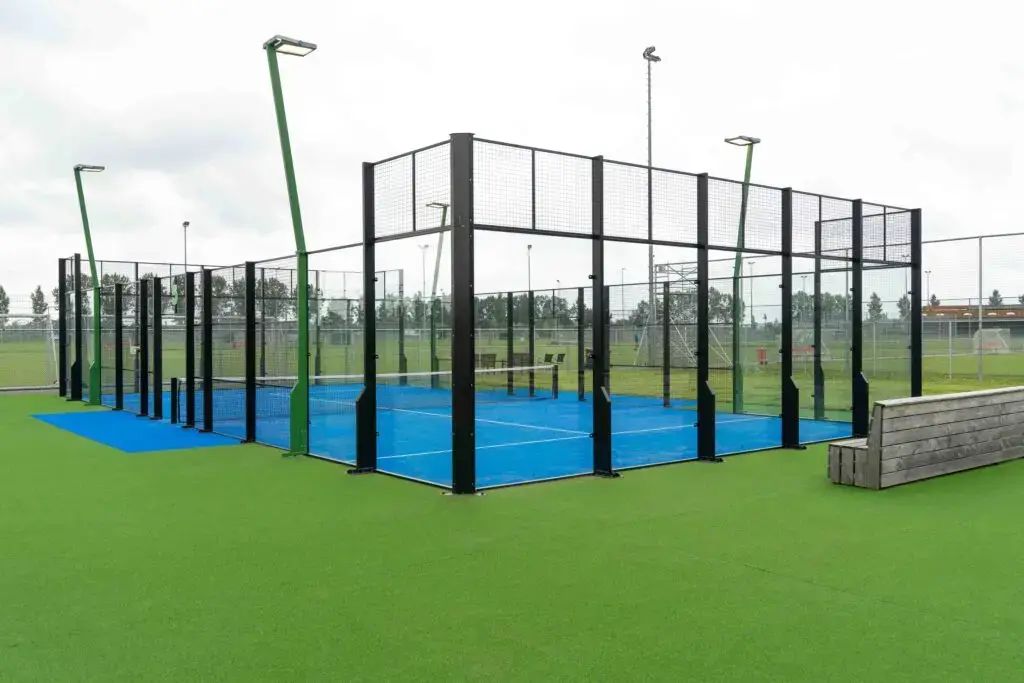
Around the cage structure you need at least 0.5 metres on every side for assembly and access. In practice, a minimum total space of 21 x 11 metres applies per court. The recommended space including run-off zones is 21 x 14 metres. This gives players enough room to move at the short ends and reduces the risk of injury.
The run-off zone at the back of the court is the most relevant: players regularly hit the ball backwards and must then be able to return without immediately running into a wall or fence. In sports complexes with several courts side by side, a minimum spacing of 1.20 metres applies without a run-off zone, or 2.00 metres if you want to include the full run-off zone.
Also allow for space for:
- Access doors on the short sides of the court
- Any technical room for LED lighting and installations
- Walkways for players and spectators
- Storage for equipment such as rackets and balls
What is the difference in space between an indoor and an outdoor padel court?
The playing dimensions of an indoor and an outdoor padel court are identical: 20 x 10 metres. The difference lies in the space you need around it. For an indoor court, the available hall is decisive. For an outdoor court, the foundation, wind load and any noise measures also play a role in the overall space planning.
For an indoor court, clear height is a factor you do not have to consider outdoors: the minimum recommended height is 6 metres. The higher the hall, the better the playing quality. A 6-metre hall is functional, but for professional use more height is desirable. Also check whether columns, skylights or roof structures restrict the playing space.
For an outdoor court you need more space for:
- The foundation, which extends wider than the cage structure itself
- Sound-absorbing panels or noise barriers, which require extra space at the side
- Drainage and water run-off around the court
- Any fencing or screening
In short: the playing dimensions are the same, but the total space requirement at site level is greater for outdoor courts and depends more on the specific situation.
Read more about indoor and outdoor courts here:
How many padel courts fit on a site?
On a site of 1,000 m², four to six courts fit in theory, depending on the layout and the spacing. The practical calculation is: add 21 x 14 metres per court (including run-off zones) and then add walkways and access areas. With an efficient side-by-side layout, you can count on roughly 21 x 12 metres of net floor area per court.
With several courts side by side, a minimum spacing of 1.20 metres applies without a run-off zone. If you want players to be able to move at the side of the court as well, 2.00 metres between the cages is the standard. At the ends of a row of courts you need more space for the full run-off zone.
A practical calculation example for a hall with six courts side by side:
- Six courts of 10 metres wide each: 60 metres
- Five gaps of 2 metres: 10 metres
- Two outer margins of 1 metre: 2 metres
- Total width: approximately 72 metres
- Length including run-off zones: approximately 28 metres
These are indicative dimensions. The exact layout depends on the shape of the site, the position of columns and the desired routing for players and visitors.
How much space is needed for the foundation of a padel court?
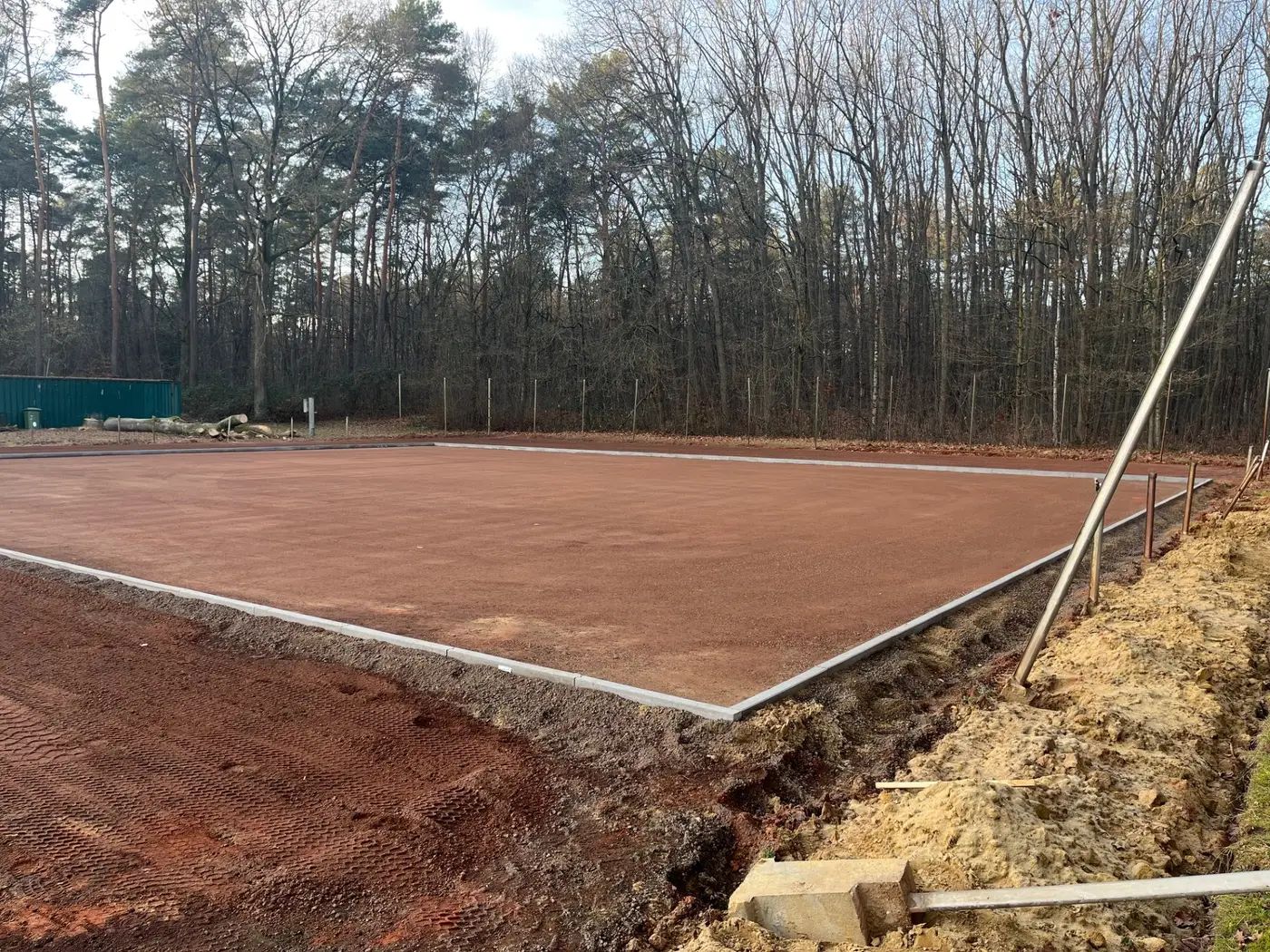
The foundation of a padel court extends slightly beyond the cage structure itself. In most cases, a foundation area is used that projects roughly 0.5 to 1 metre beyond the structure on all sides. The exact dimension depends on the foundation type and the ground conditions at the location.
There are three commonly used foundation types, each with its own spatial implications:
- Drainage concrete: a water-permeable concrete floor that drains rainwater directly through the foundation. Widely used for outdoor courts. The foundation is built slightly wider than the cage structure for a stable connection.
- Supersub: a foundation solution based on foam concrete. Lightweight, self-levelling and quick to pour. Approximately 10 cm thick for renovation, approximately 15 cm for new construction. Requires little extra space at the sides.
- ZOAB asphalt: a porous asphalt variant that lets water through. Less common for padel, but a good option in certain situations.
Besides the foundation area itself, the accessibility of the site is also relevant: machines for groundwork and pouring the foundation need room to manoeuvre. Take this into account when planning, especially on tight sites or in built-up areas.
All foundation components used in the Netherlands must have been approved by Kiwa ISA Sport. This is a requirement for certification and protects you as a client against materials that do not meet the standards.
Read more about the foundation and construction of padel courts here:
Can a padel court also be built on a small or irregular site?
Yes, a padel court can also be built on a small or irregular site, provided the minimum dimensions of 21 x 11 metres are available. For unusual sites, custom work in the structure and foundation is necessary. Standard solutions that you import or buy ready-made do not always fit a site with restrictions.
Irregular sites require a structural calculation for each situation. Think of:
- Sites with deviating ground conditions or differences in height
- Indoor sites with columns, low roof sections or stairwells nearby
- Outdoor sites in open terrain or near buildings, where the wind load differs
- Sites where noise measures are needed, so that the structure requires extra space
A specific point of attention on small sites is noise. If the court stands close to homes or a façade, sound-absorbing panels may be needed. These panels are placed on the outside of the mesh of the cage structure and reduce wind permeability. That means the steel structure has to be structurally reinforced to absorb the extra wind load. This is a technical calculation that has to be made for each location.
In short: a small or irregular site is not automatically an obstacle, but it does require more preparation and custom work than a standard situation.
What does a padel court cost, including fitting out the required space?
The cost of setting up a padel court depends strongly on the court type, the location and the desired finish. As an indication, a turnkey indoor padel court, including steel structure, glass, artificial turf, LED lighting and installation, is possible from approximately €23,000 per court. For an outdoor court including foundation, the guide price starts from approximately €50,000 per court.
Fitting out the space around the court brings additional costs that you should not underestimate:
For outdoor courts, the steel structure is heavier and better protected against the weather, which makes the price higher than for an indoor court. A fixed price for the foundation is hard to give without a site check, because ground conditions and accessibility can differ greatly.
Do you want to know what setting up a padel court at your location costs? At I-Padel we produce the steel structure entirely ourselves, which allows us to price more sharply, structurally, than suppliers who import everything. We guide the entire process from design to completion, including foundation, glass, artificial turf and LED lighting. Take a look at our offer on the page about building padel courts or get in touch for an initial exploration. We are happy to advise you without obligation.
Read more about the costs of Indoor and Outdoor Padel Courts here:
What does an Indoor Padel Court cost?
What does an Outdoor Padel Court cost?
Frequently asked questions
How long does it take to build a padel court from planning to completion?
The lead time differs per situation, but count on an average of 3 to 6 months from initial exploration to completion. The preparation, including the permit process, structural calculations and any acoustic study, often takes the most time. The actual construction of the cage structure and laying of the foundation can in many cases be completed within a few weeks, provided the site is easily accessible and all materials are available.
Do I need an environmental permit to install a padel court?
In most cases an environmental permit is required, certainly for outdoor courts and permanent structures. Whether a permit is needed, and which one, depends on the municipality, the location and the height of the structure. For indoor courts in an existing hall, the permit obligation is often more limited, but fire safety rules or zoning plan changes can also play a role there. Bring in an advisor in good time and check with your municipality what the local requirements are.
Which type of base or artificial turf is most suitable for a padel court?
For padel courts, artificial turf with silica sand infill, specifically developed for padel use, is almost always chosen. This type of artificial turf offers the right grip, ball bounce and wear resistance. The choice of the right pile height and fibre structure depends on the use, indoor or outdoor, and the intensity of play. All artificial turf products used in the Netherlands for certified courts must have been approved by Kiwa ISA Sport.
What are the most common mistakes when planning a padel court on an existing site?
The most common mistake is underestimating the total space requirement: people calculate with the playing dimensions of 20 x 10 metres but forget to include run-off zones, foundation margins and walkways. Another common mistake is starting the permit process too late, so that the schedule slips by weeks or months. Finally, ground conditions are often investigated only late, while poor or uneven ground can have a major impact on foundation costs.
Can I convert an existing tennis court into one or more padel courts?
Yes, a tennis court can in many cases be repurposed well for padel. A standard tennis court of 36 x 18 metres theoretically offers room for two padel courts side by side, including spacing. You do have to take the condition of the existing surface into account: asphalt or concrete can sometimes be reused as a base, but an inspection is necessary to determine whether the foundation is suitable or has to be replaced. Drainage and any differences in height also deserve attention during the conversion.
What about noise nuisance and which measures are possible?
Noise is one of the most underestimated challenges with padel courts, especially at outdoor locations near homes. The hard impact of the ball against glass and steel can be experienced as a nuisance at short distances.
Sound-absorbing panels on the outside of the cage reduce noise emission considerably, but they do require a structurally heavier steel structure because of the extra wind load. In some municipalities an acoustic study is mandatory before a permit is granted; check this with your municipality in good time.
What is the difference between a certified and a non-certified padel court, and does it matter for my situation?
A certified padel court meets the standards of Kiwa ISA Sport and the KNLTB, which is required if you want to organise official competitions or want to join a tennis club that falls under the KNLTB.
For recreational use or a commercial padel location without competition ambitions, certification is not formally mandatory, but it does give certainty about the quality of materials and dimensions. If you choose certified materials and an approved structure, you protect yourself as a client against substandard products and avoid problems during any future inspections.


