


Building a padel court · 6 June 2026 · 12 min read
How much noise does a padel court produce compared to a tennis court?
A padel court produces 91 dB, 10 dB more than tennis. Discover the causes, legal standards and proven measures against noise nuisance.
In this article
- How many decibels does a padel court produce on average?
- Why does a padel court make more noise than a tennis court?
- Which sounds cause the most nuisance on a padel court?
- What are the legal noise standards for a padel court in the Netherlands?
- How effective are sound-absorbing panels on a padel court?
- Which other measures reduce noise nuisance from a padel court?
- Does a padel court need to apply to the municipality for a noise study?
- Frequently asked questions
A padel court makes more noise than a tennis court. That is not an opinion, but a measurable fact. The source noise of a padel court averages around 91 dB, while a tennis court comes in at about 81 dB. That 10 dB difference sounds small, but in practice it means a padel court is perceived as roughly twice as loud. For clubs and operators who want to build a padel court near residential buildings, noise nuisance is therefore one of the first topics to take seriously.
Fortunately, good solutions are available. In this article we explain where the noise comes from, what the rules are and which measures really help.
How many decibels does a padel court produce on average?
A padel court produces an average sound power level of around 91 dB. By comparison, a tennis court averages around 81 dB. The 10 dB difference seems technically small, but in terms of sound perception every 10 dB means a doubling of perceived loudness. To local residents, a padel court therefore sounds roughly twice as loud as a tennis court.
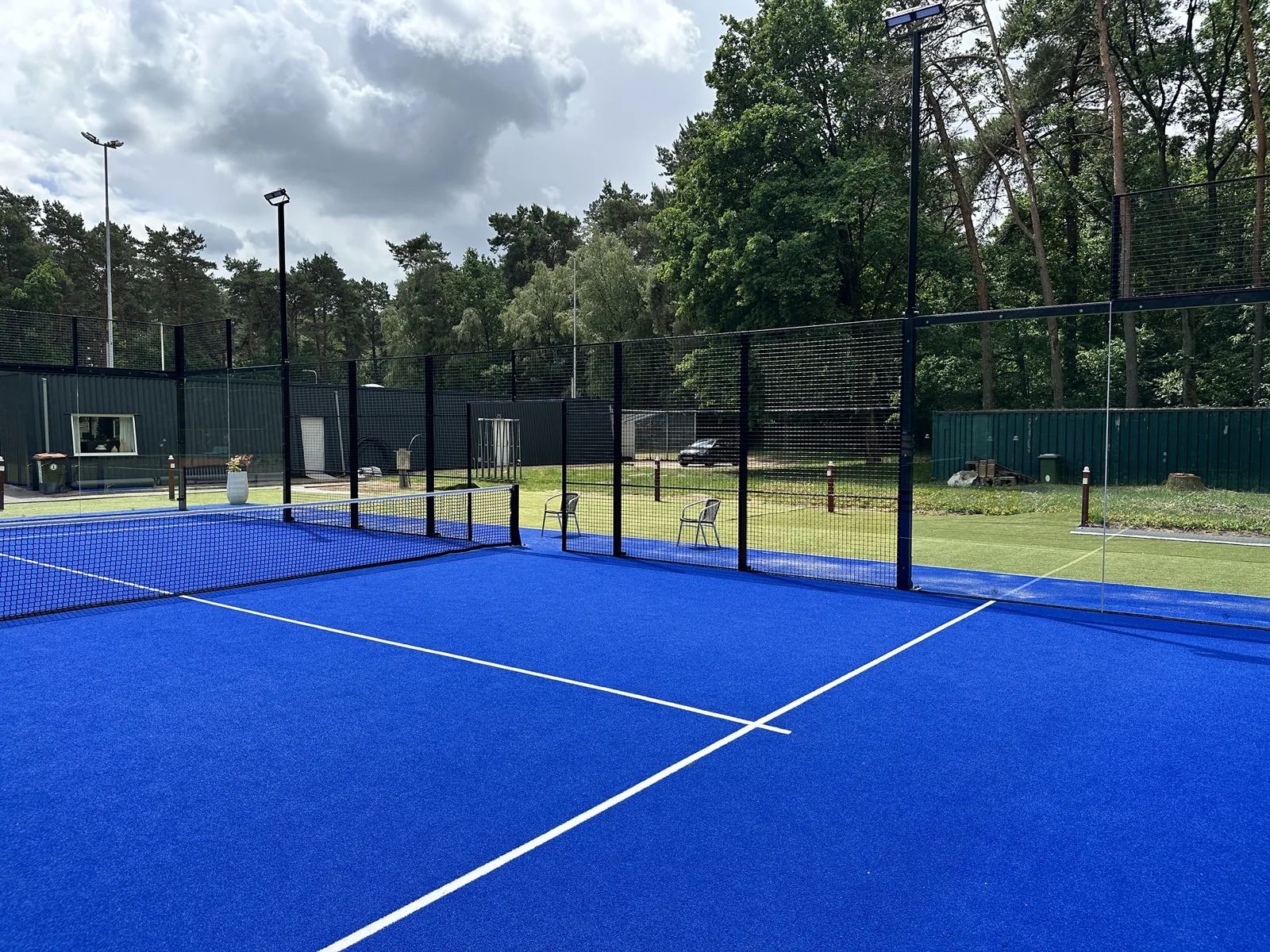
This has to do with the construction of the court itself. Whereas a tennis court is open and sound can dissipate freely, a padel cage functions as an enclosed sound box. Sound is reflected by glass and steel and amplified by the enclosed structure. The result is a higher noise load on the surroundings, especially at short distances from the court.
In practice, the nuisance experienced depends heavily on the location. A court in the middle of a sports park with sufficient distance to homes behaves differently from a court directly bordering a residential area or back garden. The distance to local residents, the presence of buildings that reflect sound and the court's opening hours together determine how great the nuisance is in practice.
Why does a padel court make more noise than a tennis court?
A padel court makes more noise than a tennis court because the glass and steel cage structure amplifies and reflects the sound instead of letting it dissipate. Tennis is played on an open court without enclosing walls. In padel, the ball constantly bounces off glass walls and steel panels, which produces a much higher noise emission.
Three mechanisms play a role here:
- The cage structure as a sound box: The enclosed structure of glass and steel around the court means sound does not dissipate but is reflected back. This considerably amplifies the overall sound level.
- Harder ball contacts: Padel is played with a solid ball that strikes glass walls and steel mesh panels with force. This impact noise is high-pitched and sharp, so it is perceived as more annoying than low, diffuse sound.
- Higher rate of play: Padel is a fast game with short points and many ball contacts per minute. More shots per unit of time also means more noise peaks per unit of time.
The combination of these three factors means that padel structurally produces more noise than tennis, regardless of the players' skill or the intensity of the game.
Which sounds cause the most nuisance on a padel court?
Most noise nuisance from a padel court does not come from the players themselves, but from the ball hitting the glass walls and the steel mesh. This impact noise is impulsive in nature: short, hard bangs that are clearly audible from a distance. It is precisely this type of sound that local residents find most disturbing.
You can roughly divide the noise sources on a padel court into:
- Ball against glass: The hard crack of a padel ball against a glass wall is the dominant sound on a padel court. Glass reflects sound efficiently and produces a sharp peak.
- Ball against steel mesh: Less sharp than glass, but still clearly audible. The mesh vibrates and slightly extends the sound pulse.
- Racket on ball: The sound of the shot itself contributes, but is less dominant than the impact noise from the walls.
- Voices and shouting: Players regularly call out during play. This is particularly relevant in the evening, when the surroundings are quieter.
The impulsive character of the impact noise is an important consideration in noise studies. Impulse noise is weighted more heavily in legislation than continuous background noise. This means a padel court can score relatively poorly in a noise measurement, even if the total sound level is not extremely high in absolute terms.
What are the legal noise standards for a padel court in the Netherlands?
In the Netherlands, padel courts fall under the Activiteitenbesluit (Activities Decree) or the Omgevingswet (Environment and Planning Act), depending on the situation and the type of facility. The applicable noise standards are generally 50 dB(A) during the day, 45 dB(A) in the evening and 40 dB(A) at night, measured at the façade of the nearest home. Municipalities can deviate from these through tailor-made regulations.
What this means in practice differs per location. A court 100 metres from the nearest home generally meets the standards with ease. A court 20 metres from a residential area is a different story. The distance to homes is the most important determining factor, alongside the opening hours and the number of courts.
When is an acoustic study mandatory?
When applying for an environmental permit for an outdoor padel court, an acoustic study is almost always mandatory if the court is within earshot of homes. On the basis of this study, the municipality assesses whether the court meets the noise standards and whether additional measures are needed.
Indoor padel courts in an existing hall do not always have to submit a separate noise study, but here too: as soon as the hall borders residential buildings or the noise situation is unclear, the municipality will almost certainly ask for one. So always expect to include this in your permit process.
How effective are sound-absorbing panels on a padel court?
Sound-absorbing panels are a proven and effective measure against noise nuisance on a padel court. They are fixed to the outside of the steel mesh of the cage structure and absorb sound instead of reflecting it back. Independently tested in an acoustic laboratory, they achieve an absorption value of 0.80 (class A) and a sound insulation index of 19 dB.
In practice, this results in a clearly audible reduction at distances of around 40 to 100 metres from the court. That is precisely the zone where local residents experience the most nuisance. The panels can be applied on one or several sides of the court, in the lower and upper metres of the cage, or across several courts at once.
What are the structural consequences of sound-absorbing panels?
Here is a point many people overlook: sound-absorbing panels reduce the wind permeability of the cage structure. That sounds technical, but the consequence is concrete. Where wind would normally blow through the mesh, the structure with panels catches more wind pressure. This considerably increases the load on the steel structure.
The cage structure must therefore be structurally reinforced before panels are installed. This is not optional, but a safety requirement. The reinforcement consists of heavier posts, additional columns or modified connections, depending on the wind zone and the location. A supplier who does not include this in the calculation creates an unsafe situation. Always have this structurally calculated.
Panels can also be installed afterwards on existing courts, but then a structural recalculation of the existing cage structure is always the first step.
Which other measures reduce noise nuisance from a padel court?
Besides sound-absorbing panels, there are several measures that reduce noise nuisance from a padel court. The most effective are a noise barrier next to or around the court, a smart choice of location and orientation of the court, limited opening hours and a sound-dampening foundation. A combination of measures is often the most effective.
Noise barriers
A noise barrier is a freestanding structure placed next to the court that blocks sound heading towards homes. Noise barriers can be up to 6 to 8 metres high and tens of metres long. They work over greater distances than panels and are particularly effective when the court is close to homes in an open environment.
Noise barriers always require an environmental permit, because they are classed as a structure. They can be built with coconut fibre or green screening on which climbing plants grow, which makes them more acceptable to the municipality and local residents and contributes to biodiversity.
Location and orientation
The orientation of the court on the site makes a big difference. By positioning the court so that the glass back walls do not face directly towards homes, you reduce the noise load at the most sensitive points. This costs nothing extra, but requires a deliberate choice in the design phase.
Sound-dampening foundation
Some foundation types contribute to sound damping. Supersub, a foundation solution based on foam concrete, has a shock-absorbing and sound-dampening effect. Drainage concrete, with its porous structure, also has some sound-absorbing properties. This contribution is limited, but can count towards an overall solution.
Does a padel court need to apply to the municipality for a noise study?
For an outdoor padel court near homes, an acoustic study is almost always mandatory with the permit application. The municipality requests this study as standard as part of the environmental permit. Without this study, the permit is generally not granted. For indoor padel courts in an existing hall it depends on the situation, but if in doubt, always expect to need one.
The noise study maps out how much noise the court produces at the façades of surrounding homes and whether this falls within the legal standards. If it does not, you must demonstrate which measures you are taking to meet the standards after all. The municipality takes this into account when assessing the permit.
A noise study is carried out by an accredited acoustic firm. The results are part of the complete permit file, which for an outdoor padel court also includes structural calculations, a lighting study and a site plan. Depending on the location, an ecological or archaeological study may also be needed.
Building without a permit is not an option. The municipality can stop the project, impose a fine or require the cage structure to be removed. The costs and delay this causes are many times higher than a carefully followed permit process.
At I-Padel we guide the entire process from permit application to completion. We coordinate the noise study, supply the structural calculations and think along with you about the best noise solution for your site. Want to know what your project involves? Get in touch for an initial exploration and we will think along with you, without obligation.
Frequently asked questions
How many courts can I build before noise nuisance becomes a real problem?
There is no fixed maximum, but every additional court increases the noise load on surrounding homes. With two or more courts side by side, the combined sound level increases by around 3 dB for each doubling of the number of courts. An acoustic study must always calculate the entire complex, not a single court in isolation. Take this into account in the planning phase, so that you can size the measures to the final situation.
What if my padel court has already been built but local residents are now complaining about noise nuisance?
Start by having an acoustic measurement carried out by an accredited firm to determine whether the court actually exceeds the legal standards. If it does, you can still have sound-absorbing panels installed, limit the opening hours or add a noise barrier. Also make sure you talk to local residents; early communication prevents escalation to the municipality or the courts. Intervening afterwards is more expensive and more complex than planning well in advance, but it is certainly not too late.
Does it matter at what height the sound-absorbing panels are installed?
Yes, the installation height affects effectiveness. Most impact noise arises in the lowest two to three metres of the cage structure, where the ball hits the walls most often. Panels in the lower metres therefore have the greatest impact on noise reduction. For an optimal result, panels are often combined across both the lower and upper zones of the cage, depending on the specific noise situation and the direction of the nearest homes.
Can I assess myself whether my location is feasible without immediately commissioning an expensive study?
You can get a first indication yourself by measuring the distance to the nearest homes. If that distance is more than 100 metres and there are no directly reflecting buildings between the court and the homes, there is a good chance you will stay within the standards.
If the court is closer to homes, a quick scan by an acoustic consultant is a good intermediate step before a full study. Many acoustic firms offer a short indicative calculation that quickly provides clarity without the full cost of a formal report.
How long does a permit process for an outdoor padel court take on average?
Allow for a lead time of three to six months for a regular environmental permit, including the acoustic study, structural calculations and the municipality's assessment period. If the municipality asks for additional studies, such as an ecological or archaeological study, this can extend to nine months or longer. Start preparing early and make sure all studies have already been set in motion before you formally submit the permit application. A complete file at the first submission prevents delay caused by repeated requests for information.
Are there specific times when a padel court causes the most nuisance for local residents?
Yes, the evening hours between 19:00 and 23:00 are the most critical. During that period the ambient sound level is lower, so the noise from the padel court comes across as relatively louder against the background.
In addition, stricter legal standards apply in the evening (45 dB(A) instead of 50 dB(A) during the day). Busy weekend mornings can also be sensitive in residential areas. Limiting the evening opening hours is therefore often the quickest and cheapest measure to reduce complaints.
What is the difference between sound absorption and sound insulation, and which do I need for a padel court?
Sound absorption means that a material takes up sound and converts it into heat, so that less sound is reflected back into the surroundings. Sound insulation means that a material prevents sound from passing from one side to the other.
For a padel court you primarily need sound absorption: you want to prevent sound from being reflected by the cage structure and spreading into the surroundings. Good sound-absorbing panels combine both properties, which explains why they have both an absorption value (0.80, class A) and an insulation index (19 dB).


