Blog · 29 August 2026 · 12 min read
How much does the location of a padel court affect noise nuisance?
The location of a padel court determines how much noise nuisance local residents experience. Discover which factors count and which measures help.
In this article
- Which location factors determine how much noise local residents hear?
- How does wind direction affect the noise of a padel court?
- Does it matter whether a padel court is indoor or outdoor?
- How far must a padel court be from homes to prevent nuisance?
- When is an acoustic study mandatory for an outdoor padel court?
- What are effective measures if the location is unfavourable?
- Not sure whether outdoor padel is feasible at your location?
- Frequently asked questions
The location of a padel court has a major influence on how much noise nuisance local residents experience. Factors such as the distance to homes, the wind direction, the open or built-up surroundings and the orientation of the court together determine to what extent padel noise is experienced as a nuisance. There is no universal threshold value: every location requires its own assessment. The questions below give you insight into the most relevant location factors and what you can do about them.
Which location factors determine how much noise local residents hear?
The amount of noise local residents hear from a padel court is determined by a combination of factors: the distance between the court and the nearest home, the presence of buildings or planting that dampen noise, the orientation of the court relative to sensitive facades and the openness of the site. None of these factors works on its own; it is always the combination that determines the result.
Padel produces mainly impulsive noise: short, sharp peaks that arise when racket and ball make contact, but also when the ball hits the glass and the fencing of the cage structure. The latter plays the largest role in the nuisance experienced. The cage structure acts as a resonance box that amplifies the sound and radiates it in all directions.
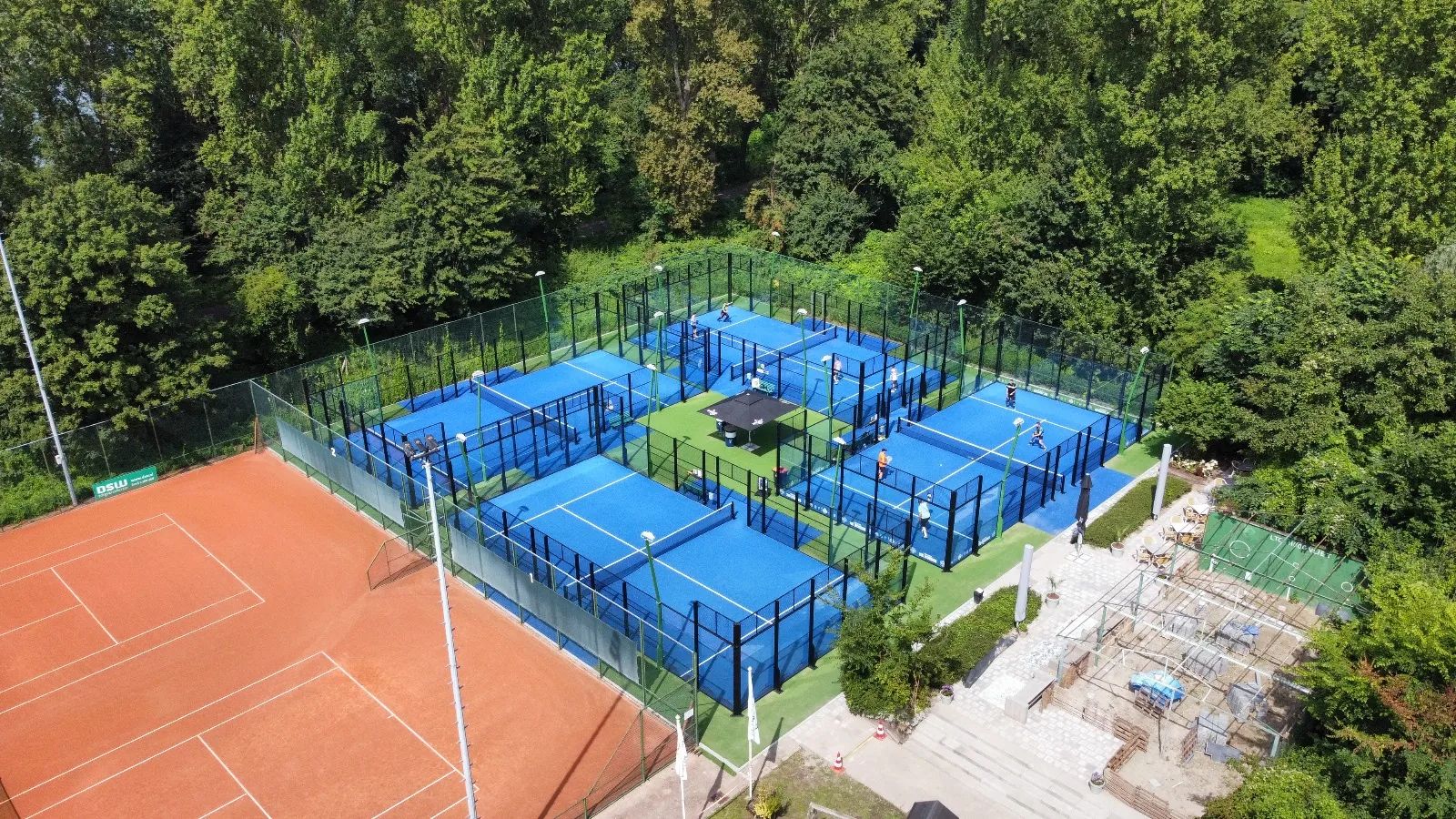
An open, flat site without buildings in the surroundings leads to a greater spread of noise than a location that is partly enclosed by buildings or trees. Buildings and planting can break, absorb or deflect sound waves. A padel court bordering a residential neighbourhood without any screening will, at the same distance, cause more nuisance than a court that is partly protected by a building or a row of trees.
Elevation also plays a role. A court that lies lower than the surrounding homes spreads noise differently from a court at the same or a greater height. The same applies to the presence of hard reflective surfaces in the surroundings, such as walls, facades or paving, which can reflect noise towards homes.
How does wind direction affect the noise of a padel court?
Wind direction influences the spread of noise. Wind blowing towards homes can carry noise further than wind blowing away from them. This effect is relevant for padel courts because the sound power level is relatively high: the average sound power level of a padel court is around 91 dB, which is roughly 10 dB higher than with tennis.
The prevailing wind direction at a location is therefore a factor that can be taken into account when positioning the court. When the prevailing wind at a location blows towards homes, it can make sense to orient the court so that the sides producing the most noise do not face directly in that direction. In practice this is not always possible because of spatial limitations, but it is a consideration that deserves attention in the early planning phase.
Wind direction also plays a structural role. A location with a lot of wind, such as an open site or a coastal location, places higher demands on the steel structure. When sound-absorbing panels are applied, the wind permeability of the cage structure decreases. This creates extra wind load on the structure, which has to be calculated. This is a technical aspect where the structure and wind load are always assessed on a project-specific basis.
Does it matter whether a padel court is indoor or outdoor?
Yes, it makes a big difference. An indoor padel court stands in an enclosed hall, so the noise largely stays inside the space. Noise nuisance for local residents is in most cases not a relevant point of attention with indoor courts, unless the hall itself is insufficiently insulated. With an outdoor padel court, the noise spreads freely into the surroundings, which, when the court is near homes, can lead directly to complaints.
Outdoor padel courts are also a different category for other reasons. The steel structure must withstand the weather, the foundation is more complex and the permit requirements are stricter. Noise is one of the most decisive factors in the permit process. Municipalities increasingly set additional requirements on noise levels at new outdoor padel locations, especially when these border residential areas.
When placed in an existing hall, indoor courts do not always require a separate building permit, depending on the situation. Outdoor courts require an environmental permit in almost all cases, including an acoustic study. For many clubs and operators this distinction is a decisive factor in the choice between indoor and outdoor.
How far must a padel court be from homes to prevent nuisance?
There is no fixed minimum distance that applies in all situations. The distance required depends on the sound power level, the surroundings, the noise measures applied and the applicable noise standards in the zoning plan or environmental plan concerned. An acoustic consultant determines, on the basis of calculations, which distance is needed in a specific situation to meet the standards.
What is certain is that padel produces more noise than most other outdoor sports. The average sound power level of around 91 dB means that, without additional measures, a considerable distance may be needed to stay below the applicable limit values at the facade of homes. At locations close to residential buildings, an acoustic study is almost always mandatory and necessary to assess feasibility.
When the space available is limited, noise measures can reduce the distance required. Integrated sound-absorbing panels work as a source measure: they dampen the noise directly at the court, so less noise reaches the surroundings.
In the practical measurement at LTC Hofgeest, an indicative noise reduction of around 3 dB(A) was measured within the configuration studied, after correction for background noise. These results apply only to the situation studied and must not be regarded as a generally valid result. You can read more about the possibilities on the page about acoustic solutions for padel.
When is an acoustic study mandatory for an outdoor padel court?
For outdoor padel courts, an acoustic study is in most cases mandatory as part of the permit application, especially when the location is near homes or other noise-sensitive uses. Based on the study, the municipality assesses whether the padel court meets the applicable noise standards from the environmental plan or the environmental permit.
In practice, almost every outdoor padel court built in or near a residential area requires an acoustic study. Even when the location seems at first sight to have sufficient distance, the municipality may ask for one. It is wise to have this carried out early in the planning process, so that any bottlenecks come to light in time and the plans can still be adjusted.
The acoustic study is carried out by an independent acoustic consultancy. That consultancy assesses the noise situation on the basis of the location, the distance to homes, the expected intensity of use and the noise measures present or planned. I-Padel does not carry out acoustic studies itself, but supplies the technical product specifications, structural data and engineering needed to carry out the calculations correctly. For more information on applying for a permit for a padel court, including the documents required, we refer you to the permit page.
What are effective measures if the location is unfavourable?
When the location is unfavourable because of the proximity of homes, an open site or limited space available, several measures are possible. Which measure is most suitable depends on the project-specific situation and the results of the acoustic study.
Integrated sound-absorbing panels
Sound-absorbing panels are fixed to the outside of the cage structure and work as a source measure: they dampen the noise directly at the court. Because the panels become part of the overall structure, the extra wind load caused by the reduced wind permeability must be taken into account during the engineering phase.
The structure must be recalculated for this. The panels can be applied on one or more sides of the court, depending on the direction of sensitive receivers. You can read more about how they work and how they can be applied on the page about acoustic solutions for padel.
Noise barriers
A noise barrier is a free-standing structure placed next to or around the padel court. Unlike panels, a noise barrier works at a greater distance and screens noise towards homes. Noise barriers can be built to heights of 6 to 8 metres and can also be applied in combination with sound-absorbing panels.
That combination can in some situations allow a lower barrier, which can limit the costs and simplify the permitting process. A drawback is that a noise barrier requires more space and almost always requires an environmental permit. You can read more about how it works and how it is built on the page about having a padel court built with a noise barrier.
Site layout and orientation
Besides technical measures, the layout of the site can also help limit noise nuisance. By positioning the court so that the sides producing the most noise do not face sensitive facades directly, the noise load can be reduced. Existing buildings, planting or differences in height on the site can be used as natural screening. This kind of measure calls for a good site analysis at an early stage of the project.
None of these measures works in the same way in every situation. The right approach is always determined on the basis of the location, the surroundings, the distance to homes and the results of an independent acoustic study.
Not sure whether outdoor padel is feasible at your location?
We are happy to think along with you on the court configuration, structural preparation and possible noise measures. Together with your acoustic consultant, we look at which solution is technically feasible and suits the project. Get in touch via the page on acoustic solutions for padel for an initial, no-obligation exploration.
Frequently asked questions
Can I judge for myself whether my location is acoustically feasible, or do I always need a consultant?
You can make an initial rough estimate yourself based on the distance to homes, the openness of the site and the presence of natural screening such as buildings or planting. But for a reliable assessment, and certainly for a permit application, you always need an independent acoustic consultancy. They calculate, on the basis of the sound power level, the location characteristics and the applicable standards, whether your situation is feasible and, if so, which measures may be needed.
What if the acoustic study shows that my location does not meet the standards: is the project then automatically off?
Not necessarily. A negative outcome of an initial calculation means that the standards are not met without additional measures, but that is often the starting point for an adjustment of the plan.
Noise measures such as sound-absorbing panels, a noise barrier or a different court orientation can still improve the situation sufficiently. It is precisely valuable to have the study carried out early in the process, so that there is still room to adjust the design before irreversible decisions have been made.
Do the times at which the padel court is used matter for the permit?
Yes, hours of use are a relevant factor in the acoustic assessment. Noise standards in the Netherlands are generally stricter in the evening hours and on Sundays than during the day on weekdays. A padel court that is in use until 11 p.m. will have to meet stricter limit values than a court that is only played on during the day. The expected intensity of use and the opening hours are therefore included in the acoustic study and can determine which measures are necessary.
Do sound-absorbing panels look different from standard cage panels, and does that affect the permit?
Sound-absorbing panels have a different appearance from standard glass or fencing panels and are generally less transparent. This can affect the aesthetic assessment (welstandsbeoordeling) in the permit application, especially in areas where aesthetic requirements apply. It is wise to inform the municipality early about the intended use of materials and, if necessary, to include a sketch design with the permit application, so that there are no surprises in the assessment phase.
What is the difference between a source measure and a transmission-path measure, and which is more effective?
A source measure, such as sound-absorbing panels on the cage structure, reduces the noise directly at the source, before it spreads. A transmission-path measure, such as a noise barrier, intercepts the noise on the way between source and receiver.
Source measures are generally regarded in acoustics as the most effective, because they lower the total noise emission. In practice both types of measure are also combined, which in some situations allows a lower noise barrier and thereby can limit both costs and use of space.
How do I deal with objections from local residents before the permit has even been applied for?
Early communication with local residents can prevent many objections at a later stage. By informing residents at an early stage about the plans, the intended location and the measures being taken to limit noise nuisance, you create support and prevent surprises. An independent acoustic report that demonstrates that the standards are met is a strong communication tool in this. Some municipalities even make participation with local residents a condition of the permit application.
Can an existing padel court still be modified if complaints about noise nuisance arise after it has been put into use?
Yes, modifications are also possible for existing courts. In many cases, sound-absorbing panels can be added to an existing cage structure, provided the structure allows this structurally; the extra wind load must be calculated.
In addition, measures such as adjusting the opening hours, placing a noise barrier or adding extra planting can help to reduce nuisance. A new acoustic study after the modifications gives insight into the improvement achieved and can be used towards the municipality or complaining local residents.