


Building a padel court · 16 April 2026 · 10 min read
How many members can an indoor padel venue serve per day?
Discover how many players your indoor padel venue can handle per day. Concrete figures on occupancy, courts and returns to help you invest wisely.
In this article
- How many playing hours does a padel court have available per day?
- How many players fit on one padel court at the same time?
- How many members can one padel court serve per day?
- How many courts does a profitable padel venue need?
- What is the influence of occupancy rate on actual capacity?
- How many square metres do you need per indoor padel court?
- Which factors limit the maximum capacity of a padel venue?
- Frequently asked questions
An indoor padel venue can serve more players per day than most operators estimate beforehand. Work it out carefully and you will see that even a single padel court can generate considerable revenue. But how many members or customers you can serve per day depends on a combination of factors: the number of available playing hours, the occupancy rate and the scale of your venue. This article gives you concrete figures to make a sound estimate for your situation.
How many playing hours does a padel court have available per day?
In theory, a padel court has between 14 and 16 playable hours available per day, if you count from early in the morning until late in the evening. In practice, an operating window from 07:00 to 23:00 is realistic, which comes to 16 hours. There is one 60-minute playing slot per hour, so you have a maximum of 16 slots per court per day.
Not every hour is equally valuable. Peak hours are usually between 17:00 and 22:00 on weekdays, and all day at weekends. Outside peak hours, slots are harder to fill. For calculating your daily capacity, it is therefore useful to distinguish between peak and off-peak hours. A realistic operation allows for 10 to 12 occupied slots per court per day, depending on the offering and target group of your venue.
How many players fit on one padel court at the same time?
Exactly four players play on one padel court at the same time. Padel is a doubles sport in which two teams of two people play against each other. A 60-minute playing slot is always occupied by four participants, no more and no less. That is a fixed given, regardless of the type of court or the location.
This makes the capacity calculation relatively simple: the number of players per day is always a multiple of four. If you want to know how many people your venue can handle, multiply the number of occupied slots by four. A court with ten occupied slots per day therefore serves forty players. That sounds limited, but scale up to several courts and the numbers quickly add up.
How many members can one padel court serve per day?
At a realistic occupancy of ten slots per day, one padel court can serve a maximum of 40 unique players. If you assume an average playing frequency of twice a week per member, you can serve an active membership base of 140 to 160 people with one court. This is a rough indication; the actual capacity depends heavily on how you manage the schedule.
At full occupancy of 16 slots per day, you arrive at 64 players. But an occupancy rate of 100% is not achievable in practice. Off-peak hours remain partly empty, maintenance takes time and not every member plays equally regularly. A realistic, well-managed venue achieves an occupancy rate of 60 to 75% at peak times.
What does this mean for a membership model?
If you work with a fixed membership in which members may reserve a certain number of hours per week, it is important to factor the spread across the week into your calculation. Members who only want to play in the evening peak create a bottleneck. By also offering attractive rates or programmes for off-peak hours, you increase the effective capacity of your venue without building extra courts.
How many courts does a profitable padel venue need?
A profitable indoor padel venue needs at least four courts in most cases. With fewer courts, the fixed costs for staff, rent and infrastructure are hard to earn back. Four courts give you the scale to make good use of peak hours, serve several groups at the same time and build a recognisable offering.
Larger venues with six to eight courts benefit from economies of scale: the cost per court falls, you can organise leagues and clinics, and the venue also attracts corporate renters. For a first investment, four courts are a solid starting point. If you also want to offer training, tournaments or corporate packages, six courts are a better basis.
From the perspective of investment and returns: the more courts you fill efficiently, the faster the investment is paid back. A court that structurally runs 10 slots per day at an average rate of €20 per slot generates €200 per day, or well over €70,000 per year. With four courts, that rises to €280,000 gross revenue per year, not counting additional income from lessons and hospitality.
What is the influence of occupancy rate on actual capacity?
The occupancy rate largely determines the difference between theoretical and actual capacity. A court with 16 available slots per day but an occupancy rate of 50% serves only 32 players. At 75% occupancy, that rises to 48 players per day. Optimising the occupancy rate therefore has more effect on your returns than adding an extra court.
Factors that positively influence the occupancy rate include a good booking system, an active membership base, attractive rates for off-peak hours and a strong programme offering. Venues that actively focus on group lessons, corporate leagues and regular playing groups achieve higher occupancy rates than venues that rely purely on one-off court rentals.
When is an occupancy rate healthy?
An occupancy rate of 60 to 70% across all hours is seen in the industry as a healthy level. Higher percentages are possible, but call for active management and a varied offering. Below 50%, it is difficult to cover the operating costs, unless the fixed costs are particularly low.
How many square metres do you need per indoor padel court?
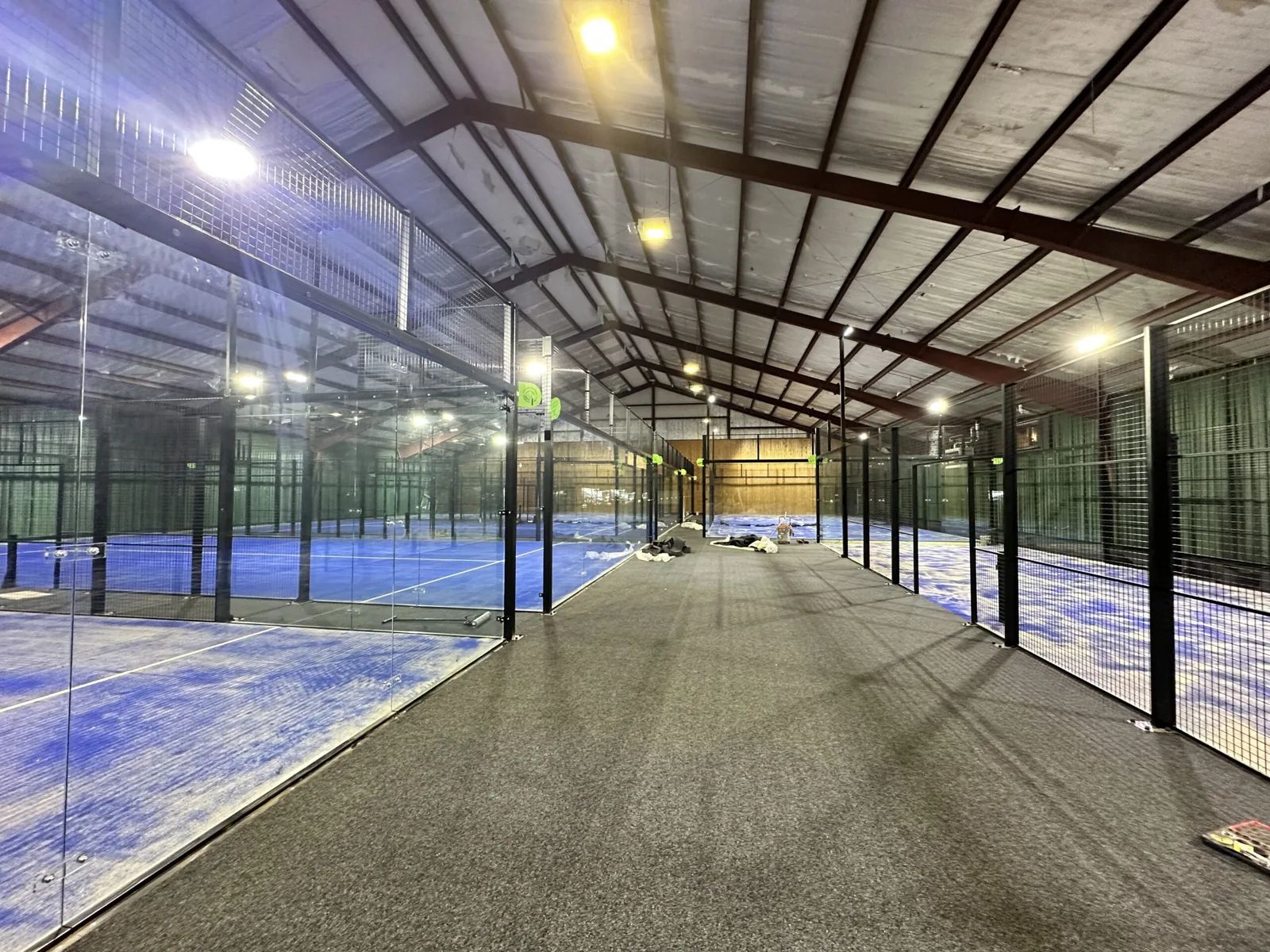
For each indoor padel court you need at least 21 by 11 metres of floor space, which comes to around 231 square metres. This is the minimum installation space for the cage structure itself. For a comfortable playing experience with enough run-off space, 21 by 14 metres is recommended, which comes to around 294 square metres per court.
The playing area of the padel court itself is 20 by 10 metres. The extra metres around the court are needed for the safety of the players and for installing the structure. When calculating your total hall area, also don't forget to include walkways between courts, changing rooms, a reception and any hospitality. For a venue with four courts, you quickly need 1,500 to 2,000 square metres of total floor area.
As for height: the minimum clear height for an indoor padel court is 6 metres. This is a hard lower limit. A higher hall, for example 7 or 8 metres, improves playing quality and gives more room for high balls, which makes a difference especially for advanced players.
Which factors limit the maximum capacity of a padel venue?
The maximum capacity of a padel venue is limited by the number of courts, the available playing hours, the occupancy rate and the supporting facilities. Even a venue with many courts grinds to a halt if there are too few changing rooms, the booking system does not work or parking is inadequate. Capacity is more than just the number of available playing slots.
Concrete limiting factors are:
- Number of courts: the absolute ceiling of your playing capacity
- Peak-hour pressure: if everyone wants to play between 18:00 and 21:00, there will always be scarcity
- Changing room space: too few changing rooms slow down the flow between slots
- Lighting quality: poor LED lighting discourages use in the evening hours
- Parking: a shortage of parking spaces discourages visits in busy periods
- Booking management: without a good system, no-shows and inefficient occupancy arise
Besides these operational factors, the quality of the floor and the structure also play a role in the long term. An artificial turf floor that does not meet the sports-technical standards of NOC*NSF leads to complaints about ball behaviour and playing comfort, which negatively affects the occupancy rate.
All artificial turf products used in the Netherlands must meet the approval requirements of Kiwa ISA Sport and be on the sports products list. This sounds technical, but it protects you as an operator against materials that look cheap on paper but cause problems in the long term.
Do you want to work out your venue's capacity properly before you invest? At I-Padel, we are happy to think along with you, without obligation, about building padel courts that suit your space, target group and operating model. Get in touch for an initial exploration.
Frequently asked questions
How can I increase the occupancy rate of my padel venue during off-peak hours?
The most effective approach is to offer attractive off-peak rates combined with a targeted programme offering, such as group lessons, beginner clinics or corporate packages. Also think of regular playing groups that you actively link to off-peak slots, so that you build a stable occupancy outside the evening peak. A loyalty programme in which members get a discount when they book outside peak times can also make a big difference.
What are the most common mistakes when planning the capacity of a new padel venue?
A common mistake is calculating only with theoretical maximum capacity, without taking peak-hour pressure and the realistic spread of reservations into account. Many operators also underestimate the impact of supporting facilities: too few changing rooms, insufficient parking or a poor booking system can severely limit effective capacity, even if there are enough courts. Always plan from a realistic scenario of 60–75% occupancy and make sure the facilities around the courts are in balance with that.
When is it smart to expand from four to six or more courts?
Expansion makes sense as soon as you structurally achieve an occupancy rate of 75% or higher over several weeks and regularly have to turn down reservation requests because of full bookings. That is the signal that demand exceeds your current offering. When expanding, also take into account the additional revenue sources that more courts make possible, such as tournaments, leagues and corporate rentals, which can considerably shorten the payback period.
Which booking system is suitable for an indoor padel venue?
Popular and proven options for padel venues are Playtomic, CourtReserve and Sportbooker, all of which were developed specifically for racket and padel sports. A good system offers online booking, automatic payment processing, no-show management and insight into occupancy statistics. Choose a system that integrates with your membership management, so that you can apply off-peak promotions and membership rights automatically without manual work.
How does the quality of the artificial turf floor affect the commercial operation of a padel court?
An artificial turf floor that does not meet the NOC*NSF standards and the approval requirements of Kiwa ISA Sport leads to complaints about ball behaviour, an increased risk of injury and lower playing quality, which translates directly into a falling occupancy rate and negative word of mouth. Cheaper materials that are not on the sports products list look attractive in the short term, but can lead in the long term to replacement, reputational damage and legal liability. Always invest in certified material that demonstrably meets the applicable sports-technical standards.
Is a membership model or one-off court rental more profitable for a padel venue?
Both models have advantages, but a combination works best in practice. A membership model gives you predictable, recurring income and a loyal customer base, while one-off court rental offers flexibility for occasional players and corporate renters. Many successful venues use a hybrid approach: members get priority bookings and a reduced rate, while slots that are not booked remain available for one-off rental at a higher rate.
How many parking spaces are needed for an indoor padel venue with four courts?
As a rule of thumb, you allow at least one parking space per playing player, which with four courts comes to at least 16 simultaneous parking spaces. In practice, it is wise to plan 20 to 25 spaces, because players often arrive a little earlier and leave later than their playing slot, so the peak in parking demand is greater than the number of simultaneous players. Insufficient parking is one of the most underestimated reasons why visitors drop out, especially in busy evening hours.


