


Building a padel court · 30 March 2026 · 12 min read
How long does it take to convert a tennis court into a padel court?
Converting a tennis court to padel? Installation takes 3–4 days, the whole process 10–12 weeks. Discover costs, permits and smart planning.
In this article
- What does converting a tennis court into a padel court involve?
- How long does it take to convert a tennis court into a padel court?
- Which factors determine how long the conversion takes?
- Can the existing foundation of a tennis court be reused?
- How many padel courts fit on one tennis court?
- What are the costs of a conversion to a padel court?
- Do you need a permit to convert a tennis court?
- Frequently asked questions
Converting a tennis court into a padel court is a smart move for tennis clubs and sports facilities that want to tap into the growing popularity of padel. The conversion takes an average of 3 to 4 days for the installation itself, but the total process, from the first conversation to the finished court, usually takes 10 to 12 weeks.
In this article you will read exactly what a conversion involves, which factors influence the lead time and what you can expect in terms of costs and permits.
Whether you are the chair of a tennis club that wants to attract younger members, or the owner of a sports facility that wants to start a new branch: the information below will help you go into the conversation with a padel builder well prepared.
What does converting a tennis court into a padel court involve?
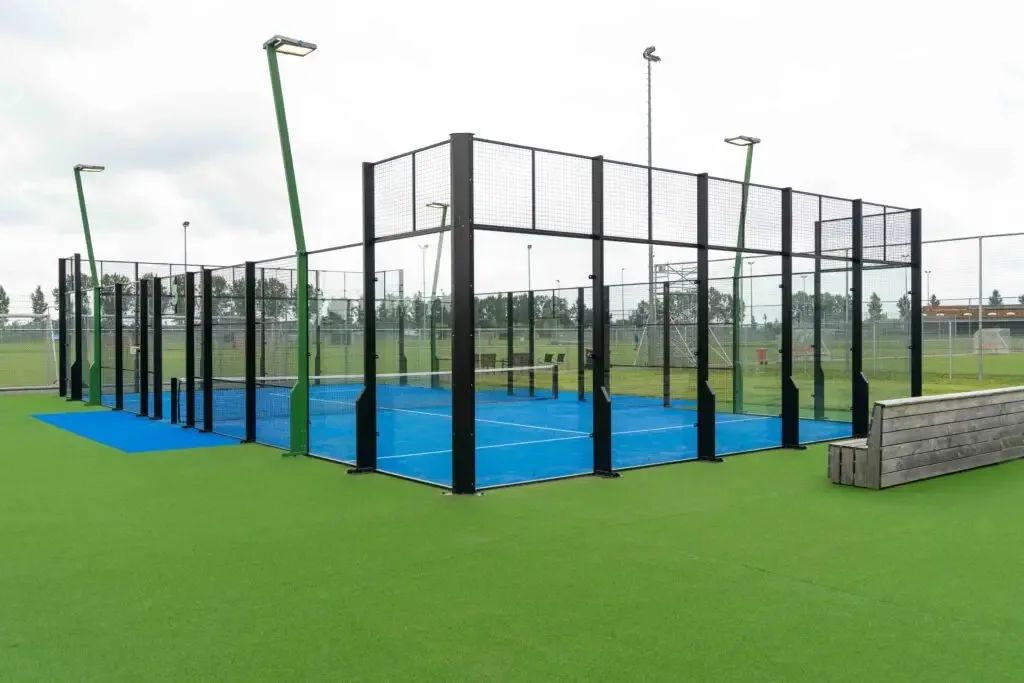
Converting a tennis court into a padel court is the process in which an existing tennis surface is turned into one or more full-size padel courts. This includes removing the existing surface, assessing whether the foundation can be reused, laying a new sports base, installing the steel structure with glass and mesh, laying artificial turf and installing LED lighting.
A padel court has fixed dimensions of 20 by 10 metres, including a cage structure of glass and mesh around the playing area. A tennis court is considerably larger: the standard is 36 by 18 metres for a single court with run-off space. That area generally fits two padel courts side by side, sometimes even three. The conversion is therefore not just a matter of laying a different surface. The entire infrastructure is laid out afresh.
The process consists roughly of the following steps: demolition and removal of the existing surface, foundation assessment and any adjustment, construction of the new sports base, installation of the steel structure, installation of the glass, laying the artificial turf and finally the LED lighting. Depending on the situation, a permit procedure and an acoustic study are added to this.
How long does it take to convert a tennis court into a padel court?
Installing a padel court takes 3 to 4 days per court. The total project, including production of the steel structure, delivery and all preparatory work, takes an average of 10 to 12 weeks. Where a permit is needed, a further 8 to 12 weeks come on top of that.
It is important to distinguish between construction time and total project lead time. The physical installation on site goes relatively quickly: the cage structure is up in two days, the artificial turf is laid in one to two days. But before the first screw goes into the ground, weeks have already passed in production, planning and possibly permit granting.
What takes the longest in the whole process?
In most cases the permit procedure is the biggest time factor. An environmental permit for an outdoor court has a statutory processing time of 8 to 12 weeks, but in practice this can take longer if there are objections or additional research requirements. Anyone who wants to start quickly is wise to start the permit procedure as early as possible, preferably in parallel with the design phase.
Production of the steel structure also takes time, especially if custom work is needed for the specific location. Allow for a production time of a few weeks, depending on the schedule and the number of courts produced at the same time.
Which factors determine how long the conversion takes?
The lead time of a conversion is determined by five factors: the condition of the existing foundation, the permit procedure, the soil conditions, the number of courts to be built and the availability of the location. Each of these factors can extend the schedule or speed it up.
- Condition of the foundation: If the existing tennis court foundation can be reused, that saves considerable time and cost. If demolition and new construction are needed, that adds several weeks to the process.
- Permit procedure: For outdoor courts an environmental permit is almost always mandatory. The processing time averages 8 to 12 weeks. For locations near residential areas an acoustic study is also mandatory, which takes extra time.
- Soil conditions: Cone penetration tests are used to determine which type of foundation is most suitable. With poor soil conditions, additional groundwork may be needed.
- Number of courts: Building several courts at the same time is more efficient than one court at a time, but it does require more preparation and logistical coordination.
- Availability of the location: Seasonal planning at tennis clubs can limit the start date. If you want to play in spring, you have to start preparing in autumn.
Can the existing foundation of a tennis court be reused?
Yes, the existing foundation of a tennis court can be reused in some cases, but this always depends on the condition, the type of foundation and the soil conditions. Reuse is possible if the foundation is flat, stable and permeable enough for padel. If that is not the case, a new foundation is needed.
A padel court places specific demands on the base. The sports surface must be extremely flat for consistent ball bounce, sufficiently water-permeable to prevent puddles and stable enough to carry the steel structure and glass walls. Older tennis court foundations do not always meet these requirements, especially if there is subsidence, cracking or an asphalt layer that is not water-permeable.
Which foundation types are suitable for padel courts?
Three foundation types are widely used for padel courts. Drainage concrete is a water-permeable concrete floor in which rainwater drains directly through the foundation into the ground. This is a proven solution with an average service life of 25 to 40 years.
Supersub is an innovative variant based on foam concrete: lightweight, self-levelling and both shock-absorbing and water-permeable. In renovations, such as converting a tennis court, Supersub is often applied at a thickness of approximately 10 centimetres. ZOAB asphalt (open-graded asphalt concrete) is a third option that works well in certain situations.
All foundation components used in the Netherlands must be inspected by Kiwa ISA Sport. This is an independent inspection body that tests whether materials meet the standards for professional use. Working with certified materials protects you as a client against non-conformity afterwards, something that regularly goes wrong with inexperienced buyers.
How many padel courts fit on one tennis court?
Two padel courts generally fit side by side on one standard tennis court. A padel court has a playing area of 20 by 10 metres, with a minimum installation space of 21 by 11 metres. A standard tennis court is approximately 36 by 18 metres, which provides room for two padel courts with sufficient run-off zone.
In practice the available space is decisive. If there is enough space for run-off zones, with the recommended size being 21 by 14 metres per court, then two courts fit comfortably side by side on one tennis court area. Some locations opt for a more compact layout without full run-off zones, but this affects the playing experience and can be a limitation for match use.
Keep in mind that when several courts are placed side by side, the distance between the courts also plays a role. Without a run-off zone a minimum distance of 1.20 metres is required; with a run-off zone it is 2 metres. This affects the total space requirement and the layout of the site.
What are the costs of a conversion to a padel court?
The cost of converting a tennis court into a padel court is generally from approximately €50,000 per court for a complete outdoor project, including foundation. If the existing foundation can be reused, the costs drop considerably. The exact price always depends on the situation on site.
With an outdoor padel court, the foundation costs are the biggest variable. A new foundation costs between €20,000 and €40,000 on average, depending on soil conditions, accessibility and the civil engineering work required. If part of the existing tennis court substructure can be reused, that saves directly on this item.
What is included in the price of a padel court?
A complete turnkey outdoor padel court includes the steel structure, the safety glass around the cage, the padel-specific artificial turf including sand bed and line markings, the LED lighting and the complete installation. Optionally, sound-absorbing panels can be added, which is relevant if the location is near homes. The foundation is budgeted separately on the basis of the site conditions.
Please note: the price of an outdoor padel court is structurally higher than that of an indoor court. The steel structure has to be built heavier to withstand the weather and wind load. Hot-dip galvanised steel is the standard here. When budgeting, also take into account any costs for the permit procedure, an acoustic study and a lighting study. These are separate items that are not always included in the contract sum.
Do you need a permit to convert a tennis court?
Yes, converting an outdoor tennis court into padel courts requires an environmental permit in virtually all cases. In the Netherlands a padel court is regarded as a structure. Building without a permit is not an option: the municipality can halt the project, impose fines or require the structure to be removed.
The following documents are generally required for the permit application: structural calculations in accordance with the Bouwbesluit (Dutch Building Decree), an acoustic study, a lighting study, a site plan and sometimes an ecological or archaeological study. Padel produces more noise than tennis. The source sound power level is on average approximately 10 dB higher, which means an acoustic study is almost always mandatory for locations near residential areas.
How long does a permit application for a padel court take?
An environmental permit has an average processing time of 8 to 12 weeks, depending on the municipality and the complexity of the project. In the event of objections from local residents or additional research requirements, this can take longer. It is therefore wise to start the permit procedure as early as possible, preferably in parallel with the design phase.
After completion, an inspection by Kiwa ISA Sport is also mandatory for official match use. This body tests whether the padel court meets the standards of the KNLTB and NOC*NSF. Schedule this inspection in good time, so that you can take the court into use for competition play immediately after completion.
Would you like to know what converting your tennis court concretely requires in terms of time, costs and permits? At I-Padel we guide the entire process from A to Z, from foundation advice and structural calculations to the permit procedure and completion. Get in touch for an initial exploration and we will gladly think along with you, without obligation, about the possibilities at your location.
Frequently asked questions
Can I convert my tennis court partially and keep the rest in use as a tennis court?
Yes, in many cases that is possible. If the location is large enough, you can choose to build one or two padel courts on part of the site and keep the remaining tennis courts. This does require a careful site layout and good coordination on access paths, lighting and any noise nuisance between the courts. An experienced padel builder can help you optimise the layout so that both sports can function well side by side.
Which common mistakes should I avoid when converting a tennis court into padel courts?
One of the most common mistakes is starting the permit procedure too late, so that the planned opening date is not met. In addition, clients sometimes choose the cheapest provider without checking whether materials are Kiwa ISA Sport certified, which can later lead to problems at match inspection. A third pitfall is underestimating the foundation costs: always have a foundation assessment carried out before you set a final budget.
What about noise nuisance from padel courts and what can I do to limit it?
Padel does indeed produce more noise than tennis, mainly from the ball hitting the glass walls. To limit nuisance, several measures are possible: placing sound-absorbing panels at strategic positions in the cage, choosing a location with sufficient distance from homes, and setting playing hours. An acoustic study, which is mandatory for locations near residential areas, shows exactly which measures are needed to meet the applicable noise standards.
What is the best time of year to start the conversion?
The most favourable period for the physical conversion is early spring or late summer, when weather conditions disrupt construction work less and the court is ready for the new season. Keep in mind that you have to start the permit procedure and the design phase at least 10 to 12 weeks earlier. For tennis clubs that want to play in spring, this means preparation must already start in the autumn of the previous year.
Are there subsidies or financing options available for converting to padel courts?
Yes, there are various financing options that can ease the investment. In some cases sports clubs can claim subsidies via the NOC*NSF Sportakkoord, municipal sports funds or provincial schemes for sports infrastructure. In addition, some suppliers and banks offer specific financing arrangements for sports facilities. It is advisable to ask your municipality and the KNLTB about current subsidy options before you finalise the project budget.
How long does a padel court last and what are the maintenance costs?
A well-built padel court has a service life of 15 to 25 years for the steel structure and the glass, provided regular maintenance is carried out. The artificial turf generally has a replacement period of 8 to 12 years, depending on use and the quality of maintenance. Annual maintenance costs include topping up the sand bed, cleaning the artificial turf and inspecting the glass and structure. Allow a few hundred euros per court per year with normal use.
What should I check when choosing a padel builder for my conversion project?
First check whether the provider works with Kiwa ISA Sport certified materials, which is a firm requirement for official match use. Also ask for reference projects at comparable locations and preferably go and look at a completed project. Make sure the contract is clear about what is and is not included in the price, such as foundation work, permit support and the final inspection. A reliable builder guides you through the entire process from A to Z and is transparent about lead times and possible risks.


