


Building a padel court · 19 April 2026 · 11 min read
How long does it take to build an outdoor padel court?
Building an outdoor padel court takes 10–12 weeks on average. Discover all the phases, costs and what can speed up your project.
In this article
- Which phases are part of building an outdoor court?
- What makes an outdoor padel court more complex than an indoor court?
- Which foundation type is best for an outdoor padel court?
- How much influence does the location have on construction time?
- What does an outdoor padel court cost and what is included?
- How does the process from quote to handover work?
- Frequently asked questions
Building an outdoor padel court takes an average of 10 to 12 weeks, from first contact to handover. The construction itself, including the foundation, cage structure and artificial turf, usually takes 1 to 2 weeks. The rest of the lead time goes into preparation: permits, structural calculations and the production of the steel structure.
Do you want to know exactly where that time goes and what can speed up or delay your project? Then read below everything you need to plan a realistic timeline.
Which phases are part of building an outdoor court?
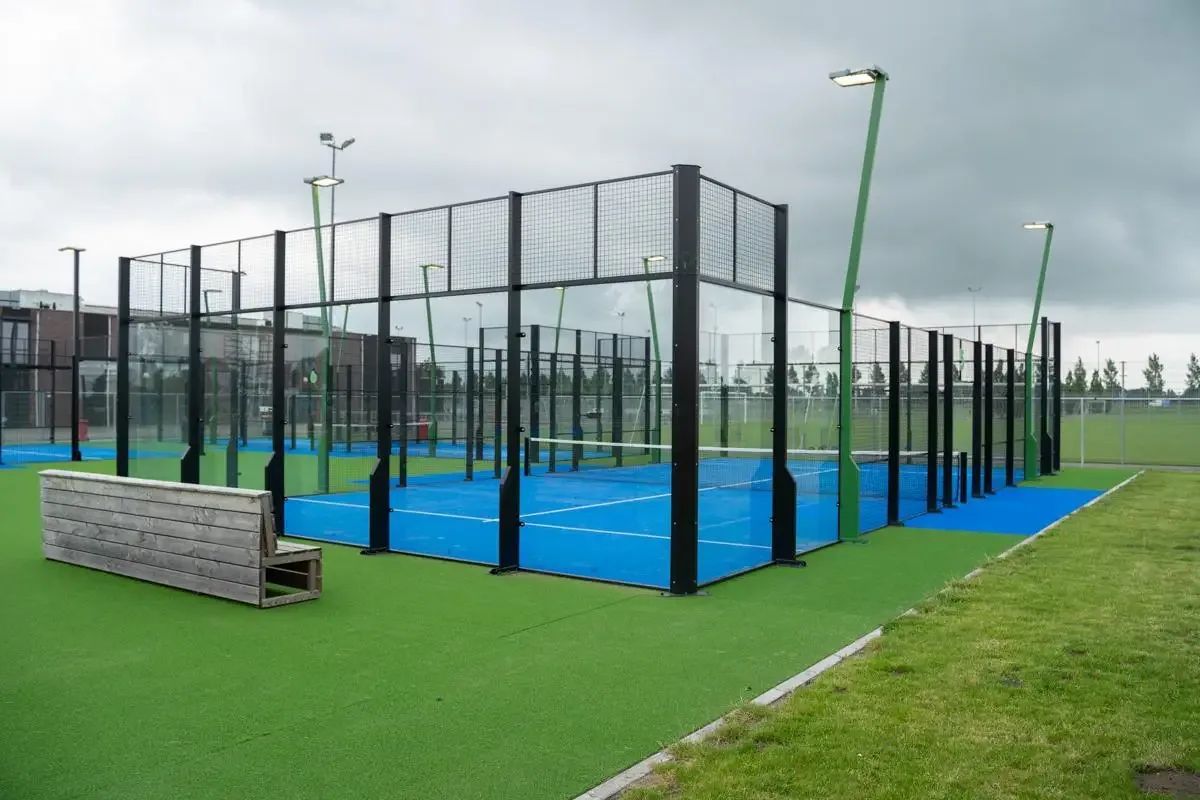
The construction process of an outdoor padel court consists of five phases: the permit process, structural calculation and production, groundwork and foundation, installation of the cage structure, and finishing with artificial turf and LED lighting. Each phase has its own lead time and depends on the previous step.
Phase 1: Permit
In the Netherlands, an outdoor padel court almost always requires a permit. Because of the impact on noise, lighting and spatial planning, an environmental permit is almost always mandatory. The application requires structural calculations, an acoustic study, a lighting study and a site plan. Allow an average lead time of 8 to 12 weeks, depending on the municipality.
Phase 2: Structural calculation and production
While the permit is being processed, the steel structure is calculated and produced. Every outdoor court gets a bespoke structural calculation, tailored to wind load, soil conditions and any noise solutions. Production takes an average of 4 to 6 weeks.
Phase 3: Groundwork and foundation
The groundwork covers preparing the site for building and laying the foundation. Depending on the foundation type chosen, this takes 3 to 5 working days. After the concrete is poured, there is a curing time of at least a week before the structure can be installed.
Phase 4: Installing the cage structure
Assembling the cage structure itself takes 2 working days. The glass walls are then installed, which takes another 1 to 2 days.
Phase 5: Artificial turf and LED lighting
Laying the artificial turf takes 1 to 2 days. The installation of the LED lighting largely runs in parallel. After handover, a final inspection follows and, if desired, an inspection by Kiwa ISA Sport for official competition use.
What makes an outdoor padel court more complex than an indoor court?
An outdoor padel court is more complex than an indoor court because of three factors: the foundation is heavier and more dependent on the location, the steel structure must withstand the weather, and an environmental permit is almost always needed. With an indoor court in an existing hall, many of these steps do not apply.
With an outdoor court, the steel structure has to cope with wind load, frost, rain and temperature fluctuations. The structure is therefore made of hot-dip galvanised steel and must be structurally calculated for each location. On open sites, coastal locations or sites close to tall buildings, the wind load can be considerably higher than average.
Noise also plays a major role with outdoor courts. Padel produces more noise than tennis: the ball hitting glass and steel, amplified by the cage structure acting as a sound box, results in an average sound power level of around 91 dB. When the court is located close to homes, an acoustic study is almost always required and additional measures sometimes have to be taken. That makes preparing an outdoor court structurally more intensive than preparing an indoor project.
Which foundation type is best for an outdoor padel court?
There is no universally best foundation type for an outdoor padel court. The choice depends on the soil conditions, the budget and the location. The three most commonly used solutions are drainage concrete, Supersub and ZOAB asphalt, each with its own properties. In practice, drainage concrete is the most widely used for outdoor courts.
Drainage concrete
Drainage concrete is a water-permeable type of concrete in which rainwater drains directly through the foundation into the subsoil. It offers high stability and load-bearing capacity, withstands frost and intensive use, and lasts an average of 25 to 40 years. For padel courts, drainage concrete is often combined with a ring foundation with steel reinforcement to properly absorb the forces from the steel structure and wind load.
Supersub
Supersub is a foundation solution based on foam concrete. It is light, self-levelling and shock-absorbing, which contributes to a more comfortable playing experience. The water-permeable variant for outdoor courts handles large amounts of rainfall quickly, so puddles do not form. An additional advantage is the installation time: in many cases, Supersub can be applied within a single day.
ZOAB asphalt
ZOAB asphalt (porous asphalt concrete) is a porous type of asphalt that lets water through. It is used less often for padel courts, but can be a good choice in certain situations, for example at locations where laying asphalt is logistically simpler.
An important point to note: in the Netherlands, all foundation components must be approved by Kiwa ISA Sport. Working with non-certified materials can lead to problems at handover or at the official inspection of the court. Good foundation advice always starts with a site check and cone penetration test data for the subsoil.
How much influence does the location have on construction time?
The location has a major influence on the construction time of an outdoor padel court. A site that is easy to reach, with stable soil and a smooth permit process, can shorten the total lead time considerably. Complex soil conditions, a busy municipality or additional environmental requirements can, on the other hand, delay the project.
Specific factors that affect construction time include:
- Soil conditions: poor or unexpected soil conditions can require extra groundwork or an adapted foundation build-up.
- Accessibility: a site that is hard to reach for heavy equipment slows down the groundwork and the installation of the structure.
- Wind zone: locations with a high wind load require heavier structural calculations and sometimes additional reinforcement.
- Permit duration: some municipalities process applications faster than others. Objection procedures from local residents can extend the lead time further.
- Noise measures: when sound-absorbing panels or a noise barrier are used, the structure and possibly the permit must be adapted. This takes extra time for calculations.
A realistic timeline is therefore always based on the specific location, not on an average. A site check at the start of the process prevents surprises later.
What does an outdoor padel court cost and what is included?
As an indication, an outdoor padel court starts from around €30,000 excluding foundation. Including foundation, the indicative price is on average from around €50,000 per court. The exact price always depends on the location, soil conditions, the foundation type chosen and any additional options.
The foundation is the biggest cost factor for an outdoor court. Foundation costs average between €20,000 and €40,000, depending on the soil conditions, accessibility and the civil works required. With an existing tennis court, part of the substructure can sometimes be reused, which saves costs.
A complete outdoor project usually includes the following components:
- Groundwork and foundation (drainage concrete, Supersub or ZOAB asphalt)
- Steel structure, hot-dip galvanised for weather resistance
- Glass walls around the court
- Padel-specific artificial turf including sand bed and line markings
- LED lighting
- Full installation and handover
Optional additions that affect the price are sound-absorbing panels, noise barriers, ball catchers (around €1,200 per side), sliding doors and additional fencing. In your budget planning, always include the permit costs and any study costs for acoustics and lighting as well, because they fall outside the construction costs themselves.
How does the process from quote to handover work?
The process from quote to handover of an outdoor padel court runs in five steps: site check and advice, a bespoke quote, the permit process, production and construction, and handover with inspection. The total lead time averages 10 to 12 weeks, but can be longer if the permit process takes more time.
Step 1: Site check and advice
The process begins with a visit to the site. Based on the soil conditions, the wind zone, the surroundings and the client's wishes, foundation advice is drawn up and the structural starting points are determined.
Step 2: Bespoke quote
After the site check, a quote follows that specifies all components: foundation, steel structure, glass, artificial turf, LED lighting and any noise solutions. That way you know exactly what is included and what the expected costs are.
Step 3: Permit process
We guide you through the entire permit process, including the zoning plan check, consultation with the municipality, coordination of the noise and lighting studies, and the submission of structural calculations. Allow a lead time of 8 to 12 weeks for the permit itself.
Step 4: Production and construction
As soon as the permit has been granted, production of the steel structure starts. In parallel, the preparatory work on site is planned. The construction itself takes 1 to 2 weeks, depending on complexity.
Step 5: Handover and inspection
Once construction is complete, a final inspection follows. For official competitions, an inspection by Kiwa ISA Sport is mandatory. We coordinate this inspection as part of the overall process.
Do you want to know what the process involves for your location and what a realistic timeline looks like? At I-Padel, we handle the entire process from A to Z: from structural calculation and permit through to the handover of a complete outdoor padel court. Get in touch for an initial exploration and we will look with you, without obligation, at the possibilities for your location.
Frequently asked questions
Can I start building before the permit has been granted?
No, starting construction before the environmental permit has been granted is not legally allowed and can lead to a stop-work order, a penalty payment or even a demolition order. What you can do in parallel is have the steel structure calculated and produced as soon as the permit application has been taken into processing. This saves valuable time once the permit comes through.
What are the most common mistakes when planning an outdoor padel court?
The most common mistake is underestimating the lead time of the permit process. Many clients expect a few weeks, whereas the reality is 8 to 12 weeks, and even longer with objection procedures. Another common mistake is leaving study costs (acoustics, lighting) and permit costs out of the budget, even though they can quickly amount to several thousand euros.
How do I know which foundation type best suits my location?
You always determine that on the basis of a site check and cone penetration test data for the subsoil, not on a general preference. Drainage concrete is the most widely used solution because of its stability and long lifespan, but at locations with poor load-bearing capacity or logistical constraints, Supersub or ZOAB asphalt may be a better choice. A specialised contractor can give concrete foundation advice after a soil investigation.
Is a Kiwa ISA Sport inspection mandatory, and what exactly does it involve?
The Kiwa ISA Sport inspection is mandatory if the court is used for official competitions and tournaments. During the inspection, the dimensions, artificial turf, structure and lighting are tested against the official standards of the padel federation. For recreational use, the inspection is not legally required, but it does give certainty about the quality and playability of the court.
What happens if the soil conditions turn out to be worse than expected?
If the soil investigation shows that the soil is worse than initially estimated, this can lead to an adapted foundation build-up, extra groundwork or the use of a lighter foundation solution such as Supersub. This affects both the costs and the construction time. That is precisely why a site check with cone penetration test data at the start of the process is so important, so that you avoid unexpected extra costs later in the project.
Can an existing tennis court be converted into a padel court?
Yes, in some cases the existing substructure of a tennis court can be partly reused, which can save costs on the foundation. Whether this is possible depends on the condition and type of the current subsurface, the dimensions of the site and the structural requirements of the padel court. An inspection of the existing situation is always the first step to determine what can be reused and what has to be replaced.
How much maintenance does an outdoor padel court need after handover?
An outdoor padel court requires relatively little maintenance, but regular maintenance considerably extends its lifespan. Think of periodically brushing the artificial turf to keep the fibres upright and the sand bed evenly distributed, checking the glass walls for damage, and inspecting the steel structure for any signs of corrosion. The hot-dip galvanised steel structure withstands the weather, but an annual visual inspection is still advisable.


