


Building a padel court · 31 March 2026 · 13 min read
How long does a drainage concrete foundation last for a padel court?
A drainage concrete foundation for a padel court lasts 25–40 years. Find out which factors determine its service life and how to keep your foundation in optimal condition for as long as possible.
In this article
- What is a drainage concrete foundation for a padel court?
- How long does a drainage concrete foundation last on average?
- Which factors determine the service life of the foundation?
- What is the difference between drainage concrete, Supersub and ZOAB asphalt?
- How do you recognise wear or damage to the foundation?
- When does a drainage concrete foundation need to be replaced?
- How do you ensure a longer service life for the foundation?
- Frequently asked questions
A drainage concrete foundation for a padel court lasts on average 25 to 40 years with correct use and good maintenance. That makes it one of the most durable foundation options for outdoor courts. Exactly how long your foundation will last depends on the soil conditions, the weather conditions at your location and how intensively the court is used.
In this article you will read everything you need to know about the service life of drainage concrete, when you need to take action and how to keep the foundation in good condition for as long as possible.
What is a drainage concrete foundation for a padel court?
A drainage concrete foundation is a water-permeable concrete layer used as the base for padel courts, particularly outdoor courts. The open structure of the material lets rainwater drain straight through the foundation into the ground, which prevents puddles from forming and means the court is quickly playable again after a downpour.
Drainage concrete is not simply ordinary concrete with a few holes in it. Its composition is specifically tuned for high water permeability, while still providing a stable and flat base that can handle the heavy load of a padel court. Think of the steel structure, the glass walls and the constant dynamic load from players. A drainage concrete foundation can absorb all of those forces, up to a load-bearing capacity of approximately 5 tonnes per square metre.
On padel courts, drainage concrete is almost always combined with a ring foundation with steel reinforcement. That ring foundation absorbs the specific point loads from the base plates of the steel structure and the wind load that is transferred to the foundation via the cage. Together they form a solid base for a padel court that has to last for decades.
How long does a drainage concrete foundation last on average?
A drainage concrete foundation for a padel court lasts 25 to 40 years on average. That range is wide, but not without reason. The actual service life depends heavily on the quality of the construction, the soil conditions at the location and how intensively the court is used. With professional installation and normal use, 30 years is a realistic average.
By comparison, the steel structure of a padel court has an expected service life of at least 25 years with good maintenance. In most cases the foundation lasts as long as, or longer than, the structure above it. That means that in a well-built project you do not, in principle, need to replace the foundation for as long as the court is in use.
What has a positive effect on service life is correct installation based on a soil investigation. Without a cone penetration test you do not know what is under the ground, and that can lead to unexpected subsidence or cracking that damages the foundation prematurely. A foundation calculated specifically for the location always performs better than a standard solution.
Which factors determine the service life of the foundation?
The service life of a drainage concrete foundation for a padel court is determined by four main factors: the quality of the construction, the soil conditions, the climatic conditions and the intensity of use. Each of these factors can either extend the service life or shorten it considerably.
Quality of the construction
This is the most decisive factor. A foundation built on the basis of a soil investigation, with the right thickness and reinforcement, structurally performs better than a foundation poured without preliminary investigation. In the Netherlands, all foundation components must be inspected by Kiwa ISA Sport. This quality mark guarantees that the materials used meet the applicable standards for sports surfaces. Anyone who overlooks this risks non-conformity that only becomes visible years later in the form of damage.
Soil conditions
Drainage concrete works best on stable, load-bearing ground. At locations with soft clay layers, peat or a high groundwater level, extra attention is needed. In those cases the foundation can be reinforced or supplemented with additional stabilisation layers. Without those adjustments you increase the risk of subsidence, which in the long run leads to an uneven base and damage to the steel structure.
Climatic conditions
Drainage concrete is resistant to frost and heat, but extreme temperature swings can cause small cracks in the long term. In coastal areas or on open sites with high wind load, the foundation and the structure are also under greater stress. That calls for a structural calculation that takes the specific wind zone of the location into account.
Intensity of use
A court that is in use every day from early to late places a heavier load on the foundation than a court that is only played on at weekends. At commercial locations with high occupancy rates it is wise to inspect the foundation periodically, so that you spot wear in good time.
What is the difference between drainage concrete, Supersub and ZOAB asphalt?
Drainage concrete, Supersub and ZOAB asphalt are all three water-permeable foundation solutions for padel courts, but they differ in material composition, technical properties and application. The biggest difference lies in how they drain water and how they deal with load and maintenance.
- Drainage concrete is a porous type of concrete in which water drains into the ground through the open structure of the material itself. It offers high stability, a flat surface and a long service life of 25 to 40 years. Drainage concrete withstands heavy loads and requires relatively little maintenance. It is the most widely used option for outdoor courts in the Netherlands.
- Supersub is a foundation solution based on foam concrete. It is lighter than traditional concrete, self-levelling and shock-absorbing. Supersub has additional advantages in terms of playing comfort and sound dampening, and can be used both indoors and outdoors. The permeable version for outdoor courts handles large amounts of rainfall quickly. Supersub is also well suited to renovation projects, such as the conversion of a tennis court into padel courts.
- ZOAB asphalt (open-graded asphalt concrete) is a porous type of asphalt that lets water through via the open structure of the asphalt. It is used less often on padel courts than drainage concrete, but can be a good choice in specific situations, for example when an asphalt base is already present or when the location sets specific requirements for the finish.
Which solution is the best fit always depends on the soil conditions, the budget, the location and the intended use. There is no universally right choice. What works for one location may be less suitable for another.
How do you recognise wear or damage to the foundation?
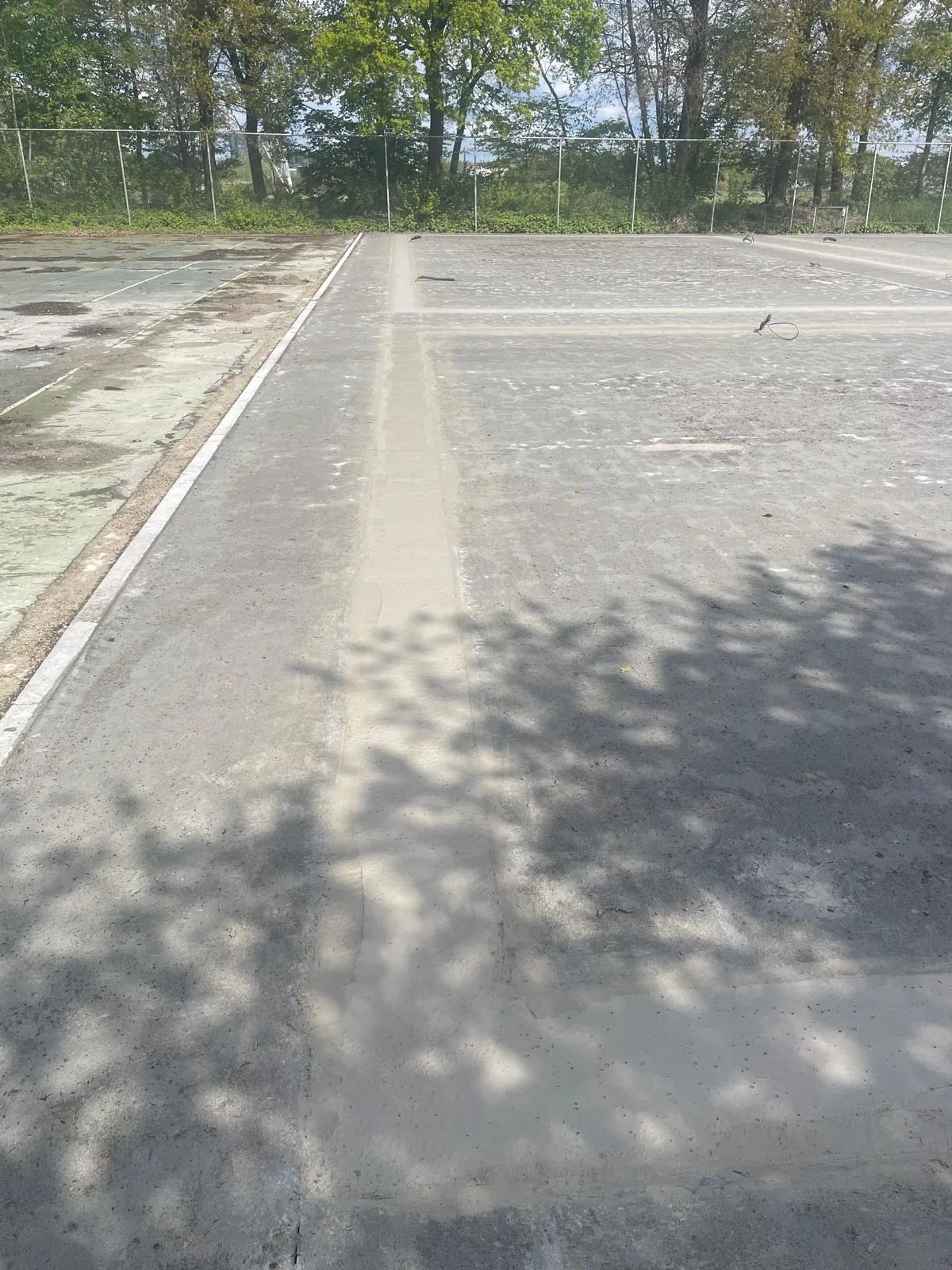
You can recognise wear or damage to a drainage concrete foundation by a number of concrete signs: uneven or sunken areas, visible cracks in the concrete surface, puddles after rain in places where that did not previously occur, and a noticeable change in ball bounce on certain parts of the court.
The earliest signs are often subtle: a slight unevenness in the surface, a small crack along the edge of the foundation or a spot where the artificial turf no longer lies completely flat. Those are the moments to take action, before the damage gets worse.
Puddles are one of the clearest indicators that water permeability has decreased. This can have two causes: the pores of the drainage concrete have become blocked by fine dust or organic material, or there is subsidence, so that water is no longer drained evenly. In the first case cleaning is sometimes enough. In the second case it is structural damage that requires professional assessment.
Also pay attention to the connections between the foundation and the base plates of the steel structure. If those connections come loose or cracks appear around the anchors, there may be movement in the foundation. That is a serious sign that you must not ignore, because it directly affects the stability of the entire structure.
When does a drainage concrete foundation need to be replaced?
A drainage concrete foundation for a padel court needs to be replaced when its structural integrity can no longer be guaranteed. That is the case with severe and persistent subsidence, wide cracking through the full thickness of the concrete layer, or when the foundation can no longer carry the steel structure in a stable way.
In many cases repairs are still possible without full replacement. Small cracks can be repaired, and limited subsidence can sometimes be corrected by local injection or additional pouring. Whether repair or replacement is the best option depends on the extent of the damage and the remaining service life of the foundation.
A practical rule of thumb: if more than 20 to 30 percent of the foundation area shows visible damage, or if several spots are causing problems at the same time, full replacement is often more cost-efficient than continually patching up individual problems. Especially if the foundation is already 25 years old or more, the investment in a new foundation outweighs the risks of an unstable base.
Keep in mind that replacing the foundation of an existing padel court is a major project. The steel structure has to be temporarily supported or dismantled, the old foundation has to be milled or removed, and the new foundation has to be built on the basis of a current soil investigation. Plan this kind of work well in advance and outside the padel season.
How do you ensure a longer service life for the foundation?
You extend the service life of a drainage concrete foundation by starting with good installation based on a soil investigation, then cleaning the foundation periodically to prevent the pores from becoming blocked, and repairing small damage immediately before it gets worse. Preventive maintenance is always cheaper than repair.
Clean the foundation regularly
The open pores of drainage concrete can become blocked over time by fine sand, leaves, moss or organic material. That reduces water permeability. Periodic high-pressure treatment or mechanical cleaning keeps the pores open and prevents puddles from forming. How often this is needed depends on the location and the surroundings, but an annual inspection is a good starting point.
Check the connections to the steel structure
The base plates of the steel structure are fixed to the foundation by anchors. Check these connections every year for loosening, rust or cracking in the concrete around the anchor points. Intervening early prevents a small problem from growing into structural damage.
Ensure good water drainage around the court
Drainage concrete drains water through the foundation itself, but the surroundings of the court also play a role. If water from the surrounding area flows towards the court and stays there, that increases the load on the foundation. Good drainage around the court supports the function of the drainage concrete.
Have the foundation built by a party that works with certified materials
In the Netherlands, all foundation components for padel courts must be inspected by Kiwa ISA Sport. That is not a formality, but a guarantee that the materials meet the standards for sports surfaces. Anyone who works with non-certified materials risks problems at the inspection after completion and misses out on the protection that certification offers in warranty claims. Would you like to know more about the options? Then take a look at our page on padel court foundations and discuss this point explicitly with the contractor before the project starts.
We are happy to think along with you, without obligation, about the foundation that best suits your location and situation. Get in touch for an initial exploration and we will look at the options together.
Frequently asked questions
What does it cost to build a drainage concrete foundation for a padel court?
The cost of a drainage concrete foundation varies depending on the location, the soil conditions and the required foundation thickness. A soil investigation beforehand is mandatory and has a direct influence on the final cost, because soft or unstable soils require additional stabilisation layers. Always request a tailored quote from a certified contractor, so that you know where you stand and are not faced with surprises.
How long does it take to build a drainage concrete foundation?
Building a drainage concrete foundation for a padel court usually takes two to four working days, depending on the size of the project and the ground conditions. After that, a curing time of at least 28 days is needed before the foundation can take its full load and the steel structure can be installed. Therefore plan the construction well ahead of the desired completion date, especially for new-build projects with a fixed deadline.
Can I reuse an existing concrete foundation if I want to build a padel court at a location with an old tennis court?
That is possible, but not automatically. The existing foundation must first be assessed for load-bearing capacity, flatness, water permeability and structural integrity. An ordinary tennis court foundation is not always suitable for the specific point loads of a padel cage. In some cases a renovation or a top-up with a layer of Supersub is sufficient, but in other cases full replacement is still the safest choice. Always have this assessed by a specialist.
What happens if I do not have a soil investigation carried out before construction?
Without a soil investigation you do not know what is under the ground, and that brings serious risks. At locations with peat, soft clay layers or a high groundwater level, the foundation can subside without the right adjustments, leading to cracking, an uneven base and ultimately damage to the steel structure. You also run the risk that the foundation does not meet the requirements of Kiwa ISA Sport, which can cause problems at completion and in any warranty claims.
Is a drainage concrete foundation also suitable for a covered or indoor padel court?
Drainage concrete is primarily used for outdoor courts, because the water-permeable property offers the greatest benefit there. For indoor courts, water drainage through the foundation is less relevant, and other foundation solutions such as Supersub or a traditional concrete floor are used more often. The choice depends on the specific situation, the building and the ground. Always discuss this with a specialist who knows the location.
How do I know whether a contractor works with Kiwa ISA Sport certified materials?
Ask the contractor explicitly about the certification of the foundation materials to be used and have this recorded in the quote or the contract. A reliable contractor can provide the certification documentation for the materials used. Also check whether the contractor has demonstrable experience in the construction of padel courts and whether he can show well-known reference projects. That way you avoid discovering only after completion that materials do not meet the standards.
What should I do if I discover cracks or subsidence in the foundation of my padel court?
Take action as soon as possible and have the damage assessed by a specialist. Small surface cracks can often be repaired without major intervention, but cracks that run through the full thickness of the concrete layer or subsidence around the anchor points of the steel structure are serious signs that must not be ignored. The sooner you intervene, the greater the chance that repair will be enough and the smaller the chance of further damage to the structure above.


