


Building a padel court · 9 June 2026 · 11 min read
How is the quality of a padel court checked after completion?
Padel court quality control after completion: what is inspected, what Kiwa ISA Sport certification means and how you protect your investment.
In this article
- What exactly does a padel court quality check involve?
- Which components of a padel court are checked after completion?
- How is the foundation of a padel court inspected?
- What is Kiwa ISA Sport certification and why is it important?
- How long does the warranty on a padel court last and what does it cover?
- Who is responsible if something goes wrong after completion?
- What are common quality problems with padel courts?
- How do you choose a padel builder who can guarantee quality?
- Frequently asked questions
You have had a padel court built and now you want to know whether everything is right. Understandably so. A padel court is a serious investment, and quality control after completion is not a formality but a concrete step that determines whether your court is safe, ready to play and certified. In this article we explain what such a check involves, which components are inspected, what Kiwa ISA Sport certification means and how you can be sure you are in good hands as a client.
What exactly does a padel court quality check involve?
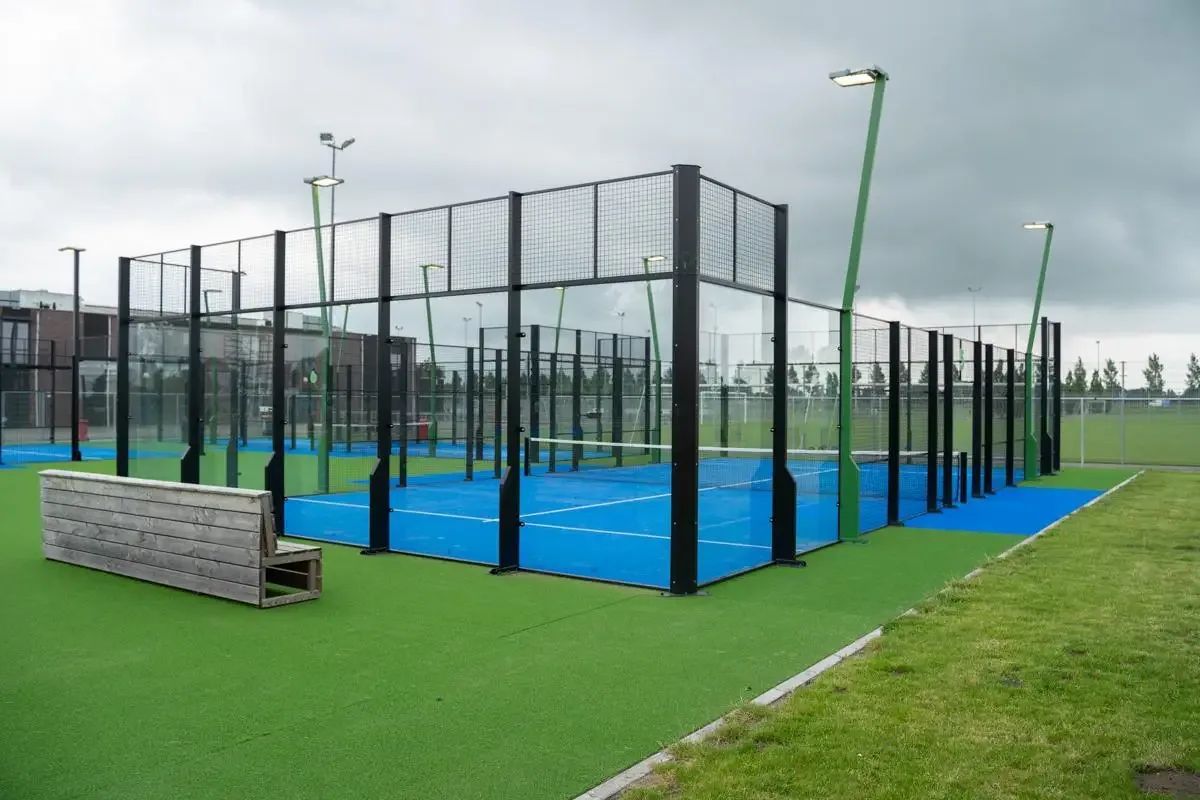
A padel court quality check is a systematic inspection in which all components of the court are tested against established standards. This covers the steel structure, the glass, the artificial turf, the foundation, the LED lighting and the safety fencing. The aim is to establish whether the court meets the requirements of NOC*NSF and Kiwa ISA Sport.
In practice, such a check takes place at two moments. During construction, the contractor checks for themselves that each component is installed correctly. After completion, an independent inspection follows, in which an accredited body measures, tests and assesses the court. For official matches, this independent inspection by Kiwa ISA Sport is mandatory. Without it, the court may not be used for competition.
The check also matters for player safety. A padel court contains tempered glass, steel structures and mesh panels, all of which must meet specific requirements to prevent injury. A good quality check protects not only the investment, but also the people who play on the court.
Which components of a padel court are checked after completion?
After completion, all main components of a padel court are checked: the steel structure, the safety glass, the artificial turf surface, the foundation, the LED lighting and the mesh fencing. Each component has its own standards it must meet, laid down in the NOC*NSF guidelines and the Kiwa ISA Sport measurement methods.
Steel structure and mesh
The steel structure is checked for dimensional accuracy, plumb and rigidity. Post tubes, base plates and connections are assessed visually and structurally. The steel mesh is inspected for correct fixing and an injury-free finish. The mesh must rest against the tube, so that players are not hurt on contact.
Safety glass
The glass around the court is tempered safety glass at least 10 mm thick (for Pro and Single versions) or 12 mm thick (for Panorama versions). During the inspection, it is checked that the glass does not touch the ground, which prevents moss growth and moisture damage, and that it is correctly mounted in the structure.
Artificial turf surface
The artificial turf surface is tested for ball bounce, shock absorption, flatness and infill material. These are measurable properties that directly affect how the game plays. The sports-technical requirements of Kiwa ISA Sport describe exactly which values are acceptable for a certified padel surface.
LED lighting
The lighting is checked for light intensity and even distribution across the court. Light poles stand at a height of 6 metres and must provide sufficient lux for safe play, including in the evening.
How is the foundation of a padel court inspected?
The foundation of a padel court is inspected for flatness, water permeability (for outdoor courts), bearing capacity and dimensional stability. The inspection is part of the overall certification of the sports surface, in which the foundation and the artificial turf layer are assessed as a single system.
Kiwa ISA Sport requires that all foundation components in the Netherlands are inspected and certified. This applies to all commonly used foundation types: drainage concrete (a water-permeable concrete layer that drains rainwater immediately), Supersub (a foundation solution based on foam concrete with good shock absorption and water permeability) and ZOAB asphalt (porous asphalt concrete that lets water through). Working with non-certified materials can lead to non-conformity, which means the court may not be officially brought into use.
The flatness is also measured during the foundation inspection. An uneven base directly affects ball bounce and playing quality. Deviations beyond a certain tolerance margin are grounds for rejection. This is why good preparation, including soil probing before construction, is so important.
What is Kiwa ISA Sport certification and why is it important?
Kiwa ISA Sport is an independent inspection body that tests and certifies padel sports surfaces and courts on the basis of the NOC*NSF standards. Kiwa ISA Sport certification proves that a padel court meets the measurable quality and safety requirements for professional use. For official matches, this certification is mandatory.
The certification is more than a stamp. It is independent confirmation that the court has been built with certified materials, correctly installed and meets the sports-technical requirements for ball bounce, shock absorption and safety. For clubs and operators, it also offers protection: if a discussion ever arises about the quality of the court, the certification is the proof that everything was delivered correctly.
Not all padel builders work with certified materials as standard. Inexperienced clients therefore run the risk that their court will not pass the inspection after completion, resulting in delays, extra costs and possibly a partial rebuild. Always ask in advance whether the materials used are Kiwa ISA Sport certified.
How long does the warranty on a padel court last and what does it cover?
The warranty period on a padel court differs per component. For the steel structure, quality providers offer a 15-year warranty. The artificial turf, glass and LED lighting have shorter warranty terms of their own, which differ per product and supplier.
It is important to understand this distinction properly before you sign a contract. A 15-year warranty on the steel structure does not automatically mean that all other components are covered for as long. Artificial turf has an average lifespan of 8 to 12 years under intensive use, depending on the type and how consistently it is maintained. Glass generally lasts much longer, unless it is damaged by impact.
Ask every provider for a clear overview of the warranty terms per component. Good providers set this out transparently in their general terms and conditions and quotation. A vague or verbal warranty promise offers little to rely on if something goes wrong later.
Who is responsible if something goes wrong after completion?
Responsibility after completion lies with the party that built and delivered the court. If a single contractor handled the entire project, that party can be held accountable for the whole. If a client works with several suppliers, responsibility is divided and a dispute can arise over who is liable when there is a problem.
This is a practical point that is often underestimated. Suppose the artificial turf comes loose at the seams after a year: is that an installation problem, a material issue or a foundation problem? If the foundation was laid by party A, the artificial turf supplied by party B and the installation done by party C, each party can point to the others. The client is then left empty-handed.
With a complete package from a single contractor, this is different. There is one point of contact, one responsibility and one warranty process. That makes resolving problems after completion considerably easier and gives you a stronger position as a client.
What are common quality problems with padel courts?
Common quality problems with padel courts include an uneven artificial turf surface caused by foundation subsidence, loose glass due to incorrect installation, rust on the steel structure due to insufficient protection, and poor drainage on outdoor courts due to the wrong foundation choice.
Foundation problems
Subsidence in the foundation is one of the most common problems, especially on outdoor courts at locations with poor soil conditions. An uneven base leads to inconsistent ball bounce and can eventually damage the steel structure. This can be prevented by having soil probing carried out in advance and basing the foundation choice on the specific soil conditions.
Structural defects
Incorrectly welded or assembled connections in the steel structure can lead to tilting or instability over time. This risk is greater with structures that are not produced in-house but imported without a structural calculation for each location. Wind load, surrounding buildings and soil conditions call for a court that is calculated for the specific site, not a standard product that is put up anywhere.
Noise nuisance as an indirect quality problem
Noise nuisance is not a structural defect, but it can lead to legal problems and a forced shutdown. If no sound-absorbing measures were taken during construction and the location borders on residential buildings, the municipality can intervene. This can be prevented by taking noise standards into account from the design stage and, if necessary, including sound-absorbing panels or a noise barrier in the plan.
How do you choose a padel builder who can guarantee quality?
A reliable padel builder works with certified materials (Kiwa ISA Sport), supplies a structural calculation for each location, offers transparent warranty terms per component and takes full responsibility for the project. Always ask for reference projects, certification documents and an itemised quotation.
Here are some concrete questions you can ask every provider:
- Are the foundation components Kiwa ISA Sport certified?
- Is the steel structure structurally calculated for my location, or is it a standard product?
- What is the warranty period on the steel structure, the artificial turf and the glass, and what do the terms say?
- Who is my point of contact if something goes wrong after completion?
- Can the court be fitted with sound-absorbing panels if the municipality requires it?
Also pay attention to how a provider handles prices. A serious party never quotes a fixed price without context and always explains what is and is not included. Transparency about costs is a good indicator of transparency about quality and service.
At I-Padel, we produce the steel structure entirely in our own factory, work exclusively with certified materials and deliver the complete process from foundation to completion. That means one responsibility, one warranty process and no discussion about who is liable. Want to know what that means for your project? Take a look at our offering for building padel courts or get in touch for an initial exploration. We are happy to think along with you, without obligation.
Frequently asked questions
How long does an official quality inspection of a padel court take on average?
An independent inspection by Kiwa ISA Sport usually takes one day, depending on the number of courts and the complexity of the site. The measurement results and the certification document then usually follow within a few weeks. Take this into account in your planning if the court has to be ready to play and certified by a specific date.
Can a rejected padel court still be certified after remedial work?
Yes, a court that fails the inspection can be submitted for inspection again after remedial work. Which components are repaired depends on the non-conformity points in the inspection report, such as relaying the artificial turf, correcting foundation unevenness or re-mounting glass panels. This brings extra costs and delays, which is exactly why it pays to work only with certified materials and an experienced builder from the start.
Is Kiwa ISA Sport certification also mandatory for padel courts at companies or private individuals, or only for clubs?
Certification is mandatory for courts used for official NOC*NSF matches. For company or private courts without competitive use, certification is technically not mandatory, but it is strongly recommended. A certified court offers demonstrable quality guarantees, increases the value of the investment and protects you in the event of any liability questions concerning player injury.
What should I do if I suspect that my completed padel court does not meet the standards?
Document the problems you have identified as soon as possible with photos, videos and written notifications to the contractor. Then consult your contract for the warranty and completion terms. If the contractor does not respond adequately, you can engage an independent party such as Kiwa ISA Sport for a second-opinion inspection. The outcome of such an inspection gives you an objective basis for taking further steps, legal or otherwise.
How often does a padel court need to be inspected or maintained after completion to preserve its quality?
After the initial certification, there is no fixed mandatory re-inspection frequency, but regular preventive maintenance is essential to maximise the lifespan of the court. Think of topping up the infill of the artificial turf every year, periodically inspecting the glass fixings and steel structure, and checking the drainage on outdoor courts. With intensive use or after extreme weather, an interim inspection by a specialist is recommended.
Which permits are needed before a padel court may be brought into use?
For most padel courts, an environmental permit is required, certainly in the case of permanent outdoor courts with lighting. Depending on the municipality and the location, additional requirements may apply regarding noise standards, the zoning plan and light emissions. It is wise to contact the municipality as early as the design stage, so that the court, including any sound-absorbing measures, immediately complies with local regulations and no forced modifications are needed after completion.
Does it make a difference to the quality check whether the padel court is indoors or outdoors?
Yes, indoor and outdoor courts partly have different inspection points. For outdoor courts, extra attention is paid to the water permeability of the foundation, the weather resistance of the steel structure and the rust protection. For indoor courts, factors such as ventilation, light reflection and the interaction with the existing floor play a larger role. The core of the Kiwa ISA Sport standards, namely ball bounce, shock absorption, structural rigidity and safety, applies to both types of court.


