Blog · 10 September 2026 · 12 min read
How is the noise of a padel court assessed?
Padel court noise tested against the Activiteitenbesluit: learn how measurements, calculations and the impulse correction determine the assessment. Find out what it means for your location.
In this article
- Which noise standards apply to a padel court?
- How is the noise of a padel court measured?
- What is the difference between an acoustic study and a noise calculation?
- Why is padel noise assessed as impulsive noise?
- Who carries out an acoustic study for a padel court?
- Which factors influence the outcome of a noise calculation?
- How do sound-dampening panels influence the assessment?
- Not sure whether outdoor padel is feasible at your location?
- Frequently asked questions
The noise of a padel court is assessed against the applicable noise standards from the Activiteitenbesluit or a tailor-made permit, in which an independent acoustic consultant measures or calculates whether the noise load on the façades of nearby homes stays within the permitted limits. The assessment is always location-specific: distance, surroundings and intensity of use all help determine the outcome. The questions below explain how this assessment process works in practice and which factors play a role.
Which noise standards apply to a padel court?
For outdoor padel courts in the Netherlands, the noise standards from the Activiteitenbesluit milieubeheer (Dutch Environmental Management Activities Decree) apply. This decree sets limit values for the long-term average rating level (LAr,LT) and the maximum sound level (LAmax) on the façades of third-party homes. The standards differ by period of the day: during the day, more lenient limit values apply than in the evening and at night.
As an indication, the following limit values for the long-term average rating level apply to sports facilities:
- Day period (07:00 to 19:00): 50 dB(A)
- Evening period (19:00 to 23:00): 45 dB(A)
- Night period (23:00 to 07:00): 40 dB(A)
Besides the long-term average, limit values for peak noise also apply. Padel noise falls into the category of impulsive noise, which means a correction is applied to the measured sound level in the assessment. More on this later in this article.
When a location does not meet the standard norms from the Activiteitenbesluit, a municipality can set deviating limit values through a tailor-made decision. This can turn out more lenient or stricter, depending on the surroundings and circumstances. It is therefore not possible to say in advance exactly which standards apply: that always depends on the municipality and the project situation. More information about the permit process can be found on the page about permit for a padel court.
How is the noise of a padel court measured?
The noise of a padel court is measured with a calibrated sound level meter at a fixed position, usually on the façade or at a height of 1.5 metres on the plot boundary of the nearest home. The measurement takes place during representative use of the court, so that the measured values give a realistic picture of the actual noise load.
In a measurement, a distinction is made between the source noise and the background noise. The background noise, caused by traffic or other environmental sources, is determined separately and then corrected for in the assessment. This prevents ambient noise from distorting the result.
Measurements are carried out by an independent acoustic firm, which works in accordance with Dutch measurement methods and the guidelines of the Handleiding meten en rekenen industrielawaai (Dutch manual for measuring and calculating industrial noise). The measurement results are then tested against the applicable noise standards.
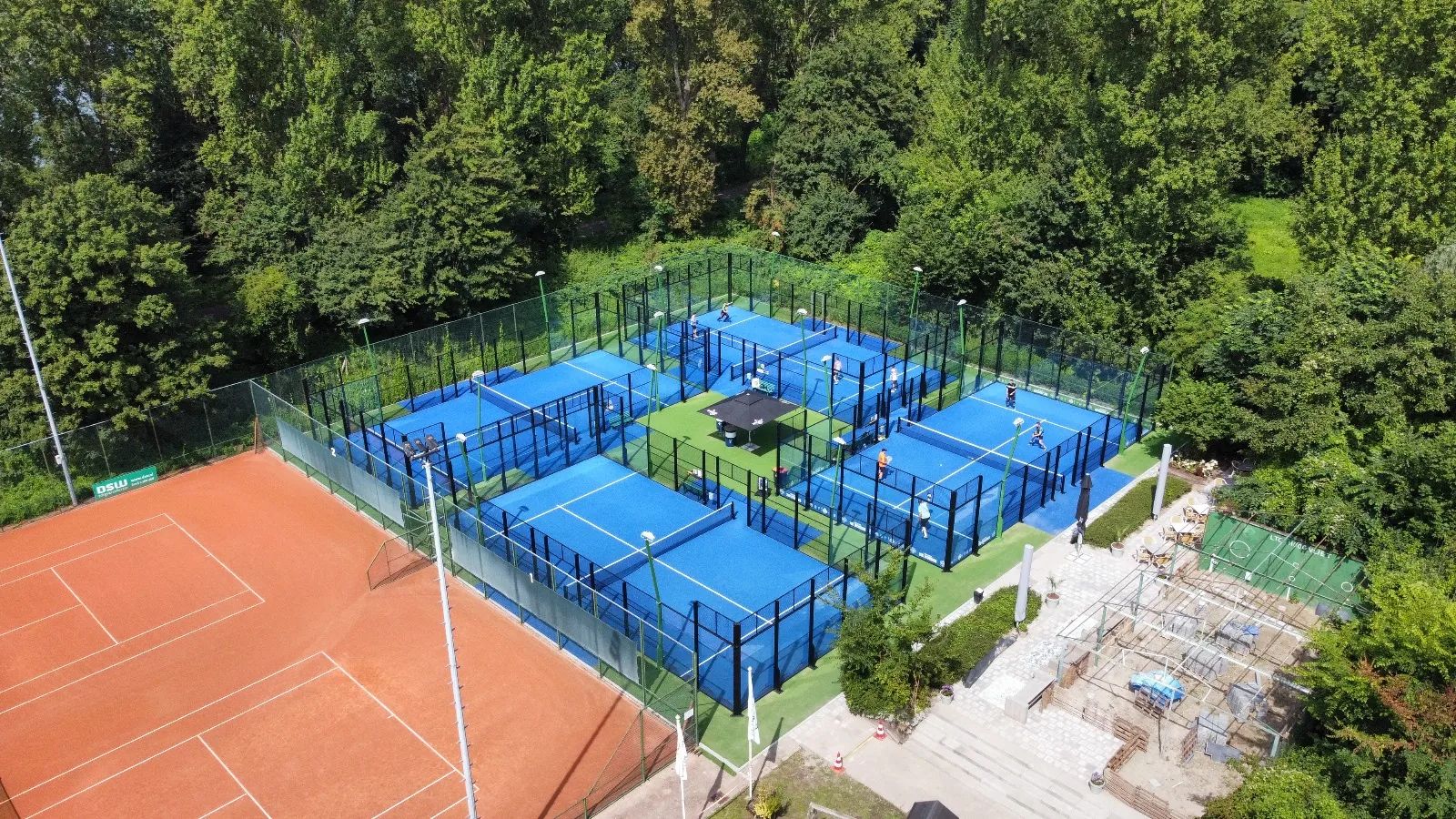
In the practical measurement at LTC Hofgeest, where sound-dampening panels were applied to the two short sides of the court, an indicative noise reduction of around 3 dB(A) was measured within the configuration studied, after correcting for background noise. These results apply only to that specific situation and must not be regarded as a generally valid result for other locations or configurations.
What is the difference between an acoustic study and a noise calculation?
An acoustic study is a broad term that can include both measurements and calculations. A noise calculation is a specific part of that study: calculation models are used to predict how sound spreads from a source to the surroundings. The difference lies in the method: measuring records what actually is, calculating predicts what is expected.
When is a calculation used?
A noise calculation is almost always used in the permit phase, before the padel court is built. At that point a measurement is not yet possible. The acoustic consultant models the situation on the basis of sound power levels, distances, screening and characteristics of the surroundings. The outcome indicates whether the expected noise load falls within the applicable standards.
When is a measurement used?
A measurement is carried out when the court is already in use, or when a calculation does not provide enough certainty. Sometimes a municipality requires a measurement as part of permit enforcement or following complaints from local residents. A measurement after completion is also the most reliable method for assessing the effectiveness of noise measures, such as sound-dampening panels.
In practice, calculation and measurement are regularly combined: the calculation substantiates the permit application, and the measurement verifies afterwards whether the situation matches the expectation.
Why is padel noise assessed as impulsive noise?
Padel noise is assessed as impulsive noise because the impacts of the ball against the glass and the steel structure have a short, sudden and repeated character. The human ear experiences this type of sound as more annoying than a continuous sound at the same average level. For that reason, a correction of 5 dB(A) is added to the measured or calculated sound level in the assessment.
In practice this means that a padel court that seems at first sight to be within the standards can still exceed the limit values after the impulse correction is applied. This is one of the reasons why acoustic solutions for padel are so relevant at locations near homes.
The distinction from tennis is relevant here. Padel produces more noise than tennis, partly because the cage structure acts as a sound box. The average sound power level of a padel court is around 91 dB, which is about 10 dB higher than with tennis. The combination of a higher sound power level and the impulse correction makes padel noise an acoustic point of attention at virtually every outdoor location near buildings.
Who carries out an acoustic study for a padel court?
An acoustic study for a padel court is carried out by an independent acoustic consultancy. This is a specialist party with the necessary knowledge of noise standards, measurement methods and calculation models. The acoustic consultant is responsible for the calculations, the measurements and the reporting to the municipality.
I-Padel does not carry out acoustic studies itself. Our role is to supply the technical product specifications, structural data and engineering needed to carry out the calculations correctly. Think of information about court dimensions, structural build-up, the properties of sound-dampening panels and the effect of additional provisions on the wind load of the structure.
For municipalities and acoustic consultants who need technical information about the structure or the tested application of acoustic panels, we can supply the necessary specifications. Good cooperation between the client, the acoustic consultant and the structural engineer increases the chance of a technically substantiated project that is feasible in terms of permits.
Which factors influence the outcome of a noise calculation?
The outcome of a noise calculation for a padel court is determined by a combination of factors that can differ greatly per location. The distance between the court and the nearest homes is the most decisive factor: the greater the distance, the lower the noise load on the façade.
The following factors also play a role:
- Orientation of the court: the position of the court relative to homes determines which sides radiate the most noise towards sensitive receivers.
- Characteristics of the surroundings: buildings, trees, differences in height and other obstacles can screen or, conversely, reflect sound.
- Intensity of use: the number of hours per day and the number of courts in use at the same time influence the calculated long-term average level.
- Noise measures present: sound-dampening panels or a noise embankment can limit the spread of sound and thereby favourably influence the outcome of the calculation.
- Background noise level: at locations with higher background noise from traffic or industry, the relative contribution of the padel court may be smaller.
- Time of day of use: playing in the evening period is assessed more heavily than during the day, because the standards are stricter then.
Because all these factors differ per location, it is not possible to say in advance whether a specific location meets the standards. A project-specific calculation by an independent acoustic consultant is necessary for that.
How do sound-dampening panels influence the assessment?
Sound-dampening panels can favourably influence the outcome of an acoustic assessment because they dampen the sound at the source. They are fixed to the outside of the cage structure and absorb part of the sound energy that would otherwise be reflected back or spread further. In a noise calculation, the acoustic consultant can include the acoustic properties of the panels as a reduction factor.
The panels we use have been independently tested in an acoustic laboratory. The measured properties are:
- Sound absorption class: A
- Absorption value αw: 0.80
- Absorption index DLα: 8 dB
- Airborne sound insulation Rw: 22 dB
- Sound insulation index DLR: 19 dB
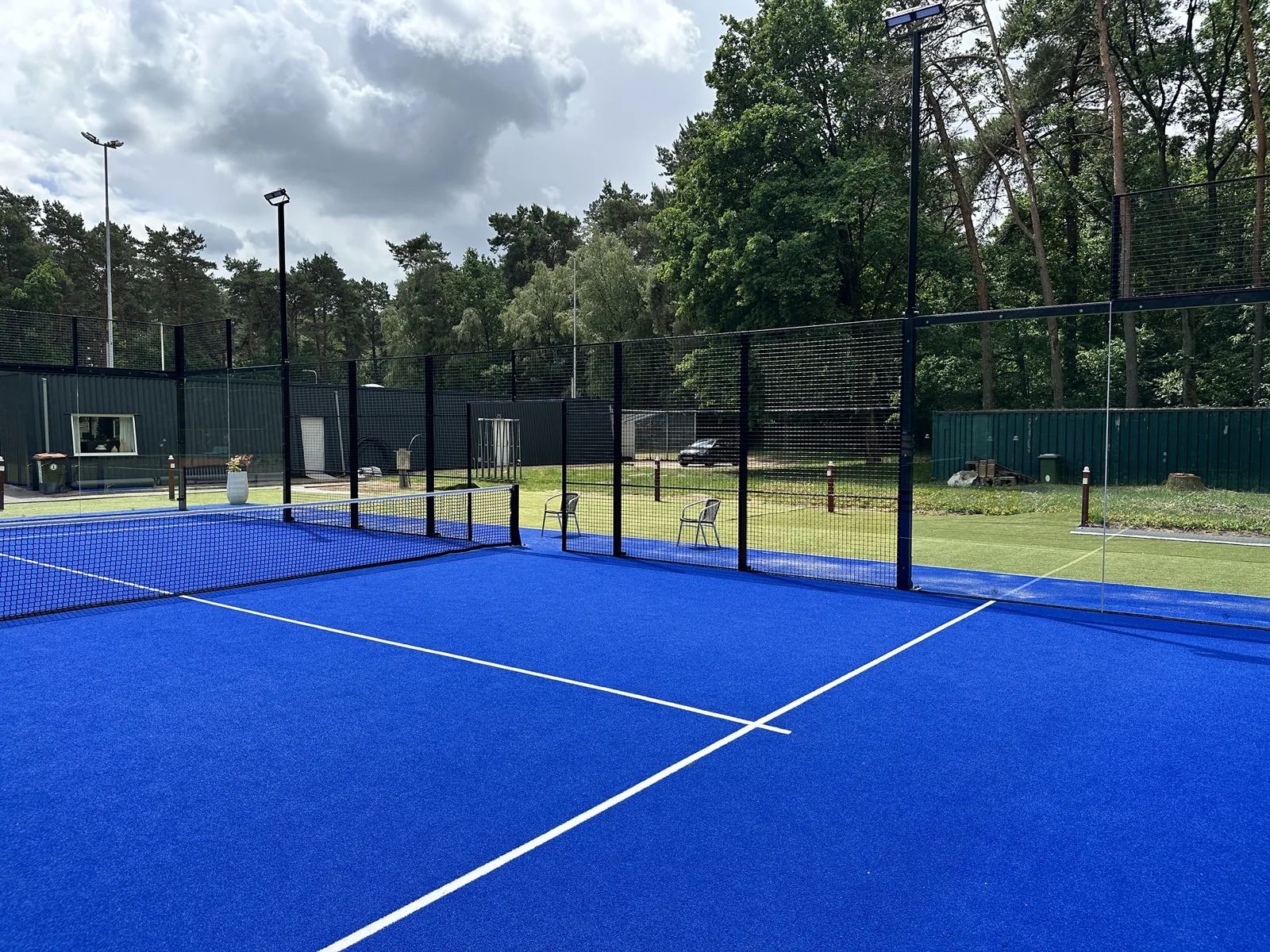
These laboratory values give the acoustic consultant concrete input data for the calculation. The final reduction at a specific location does, however, depend on the configuration, the position of the panels, the direction of sensitive receivers and the characteristics of the surroundings. At LTC Hofgeest, for example, the panels were fitted on the two short sides of the court. That configuration was chosen specifically for that project and is not automatically the right solution for another location.
An important technical point of attention is that sound-dampening panels reduce the wind permeability of the structure. This increases the wind load on the steel structure. The structure has to be calculated for this and in many cases reinforced, for example with heavier posts, additional columns or adapted connections. This is not a side issue: it is a structural condition for a safe and durable application. With a custom-built padel court, this is already taken into account in the engineering phase.
Sound-dampening panels are one possible measure within a broader noise approach. Whether they are necessary or sufficient in a specific situation is determined by the independent acoustic consultant on the basis of the project situation. In some cases a combination with a noise embankment is more effective than either measure on its own.
Not sure whether outdoor padel is feasible at your location?
We are happy to help you think through the court configuration, structural preparation and possible noise measures. Together with your acoustic consultant, we look at which solution is technically feasible and suits the project. Get in touch via the page on acoustic solutions for padel for an initial, no-obligation exploration.
Frequently asked questions
As the initiator, do I have to engage an acoustic consultant myself, or does the municipality arrange that?
As the initiator, you are responsible for submitting an acoustic study with the permit application. The municipality assesses the report, but does not carry out the study itself. It is therefore up to you to engage an independent acoustic firm in good time, preferably already in the early planning phase, so that the results can still influence the position or configuration of the court.
What if the noise calculation shows that my location exceeds the standards?
An exceedance does not automatically have to be the end of the project. Various measures are possible: placing the court further from homes, restricting the hours of use (for example no evening play), applying sound-dampening panels, or building a noise embankment. In some cases the municipality can also set deviating standards through a tailor-made decision. Based on the calculation, the acoustic consultant can advise specifically on which measures are most effective for your particular situation.
How early in the planning process should I take noise into account?
As early as possible, ideally already at the first sketch plans. The position and orientation of the court relative to nearby homes is the most decisive factor for the noise load, and that choice is difficult to correct afterwards. By including noise in the design phase, you avoid costly modifications later in the process and increase the chance of swift permit approval.
Does the 5 dB(A) impulse correction always apply, or does it depend on the situation?
The 5 dB(A) impulse correction is applied when the sound has an impulsive character, which is generally the case with padel noise because of the repeated, short impacts of the ball. Whether the correction is actually imposed is for the acoustic consultant and the municipality to assess. In practice, padel noise at outdoor locations is almost always assessed as impulsive noise, so you should always allow for this correction in your planning.
Are there specific requirements for the placement of sound-dampening panels, or can they go anywhere on the structure?
The placement of sound-dampening panels is tailor-made and is determined on the basis of the direction of the sensitive receivers (the nearest homes) and the results of the noise calculation. The acoustic consultant determines on which sides the panels have the most effect. There is also a structural condition: panels reduce the wind permeability of the cage, so the wind load increases. The steel structure has to be calculated for this and, if necessary, reinforced before panels can be applied.
Can an existing padel court still be measured if local residents file complaints?
Yes, a practical measurement is precisely the appropriate method when a court is already in use and there are complaints from local residents. The municipality can require a measurement as part of enforcement or permit checks. An independent acoustic firm carries out the measurement during representative use and tests the results against the applicable standards. On the basis of the measurement results, it can then be determined whether additional measures are needed.
Does it matter for the noise load whether there is one padel court or several next to each other?
Yes, the number of courts in use at the same time has a direct influence on the calculated long-term average rating level. More courts means a higher cumulative noise contribution on the façades of nearby homes. For the permit application for a complex with several courts, the acoustic consultant must calculate the combined noise load of all courts together, including the expected simultaneity of use.