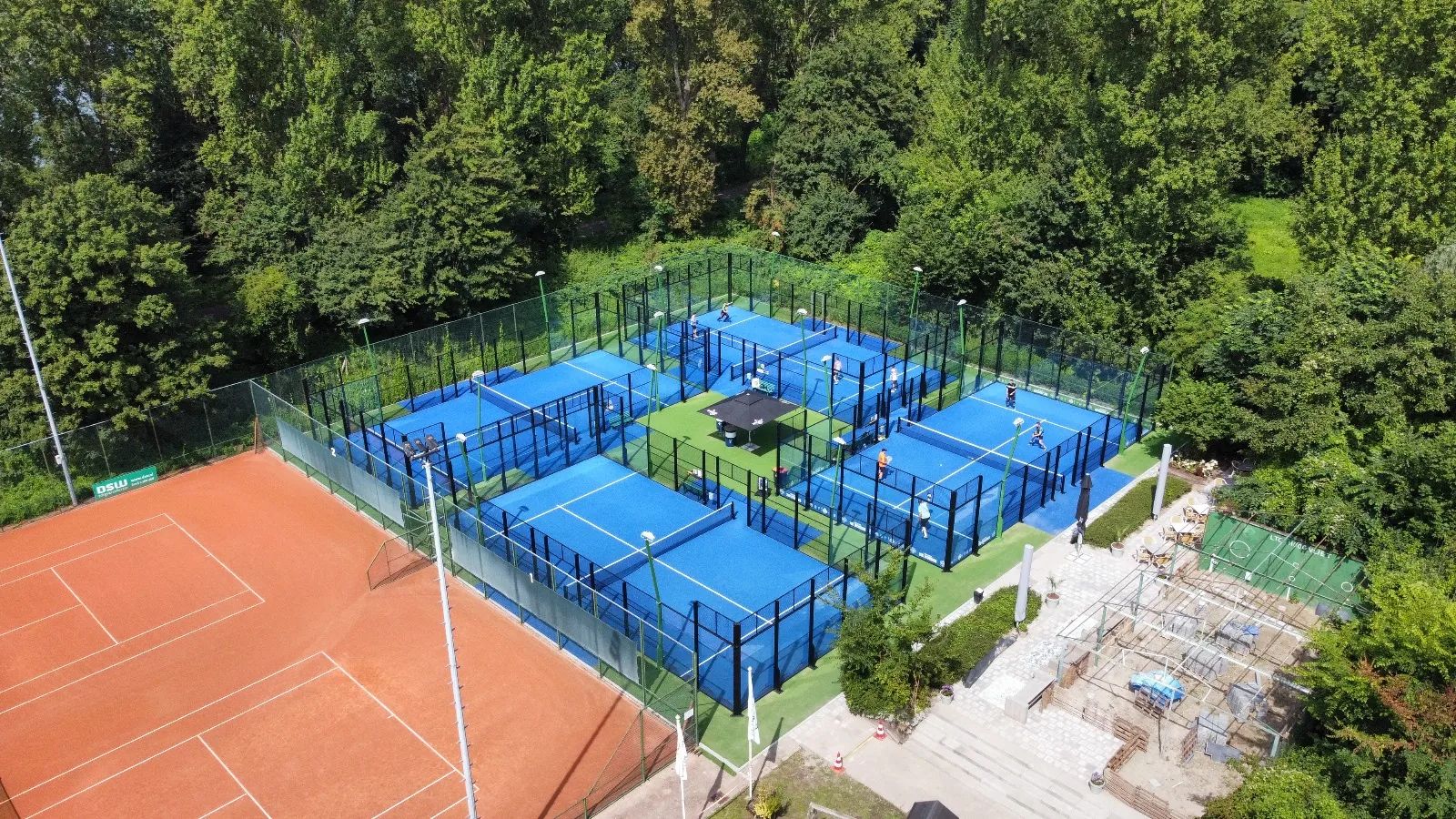
Blog · 16 September 2026 · 12 min read
How do you prevent noise nuisance from a padel court?
Want to limit noise nuisance from a padel court? Find out which measures work, what they cost and how the permit process works.
In this article
- Which noise measures are possible for a padel court?
- What is the difference between a noise barrier and sound-absorbing panels?
- How do sound-absorbing panels work as a source measure?
- What effect do sound-absorbing panels have on the structure?
- Do you need an acoustic study for an outdoor padel court?
- How does the permit process work for a padel court with noise measures?
- What does it cost to solve noise nuisance from a padel court?
- Not sure whether outdoor padel is feasible at your location?
- Frequently asked questions
Noise nuisance from a padel court can be limited through a combination of measures: sound-absorbing panels directly on the cage structure, freestanding noise barriers or a combination of both. Which approach is most suitable depends on the location, the distance to homes and the results of an independent acoustic study. The questions below give you a clear picture of the available options, the technical consequences and the associated permit process.
Which noise measures are possible for a padel court?
For an outdoor padel court, there are two main categories of noise measures: source measures applied directly to the structure and screening measures that block the noise at a greater distance. In many situations, a combination of both delivers the best results.
Noise nuisance from padel arises mainly from the contact of the ball with the glass and the mesh of the cage structure. This produces an average sound power level of around 91 dB, which is considerably more than with tennis. Because the noise is generated at the source itself, it makes sense to look there first.
The most commonly applied measures are:
- Sound-absorbing panels fixed to the outside of the cage structure. These panels absorb noise at the source instead of reflecting it back.
- Noise barriers placed freestanding next to or around the court that screen noise towards homes.
- Adjustments to the site layout, such as the orientation of the court relative to sensitive uses.
Which measure or combination of measures is suitable differs per location. Factors such as the distance to homes, the wind direction, the available space and the surroundings together determine which approach is technically feasible and achievable in terms of permits.
What is the difference between a noise barrier and sound-absorbing panels?
A noise barrier is a freestanding structure placed next to the padel court that screens noise towards sensitive uses. Sound-absorbing panels are fixed directly to the cage structure of the padel court and work as a source measure by absorbing noise where it is created. This is the essential difference between the two solutions.
Noise barrier: screening at a distance
A noise barrier works by forming a physical barrier between the noise source and the surroundings. Barriers can be built to heights of up to 6 to 8 metres and can be tens of metres long. They are aimed at one specific direction in which noise reduction is needed. A noise barrier requires a structural calculation, soil investigation data (CPT) and almost always an environmental permit, because it is regarded as a standalone structure.
An advantage of noise barriers is that they can also be built with planting, such as climbing plants on coconut-fibre matting. This gives a natural appearance, which can improve acceptance by municipalities and local residents. You can find more information about the technical build-up and application options on the page about acoustic solutions for padel.
Sound-absorbing panels: a source measure on the structure
Sound-absorbing panels are placed on the outside of the mesh of the cage structure. They are built up from an open fibre structure, often rock wool, that partly absorbs sound waves because the kinetic energy of air particles is converted into heat. This reduces the amount of reflected noise.
Because the panels become part of the structure, their placement has a direct effect on the wind load and the structural requirements. This makes the coordination between acoustics and engineering inseparable.
How do sound-absorbing panels work as a source measure?
Sound-absorbing panels work by absorbing noise where it is created: directly at the cage structure of the padel court. The panels are fixed to the outside of the mesh and consist of a material with an open fibre structure, such as rock wool, that partly absorbs sound waves instead of reflecting them.
The distinction between sound absorption and sound insulation is relevant here. Sound absorption refers to the absorption of sound energy within the material, which reduces reflections. Sound insulation focuses on limiting the transmission of sound from one side to the other. In padel projects, both principles often play a role at the same time.
The performance of sound-absorbing panels depends on the material thickness, density, finish, placement and the frequencies of the sound. Based on independent laboratory tests, the panels we use have the following characteristics:
- Sound absorption class: A
- Absorption value αw: 0.80
- Absorption index DLα: 8 dB
- Airborne sound insulation Rw: 22 dB
- Sound insulation index DLR: 19 dB
In a field measurement at LTC Hofgeest, an indicative noise reduction of approximately 3 dB(A) was measured for the configuration examined, after correction for background noise. These results apply only to the situation examined and must not be regarded as a guarantee for other projects. Other locations have different distances, weather conditions, structures and environmental factors.
The position of the panels is also of great importance. At LTC Hofgeest, the panels were installed above the glass on the two short sides of the court. This was a project-specific choice. At other locations it may be necessary to fit panels on several sides, or to apply a different configuration altogether.
The optimal position is always determined by the location, the direction of sensitive uses and the results of the acoustic study. You can find more technical details about the panels on the page about acoustic panels.
What effect do sound-absorbing panels have on the structure?
Sound-absorbing panels must never be seen separately from the structure to which they are fixed. Because of the panels, the wind permeability of the cage structure decreases, creating extra wind load on the steel structure. The structure must be calculated for this before the panels are installed.
This is a technical point that is regularly underestimated in practice. A standard padel court is designed for a certain wind load, with the mesh letting most of the wind through. As soon as panels cover part of the mesh surface, that wind profile changes. The structure catches more wind pressure and must be reinforced for it.
The reinforcement can consist of heavier posts, additional columns or modified connections, depending on the wind zone and the configuration of the panels. Because we manufacture the steel structure in our own production facility, columns, connections, base plates and anchors can be adapted project by project when additional requirements arise from noise measures or higher wind load.
The same applies when panels are added afterwards to an existing court. In that case, the existing structure must be assessed for its suitability for the extra load. Not every existing cage structure is simply suitable for installing sound-absorbing panels. A structural engineer must assess the situation before anything can be said about feasibility. You can read more about the technical build-up and structure and wind load on the relevant product page.
Do you need an acoustic study for an outdoor padel court?
An acoustic study is not mandatory in every situation, but when homes or other noise-sensitive uses are located in the surroundings, it is in most cases part of the permit process. The municipality ultimately determines which studies are necessary.
In practice, outdoor padel courts almost always require an acoustic study when the court is located on or near a sports park that borders residential buildings. Padel produces more noise than tennis, and municipalities increasingly set additional requirements for the substantiation of a permit application.
An independent acoustic consultant is responsible for the calculations and measurements. We do not carry out acoustic studies ourselves, but we supply the technical product specifications, structural data and engineering needed to carry out acoustic calculations correctly. Based on the results of the study, it can then be determined which noise measures are necessary and feasible at the location in question.
Sound-absorbing panels are only one possible measure within an overall package. They do not guarantee that a permit will be granted. Municipalities assess permit applications on the basis of the full situation, including noise, structural safety, spatial integration and the underlying studies.
How does the permit process work for a padel court with noise measures?
In the Netherlands, an outdoor padel court is regarded as a structure and in almost all cases requires an environmental permit. When noise measures are part of the project, such as sound-absorbing panels or a noise barrier, the acoustic substantiation becomes a fixed part of the permit application.
A permit application for an outdoor padel court with noise measures usually includes the following documents:
- Structural calculations in accordance with the Dutch Building Decree (Bouwbesluit)
- An acoustic study carried out by an independent consultant
- A lighting study
- A site plan showing the position of the court relative to homes and other sensitive uses
- Possibly an ecological or archaeological study, depending on the location
The average lead time of a permit application is 8 to 12 weeks, depending on the municipality and the complexity of the project. If local residents object, the process can take longer.
Noise measures can contribute to a feasible permit process, but do not guarantee that a permit will be granted. The municipality assesses the project as a whole. A well-substantiated application, with an independent acoustic report and a structurally sound design, considerably increases the chance of a smooth permit process. You can find more information about applying for a padel court permit on the relevant page.
What does it cost to solve noise nuisance from a padel court?
The costs of noise measures for a padel court vary widely and depend on the chosen solution, the scale of the measure, the location and the structural consequences. There is no fixed price that applies to every situation. The exact costs are always determined on the basis of a project-specific assessment.
A number of factors that influence the costs:
- Type of measure: sound-absorbing panels on the cage structure have different costs than a freestanding noise barrier 6 metres high and tens of metres long.
- Scale: panels on one side of one court cost less than a configuration across several sides or several courts.
- Structural modifications: when the steel structure has to be reinforced because of extra wind load, this brings additional costs.
- Acoustic study: an independent study is a separate cost item, but forms the basis of every well-substantiated application.
- Foundation: a noise barrier requires soil investigation data (CPT) and a structural calculation, which increases the costs.
In some situations, a source measure such as sound-absorbing panels can be more compact and cheaper than a large noise barrier, because less space is needed and the structural intervention can be more limited. At other locations, a noise barrier or a combination of both is the most practical solution. Which approach is most cost-efficient depends on the project situation.
For a realistic picture of the cost of a padel court including noise measures, a project-specific quotation is always needed.
Not sure whether outdoor padel is feasible at your location?
We are happy to think along with you about the court configuration, structural preparation and possible noise measures. Together with your acoustic consultant, we look at which solution is technically feasible and suits the project. Get in touch via the page on acoustic solutions for padel for an initial, no-obligation exploration.
Frequently asked questions
Can I add sound-absorbing panels to an existing padel court afterwards?
Yes, that is possible in principle, but it always requires a structural assessment of the existing cage structure. Not every existing structure is suitable, without modifications, for the extra wind load that the panels cause. A structural engineer must assess the situation before anything can be said about feasibility and any reinforcements.
How do I know which noise measures are sufficient to meet municipal standards?
That is determined by an independent acoustic consultant on the basis of an acoustic study carried out specifically for your location. The consultant calculates the current noise situation, tests it against the applicable standards and advises which measures are needed to meet the requirements. We supply the technical product specifications and structural data the consultant needs for correct calculations.
What is a realistic timeline for building an outdoor padel court including noise measures?
Allow for a total timeline of at least 6 to 12 months, depending on the complexity of the project and the municipality. The acoustic study, the permit application (average lead time of 8 to 12 weeks) and any objection procedures by local residents can extend the process considerably. It is wise to involve an acoustic consultant and a structural engineer as early as possible, so that the application can be submitted well substantiated and complete.
Does planting or a green noise barrier really help reduce noise nuisance, or is it purely aesthetic?
Planting on a noise barrier, such as climbing plants on a coconut-fibre mat, has a limited additional acoustic effect, but the primary noise-reducing effect comes from the solid structure of the barrier itself. The biggest advantage of planting is therefore visual and social acceptance: municipalities and local residents are generally more positive towards a green barrier than a bare concrete or wooden structure. This can make the permit process run more smoothly.
Does every side of the padel court need sound-absorbing panels, or is one side enough?
That depends entirely on the location, the position of sensitive uses such as homes, and the results of the acoustic study. In some projects, panels on the two short sides are sufficient, as was the case at LTC Hofgeest. At other locations it may be necessary to fit panels on several or even all sides. The optimal configuration is always determined project by project and must not be copied from another situation.
What is a common mistake when tackling noise nuisance from a padel court?
A common mistake is choosing a noise solution without a prior acoustic study, for example on the basis of experience with other projects. Every location has different distances, environmental factors and municipal standards, so a measure that worked elsewhere is not automatically sufficient for your situation. Another common mistake is underestimating the structural consequences of sound-absorbing panels, as a result of which the existing steel structure still has to be reinforced afterwards.
Can I include the costs of noise measures in the grant application or financing of the padel court?
In some cases that is possible, depending on the grant scheme and the conditions of the financier. Some municipalities or sports funds regard noise measures as an integral part of the court investment and allow these costs to be included. It is wise to discuss this early with the municipality and any grant providers, so that the financing of the overall project can be realistically mapped out.